Soft Computing
Group Members
Nabarun Paul
Nilanjan Banerjee
Niraj Khaitan
Nirban Kumar
What is Soft Computing
• Soft computing is a term applied to a field
within computer science which is
characterized by the use of inexact solutions
for problems which has no known method to
compute an exact solution.
• It uses uncertainty, partial truth, and
approximation as input.
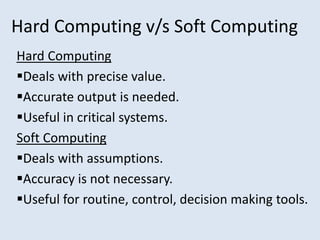
Hard Computing v/s Soft Computing
Hard Computing
Deals with precise value.
Accurate output is needed.
Useful in critical systems.
Soft Computing
Deals with assumptions.
Accuracy is not necessary.
Useful for routine, control, decision making tools.
Techniques in Soft Computing
• Fuzzy Systems
• Neutral Networks
• Machine Learning
• Probabilistic Reasoning
Fuzzy Systems
• Fuzzy system is a superset of conventional
logic that has been extended to handle the
concept of partial truth- truth values between
"completely true" and "completely false".
• Based on fuzzy set theory and fuzzy logic.
• Most applications in control and decision
making.
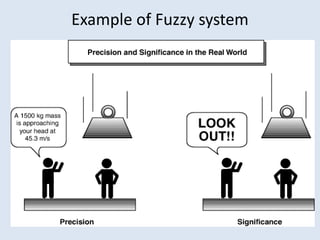
Example of Fuzzy system
Neutral Networks
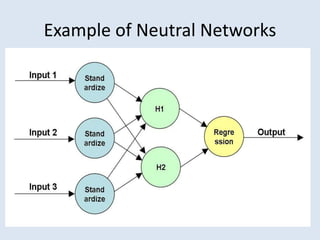
• Neural Network is an information processing
paradigm that is inspired by the way biological
nervous systems, such as the brain, process
information.
• Essentially a function approximator.
Transforms inputs into outputs to the best
of its ability
Example of Neutral Networks
Machine Learning
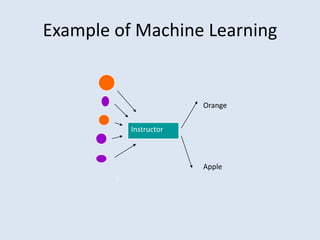
• Pattern recognition based on training data,
classification supervised by instructor.
• Unsupervised machine learning is also used
where the machine learns from the given data
by detecting patterns.
Example of Machine Learning
?
Instructor
Orange
Apple
Probabilistic Reasoning
• Dealing with incomplete and uncertain data is
an important part of many artificial
intelligence systems
• Approaches
– Classical Probability Theory
– Fuzzy Set Theory
Advantages of Soft Computing
• Models based on human reasoning.
• Closer to human thinking and biologically
inspired
• Models can be
Linguistic
Comprehensible
Fast when computing
Effective in practice.
APPLICATIONS OF SOFT COMPUTING
• Handwriting Recognition
• Image Processing and Data Compression
• Automotive Systems and Manufacturing
• Soft Computing to Architecture
• Decision-support Systems
THANK YOU

Soft computing

  • 1.
  • 2.
    Group Members Nabarun Paul NilanjanBanerjee Niraj Khaitan Nirban Kumar
  • 3.
    What is SoftComputing • Soft computing is a term applied to a field within computer science which is characterized by the use of inexact solutions for problems which has no known method to compute an exact solution. • It uses uncertainty, partial truth, and approximation as input.
  • 4.
    Hard Computing v/sSoft Computing Hard Computing Deals with precise value. Accurate output is needed. Useful in critical systems. Soft Computing Deals with assumptions. Accuracy is not necessary. Useful for routine, control, decision making tools.
  • 5.
    Techniques in SoftComputing • Fuzzy Systems • Neutral Networks • Machine Learning • Probabilistic Reasoning
  • 6.
    Fuzzy Systems • Fuzzysystem is a superset of conventional logic that has been extended to handle the concept of partial truth- truth values between "completely true" and "completely false". • Based on fuzzy set theory and fuzzy logic. • Most applications in control and decision making.
  • 7.
  • 8.
    Neutral Networks • NeuralNetwork is an information processing paradigm that is inspired by the way biological nervous systems, such as the brain, process information. • Essentially a function approximator. Transforms inputs into outputs to the best of its ability
  • 9.
  • 10.
    Machine Learning • Patternrecognition based on training data, classification supervised by instructor. • Unsupervised machine learning is also used where the machine learns from the given data by detecting patterns.
  • 11.
    Example of MachineLearning ? Instructor Orange Apple
  • 12.
    Probabilistic Reasoning • Dealingwith incomplete and uncertain data is an important part of many artificial intelligence systems • Approaches – Classical Probability Theory – Fuzzy Set Theory
  • 13.
    Advantages of SoftComputing • Models based on human reasoning. • Closer to human thinking and biologically inspired • Models can be Linguistic Comprehensible Fast when computing Effective in practice.
  • 14.
    APPLICATIONS OF SOFTCOMPUTING • Handwriting Recognition • Image Processing and Data Compression • Automotive Systems and Manufacturing • Soft Computing to Architecture • Decision-support Systems
  • 15.