
Machine Learning Basics
Chapter 1
Presented to
Prof. Vibhakar Mansotra
Dean of Mathematical science
Presented by
Akanksha Bali
Research Scholar, Dept of Computer science and IT
Contents
• Introduction
• Types of machine learning
• Supervised Learning
• Unsupervised Learning
• Semi Supervised Learning
• Reinforcement Learning
• Applications
• Machine learning vs Deep Learning
Introduction (When, What and Why)
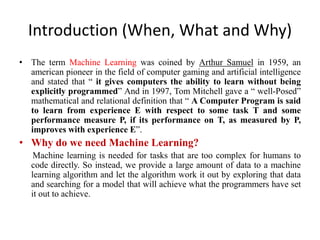
• The term Machine Learning was coined by Arthur Samuel in 1959, an
american pioneer in the field of computer gaming and artificial intelligence
and stated that “ it gives computers the ability to learn without being
explicitly programmed” And in 1997, Tom Mitchell gave a “ well-Posed”
mathematical and relational definition that “ A Computer Program is said
to learn from experience E with respect to some task T and some
performance measure P, if its performance on T, as measured by P,
improves with experience E”.
• Why do we need Machine Learning?
Machine learning is needed for tasks that are too complex for humans to
code directly. So instead, we provide a large amount of data to a machine
learning algorithm and let the algorithm work it out by exploring that data
and searching for a model that will achieve what the programmers have set
it out to achieve.
Example
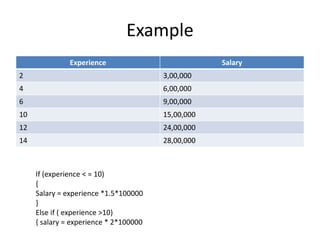
Experience Salary
2 3,00,000
4 6,00,000
6 9,00,000
10 15,00,000
12 24,00,000
14 28,00,000
If (experience < = 10)
{
Salary = experience *1.5*100000
}
Else if ( experience >10)
{ salary = experience * 2*100000
Types of Machine Learning
• Supervised Learning
• Unsupervised Learning
• Semi Supervised Learning
• Reinforcement Learning
Supervised Learning
• This algorithm contains a target variable which is to be predicted from any
given set of predictors. Using these set of variables, we can generate a
function that maps inputs to the desired outputs. This Process Continues
until a model achieves a desired level of accuracy on a training data
• Supervised Learning can be further grouped into classification and
regression
• Examples: KNN, Logistic Regression, Decision Tree, Random forest etc
• For the spam detection task, we consider a setting in which the learner
receives training emails for which the label spam/ non spam is provided.
On the basis of such training, the learner should figure out a rule for
labelling a newly arriving email message.
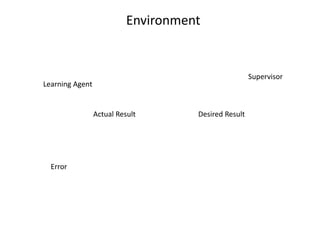
Environment
Actual Result Desired Result
Error
Learning Agent
Supervisor
Unsupervised Learning
• In unsupervised learning, we dont have any outcome variable to predict
• In unsupervised learning, there is no correct answers and there is no
teacher.
• It can be further grouped into clustering and association problem
• Examples: K-Means, Apriori Algorithm
• Clustering a dataset into subsets of similar objects is a typical example of
such a task.
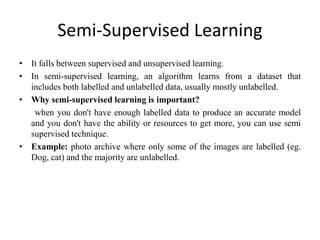
Semi-Supervised Learning
• It falls between supervised and unsupervised learning.
• In semi-supervised learning, an algorithm learns from a dataset that
includes both labelled and unlabelled data, usually mostly unlabelled.
• Why semi-supervised learning is important?
when you don't have enough labelled data to produce an accurate model
and you don't have the ability or resources to get more, you can use semi
supervised technique.
• Example: photo archive where only some of the images are labelled (eg.
Dog, cat) and the majority are unlabelled.
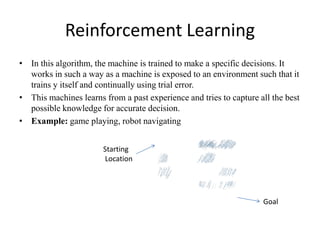
Reinforcement Learning
• In this algorithm, the machine is trained to make a specific decisions. It
works in such a way as a machine is exposed to an environment such that it
trains y itself and continually using trial error.
• This machines learns from a past experience and tries to capture all the best
possible knowledge for accurate decision.
• Example: game playing, robot navigating
Starting
Location
Goal
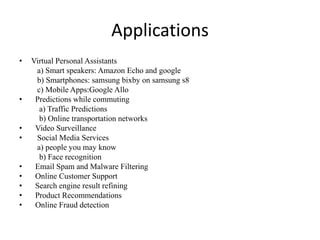
Applications
• Virtual Personal Assistants
a) Smart speakers: Amazon Echo and google
b) Smartphones: samsung bixby on samsung s8
c) Mobile Apps:Google Allo
• Predictions while commuting
a) Traffic Predictions
b) Online transportation networks
• Video Surveillance
• Social Media Services
a) people you may know
b) Face recognition
• Email Spam and Malware Filtering
• Online Customer Support
• Search engine result refining
• Product Recommendations
• Online Fraud detection
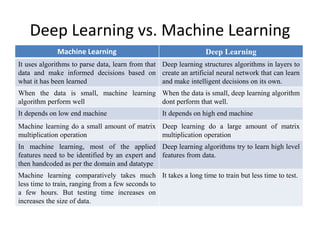
Deep Learning vs. Machine Learning
Machine Learning Deep Learning
It uses algorithms to parse data, learn from that
data and make informed decisions based on
what it has been learned
Deep learning structures algorithms in layers to
create an artificial neural network that can learn
and make intelligent decisions on its own.
When the data is small, machine learning
algorithm perform well
When the data is small, deep learning algorithm
dont perform that well.
It depends on low end machine It depends on high end machine
Machine learning do a small amount of matrix
multiplication operation
Deep learning do a large amount of matrix
multiplication operation
In machine learning, most of the applied
features need to be identified by an expert and
then handcoded as per the domain and datatype
Deep learning algorithms try to learn high level
features from data.
Machine learning comparatively takes much
less time to train, ranging from a few seconds to
a few hours. But testing time increases on
increases the size of data.
It takes a long time to train but less time to test.
References
• https://www.geeksforgeeks.org/machine-learning/
• Ethem Alpaydn, “ introduction to machine
learning”, MIT Press Cambridge, Massachusetts
london, England, second edition, 2010.
Machine learning basics

Machine learning basics

  • 1.
    Machine Learning Basics Chapter1 Presented to Prof. Vibhakar Mansotra Dean of Mathematical science Presented by Akanksha Bali Research Scholar, Dept of Computer science and IT
  • 2.
    Contents • Introduction • Typesof machine learning • Supervised Learning • Unsupervised Learning • Semi Supervised Learning • Reinforcement Learning • Applications • Machine learning vs Deep Learning
  • 3.
    Introduction (When, Whatand Why) • The term Machine Learning was coined by Arthur Samuel in 1959, an american pioneer in the field of computer gaming and artificial intelligence and stated that “ it gives computers the ability to learn without being explicitly programmed” And in 1997, Tom Mitchell gave a “ well-Posed” mathematical and relational definition that “ A Computer Program is said to learn from experience E with respect to some task T and some performance measure P, if its performance on T, as measured by P, improves with experience E”. • Why do we need Machine Learning? Machine learning is needed for tasks that are too complex for humans to code directly. So instead, we provide a large amount of data to a machine learning algorithm and let the algorithm work it out by exploring that data and searching for a model that will achieve what the programmers have set it out to achieve.
  • 4.
    Example Experience Salary 2 3,00,000 46,00,000 6 9,00,000 10 15,00,000 12 24,00,000 14 28,00,000 If (experience < = 10) { Salary = experience *1.5*100000 } Else if ( experience >10) { salary = experience * 2*100000
  • 5.
    Types of MachineLearning • Supervised Learning • Unsupervised Learning • Semi Supervised Learning • Reinforcement Learning
  • 6.
    Supervised Learning • Thisalgorithm contains a target variable which is to be predicted from any given set of predictors. Using these set of variables, we can generate a function that maps inputs to the desired outputs. This Process Continues until a model achieves a desired level of accuracy on a training data • Supervised Learning can be further grouped into classification and regression • Examples: KNN, Logistic Regression, Decision Tree, Random forest etc • For the spam detection task, we consider a setting in which the learner receives training emails for which the label spam/ non spam is provided. On the basis of such training, the learner should figure out a rule for labelling a newly arriving email message.
  • 7.
    Environment Actual Result DesiredResult Error Learning Agent Supervisor
  • 8.
    Unsupervised Learning • Inunsupervised learning, we dont have any outcome variable to predict • In unsupervised learning, there is no correct answers and there is no teacher. • It can be further grouped into clustering and association problem • Examples: K-Means, Apriori Algorithm • Clustering a dataset into subsets of similar objects is a typical example of such a task.
  • 9.
    Semi-Supervised Learning • Itfalls between supervised and unsupervised learning. • In semi-supervised learning, an algorithm learns from a dataset that includes both labelled and unlabelled data, usually mostly unlabelled. • Why semi-supervised learning is important? when you don't have enough labelled data to produce an accurate model and you don't have the ability or resources to get more, you can use semi supervised technique. • Example: photo archive where only some of the images are labelled (eg. Dog, cat) and the majority are unlabelled.
  • 10.
    Reinforcement Learning • Inthis algorithm, the machine is trained to make a specific decisions. It works in such a way as a machine is exposed to an environment such that it trains y itself and continually using trial error. • This machines learns from a past experience and tries to capture all the best possible knowledge for accurate decision. • Example: game playing, robot navigating Starting Location Goal
  • 11.
    Applications • Virtual PersonalAssistants a) Smart speakers: Amazon Echo and google b) Smartphones: samsung bixby on samsung s8 c) Mobile Apps:Google Allo • Predictions while commuting a) Traffic Predictions b) Online transportation networks • Video Surveillance • Social Media Services a) people you may know b) Face recognition • Email Spam and Malware Filtering • Online Customer Support • Search engine result refining • Product Recommendations • Online Fraud detection
  • 12.
    Deep Learning vs.Machine Learning Machine Learning Deep Learning It uses algorithms to parse data, learn from that data and make informed decisions based on what it has been learned Deep learning structures algorithms in layers to create an artificial neural network that can learn and make intelligent decisions on its own. When the data is small, machine learning algorithm perform well When the data is small, deep learning algorithm dont perform that well. It depends on low end machine It depends on high end machine Machine learning do a small amount of matrix multiplication operation Deep learning do a large amount of matrix multiplication operation In machine learning, most of the applied features need to be identified by an expert and then handcoded as per the domain and datatype Deep learning algorithms try to learn high level features from data. Machine learning comparatively takes much less time to train, ranging from a few seconds to a few hours. But testing time increases on increases the size of data. It takes a long time to train but less time to test.
  • 13.
    References • https://www.geeksforgeeks.org/machine-learning/ • EthemAlpaydn, “ introduction to machine learning”, MIT Press Cambridge, Massachusetts london, England, second edition, 2010.