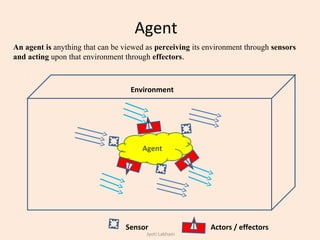
Agent
An agent is anything that can be viewed as perceiving its environment through sensors
and acting upon that environment through effectors.
Environment
Agent
Sensor Actors / effectors
Jyoti Lakhani
Agent
The job of AI is to design the agent program.
Agent program is a function that implements the mapping from percepts to actions.
A problem is-
a collection of information
that will the agent use
to decide
what to do.
1. The initial state that the agent knows itself to be in
2. Set of possible actions available to the agent, called Operators
3. The state space of the problem: The set of all states reachable from the initial state
by any sequence of actions.
4. A path in the state space is simply any sequence of actions leading from one state to
another.
5. The goal test, which the agent can apply to a single state description to determine if
it is a goal state
6. A path cost function is a function that assigns a cost to a path.
Together, the initial state, operator
set, goal test, and path cost function
define a problem.
Jyoti Lakhani
Measuring problem-solving performance
The effectiveness of a search can be measured in at least three ways -
First, does it find a solution at all?
Second, is it a good solution (one with a low path cost)?
Third, what is the search cost associated with the time and memory required to find a solution?
The total cost of the search is-
The sum of the path cost + The search cost.
SEARCHING FOR SOLUTIONS
finding a solution—is done by a search through the state space
•applying the operators to the current state
•thereby generating a new set of states.
•The process is called expanding the state
This is the essence of search—choosing one option and putting the others aside for later,
in case the first choice does not lead to a solution.
Jyoti Lakhani
Search Strategy
The Search Strategy determines which state to expand first.
It is helpful to think of the search process as building up a search tree that is
superimposed over the state space.
•The root of the search tree is a search node corresponding to the initial state.
•The leaf nodes of the tree correspond to states that do not have successors in the tree,
either because they have not been expanded yet, or because they were expanded, but
generated the empty set.
•At each step, the search algorithm chooses one leaf node to expand.
Jyoti Lakhani
Problem Solving As Search
Initial State
State 2
State 3
State 4
State 1
State 5
State 6
State 7
State 8
State 9
State 10
State 11
State 12
State 13
State 14
State 15
State 16
State 17
State 18
State 19
State 20
Jyoti Lakhani
Data-Driven Search Goal-Driven Search
Data-driven search starts from an
initial state and uses actions that are
allowed to move forward until a goal is
reached. This approach is also known as
forward chaining.
Alternatively, search can start at the goal and
work back toward a start state, by seeing what
moves could have led to the goal state. This is
goal-driven search, also known as backward
chaining.
goal-driven search is preferable to data driven search
Goal-driven search and data-driven search will end up producing the same results, but
depending on the nature of the problem being solved, in some cases one can run more
efficiently than the other
Goal-driven search is particularly useful in situations in which the goal can be clearly
specified (for example, a theorem that is to be proved or finding an exit from a maze).
It is also clearly the best choice in situations such as medical diagnosis where the goal (the
condition to be diagnosed) is known, but the rest of the data (in this case, the causes of
the condition) need to be found.
There are two main approaches to searching a search tree-
Jyoti Lakhani
Data-driven search is most useful when the initial data are provided, and it is not clear
what the goal is.
It is nearly always far easier to start from the end point and work back toward the
start point. This is because a number of dead end paths have been set up from the
start (data) point, and only one path has been set up to the end (goal) point. As a
result, working back from the goal to the start has only one possible path.
Initial State
Goal State
Goal State
Initial State
Data Driven Search
Or
Forward Chaining
Goal Driven Search
Or
Backward ChainingJyoti Lakhani
Search Methodologies
OR
Search Techniques
1. Generate and Test
2. Depth First Search
3. Breath First Search
Un- Informed Informed
Brute Force Search
No Information Required Additional Information required
i.e. called Heuristics
Informed
Techniques are
more intelligent
than Un-informed
techniques
We are talking
about
Methodologies
not methods
SiMpLeSt
CoMmOn
AlTeRnAtIvE Jyoti Lakhani
Generate and Test
Or Brute Force Search
•Simplest Approach
• Examine every node in the tree until it finds a goal
•Solve problems where there is no additional information about
how to reach a solution.
State Space
1
4
2
6
8
3
7
5
1
4
6
8
3
7
5
Goal State
Jyoti Lakhani
To successfully operate
Generate and Test needs to have a suitable Generator
with three properties-
1. It must be complete
2. It must be non-redundant
3. It must be well informed
It must generate every possible solution
It should not generate the same solution twice
It should only propose suitable solutions and
should not examine possible solutions that do
not match the search space
Jyoti Lakhani
Depth-First Search
it follows each path to its
greatest depth
before moving on to the next path
A
B C
D FE
G H I J K L
Goal State
Initial State
Current StateSearch Tree
Blind End
Jyoti Lakhani
Depth-first search is often used by computers for search problems
such as locating files on a disk, or by search engines for spidering
the Internet.
A
B C
D FE
G H I J K L
1
2
3
4 5
6
7
8 9
10
Search Sequence A B D G H C E I J F
Jyoti Lakhani
Jyoti Lakhani
Depth First Algorithm
Function depth ()
{
queue = []; // initialize an empty queue
state = root_node; // initialize the start state
while (true)
{
if is_goal (state)
then return SUCCESS
else add_to_front_of_queue
(successors (state));
if queue == []
then report FAILURE;
state = queue [0]; // state = first item in
queue
remove_first_item_from (queue);
}
}
Breadth-First Search
This approach involves traversing a tree by breadth rather than by depth.
The breadth-first algorithm starts by examining all nodes one
level (sometimes called one ply) down from the root node.
A
B C
D FE
G H I J K L
Ply 1
Ply 2
Ply 3
Ply 4
Jyoti Lakhani
IF goal Then
success
Else
search continues to the next ply
Else
Fail
Breadth-first search is
a far better method to
use in situations
where the
tree may have very
deep paths
Breadth-first search is a poor idea in trees where all paths lead to a
goal node with similar length paths
A
B C
D FE
G H I J K L
1
2 3
4 5 6
Jyoti Lakhani
Jyoti Lakhani
Search Sequence
A
B C
D FE
G H I J K L
1
2 3
4 5 6
A B D G HC E I JF
Jyoti Lakhani
Breadth First Algorithm
Function breadth ()
{
queue = []; // initialize an empty queue
state = root_node; // initialize the start state
while (true)
{
(state if is_goal)
then return SUCCESS
else add_to_back_of_queue
(successors (state));
if queue == []
then report FAILURE;
state = queue [0];
remove_first_item_from (queue);
}
}
Jyoti Lakhani
Scenario Depth First Search Breath First Search
Some paths are extremely
long, or even infinite
Performs badly Performs well
All paths are of similar length Performs well Performs well
All paths are of similar length,
and all
paths lead to a goal state
Performs well Wasteful of time and
memory
High branching factor Performance depends on
other factors
Performs poorly
Difference Between Depth and Breadth First Search
Function: SUCCESSOR(State)
If GOAL STATE
SUCCESS
EXIT
Jyoti Lakhani
Implementing Breadth-First Search
Variable : CURRENT
Queue: STATES
B
A
A
B C
D FE
G H I J K L
Current State
Goal Test
A
CD
Jyoti Lakhani
Step Current
State
Queue Comment
1 A [] Queue Empty
2 A [BC] A is not a Goal State,
Expend A
3 B [C] B is Current State
4 B [CD] B is not a Goal State,
Expend B
5 C [D]
6 .
.
.
7
Jyoti Lakhani
Implementing Depth-First Search
Variable : CURRENT
Function: SUCCESSOR(State)
Stack: STATES
A
B C
D FE
G H I J K L
Current State
Goal Test
Jyoti Lakhani
Properties of Search Methods
• Space Complexity
• Time Complexity
Complexity
Depth-first search is very efficient in
space because it only needs to store
information about the path it is
currently examining
But it is not efficient in time because it
can end up examining very deep
branches of the tree.
Jyoti Lakhani
Completeness
A Search Method should guaranteed to find a goal
state if one exists
Properties of Search Methods
Breadth-first search is complete, but depth-first
search is not because it may explore a path of
infinite length and never find a goal node that
exists on another path.
Jyoti Lakhani
A search method is optimal if it is guaranteed to find
the best solution that exists.
Optimality
Properties of Search Methods
Breadth-first search is an optimal search method, but
depth-first search is not.
Depth-first search returns the first solution it happens to
find, which may be the worst solution that exists.
Because breadth-first search examines all nodes at a
given depth before moving on to the next depth, if it
finds a solution, there cannot be another solution
before it in the search tree.
Jyoti Lakhani
Irrevocability
Properties of Search Methods
Methods that use backtracking are described as tentative
Methods that do not use backtracking, and which
therefore examine just one path, are described as
irrevocable.
Depth-first search is an example of tentative search.
Jyoti Lakhani
Using Heuristics for Search: Informed Search
Depth-first and breadth-first search were described as brute-force
search methods.
This is because they do not employ any special knowledge of the
search trees they are examining
but simply examine every node in order until the goal.
This kind of information is called a heuristic
Heuristics can reduce an impossible problem to a relatively simple
one.
Heuristic Search Uses a Heuristic Evaluation Function or
Heuristic Function
Jyoti Lakhani
Heuristic Function
Heuristic Function apply on a Node
It will Give the Estimate of Distance of goal from Node
H(Node) = Distance of Node from Goal
Suppose there are two nodes m and n and
H(m,g) < H(n,g)
m is more likely to be on an optimal path to the goal node than n.
Jyoti Lakhani
A
B C
D FE
G H I J K L
H( A, F ) = H( A, C ) + H( C, F)
H(A,C)
H(C, F)
Suppose “ F “ is the Goal node
Heuristic Estimate from A to Goal node F is the Summation of –
H(A,C) and H(C,F)
In choosing heuristics, we usually consider
that a heuristic that reduces the number of
nodes that need to be examined in the
search tree is a good heuristic.
Jyoti Lakhani
More than One Heuristics can be applied to the same search
A
B C
D FE
G H I J K L
Suppose we have to Reach the Goal Node , which is F
H1 (A, F) H2 (A, F)
H2 (node, Goal) ≥ H1 (node, Goal)
H2 dominates H1
Which means that a search method using heuristic h2 will
always perform more efficiently than the same search method using h1.
Jyoti Lakhani
Informed SearchesHill Climbing
Best First Search
Branch and Bound A*
Beam Search
AO*
In examining a search tree,
hill climbing will move to the first successor node
that is “better” than the current node
—in other words, the first node that it comes across with a heuristic value lower than
that of the current node.
Hill Climbing
If all directions lead lower than your current position, then you stop and assume
you have reached the summit. As we see later, this might not necessarily always
be true.
Jyoti Lakhani
Steepest Ascent Hill Climbing
Similar to Hill Climbing
Except that rather than moving to the first position you find that is higher
than the current position
you always check around you in all four directions and choose the
position that is highest.
Jyoti Lakhani
Three Problems with Hill Climbing
1. Local Maxima or Foot Hill
Global Maxima
Local Maxima
A local maximum is a part of the search space
that appears to be preferable to the parts around it,
but which is in fact just a foothill of a larger hill
Jyoti Lakhani
Three Problems with Hill Climbing
2. Plateau
Maximum
Plateau
A plateau is a region in a search space where all the
values are the same
Jyoti Lakhani
Three Problems with Hill Climbing
3. Ridge
A ridge is a long, thin region of high land with low land on either side.
Jyoti Lakhani
Best First Search
Depth First Search is good becoz it –
Found solution without expanding all competing branches
= Features of Depth First Search
+
Features of Breadth First Search
Breadth First is good becoz it –
Does not get trapped on dead end paths
Best First search combine both these characters
At each step of Best First Search process
select the most promising nodes,
we have generated so far
Jyoti Lakhani
A
B C
D FE
G H I G K G
Best First Search
50 80
Current Node
f(n)= h(n)
20
10
Jyoti Lakhani
Beam Search
Same like Best First Search,
but n promising states are kept for future considerations
A* Algorithm
Variation of Best First Search
Along each node
on a path to the goal,
A* generates all successor nodes and
estimates the distance (cost)
from the start node to the goal node
Jyoti Lakhani
A * Combines the cost so far and the estimated cost to the goal
That is evaluation function f(n) = g(n) + h(n)
An estimated cost of the cheapest solution via n
Jyoti Lakhani
A
B C
D FE
G H I G K G
A* Search
50 h(n)=80 g(n)=0
Current Node
f(n)= g(n) + h(n)
h(n)=20
g(n)= 50
h(n)=10
g(n)= 50
Jyoti Lakhani
Jyoti Lakhani
Jyoti Lakhani
Jyoti Lakhani
Jyoti Lakhani
Jyoti Lakhani
Jyoti Lakhani
A* (Start, Goal)
{
CLOSE={ }
OPEN= { root }
g[ root ] = 0
f [ root ]
}

Searching methodologies

  • 1.
    Agent An agent isanything that can be viewed as perceiving its environment through sensors and acting upon that environment through effectors. Environment Agent Sensor Actors / effectors Jyoti Lakhani
  • 2.
    Agent The job ofAI is to design the agent program. Agent program is a function that implements the mapping from percepts to actions. A problem is- a collection of information that will the agent use to decide what to do. 1. The initial state that the agent knows itself to be in 2. Set of possible actions available to the agent, called Operators 3. The state space of the problem: The set of all states reachable from the initial state by any sequence of actions. 4. A path in the state space is simply any sequence of actions leading from one state to another. 5. The goal test, which the agent can apply to a single state description to determine if it is a goal state 6. A path cost function is a function that assigns a cost to a path. Together, the initial state, operator set, goal test, and path cost function define a problem. Jyoti Lakhani
  • 3.
    Measuring problem-solving performance Theeffectiveness of a search can be measured in at least three ways - First, does it find a solution at all? Second, is it a good solution (one with a low path cost)? Third, what is the search cost associated with the time and memory required to find a solution? The total cost of the search is- The sum of the path cost + The search cost. SEARCHING FOR SOLUTIONS finding a solution—is done by a search through the state space •applying the operators to the current state •thereby generating a new set of states. •The process is called expanding the state This is the essence of search—choosing one option and putting the others aside for later, in case the first choice does not lead to a solution. Jyoti Lakhani
  • 4.
    Search Strategy The SearchStrategy determines which state to expand first. It is helpful to think of the search process as building up a search tree that is superimposed over the state space. •The root of the search tree is a search node corresponding to the initial state. •The leaf nodes of the tree correspond to states that do not have successors in the tree, either because they have not been expanded yet, or because they were expanded, but generated the empty set. •At each step, the search algorithm chooses one leaf node to expand. Jyoti Lakhani
  • 5.
    Problem Solving AsSearch Initial State State 2 State 3 State 4 State 1 State 5 State 6 State 7 State 8 State 9 State 10 State 11 State 12 State 13 State 14 State 15 State 16 State 17 State 18 State 19 State 20 Jyoti Lakhani
  • 6.
    Data-Driven Search Goal-DrivenSearch Data-driven search starts from an initial state and uses actions that are allowed to move forward until a goal is reached. This approach is also known as forward chaining. Alternatively, search can start at the goal and work back toward a start state, by seeing what moves could have led to the goal state. This is goal-driven search, also known as backward chaining. goal-driven search is preferable to data driven search Goal-driven search and data-driven search will end up producing the same results, but depending on the nature of the problem being solved, in some cases one can run more efficiently than the other Goal-driven search is particularly useful in situations in which the goal can be clearly specified (for example, a theorem that is to be proved or finding an exit from a maze). It is also clearly the best choice in situations such as medical diagnosis where the goal (the condition to be diagnosed) is known, but the rest of the data (in this case, the causes of the condition) need to be found. There are two main approaches to searching a search tree- Jyoti Lakhani
  • 7.
    Data-driven search ismost useful when the initial data are provided, and it is not clear what the goal is. It is nearly always far easier to start from the end point and work back toward the start point. This is because a number of dead end paths have been set up from the start (data) point, and only one path has been set up to the end (goal) point. As a result, working back from the goal to the start has only one possible path. Initial State Goal State Goal State Initial State Data Driven Search Or Forward Chaining Goal Driven Search Or Backward ChainingJyoti Lakhani
  • 8.
    Search Methodologies OR Search Techniques 1.Generate and Test 2. Depth First Search 3. Breath First Search Un- Informed Informed Brute Force Search No Information Required Additional Information required i.e. called Heuristics Informed Techniques are more intelligent than Un-informed techniques We are talking about Methodologies not methods SiMpLeSt CoMmOn AlTeRnAtIvE Jyoti Lakhani
  • 9.
    Generate and Test OrBrute Force Search •Simplest Approach • Examine every node in the tree until it finds a goal •Solve problems where there is no additional information about how to reach a solution. State Space 1 4 2 6 8 3 7 5 1 4 6 8 3 7 5 Goal State Jyoti Lakhani
  • 10.
    To successfully operate Generateand Test needs to have a suitable Generator with three properties- 1. It must be complete 2. It must be non-redundant 3. It must be well informed It must generate every possible solution It should not generate the same solution twice It should only propose suitable solutions and should not examine possible solutions that do not match the search space Jyoti Lakhani
  • 11.
    Depth-First Search it followseach path to its greatest depth before moving on to the next path A B C D FE G H I J K L Goal State Initial State Current StateSearch Tree Blind End Jyoti Lakhani
  • 12.
    Depth-first search isoften used by computers for search problems such as locating files on a disk, or by search engines for spidering the Internet. A B C D FE G H I J K L 1 2 3 4 5 6 7 8 9 10 Search Sequence A B D G H C E I J F Jyoti Lakhani
  • 13.
    Jyoti Lakhani Depth FirstAlgorithm Function depth () { queue = []; // initialize an empty queue state = root_node; // initialize the start state while (true) { if is_goal (state) then return SUCCESS else add_to_front_of_queue (successors (state)); if queue == [] then report FAILURE; state = queue [0]; // state = first item in queue remove_first_item_from (queue); } }
  • 14.
    Breadth-First Search This approachinvolves traversing a tree by breadth rather than by depth. The breadth-first algorithm starts by examining all nodes one level (sometimes called one ply) down from the root node. A B C D FE G H I J K L Ply 1 Ply 2 Ply 3 Ply 4 Jyoti Lakhani
  • 15.
    IF goal Then success Else searchcontinues to the next ply Else Fail Breadth-first search is a far better method to use in situations where the tree may have very deep paths Breadth-first search is a poor idea in trees where all paths lead to a goal node with similar length paths A B C D FE G H I J K L 1 2 3 4 5 6 Jyoti Lakhani
  • 16.
    Jyoti Lakhani Search Sequence A BC D FE G H I J K L 1 2 3 4 5 6 A B D G HC E I JF
  • 17.
    Jyoti Lakhani Breadth FirstAlgorithm Function breadth () { queue = []; // initialize an empty queue state = root_node; // initialize the start state while (true) { (state if is_goal) then return SUCCESS else add_to_back_of_queue (successors (state)); if queue == [] then report FAILURE; state = queue [0]; remove_first_item_from (queue); } }
  • 18.
    Jyoti Lakhani Scenario DepthFirst Search Breath First Search Some paths are extremely long, or even infinite Performs badly Performs well All paths are of similar length Performs well Performs well All paths are of similar length, and all paths lead to a goal state Performs well Wasteful of time and memory High branching factor Performance depends on other factors Performs poorly Difference Between Depth and Breadth First Search
  • 19.
    Function: SUCCESSOR(State) If GOALSTATE SUCCESS EXIT Jyoti Lakhani Implementing Breadth-First Search Variable : CURRENT Queue: STATES B A A B C D FE G H I J K L Current State Goal Test A CD
  • 20.
    Jyoti Lakhani Step Current State QueueComment 1 A [] Queue Empty 2 A [BC] A is not a Goal State, Expend A 3 B [C] B is Current State 4 B [CD] B is not a Goal State, Expend B 5 C [D] 6 . . . 7
  • 21.
    Jyoti Lakhani Implementing Depth-FirstSearch Variable : CURRENT Function: SUCCESSOR(State) Stack: STATES A B C D FE G H I J K L Current State Goal Test
  • 22.
    Jyoti Lakhani Properties ofSearch Methods • Space Complexity • Time Complexity Complexity Depth-first search is very efficient in space because it only needs to store information about the path it is currently examining But it is not efficient in time because it can end up examining very deep branches of the tree.
  • 23.
    Jyoti Lakhani Completeness A SearchMethod should guaranteed to find a goal state if one exists Properties of Search Methods Breadth-first search is complete, but depth-first search is not because it may explore a path of infinite length and never find a goal node that exists on another path.
  • 24.
    Jyoti Lakhani A searchmethod is optimal if it is guaranteed to find the best solution that exists. Optimality Properties of Search Methods Breadth-first search is an optimal search method, but depth-first search is not. Depth-first search returns the first solution it happens to find, which may be the worst solution that exists. Because breadth-first search examines all nodes at a given depth before moving on to the next depth, if it finds a solution, there cannot be another solution before it in the search tree.
  • 25.
    Jyoti Lakhani Irrevocability Properties ofSearch Methods Methods that use backtracking are described as tentative Methods that do not use backtracking, and which therefore examine just one path, are described as irrevocable. Depth-first search is an example of tentative search.
  • 26.
    Jyoti Lakhani Using Heuristicsfor Search: Informed Search Depth-first and breadth-first search were described as brute-force search methods. This is because they do not employ any special knowledge of the search trees they are examining but simply examine every node in order until the goal. This kind of information is called a heuristic Heuristics can reduce an impossible problem to a relatively simple one. Heuristic Search Uses a Heuristic Evaluation Function or Heuristic Function
  • 27.
    Jyoti Lakhani Heuristic Function HeuristicFunction apply on a Node It will Give the Estimate of Distance of goal from Node H(Node) = Distance of Node from Goal Suppose there are two nodes m and n and H(m,g) < H(n,g) m is more likely to be on an optimal path to the goal node than n.
  • 28.
    Jyoti Lakhani A B C DFE G H I J K L H( A, F ) = H( A, C ) + H( C, F) H(A,C) H(C, F) Suppose “ F “ is the Goal node Heuristic Estimate from A to Goal node F is the Summation of – H(A,C) and H(C,F) In choosing heuristics, we usually consider that a heuristic that reduces the number of nodes that need to be examined in the search tree is a good heuristic.
  • 29.
    Jyoti Lakhani More thanOne Heuristics can be applied to the same search A B C D FE G H I J K L Suppose we have to Reach the Goal Node , which is F H1 (A, F) H2 (A, F) H2 (node, Goal) ≥ H1 (node, Goal) H2 dominates H1 Which means that a search method using heuristic h2 will always perform more efficiently than the same search method using h1.
  • 30.
    Jyoti Lakhani Informed SearchesHillClimbing Best First Search Branch and Bound A* Beam Search AO* In examining a search tree, hill climbing will move to the first successor node that is “better” than the current node —in other words, the first node that it comes across with a heuristic value lower than that of the current node. Hill Climbing If all directions lead lower than your current position, then you stop and assume you have reached the summit. As we see later, this might not necessarily always be true.
  • 31.
    Jyoti Lakhani Steepest AscentHill Climbing Similar to Hill Climbing Except that rather than moving to the first position you find that is higher than the current position you always check around you in all four directions and choose the position that is highest.
  • 32.
    Jyoti Lakhani Three Problemswith Hill Climbing 1. Local Maxima or Foot Hill Global Maxima Local Maxima A local maximum is a part of the search space that appears to be preferable to the parts around it, but which is in fact just a foothill of a larger hill
  • 33.
    Jyoti Lakhani Three Problemswith Hill Climbing 2. Plateau Maximum Plateau A plateau is a region in a search space where all the values are the same
  • 34.
    Jyoti Lakhani Three Problemswith Hill Climbing 3. Ridge A ridge is a long, thin region of high land with low land on either side.
  • 35.
    Jyoti Lakhani Best FirstSearch Depth First Search is good becoz it – Found solution without expanding all competing branches = Features of Depth First Search + Features of Breadth First Search Breadth First is good becoz it – Does not get trapped on dead end paths Best First search combine both these characters At each step of Best First Search process select the most promising nodes, we have generated so far
  • 36.
    Jyoti Lakhani A B C DFE G H I G K G Best First Search 50 80 Current Node f(n)= h(n) 20 10
  • 37.
    Jyoti Lakhani Beam Search Samelike Best First Search, but n promising states are kept for future considerations A* Algorithm Variation of Best First Search Along each node on a path to the goal, A* generates all successor nodes and estimates the distance (cost) from the start node to the goal node
  • 38.
    Jyoti Lakhani A *Combines the cost so far and the estimated cost to the goal That is evaluation function f(n) = g(n) + h(n) An estimated cost of the cheapest solution via n
  • 39.
    Jyoti Lakhani A B C DFE G H I G K G A* Search 50 h(n)=80 g(n)=0 Current Node f(n)= g(n) + h(n) h(n)=20 g(n)= 50 h(n)=10 g(n)= 50
  • 40.
  • 41.
  • 42.
  • 43.
  • 44.
  • 45.
  • 46.
    Jyoti Lakhani A* (Start,Goal) { CLOSE={ } OPEN= { root } g[ root ] = 0 f [ root ] }

Editor's Notes