Soft Computing
Introduction
Introduction
• Soft Computing refers to a consortium of computational
methodologies like fuzzy logic, neural networks, genetic
algorithms etc
• All having their roots in the Artificial Intelligence
• Artificial Intelligence is an area of computer science
concerned with designing intelligent computer systems.
• Systems that exhibit the characteristics we associate with
intelligence in human behavior.
• Soft Computing was introduced by Lotfi A zadeh of the
university of California, Berkley, U.S.A
• The soft computing differs from hard computing in its
tolerance to imprecision, uncertainty and partial truth.
• Soft Computing has high Machine Intelligent Quotient [MIQ]
• It is the processes of analyzing, organizing and converting
data into knowledge is defined as the structured information
acquired and applied to remove ignorance and uncertainty
about a specific task pertaining to the intelligent machine.
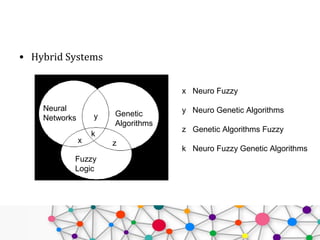
• Hybrid Systems
Neural
Networks
Genetic
Algorithms
Fuzzy
Logic
x
y
z
k
x Neuro Fuzzy
y Neuro Genetic Algorithms
z Genetic Algorithms Fuzzy
k Neuro Fuzzy Genetic Algorithms
Neural Networks
• It is simplified models of the biological nervous system
and therefore have drawn their motivation from the kind
of computing performed by a human brain.
• It is as highly interconnected networks of a large number
of processing elements called neurons is an architecture
inspired by the brain.
• It can be massively parallel , so it exhibits parallel
distributed processing.
• Neural networks learn by examples
• To be trained with known examples of a problem to
acquire knowledge about it.
• This trained network can be put to effective use in solving
‘unknown’ or ‘untrained’ instances of the problem.
• Supervised Learning
A ‘teacher ‘ is assumed to be present during the learning
process.
The network aims to minimize the error between the
target output presented by the teacher and the computed
output, to achieve better performance.
• Unsupervised Learning
There is no teacher present to hand over the desired
output and the network therefore tries to learn by itself
organizing the input instances of the problem.
• Neural Networks Architectures Classification
Single Layer Feed forward Networks
Multi Layer Feed forward Networks
Recurrent Networks
Neural Networks Application Areas
• Pattern Recognition
• Image Processing
• Data Compression
• Forecasting
• Optimization
• Stock Market Prediction
Neural Networks Systems
• Backpropagation Network
• Perceptron
• ADALINE [Adaptive Linear Element]
• Associative Memory
• Boltzmann Machine
• Adaptive Resonance Theory
• Self-organizing feature map
• Hopfield network
Fuzzy Logic
It try to capture the way humans represent and reason with
real world knowledge in the face of uncertainty.
Uncertainty could arise due to generality, vagueness, ambiguity,
chance or incomplete knowledge
The capability of fuzzy set to express gradual transitions from
membership to non-membership and vice versa has a broad
utility.
Operations on fuzzy sets
Union
Intersection
Subsethood
Composition of relations
Fuzzy Logic Multivalued truth values
True
Absolutely True
Fairly True
False
Absolutely False
Partly False
● Fuzzy logic washing machines
These machines offer the advantages of performance, productivity, simplicity,
productivity,and less cost. Sensors continually monitor varying conditions
inside the machine and accordingly adjust operations for the best wash results.
Typically, fuzzy logic controls the washing process, water intake,water
temperature, wash time, rinse performance, and spin speed. This optimises
the life span of the washing machine.
More sophisticated machines weigh the load , advise on the required amount
of detergent, assess cloth material type and water hardness, and check
whether the detergent is in powder or liquid form.
Some machines even learn from past experience,memorising programs and
adjusting them to minimise running costs.
Genetic Algorithms
It initiated and developed in the early 1970 by John Holland are
unorthodox
search and optimization algorithms, which mimic some of the
processes of
natural evolution.
GAs perform random searches through a given set of alternatives
with the aim
of finding the best alternative with respect to the given criteria of
goodness.
These criteria are required to be expressed in terms of an
objective function
which is usually referred to as a fitness function.
Genetic Operations
ReproductionCross over Mutation Inversion
Dominance Deletion Duplication Translocation
Segregation Speciation Migration Sharing
Mating
Application: Robotics
Robotics involves human designers and engineers trying out all sorts
of
things in order to create useful machines that can do work for
humans.
Each robot's design is dependent on the job or jobs it is intended to
do, so
there are many different designs out there.
GAs can be programmed to search for a range of optimal designs and
components for each specific use, or to return results for entirely new
types
of robots that can perform multiple tasks and have more general
application.
GA-designed robotics just might get us those nifty multi-purpose,
• References
Neural Networks, Fuzzy Logic & Genetic Algorithms –Synthesis &
applications, T.S. Rajasekaran & G.A. Vijaylakshmi Pai, PHI
http://cs.stanford.edu/people/eroberts/courses/soco/projects/2000-
01/neural-networks/index.html
http://www.samsung.com/in/consumer/home-appliances/washing-m
achines/front-loading/WF700B0BKWQ/TL
http://brainz.org/15-real-world-applications-genetic-algorithms/

Soft Computing

  • 1.
  • 2.
    Introduction • Soft Computingrefers to a consortium of computational methodologies like fuzzy logic, neural networks, genetic algorithms etc • All having their roots in the Artificial Intelligence • Artificial Intelligence is an area of computer science concerned with designing intelligent computer systems. • Systems that exhibit the characteristics we associate with intelligence in human behavior.
  • 3.
    • Soft Computingwas introduced by Lotfi A zadeh of the university of California, Berkley, U.S.A • The soft computing differs from hard computing in its tolerance to imprecision, uncertainty and partial truth. • Soft Computing has high Machine Intelligent Quotient [MIQ] • It is the processes of analyzing, organizing and converting data into knowledge is defined as the structured information acquired and applied to remove ignorance and uncertainty about a specific task pertaining to the intelligent machine.
  • 4.
    • Hybrid Systems Neural Networks Genetic Algorithms Fuzzy Logic x y z k xNeuro Fuzzy y Neuro Genetic Algorithms z Genetic Algorithms Fuzzy k Neuro Fuzzy Genetic Algorithms
  • 5.
    Neural Networks • Itis simplified models of the biological nervous system and therefore have drawn their motivation from the kind of computing performed by a human brain. • It is as highly interconnected networks of a large number of processing elements called neurons is an architecture inspired by the brain. • It can be massively parallel , so it exhibits parallel distributed processing. • Neural networks learn by examples
  • 6.
    • To betrained with known examples of a problem to acquire knowledge about it. • This trained network can be put to effective use in solving ‘unknown’ or ‘untrained’ instances of the problem. • Supervised Learning A ‘teacher ‘ is assumed to be present during the learning process. The network aims to minimize the error between the target output presented by the teacher and the computed output, to achieve better performance.
  • 7.
    • Unsupervised Learning Thereis no teacher present to hand over the desired output and the network therefore tries to learn by itself organizing the input instances of the problem. • Neural Networks Architectures Classification Single Layer Feed forward Networks Multi Layer Feed forward Networks Recurrent Networks
  • 8.
    Neural Networks ApplicationAreas • Pattern Recognition • Image Processing • Data Compression • Forecasting • Optimization • Stock Market Prediction
  • 9.
    Neural Networks Systems •Backpropagation Network • Perceptron • ADALINE [Adaptive Linear Element] • Associative Memory • Boltzmann Machine • Adaptive Resonance Theory • Self-organizing feature map • Hopfield network
  • 10.
    Fuzzy Logic It tryto capture the way humans represent and reason with real world knowledge in the face of uncertainty. Uncertainty could arise due to generality, vagueness, ambiguity, chance or incomplete knowledge The capability of fuzzy set to express gradual transitions from membership to non-membership and vice versa has a broad utility.
  • 11.
    Operations on fuzzysets Union Intersection Subsethood Composition of relations Fuzzy Logic Multivalued truth values True Absolutely True Fairly True False Absolutely False Partly False
  • 12.
    ● Fuzzy logicwashing machines These machines offer the advantages of performance, productivity, simplicity, productivity,and less cost. Sensors continually monitor varying conditions inside the machine and accordingly adjust operations for the best wash results. Typically, fuzzy logic controls the washing process, water intake,water temperature, wash time, rinse performance, and spin speed. This optimises the life span of the washing machine. More sophisticated machines weigh the load , advise on the required amount of detergent, assess cloth material type and water hardness, and check whether the detergent is in powder or liquid form. Some machines even learn from past experience,memorising programs and adjusting them to minimise running costs.
  • 13.
    Genetic Algorithms It initiatedand developed in the early 1970 by John Holland are unorthodox search and optimization algorithms, which mimic some of the processes of natural evolution. GAs perform random searches through a given set of alternatives with the aim of finding the best alternative with respect to the given criteria of goodness. These criteria are required to be expressed in terms of an objective function which is usually referred to as a fitness function.
  • 14.
    Genetic Operations ReproductionCross overMutation Inversion Dominance Deletion Duplication Translocation Segregation Speciation Migration Sharing Mating
  • 15.
    Application: Robotics Robotics involveshuman designers and engineers trying out all sorts of things in order to create useful machines that can do work for humans. Each robot's design is dependent on the job or jobs it is intended to do, so there are many different designs out there. GAs can be programmed to search for a range of optimal designs and components for each specific use, or to return results for entirely new types of robots that can perform multiple tasks and have more general application. GA-designed robotics just might get us those nifty multi-purpose,
  • 16.
    • References Neural Networks,Fuzzy Logic & Genetic Algorithms –Synthesis & applications, T.S. Rajasekaran & G.A. Vijaylakshmi Pai, PHI http://cs.stanford.edu/people/eroberts/courses/soco/projects/2000- 01/neural-networks/index.html http://www.samsung.com/in/consumer/home-appliances/washing-m achines/front-loading/WF700B0BKWQ/TL http://brainz.org/15-real-world-applications-genetic-algorithms/