SOCIAL PSYCHOLOGY chapter 1-what is social psychology and its definition
1.
SOCIAL PSYCHOLOGY
CHAPTER 1:Introducing Social Psychology
What is Social Psychology?
Social psychology is the scientific study of how people
think about, influence, and relate to one another,
focusing on the effects of situations rather than just
individual differences. It overlaps with sociology but
emphasizes individuals and experimental methods, and
differs from personality psychology by centering on
general patterns of interaction rather than unique traits.
The field is relatively young—emerging in the early
1900s, gaining structure in the 1930s, expanding
significantly during and after World War II, and growing
rapidly in Asia from the 1970s onward.
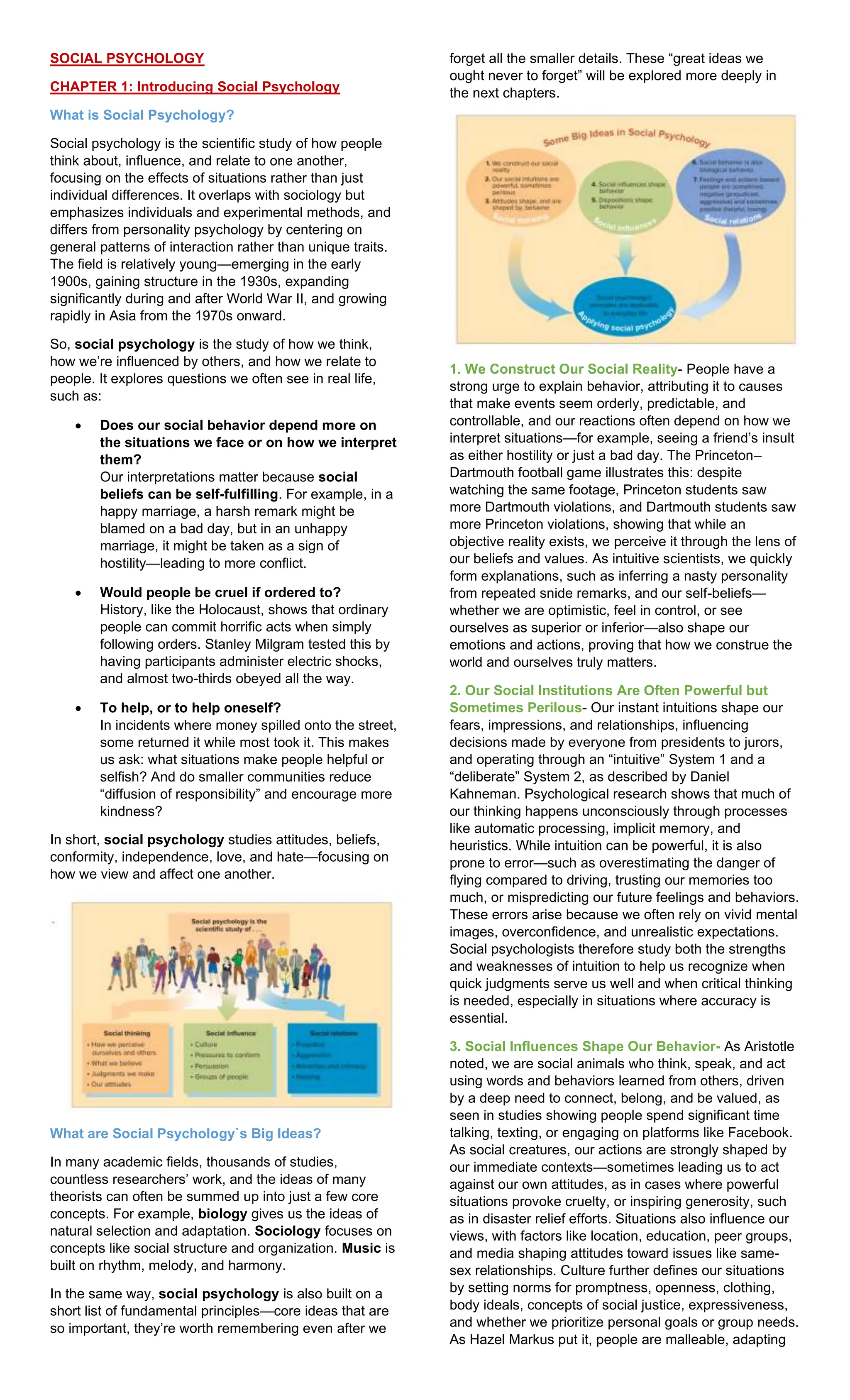
So, social psychology is the study of how we think,
how we’re influenced by others, and how we relate to
people. It explores questions we often see in real life,
such as:
• Does our social behavior depend more on
the situations we face or on how we interpret
them?
Our interpretations matter because social
beliefs can be self-fulfilling. For example, in a
happy marriage, a harsh remark might be
blamed on a bad day, but in an unhappy
marriage, it might be taken as a sign of
hostility—leading to more conflict.
• Would people be cruel if ordered to?
History, like the Holocaust, shows that ordinary
people can commit horrific acts when simply
following orders. Stanley Milgram tested this by
having participants administer electric shocks,
and almost two-thirds obeyed all the way.
• To help, or to help oneself?
In incidents where money spilled onto the street,
some returned it while most took it. This makes
us ask: what situations make people helpful or
selfish? And do smaller communities reduce
“diffusion of responsibility” and encourage more
kindness?
In short, social psychology studies attitudes, beliefs,
conformity, independence, love, and hate—focusing on
how we view and affect one another.
What are Social Psychology`s Big Ideas?
In many academic fields, thousands of studies,
countless researchers’ work, and the ideas of many
theorists can often be summed up into just a few core
concepts. For example, biology gives us the ideas of
natural selection and adaptation. Sociology focuses on
concepts like social structure and organization. Music is
built on rhythm, melody, and harmony.
In the same way, social psychology is also built on a
short list of fundamental principles—core ideas that are
so important, they’re worth remembering even after we
forget all the smaller details. These “great ideas we
ought never to forget” will be explored more deeply in
the next chapters.
1. We Construct Our Social Reality- People have a
strong urge to explain behavior, attributing it to causes
that make events seem orderly, predictable, and
controllable, and our reactions often depend on how we
interpret situations—for example, seeing a friend’s insult
as either hostility or just a bad day. The Princeton–
Dartmouth football game illustrates this: despite
watching the same footage, Princeton students saw
more Dartmouth violations, and Dartmouth students saw
more Princeton violations, showing that while an
objective reality exists, we perceive it through the lens of
our beliefs and values. As intuitive scientists, we quickly
form explanations, such as inferring a nasty personality
from repeated snide remarks, and our self-beliefs—
whether we are optimistic, feel in control, or see
ourselves as superior or inferior—also shape our
emotions and actions, proving that how we construe the
world and ourselves truly matters.
2. Our Social Institutions Are Often Powerful but
Sometimes Perilous- Our instant intuitions shape our
fears, impressions, and relationships, influencing
decisions made by everyone from presidents to jurors,
and operating through an “intuitive” System 1 and a
“deliberate” System 2, as described by Daniel
Kahneman. Psychological research shows that much of
our thinking happens unconsciously through processes
like automatic processing, implicit memory, and
heuristics. While intuition can be powerful, it is also
prone to error—such as overestimating the danger of
flying compared to driving, trusting our memories too
much, or mispredicting our future feelings and behaviors.
These errors arise because we often rely on vivid mental
images, overconfidence, and unrealistic expectations.
Social psychologists therefore study both the strengths
and weaknesses of intuition to help us recognize when
quick judgments serve us well and when critical thinking
is needed, especially in situations where accuracy is
essential.
3. Social Influences Shape Our Behavior- As Aristotle
noted, we are social animals who think, speak, and act
using words and behaviors learned from others, driven
by a deep need to connect, belong, and be valued, as
seen in studies showing people spend significant time
talking, texting, or engaging on platforms like Facebook.
As social creatures, our actions are strongly shaped by
our immediate contexts—sometimes leading us to act
against our own attitudes, as in cases where powerful
situations provoke cruelty, or inspiring generosity, such
as in disaster relief efforts. Situations also influence our
views, with factors like location, education, peer groups,
and media shaping attitudes toward issues like same-
sex relationships. Culture further defines our situations
by setting norms for promptness, openness, clothing,
body ideals, concepts of social justice, expressiveness,
and whether we prioritize personal goals or group needs.
As Hazel Markus put it, people are malleable, adapting
2.
their attitudes andbehaviors to social contexts shaped
by external forces.
4. Personal Attitudes and Dispositions Also Shape
Behavior- Internal forces play a major role in shaping
behavior, showing that we are not just passive beings
swayed by social influences. Our inner attitudes—such
as political beliefs, views on alcohol, or opinions about
the poor—affect how we vote, respond to peer pressure,
and choose to help others. Interestingly, attitudes can
also follow behavior, meaning we often grow to believe
more strongly in what we’ve committed to or endured.
Personality dispositions further influence our responses,
as people facing the same situation may react very
differently—one emerging from hardship with bitterness
and a desire for revenge, another, like Nelson Mandela,
choosing reconciliation and unity. Ultimately, both
attitudes and personality shape our behavior.
5. Social Behavior Is Biologically Rooted- Twenty-
first-century social psychology offers growing insights
into the biological foundations of our behavior, showing
that nature and nurture work together to shape who we
are—much like the length and width determining the
area of a rectangle. Evolutionary psychology explains
that our inherited traits, shaped by natural selection,
predispose us toward behaviors that aided our
ancestors’ survival and reproduction, while nature also
gives us the ability to learn and adapt to different
environments. Because every psychological event is
also a biological event, social neuroscience explores
how brain structures, hormones, and neural processes
influence social behaviors such as love, aggression,
trust, and helping, while acknowledging that complex
social behaviors cannot be reduced to mere biology.
Understanding social behavior therefore requires
examining both “under-the-skin” biological influences
and “between-skins” social influences, as mind and body
function as one system. Hormones like testosterone can
decrease trust, oxytocin can increase it, social rejection
can raise blood pressure, and social support can
strengthen the immune system, highlighting that we are
bio-psycho-social organisms shaped by the interaction of
biological, psychological, and social forces.
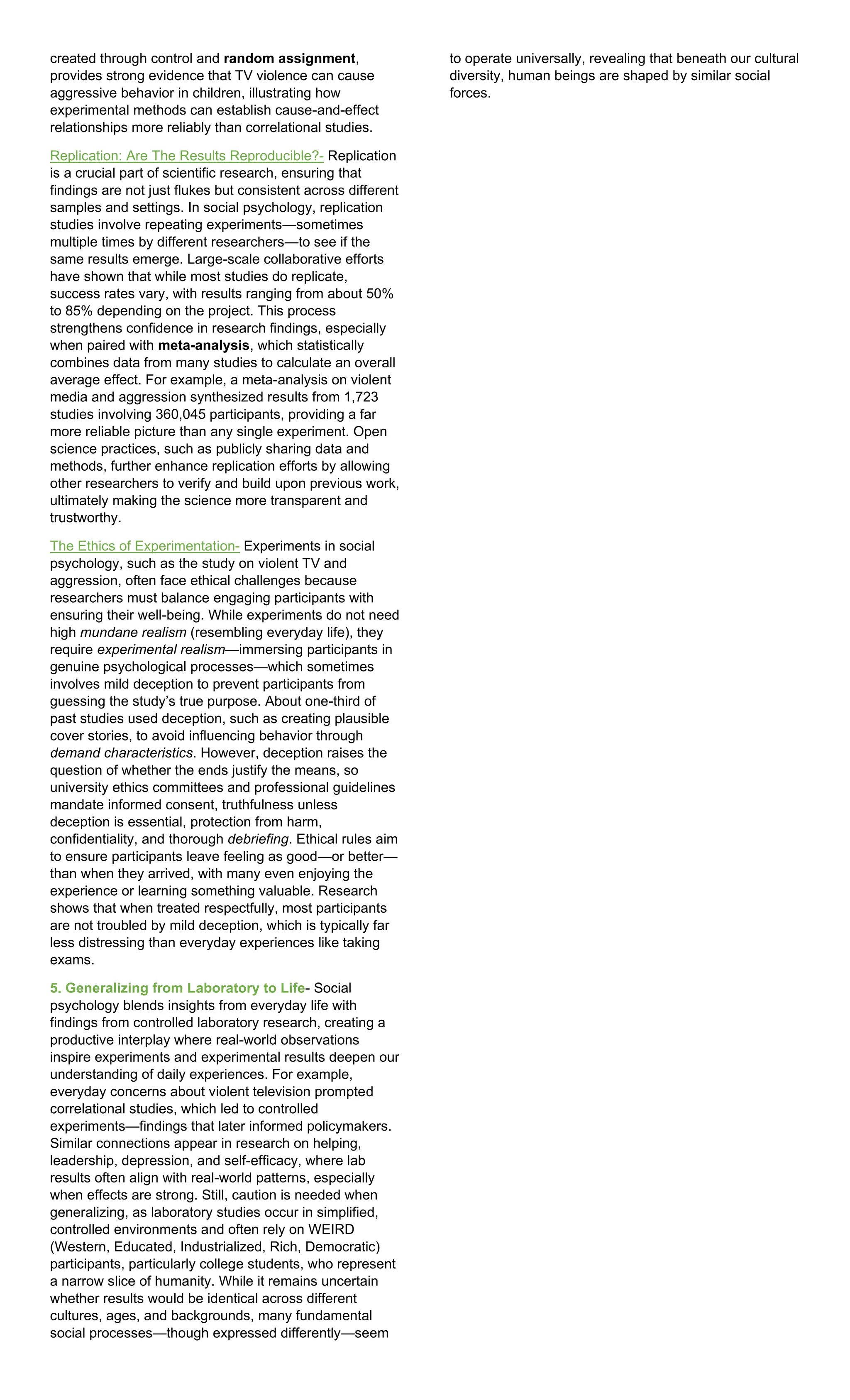
6. Social Psychology`s Principles Are Applicable in
Everyday Life- Social psychology can make the hidden
influences on our thoughts and actions more visible,
helping us understand ourselves better, build
relationships, and turn conflict into cooperation. Its
principles of social thinking, social influence, and social
relations are applied in areas like health, courtroom
decision-making, and promoting environmentally
sustainable behaviors. While it does not answer life’s
ultimate questions about meaning, purpose, or destiny, it
provides tools to explore important questions about our
beliefs, attitudes, and relationships. Ultimately, social
psychology is about life—our everyday interactions and
perspectives—and it equips us with methods to analyze
and understand social behavior, guiding us to think and
act more wisely.
I Knew it All Along: Is Social Psychology Simply
Common Sense?
Many social psychological findings often appear like
plain common sense, but this perception is largely the
result of hindsight bias—the inclination to believe, after
we already know an outcome, that it was predictable and
obvious all along. This bias makes us feel as though “we
knew it all along,” even when, in reality, the result was
not so easily foreseen beforehand. For example, people
can just as easily accept and rationalize two opposing
ideas—such as “opposites attract” or “birds of a feather
flock together”—by adjusting their explanations to fit the
known outcome. Once something happens, we tend to
reinterpret and reconstruct past events to make them
seem like they naturally led to that outcome, which
creates the illusion of inevitability. The problem is that
before the outcome is revealed, events are much harder
to predict, and multiple possibilities seem plausible.
Hindsight bias can lead us to overestimate our ability to
foresee events, give us a false sense of understanding,
and make the field of psychology appear deceptively
simple when reading about findings. However, when we
are tested without having the results in advance, we
realize that predicting human behavior is far more
complex than it initially seemed.
Social psychology aims to shed light on the subtle
influences that shape our thoughts, actions, and
relationships, offering valuable insights into
understanding ourselves, building meaningful
connections, and resolving conflicts. By applying
principles of social thinking, social influence, and
social relations, it contributes to areas such as
promoting health and well-being, improving judicial
processes, and encouraging behaviors that support
environmental sustainability. While it does not answer
ultimate philosophical questions about life’s meaning,
purpose, or destiny, social psychology equips us with
methods to explore significant and interesting questions
about human behavior. It emphasizes that the field is
deeply connected to everyday life—our beliefs, attitudes,
and interactions—while also acknowledging that social
psychologists’ values can subtly shape their work. The
discipline’s main goal is to examine how explanations for
social behavior are developed and to use its analytical
tools to enhance our understanding and make wiser
decisions in navigating the complexities of social life.
Research Methods: How Do We Do Social
Psychology? We have considered some of the
intriguing questions social psychology seeks to answer.
We’ve also explored how “common sense” can’t reliably
answer these questions. So how can we answer social
psychology’s questions by more scientific means? Let’s
consider how using scientific methods can help us
understand our social world.
1. Forming and Testing Hypotheses- A theory, in
scientific terms, is an integrated set of principles that
explains and predicts observed events, serving as a
framework to organize facts and guide research. Unlike
the casual use of the word “theory” as a mere guess, in
science, facts are agreed-upon observations, while
theories explain those facts and generate testable
predictions called hypotheses. Hypotheses help test
theories, guide research toward new ideas, and offer
practical applications, as illustrated by studies on crowd
behavior and anonymity in aggression. Good theories
summarize many observations, make clear predictions
that can confirm or modify the theory, inspire further
research, and suggest real-world uses. They are valued
for their explanatory power and practicality, as Kurt
Lewin noted, “There is nothing so practical as a good
theory.” Over time, theories are not typically discarded
for being entirely false but are replaced by newer, more
comprehensive models that better account for the
evidence, much like upgrading to a more advanced car.
2. Sampling and Question Wording- This section
invites us to take a behind-the-scenes look at how social
psychology research is conducted, offering insights that
will help us better understand the findings discussed
later. By exploring the logic behind research, we can
develop critical thinking skills that allow us to evaluate
everyday social events more thoughtfully and interpret
studies reported in the media with greater accuracy. The
discussion focuses on two main aspects: identifying who
participates in the research and determining what
questions are asked of them. These considerations are
crucial because the selection of participants influences
3.
how well thefindings apply to different groups, while the
framing and nature of the questions shape the kind of
data collected and the interpretations that follow.
Together, they form the foundation for producing
reliable, valid, and meaningful social psychology
research.
Sampling: Choosing Participants- Researchers in social
psychology must carefully decide who will participate in
their studies, since it is rarely possible to study an entire
population. Instead, they select a sample, ideally a
random sample, in which every person in the
population has an equal chance of being included,
ensuring proportional representation of subgroups. In
practice, obtaining a truly random global or even national
sample is challenging, so many studies rely on college
students or paid online participants, which may differ
from the general population but often produce results
that replicate in broader samples. Nonrandom sampling
can bias results, especially when participants self-select
based on interest—such as polling soccer fans about
their favorite sport—or when response rates are low, as
in declining telephone poll participation. Another key
factor is sample size, which affects reliability: larger
samples yield smaller margins of error and results closer
to the true population values, while smaller samples
produce wider margins. For example, a sample of 1,200
people provides much more precise estimates than a
sample of 100. Recent social psychology research has
improved reliability by increasing sample sizes, making
findings more robust and generalizable.
Asking the Right Questions- Researchers must design
surveys and questionnaires carefully to avoid bias, as
both the order and wording of questions can significantly
influence responses. Even subtle differences in
phrasing—such as asking about “global warming” versus
“climate change,” or “forbidding” versus “not allowing”
speeches—can yield markedly different results,
revealing how people’s answers can shift based on
framing. This framing effect is often used by political
consultants, advertisers, and policymakers to shape
public opinion or encourage specific behaviors without
restricting choice. For example, labeling beef as “70%
lean” gains more approval than calling it “30% fat,” and
“gun safety” garners more support than “gun control.”
Framing also plays a powerful role in everyday decision-
making defaults, such as organ donation and retirement
savings, where making the default option participation
rather than nonparticipation dramatically increases
uptake. The underlying principle is that the way
information or options are presented—whether in
surveys, policies, or everyday choices—can nudge
people toward certain decisions, highlighting that how
something is said can be as influential as what is said.
3. Correlational Research: Detecting Natural
Association- Social psychological research often uses
two main methods: correlational research, which
examines naturally occurring relationships between
variables, and experimental research, which manipulates
variables to determine cause and effect. Correlational
research offers the advantage of studying important
factors in real-world settings—such as the observed
relationship between wealth and health, where taller
(and presumably more expensive) grave markers in
Scotland predicted longer lifespans—but it cannot
determine causality. Such relationships may result from
one variable influencing the other, the reverse being
true, or a third factor influencing both; for instance,
healthy individuals may earn more, or certain
socioeconomic or cultural factors may affect both health
and wealth. The same reasoning applies to the link
between self-esteem and academic achievement: while
high self-esteem is associated with better performance,
this correlation may arise because achievement builds
self-esteem, or because both are influenced by
intelligence, family background, or supportive
environments. Correlations are measured with a
coefficient (r) ranging from −1.0 to +1.0, indicating the
strength and direction of the relationship, but they do not
imply causation. More advanced techniques, such as
time-lagged correlations and controlling for third
variables, can suggest possible causal pathways—like
finding that the wealth–longevity link persisted in
Scotland even after accounting for smoking—but the
fundamental caution remains: correlation helps
prediction, not definitive cause–effect conclusions.
4. Experimental Research: Searching for Cause and
Effect- In social psychology, determining cause and
effect can be challenging in correlational studies, which
is why researchers often use laboratory simulations of
everyday processes when possible and ethical. These
simulations work like aeronautical wind tunnels, where
engineers avoid starting with natural observations
because real-world conditions and objects are too
complex, and instead create controlled environments to
manipulate variables such as wind and wing design.
Similarly, in experiments, researchers construct a
simulated reality where they can carefully manipulate
social variables, giving them two key advantages over
correlational studies: random assignment, which
ensures participants are equally likely to be placed in
any group to minimize bias, and control, which allows
them to hold constant all other factors so they can
isolate the specific effect of the variable being studied.
This approach makes experiments more effective for
identifying cause-and-effect relationships in social
psychology.
Random Assignment: The Great Equalizer- A study by
Huesmann et al. (2003) found that children who watched
more violent TV were more likely to act aggressively
later in life, but because this was a correlational study,
it’s unclear whether violent TV causes aggression,
aggressive children choose more violent content, or a
third factor influences both behaviors. Survey
researchers can attempt to statistically control for
possible third variables, but it’s impossible to account for
every difference—such as personality, intelligence, or
self-control—between people who enjoy violent TV and
those who don’t. Experimental research overcomes this
limitation through random assignment, which evenly
distributes participants across conditions so that groups
are equivalent in every conceivable way except for the
manipulated factor. For instance, if participants are
randomly assigned to watch either violent or nonviolent
TV, highly aggressive individuals are just as likely to end
up in both groups. Therefore, if one group later shows
more aggressive behavior, researchers can attribute the
difference to the TV content rather than preexisting
differences, making experiments much stronger for
establishing cause and effect.
Control: Manipulating Variables- Social psychologists
often design experiments that replicate important
aspects of daily life, allowing them to manipulate one or
two independent variables at a time to see their effects
on dependent variables. Similar to how wind tunnels
help engineers test aerodynamic principles, experiments
help researchers uncover principles of social thinking,
influence, and relationships. In the example of violent TV
and aggression, Chris Boyatzis and colleagues (1995)
showed some elementary school children an episode of
the popular and violent 1990s show Power Rangers,
while others did not watch it, thereby controlling the
situation and manipulating the independent variable—
exposure to violent TV. Immediately afterward, the
children who watched committed seven times more
aggressive acts than those who did not, with aggression
serving as the dependent variable. This clear difference,
4.
created through controland random assignment,
provides strong evidence that TV violence can cause
aggressive behavior in children, illustrating how
experimental methods can establish cause-and-effect
relationships more reliably than correlational studies.
Replication: Are The Results Reproducible?- Replication
is a crucial part of scientific research, ensuring that
findings are not just flukes but consistent across different
samples and settings. In social psychology, replication
studies involve repeating experiments—sometimes
multiple times by different researchers—to see if the
same results emerge. Large-scale collaborative efforts
have shown that while most studies do replicate,
success rates vary, with results ranging from about 50%
to 85% depending on the project. This process
strengthens confidence in research findings, especially
when paired with meta-analysis, which statistically
combines data from many studies to calculate an overall
average effect. For example, a meta-analysis on violent
media and aggression synthesized results from 1,723
studies involving 360,045 participants, providing a far
more reliable picture than any single experiment. Open
science practices, such as publicly sharing data and
methods, further enhance replication efforts by allowing
other researchers to verify and build upon previous work,
ultimately making the science more transparent and
trustworthy.
The Ethics of Experimentation- Experiments in social
psychology, such as the study on violent TV and
aggression, often face ethical challenges because
researchers must balance engaging participants with
ensuring their well-being. While experiments do not need
high mundane realism (resembling everyday life), they
require experimental realism—immersing participants in
genuine psychological processes—which sometimes
involves mild deception to prevent participants from
guessing the study’s true purpose. About one-third of
past studies used deception, such as creating plausible
cover stories, to avoid influencing behavior through
demand characteristics. However, deception raises the
question of whether the ends justify the means, so
university ethics committees and professional guidelines
mandate informed consent, truthfulness unless
deception is essential, protection from harm,
confidentiality, and thorough debriefing. Ethical rules aim
to ensure participants leave feeling as good—or better—
than when they arrived, with many even enjoying the
experience or learning something valuable. Research
shows that when treated respectfully, most participants
are not troubled by mild deception, which is typically far
less distressing than everyday experiences like taking
exams.
5. Generalizing from Laboratory to Life- Social
psychology blends insights from everyday life with
findings from controlled laboratory research, creating a
productive interplay where real-world observations
inspire experiments and experimental results deepen our
understanding of daily experiences. For example,
everyday concerns about violent television prompted
correlational studies, which led to controlled
experiments—findings that later informed policymakers.
Similar connections appear in research on helping,
leadership, depression, and self-efficacy, where lab
results often align with real-world patterns, especially
when effects are strong. Still, caution is needed when
generalizing, as laboratory studies occur in simplified,
controlled environments and often rely on WEIRD
(Western, Educated, Industrialized, Rich, Democratic)
participants, particularly college students, who represent
a narrow slice of humanity. While it remains uncertain
whether results would be identical across different
cultures, ages, and backgrounds, many fundamental
social processes—though expressed differently—seem
to operate universally, revealing that beneath our cultural
diversity, human beings are shaped by similar social
forces.