Social PsychologySocial Psychology
IntroductionIntroduction
 When we talked about personality weWhen we talked about personality we
talked about similarities in behaviourtalked about similarities in behaviour
between and within individualsbetween and within individuals
 Most social psychologists don’tMost social psychologists don’t
dispute these individual differencesdispute these individual differences
but they realize the importance ofbut they realize the importance of
the situationthe situation
IntroductionIntroduction
 Social psychologists are concernedSocial psychologists are concerned
with how we explains others’with how we explains others’
behaviour and how others’ behaviourbehaviour and how others’ behaviour
affects usaffects us
 May be as important as theMay be as important as the
individualindividual
Attribution TheoryAttribution Theory
 Hieder (1958)Hieder (1958)
 People attribute others’ behaviour toPeople attribute others’ behaviour to
their dispositionstheir dispositions
 PersonalityPersonality
 Sometimes this is over course true,Sometimes this is over course true,
we do have personalities after allwe do have personalities after all
 We overestimate the importance ofWe overestimate the importance of
personality in others’ behaviourpersonality in others’ behaviour
Attribution TheoryAttribution Theory
 We tend to do the other with us, soWe tend to do the other with us, so
when we do something we blame thewhen we do something we blame the
situationsituation
 The fundamental attribution errorThe fundamental attribution error
• We have more data in essenceWe have more data in essence
 Attributions have big effectsAttributions have big effects
• Do you blame the person or theDo you blame the person or the
situation, and then do you generalize….situation, and then do you generalize….
AttitudesAttitudes
 Attributions can affect, and areAttributions can affect, and are
affected by attributionsaffected by attributions
 Attitudes are behaviours and feelingsAttitudes are behaviours and feelings
that predispose us to react in athat predispose us to react in a
certain way tocertain way to
• ObjectsObjects
• EventsEvents
• peoplepeople
Attitude changeAttitude change
 Do we change the way people think?Do we change the way people think?
 Not necessarilyNot necessarily
 Attitudes guide actions ifAttitudes guide actions if
• Outside influences are minimalOutside influences are minimal
• Attitude is specifically related to theAttitude is specifically related to the
behaviourbehaviour
• Awareness of attitudes is importantAwareness of attitudes is important
 Counter intuitiveCounter intuitive
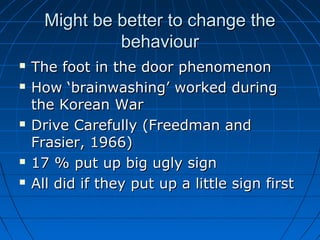
Might be better to change theMight be better to change the
behaviourbehaviour
 The foot in the door phenomenonThe foot in the door phenomenon
 How ‘brainwashing’ worked duringHow ‘brainwashing’ worked during
the Korean Warthe Korean War
 Drive Carefully (Freedman andDrive Carefully (Freedman and
Frasier, 1966)Frasier, 1966)
 17 % put up big ugly sign17 % put up big ugly sign
 All did if they put up a little sign firstAll did if they put up a little sign first
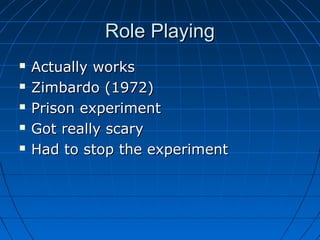
Role PlayingRole Playing
 Actually worksActually works
 Zimbardo (1972)Zimbardo (1972)
 Prison experimentPrison experiment
 Got really scaryGot really scary
 Had to stop the experimentHad to stop the experiment
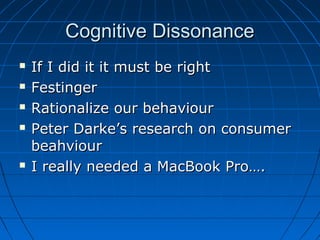
Cognitive DissonanceCognitive Dissonance
 If I did it it must be rightIf I did it it must be right
 FestingerFestinger
 Rationalize our behaviourRationalize our behaviour
 Peter Darke’s research on consumerPeter Darke’s research on consumer
beahviourbeahviour
 I really needed a MacBook Pro….I really needed a MacBook Pro….
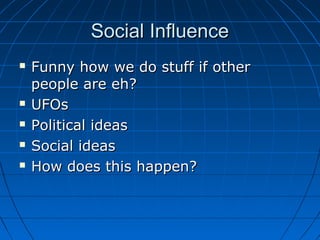
Social InfluenceSocial Influence
 Funny how we do stuff if otherFunny how we do stuff if other
people are eh?people are eh?
 UFOsUFOs
 Political ideasPolitical ideas
 Social ideasSocial ideas
 How does this happen?How does this happen?
Conformity and ObedienceConformity and Obedience
 Phillips’ odd dataPhillips’ odd data
• Suicides go up after suicides areSuicides go up after suicides are
publishedpublished
• So do car crashesSo do car crashes
• Airplane crashesAirplane crashes
 Ash’s classic line length experimentsAsh’s classic line length experiments
• About 1/3 of people give the wrongAbout 1/3 of people give the wrong
answeranswer
Factors that affect conformityFactors that affect conformity
 Made to feel incompetentMade to feel incompetent
 At least three peopleAt least three people
 High status groupHigh status group
 UnanimityUnanimity
 No prior commitmentNo prior commitment
 Our behaviour is in the openOur behaviour is in the open
 Cultural effectsCultural effects
Social InfluenceSocial Influence
 Normative social influenceNormative social influence
• When it is clear what the norm isWhen it is clear what the norm is
 Informational social influenceInformational social influence
• When we are not sure about what to do,When we are not sure about what to do,
but we have to do the right thingbut we have to do the right thing
MilgramMilgram
 Teacher and LearnerTeacher and Learner
 Learner was a confederateLearner was a confederate
 Paired associatesPaired associates
 Wrong answer, given a ‘shock’Wrong answer, given a ‘shock’
 ‘‘You must continue’You must continue’
 63% completed!63% completed!
 Started a big debate about ethicsStarted a big debate about ethics
 Most participants were happy to learn thisMost participants were happy to learn this
scary thing about themselvesscary thing about themselves
More MilgramMore Milgram
 I have a heart condition’ -> noI have a heart condition’ -> no
effect!effect!
 Legitimate authority was the keyLegitimate authority was the key
 AffiliationAffiliation
 DepersonalizationDepersonalization
 Modeling effectsModeling effects
What does it all mean?What does it all mean?
 People go against their beliefs underPeople go against their beliefs under
the right circumstancesthe right circumstances
 Under the right conditions people willUnder the right conditions people will
do awful thingsdo awful things
• Don’t let this absolve anyoneDon’t let this absolve anyone
Social FacilitationSocial Facilitation
 Improved performance in theImproved performance in the
presence of otherspresence of others
 Probably due to arousalProbably due to arousal
 The whole Yerkes-Dotson thingThe whole Yerkes-Dotson thing
Social LoafingSocial Loafing
 Doing things as a group and loafingDoing things as a group and loafing
 When you believe others are trying,When you believe others are trying,
you may quityou may quit
 Cultural effectsCultural effects
 Less accountableLess accountable
DeindividuationDeindividuation
 ArousalArousal
 Diminished responsibilityDiminished responsibility
 RiotsRiots
 Less likely to help a stranger whenLess likely to help a stranger when
you are in a groupyou are in a group
Group PolarizationGroup Polarization
 Small differences between groupsSmall differences between groups
tend to growtend to grow
 More specifically you get anMore specifically you get an
enhancement of a group’s prevailingenhancement of a group’s prevailing
tendanciestendancies
GroupthinkGroupthink
 OverconfidenceOverconfidence
 ConformityConformity
 Self justificationSelf justification
 Can be stopped by a good leaderCan be stopped by a good leader
that listens to others and welcomesthat listens to others and welcomes
criticismcriticism
 Minorities can affect the group if theyMinorities can affect the group if they
stick to their gunsstick to their guns
Cultural effectsCultural effects
 Of course, in social psych culturalOf course, in social psych cultural
effects are going to be hugeeffects are going to be huge
 Different cultures have differentDifferent cultures have different
normsnorms
 Personal space for examplePersonal space for example
 There are cultural effects on genderThere are cultural effects on gender
roles, though there are quite a fewroles, though there are quite a few
universals toouniversals too
PrejudicePrejudice
 Mixture of beliefs, emotions andMixture of beliefs, emotions and
actions towards a groupactions towards a group
 Influences cognitionInfluences cognition
 While blatant prejudice is on theWhile blatant prejudice is on the
wane, subtler forms are still outwane, subtler forms are still out
therethere
VictimsVictims
 They experience a few differentThey experience a few different
thingsthings
 Social inequalitySocial inequality
 ExclusionExclusion
 scapegoatingscapegoating
Where does it come from?Where does it come from?
 We have a need to categorize stuffWe have a need to categorize stuff
 The availability heuristic does notThe availability heuristic does not
help muchhelp much
 The just world hypothesisThe just world hypothesis
• They deserve itThey deserve it
AggressionAggression
 There are genetic factorsThere are genetic factors
 There are biochemical factorsThere are biochemical factors
 The frustration aggressionThe frustration aggression
hypothesishypothesis
 Learning effectsLearning effects
ConclusionsConclusions
 Social psychology is coolSocial psychology is cool
 Just because you think you knowJust because you think you know
something, does not mean you do,something, does not mean you do,
lots of counter-intuitive datalots of counter-intuitive data
 The situation is importantThe situation is important
 The group is importantThe group is important
 WE ARE DONEWE ARE DONE

Social.psy

  • 1.
  • 2.
    IntroductionIntroduction  When wetalked about personality weWhen we talked about personality we talked about similarities in behaviourtalked about similarities in behaviour between and within individualsbetween and within individuals  Most social psychologists don’tMost social psychologists don’t dispute these individual differencesdispute these individual differences but they realize the importance ofbut they realize the importance of the situationthe situation
  • 3.
    IntroductionIntroduction  Social psychologistsare concernedSocial psychologists are concerned with how we explains others’with how we explains others’ behaviour and how others’ behaviourbehaviour and how others’ behaviour affects usaffects us  May be as important as theMay be as important as the individualindividual
  • 4.
    Attribution TheoryAttribution Theory Hieder (1958)Hieder (1958)  People attribute others’ behaviour toPeople attribute others’ behaviour to their dispositionstheir dispositions  PersonalityPersonality  Sometimes this is over course true,Sometimes this is over course true, we do have personalities after allwe do have personalities after all  We overestimate the importance ofWe overestimate the importance of personality in others’ behaviourpersonality in others’ behaviour
  • 5.
    Attribution TheoryAttribution Theory We tend to do the other with us, soWe tend to do the other with us, so when we do something we blame thewhen we do something we blame the situationsituation  The fundamental attribution errorThe fundamental attribution error • We have more data in essenceWe have more data in essence  Attributions have big effectsAttributions have big effects • Do you blame the person or theDo you blame the person or the situation, and then do you generalize….situation, and then do you generalize….
  • 6.
    AttitudesAttitudes  Attributions canaffect, and areAttributions can affect, and are affected by attributionsaffected by attributions  Attitudes are behaviours and feelingsAttitudes are behaviours and feelings that predispose us to react in athat predispose us to react in a certain way tocertain way to • ObjectsObjects • EventsEvents • peoplepeople
  • 7.
    Attitude changeAttitude change Do we change the way people think?Do we change the way people think?  Not necessarilyNot necessarily  Attitudes guide actions ifAttitudes guide actions if • Outside influences are minimalOutside influences are minimal • Attitude is specifically related to theAttitude is specifically related to the behaviourbehaviour • Awareness of attitudes is importantAwareness of attitudes is important  Counter intuitiveCounter intuitive
  • 8.
    Might be betterto change theMight be better to change the behaviourbehaviour  The foot in the door phenomenonThe foot in the door phenomenon  How ‘brainwashing’ worked duringHow ‘brainwashing’ worked during the Korean Warthe Korean War  Drive Carefully (Freedman andDrive Carefully (Freedman and Frasier, 1966)Frasier, 1966)  17 % put up big ugly sign17 % put up big ugly sign  All did if they put up a little sign firstAll did if they put up a little sign first
  • 9.
    Role PlayingRole Playing Actually worksActually works  Zimbardo (1972)Zimbardo (1972)  Prison experimentPrison experiment  Got really scaryGot really scary  Had to stop the experimentHad to stop the experiment
  • 10.
    Cognitive DissonanceCognitive Dissonance If I did it it must be rightIf I did it it must be right  FestingerFestinger  Rationalize our behaviourRationalize our behaviour  Peter Darke’s research on consumerPeter Darke’s research on consumer beahviourbeahviour  I really needed a MacBook Pro….I really needed a MacBook Pro….
  • 11.
    Social InfluenceSocial Influence Funny how we do stuff if otherFunny how we do stuff if other people are eh?people are eh?  UFOsUFOs  Political ideasPolitical ideas  Social ideasSocial ideas  How does this happen?How does this happen?
  • 12.
    Conformity and ObedienceConformityand Obedience  Phillips’ odd dataPhillips’ odd data • Suicides go up after suicides areSuicides go up after suicides are publishedpublished • So do car crashesSo do car crashes • Airplane crashesAirplane crashes  Ash’s classic line length experimentsAsh’s classic line length experiments • About 1/3 of people give the wrongAbout 1/3 of people give the wrong answeranswer
  • 13.
    Factors that affectconformityFactors that affect conformity  Made to feel incompetentMade to feel incompetent  At least three peopleAt least three people  High status groupHigh status group  UnanimityUnanimity  No prior commitmentNo prior commitment  Our behaviour is in the openOur behaviour is in the open  Cultural effectsCultural effects
  • 14.
    Social InfluenceSocial Influence Normative social influenceNormative social influence • When it is clear what the norm isWhen it is clear what the norm is  Informational social influenceInformational social influence • When we are not sure about what to do,When we are not sure about what to do, but we have to do the right thingbut we have to do the right thing
  • 15.
    MilgramMilgram  Teacher andLearnerTeacher and Learner  Learner was a confederateLearner was a confederate  Paired associatesPaired associates  Wrong answer, given a ‘shock’Wrong answer, given a ‘shock’  ‘‘You must continue’You must continue’  63% completed!63% completed!  Started a big debate about ethicsStarted a big debate about ethics  Most participants were happy to learn thisMost participants were happy to learn this scary thing about themselvesscary thing about themselves
  • 16.
    More MilgramMore Milgram I have a heart condition’ -> noI have a heart condition’ -> no effect!effect!  Legitimate authority was the keyLegitimate authority was the key  AffiliationAffiliation  DepersonalizationDepersonalization  Modeling effectsModeling effects
  • 17.
    What does itall mean?What does it all mean?  People go against their beliefs underPeople go against their beliefs under the right circumstancesthe right circumstances  Under the right conditions people willUnder the right conditions people will do awful thingsdo awful things • Don’t let this absolve anyoneDon’t let this absolve anyone
  • 18.
    Social FacilitationSocial Facilitation Improved performance in theImproved performance in the presence of otherspresence of others  Probably due to arousalProbably due to arousal  The whole Yerkes-Dotson thingThe whole Yerkes-Dotson thing
  • 19.
    Social LoafingSocial Loafing Doing things as a group and loafingDoing things as a group and loafing  When you believe others are trying,When you believe others are trying, you may quityou may quit  Cultural effectsCultural effects  Less accountableLess accountable
  • 20.
    DeindividuationDeindividuation  ArousalArousal  DiminishedresponsibilityDiminished responsibility  RiotsRiots  Less likely to help a stranger whenLess likely to help a stranger when you are in a groupyou are in a group
  • 21.
    Group PolarizationGroup Polarization Small differences between groupsSmall differences between groups tend to growtend to grow  More specifically you get anMore specifically you get an enhancement of a group’s prevailingenhancement of a group’s prevailing tendanciestendancies
  • 22.
    GroupthinkGroupthink  OverconfidenceOverconfidence  ConformityConformity Self justificationSelf justification  Can be stopped by a good leaderCan be stopped by a good leader that listens to others and welcomesthat listens to others and welcomes criticismcriticism  Minorities can affect the group if theyMinorities can affect the group if they stick to their gunsstick to their guns
  • 23.
    Cultural effectsCultural effects Of course, in social psych culturalOf course, in social psych cultural effects are going to be hugeeffects are going to be huge  Different cultures have differentDifferent cultures have different normsnorms  Personal space for examplePersonal space for example  There are cultural effects on genderThere are cultural effects on gender roles, though there are quite a fewroles, though there are quite a few universals toouniversals too
  • 24.
    PrejudicePrejudice  Mixture ofbeliefs, emotions andMixture of beliefs, emotions and actions towards a groupactions towards a group  Influences cognitionInfluences cognition  While blatant prejudice is on theWhile blatant prejudice is on the wane, subtler forms are still outwane, subtler forms are still out therethere
  • 25.
    VictimsVictims  They experiencea few differentThey experience a few different thingsthings  Social inequalitySocial inequality  ExclusionExclusion  scapegoatingscapegoating
  • 26.
    Where does itcome from?Where does it come from?  We have a need to categorize stuffWe have a need to categorize stuff  The availability heuristic does notThe availability heuristic does not help muchhelp much  The just world hypothesisThe just world hypothesis • They deserve itThey deserve it
  • 27.
    AggressionAggression  There aregenetic factorsThere are genetic factors  There are biochemical factorsThere are biochemical factors  The frustration aggressionThe frustration aggression hypothesishypothesis  Learning effectsLearning effects
  • 28.
    ConclusionsConclusions  Social psychologyis coolSocial psychology is cool  Just because you think you knowJust because you think you know something, does not mean you do,something, does not mean you do, lots of counter-intuitive datalots of counter-intuitive data  The situation is importantThe situation is important  The group is importantThe group is important  WE ARE DONEWE ARE DONE