1
PSYCHOLOGY
(9th Edition)
David Myers
PowerPoint Slides
Aneeq Ahmad
Henderson State University
Worth Publishers, © 2010
2
Social Psychology
Chapter 16
3
Social Psychology
Social Thinking
 Attributing Behavior to Persons
or to Situations
 Attitudes and Actions
Social Influence
 Conformity and Obedience
 Group Influence
 The Power of Individuals
4
Social Relations
 Prejudice
 Aggression
 Attraction
 Altruism
 Conflict and Peacemaking
5
Focuses in Social Psychology
Social psychology scientifically studies how we
think about, influence, and relate to one another.
“We cannot live for ourselves alone.”
Herman Melville
6
Social Thinking
Social thinking involves thinking about others,
especially when they engage in doing things
that are unexpected.
1. Does his absenteeism signify illness,
laziness, or a stressful work atmosphere?
2. Was the horror of 9/11 the work of
crazed evil people or ordinary people
corrupted by life events?
7
Attributing Behavior to Persons or to
Situations
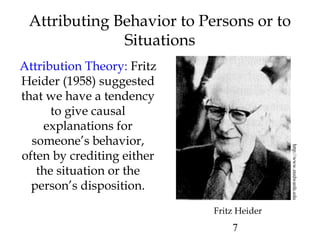
Attribution Theory: Fritz
Heider (1958) suggested
that we have a tendency
to give causal
explanations for
someone’s behavior,
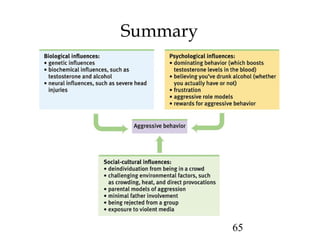
often by crediting either
the situation or the
person’s disposition.
http://www.stedwards.edu
Fritz Heider
8
Attributing Behavior to Persons or to
Situations
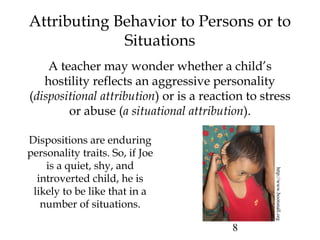
A teacher may wonder whether a child’s
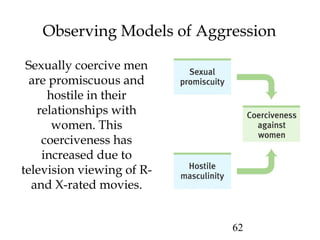
hostility reflects an aggressive personality
(dispositional attribution) or is a reaction to stress
or abuse (a situational attribution).
http://www.bootsnall.org
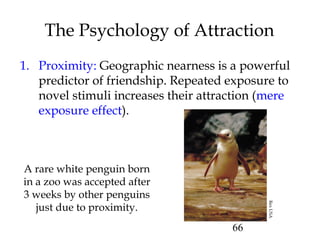
Dispositions are enduring
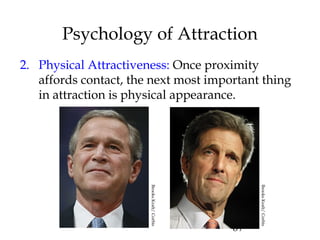
personality traits. So, if Joe
is a quiet, shy, and
introverted child, he is
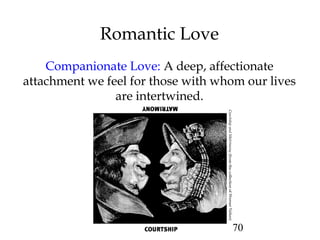
likely to be like that in a
number of situations.
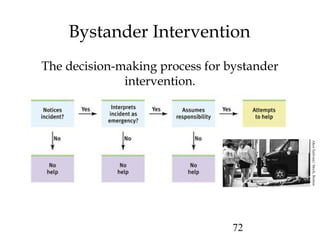
9
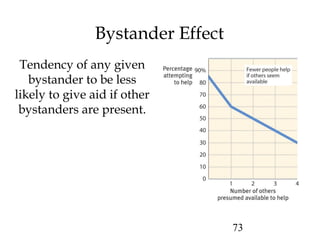
Fundamental Attribution Error
The tendency to overestimate the impact of
personal disposition and underestimate the
impact of the situations in analyzing the
behaviors of others leads to the fundamental
attribution error.
We see Joe as quiet, shy, and introverted most
of the time, but with friends he is very talkative,
loud, and extroverted.
10
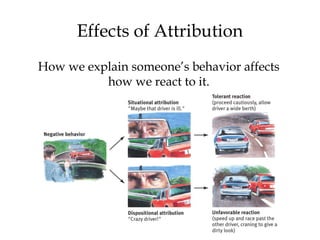
Effects of Attribution
How we explain someone’s behavior affects
how we react to it.
11
Attitudes & Actions
A belief and feeling that predisposes a person to
respond in a particular way to objects, other
people, and events.
If we believe a person is mean, we may feel
dislike for the person and act in an unfriendly
manner.
12
Attitudes Can Affect Actions
Our attitudes predict our behaviors imperfectly
because other factors, including the external
situation, also influence behavior.
Democratic leaders supported Bush’s attack on
Iraq under public pressure. However, they had
their private reservations.
13
Actions Can Affect Attitudes
Not only do people stand for what they believe in
(attitude), they start believing in what they stand
for.
Cooperative actions can lead to mutual liking (beliefs).
D.MacDonald/PhotoEdit
14
Small Request – Large Request
In the Korean War, Chinese communists
solicited cooperation from US army prisoners
by asking them to carry out small errands. By
complying to small errands they were likely to
comply to larger ones.
Foot-in-the-Door Phenomenon: The tendency
for people who have first agreed to a small
request to comply later with a larger request.
15
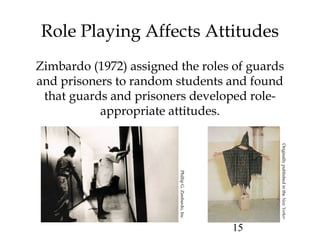
Role Playing Affects Attitudes
Zimbardo (1972) assigned the roles of guards
and prisoners to random students and found
that guards and prisoners developed role-
appropriate attitudes.
OriginallypublishedintheNewYorker
PhillipG.Zimbardo,Inc.
16
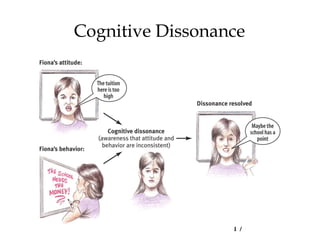
Actions Can Affect Attitudes
Why do actions affect attitudes? One
explanation is that when our attitudes and
actions are opposed, we experience tension.
This is called cognitive dissonance.
To relieve ourselves of this tension we bring our
attitudes closer to our actions (Festinger, 1957).
17
Cognitive Dissonance
18
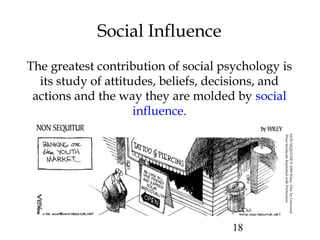
Social Influence
The greatest contribution of social psychology is
its study of attitudes, beliefs, decisions, and
actions and the way they are molded by social
influence.
NONSEQUITER©2000Wiley.Dist.byUniversal
PressSyndicateReprintedwithPermission
19
Conformity & Obedience
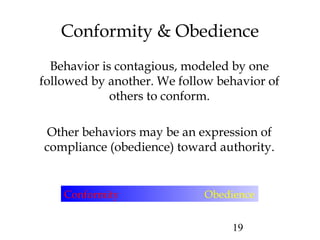
Behavior is contagious, modeled by one
followed by another. We follow behavior of
others to conform.
Other behaviors may be an expression of
compliance (obedience) toward authority.
Conformity Obedience
20
The Chameleon Effect
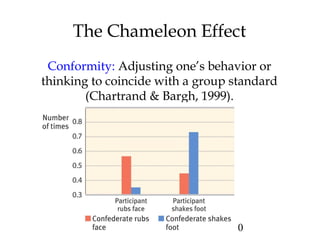
Conformity: Adjusting one’s behavior or
thinking to coincide with a group standard
(Chartrand & Bargh, 1999).
21
Group Pressure & Conformity
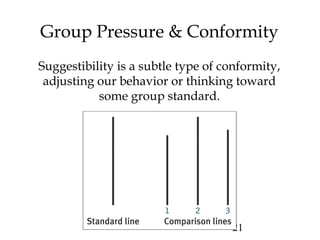
Suggestibility is a subtle type of conformity,
adjusting our behavior or thinking toward
some group standard.
22
Group Pressure & Conformity
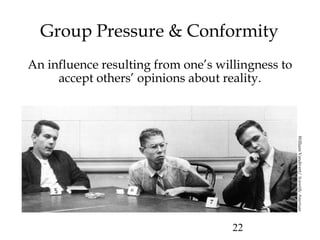
An influence resulting from one’s willingness to
accept others’ opinions about reality.
WilliamVandivert/ScientificAmerican
23
Conditions that Strengthen
Conformity
1. One is made to feel incompetent or insecure.
2. The group has at least three people.
3. The group is unanimous.
4. One admires the group’s status and
attractiveness.
5. One has no prior commitment to a response.
6. The group observes one’s behavior.
7. One’s culture strongly encourages respect for a
social standard.
24
Reasons for Conforming
Normative Social Influence: Influence resulting
from a person’s desire to gain approval or avoid
rejection. A person may respect normative
behavior because there may be a severe price to
pay if not respected.
Informational Social Influence: The group may
provide valuable information, but stubborn
people will never listen to others.
25
Obedience
People comply to social
pressures. How would
they respond to outright
command?
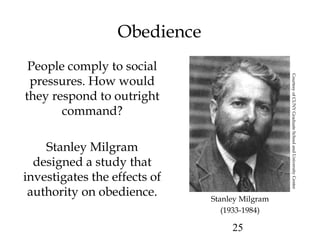
Stanley Milgram
designed a study that
investigates the effects of
authority on obedience. Stanley Milgram
(1933-1984)
CourtesyofCUNYGraduateSchoolandUniversityCenter
26
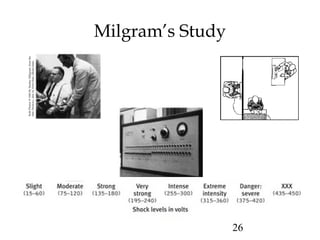
Milgram’s StudyBothPhotos:©1965ByStanleyMiligram,fromthe
filmObedience,dist.byPennState,MediaSales
27
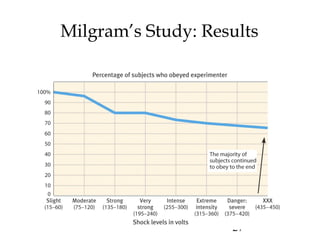
Milgram’s Study: Results
28
Individual Resistance
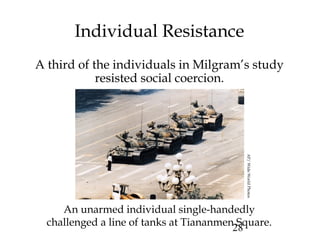
A third of the individuals in Milgram’s study
resisted social coercion.
An unarmed individual single-handedly
challenged a line of tanks at Tiananmen Square.
AP/WideWorldPhotos
29
Lessons from the Conformity and
Obedience Studies
In both Asch's and Milgram's studies,
participants were pressured to choose between
following their standards and being responsive
to others.
In Milgram’s study, participants were torn
between hearing the victims pleas and the
experimenter’s orders.
30
Group Influence
How do groups affect our behavior? Social
psychologists study various groups:
1. One person affecting another
2. Families
3. Teams
4. Committees
31
Individual Behavior in the Presence
of Others
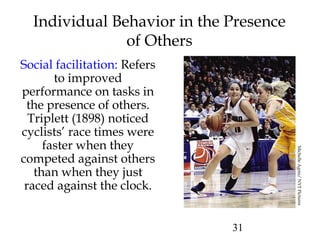
Social facilitation: Refers
to improved
performance on tasks in
the presence of others.
Triplett (1898) noticed
cyclists’ race times were
faster when they
competed against others
than when they just
raced against the clock.
MichelleAgnis/NYTPictures
32
Social Loafing
The tendency of an individual in a group to
exert less effort toward attaining a common
goal than when tested individually (Latané,
1981).
33
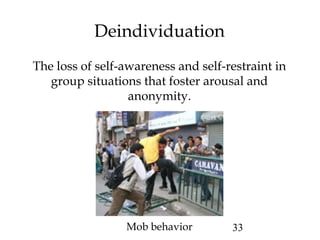
Deindividuation
The loss of self-awareness and self-restraint in
group situations that foster arousal and
anonymity.
Mob behavior
34
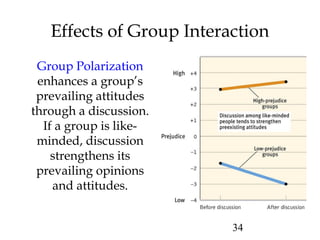
Effects of Group Interaction
Group Polarization
enhances a group’s
prevailing attitudes
through a discussion.
If a group is like-
minded, discussion
strengthens its
prevailing opinions
and attitudes.
35
Groupthink
A mode of thinking that occurs when the desire
for harmony in a decision-making group
overrides the realistic appraisal of alternatives.
Attack on Pearl Harbor
Kennedy and the Cuban Missile Crisis
Watergate Cover-up
Chernobyl Reactor Accident
36
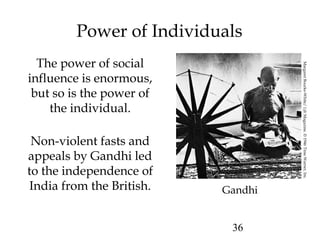
Power of Individuals
The power of social
influence is enormous,
but so is the power of
the individual.
Non-violent fasts and
appeals by Gandhi led
to the independence of
India from the British. Gandhi
MargaretBourke-White/LifeMagazine.©1946TimeWarner,Inc.
37
Social Relations
Social psychology teaches us how we relate to
one another through prejudice, aggression, and
conflict to attraction, and altruism and
peacemaking.
38
Prejudice
Simply called “prejudgment,” a prejudice is an
unjustifiable (usually negative) attitude toward
a group and its members. Prejudice is often
directed towards different cultural, ethnic, or
gender groups.
1. Beliefs (stereotypes)
2. Emotions (hostility, envy, fear)
3. Predisposition to act (to discriminate)
Components of Prejudice
39
Reign of Prejudice
Prejudice works at the conscious and [more at]
the unconscious level. Therefore, prejudice is
more like a knee-jerk response than a conscious
decision.
40
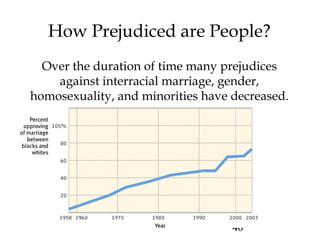
How Prejudiced are People?
Over the duration of time many prejudices
against interracial marriage, gender,
homosexuality, and minorities have decreased.
41
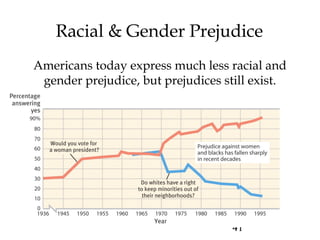
Racial & Gender Prejudice
Americans today express much less racial and
gender prejudice, but prejudices still exist.
42
Race
Nine out of ten white respondents were slow
when responding to words like “peace” or
“paradise” when they saw a black individual’s
photo compared to a white individual’s photo
(Hugenberg & Bodenhausen, 2003).
43
Gender
Most women still live in more poverty than
men. About 100,000,000 women are missing in
the world. There is a preference for male
children in China and India, even with sex-
selected abortion outlawed.
44
Gender
Although prejudice prevails against women, more people
feel positively toward women than men. Women rated
picture b [feminized] higher (66%) for a matrimonial ad
(Perrett & others, 1998).
ProfessorDavePerrett,St.AndrewsUniversity
45
Social Roots of Prejudice
Why does prejudice arise?
1. Social Inequalities
2. Social Divisions
3. Emotional Scapegoating
46
Social Inequality
Prejudice develops when people have money,
power, and prestige, and others do not. Social
inequality increases prejudice.
47
Us and Them
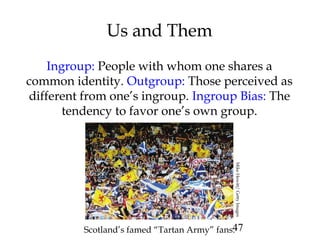
Ingroup: People with whom one shares a
common identity. Outgroup: Those perceived as
different from one’s ingroup. Ingroup Bias: The
tendency to favor one’s own group.
Scotland’s famed “Tartan Army” fans.MikeHewitt/GettyImages
48
Emotional Roots of Prejudice
Prejudice provides an outlet for anger [emotion]
by providing someone to blame. After 9/11
many people lashed out against innocent
Arab-Americans.
49
Cognitive Roots of Prejudice
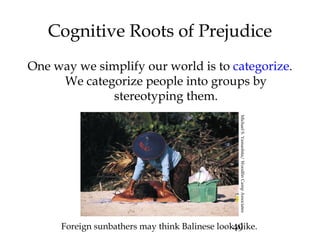
One way we simplify our world is to categorize.
We categorize people into groups by
stereotyping them.
Foreign sunbathers may think Balinese look alike.
MichaelS.Yamashita/WoodfinCampAssociates
50
Cognitive Roots of Prejudice
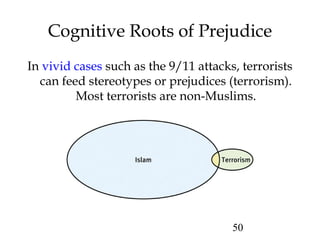
In vivid cases such as the 9/11 attacks, terrorists
can feed stereotypes or prejudices (terrorism).
Most terrorists are non-Muslims.
51
Cognitive Roots of Prejudice
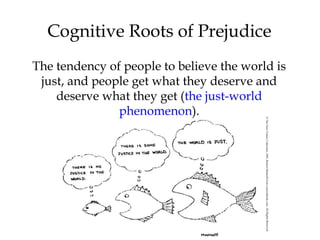
The tendency of people to believe the world is
just, and people get what they deserve and
deserve what they get (the just-world
phenomenon).
©TheNewYorkerCollection,1981,RobertMankofffromcartoonbank.com.AllRightsReserved.
52
Hindsight Bias
After learning an outcome, the tendency to
believe that we could have predicted it
beforehand may contribute to blaming the
victim and forming a prejudice against them.
53
Aggression
Aggression can be any physical or verbal
behavior intended to hurt or destroy.
It may be done reactively out of hostility or
proactively as a calculated means to an end.
Research shows that aggressive behavior emerges
from the interaction of biology and experience.
54
The Biology of Aggression
Three biological influences on aggressive
behavior are:
1. Genetic Influences
2. Neural Influences
3. Biochemical Influences
55
Influences
Genetic Influences: Animals have been bred for
aggressiveness for sport and at times for research.
Twin studies show aggression may be genetic. In
men, aggression is possibly linked to the Y
chromosome.
Neural Influences: Some centers in the brain,
especially the limbic system (amygdala) and the
frontal lobe, are intimately involved with
aggression.
56
Influences
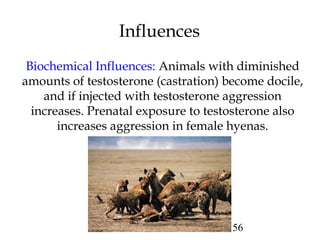
Biochemical Influences: Animals with diminished
amounts of testosterone (castration) become docile,
and if injected with testosterone aggression
increases. Prenatal exposure to testosterone also
increases aggression in female hyenas.
57
The Psychology of Aggression
Four psychological factors that influence
aggressive behavior are:
1. dealing with aversive events;
2. learning aggression is rewarding;
3. observing models of aggression; and
4. acquiring social scripts.
58
Aversive Events
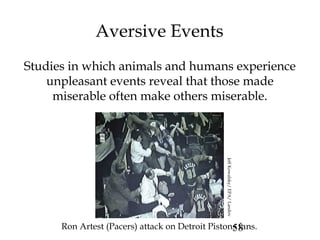
Studies in which animals and humans experience
unpleasant events reveal that those made
miserable often make others miserable.
Ron Artest (Pacers) attack on Detroit Pistons fans.JeffKowalsky/EPA/Landov
59
Environment
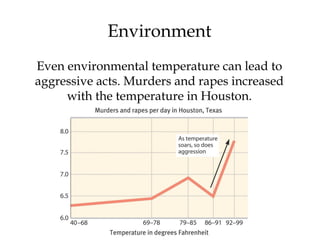
Even environmental temperature can lead to
aggressive acts. Murders and rapes increased
with the temperature in Houston.
60
Frustration-Aggression Principle
A principle in which frustration (caused by the
blocking of an attempt to achieve a desired goal)
creates anger, which can generate aggression.
61
Learning that Aggression is
Rewarding
When aggression leads to desired outcomes, one
learns to be aggressive. This is shown in both
animals and humans.
Cultures that favor violence breed violence.
Scotch-Irish settlers in the South had more violent
tendencies than their Puritan, Quaker, & Dutch
counterparts in the Northeast of the US.
62
Observing Models of Aggression
Sexually coercive men
are promiscuous and
hostile in their
relationships with
women. This
coerciveness has
increased due to
television viewing of R-
and X-rated movies.
63
Acquiring Social Scripts
The media portrays social scripts and generates
mental tapes in the minds of the viewers. When
confronted with new situations individuals may
rely on such social scripts. If social scripts are
violent in nature, people may act them out.
64
Do Video Games Teach or Release
Violence?
The general consensus on violent video games
is that, to some extent, they breed violence.
Adolescents view the world as hostile when
they get into arguments and receive bad grades
after playing such games.
65
Summary
66
The Psychology of Attraction
1. Proximity: Geographic nearness is a powerful
predictor of friendship. Repeated exposure to
novel stimuli increases their attraction (mere
exposure effect).
A rare white penguin born
in a zoo was accepted after
3 weeks by other penguins
just due to proximity.
RexUSA
67
Psychology of Attraction
2. Physical Attractiveness: Once proximity
affords contact, the next most important thing
in attraction is physical appearance.
BrooksKraft/Corbis
BrooksKraft/Corbis
68
Psychology of Attraction
3. Similarity: Similar views among individuals
causes the bond of attraction to strengthen.
Similarity breeds content!
69
Romantic Love
Passionate Love: An aroused state of intense
positive absorption in another, usually present at
the beginning of a love relationship.
1. Physical arousal plus cognitive appraisal
2. Arousal from any source can enhance one
emotion depending upon what we interpret or
label the arousal
Two-factor theory of emotion
70
Romantic Love
Companionate Love: A deep, affectionate
attachment we feel for those with whom our lives
are intertwined.
CourtshipandMatrimony(fromthecollectionofWernerNekes)
71
An unselfish regard for the welfare of others.
Altruism
Equity: A condition in which people
receive from a relationship in proportion
to what they give.
Self-Disclosure: Revealing intimate
aspects of oneself to others.
72
Bystander Intervention
The decision-making process for bystander
intervention.
AkosSzilvasi/Stock,Boston
73
Bystander Effect
Tendency of any given
bystander to be less
likely to give aid if other
bystanders are present.
74
Conflict
Conflict is perceived as an incompatibility of
actions, goals, or ideas.
The elements of conflict are the same at all levels.
People become deeply involved in potentially
destructive social processes that have undesirable
effects.
75
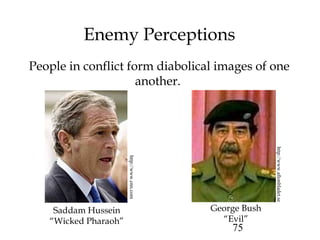
Enemy Perceptions
People in conflict form diabolical images of one
another.
George Bush
“Evil”
Saddam Hussein
“Wicked Pharaoh”
http://www.cnn.com
http://www.aftonbladet.se
76
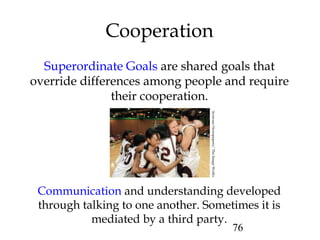
Superordinate Goals are shared goals that
override differences among people and require
their cooperation.
Cooperation
Communication and understanding developed
through talking to one another. Sometimes it is
mediated by a third party.
SyracuseNewspapers/TheImageWorks
77
Graduated & Reciprocated Initiatives in
Tension-Reduction (GRIT): This is a strategy
designed to decrease international tensions.
One side recognizes mutual interests and
initiates a small conciliatory act that opens the
door for reciprocation by the other party.
Communication

9e ch 18 social psych

  • 1.
    1 PSYCHOLOGY (9th Edition) David Myers PowerPointSlides Aneeq Ahmad Henderson State University Worth Publishers, © 2010
  • 2.
  • 3.
    3 Social Psychology Social Thinking Attributing Behavior to Persons or to Situations  Attitudes and Actions Social Influence  Conformity and Obedience  Group Influence  The Power of Individuals
  • 4.
    4 Social Relations  Prejudice Aggression  Attraction  Altruism  Conflict and Peacemaking
  • 5.
    5 Focuses in SocialPsychology Social psychology scientifically studies how we think about, influence, and relate to one another. “We cannot live for ourselves alone.” Herman Melville
  • 6.
    6 Social Thinking Social thinkinginvolves thinking about others, especially when they engage in doing things that are unexpected. 1. Does his absenteeism signify illness, laziness, or a stressful work atmosphere? 2. Was the horror of 9/11 the work of crazed evil people or ordinary people corrupted by life events?
  • 7.
    7 Attributing Behavior toPersons or to Situations Attribution Theory: Fritz Heider (1958) suggested that we have a tendency to give causal explanations for someone’s behavior, often by crediting either the situation or the person’s disposition. http://www.stedwards.edu Fritz Heider
  • 8.
    8 Attributing Behavior toPersons or to Situations A teacher may wonder whether a child’s hostility reflects an aggressive personality (dispositional attribution) or is a reaction to stress or abuse (a situational attribution). http://www.bootsnall.org Dispositions are enduring personality traits. So, if Joe is a quiet, shy, and introverted child, he is likely to be like that in a number of situations.
  • 9.
    9 Fundamental Attribution Error Thetendency to overestimate the impact of personal disposition and underestimate the impact of the situations in analyzing the behaviors of others leads to the fundamental attribution error. We see Joe as quiet, shy, and introverted most of the time, but with friends he is very talkative, loud, and extroverted.
  • 10.
    10 Effects of Attribution Howwe explain someone’s behavior affects how we react to it.
  • 11.
    11 Attitudes & Actions Abelief and feeling that predisposes a person to respond in a particular way to objects, other people, and events. If we believe a person is mean, we may feel dislike for the person and act in an unfriendly manner.
  • 12.
    12 Attitudes Can AffectActions Our attitudes predict our behaviors imperfectly because other factors, including the external situation, also influence behavior. Democratic leaders supported Bush’s attack on Iraq under public pressure. However, they had their private reservations.
  • 13.
    13 Actions Can AffectAttitudes Not only do people stand for what they believe in (attitude), they start believing in what they stand for. Cooperative actions can lead to mutual liking (beliefs). D.MacDonald/PhotoEdit
  • 14.
    14 Small Request –Large Request In the Korean War, Chinese communists solicited cooperation from US army prisoners by asking them to carry out small errands. By complying to small errands they were likely to comply to larger ones. Foot-in-the-Door Phenomenon: The tendency for people who have first agreed to a small request to comply later with a larger request.
  • 15.
    15 Role Playing AffectsAttitudes Zimbardo (1972) assigned the roles of guards and prisoners to random students and found that guards and prisoners developed role- appropriate attitudes. OriginallypublishedintheNewYorker PhillipG.Zimbardo,Inc.
  • 16.
    16 Actions Can AffectAttitudes Why do actions affect attitudes? One explanation is that when our attitudes and actions are opposed, we experience tension. This is called cognitive dissonance. To relieve ourselves of this tension we bring our attitudes closer to our actions (Festinger, 1957).
  • 17.
  • 18.
    18 Social Influence The greatestcontribution of social psychology is its study of attitudes, beliefs, decisions, and actions and the way they are molded by social influence. NONSEQUITER©2000Wiley.Dist.byUniversal PressSyndicateReprintedwithPermission
  • 19.
    19 Conformity & Obedience Behavioris contagious, modeled by one followed by another. We follow behavior of others to conform. Other behaviors may be an expression of compliance (obedience) toward authority. Conformity Obedience
  • 20.
    20 The Chameleon Effect Conformity:Adjusting one’s behavior or thinking to coincide with a group standard (Chartrand & Bargh, 1999).
  • 21.
    21 Group Pressure &Conformity Suggestibility is a subtle type of conformity, adjusting our behavior or thinking toward some group standard.
  • 22.
    22 Group Pressure &Conformity An influence resulting from one’s willingness to accept others’ opinions about reality. WilliamVandivert/ScientificAmerican
  • 23.
    23 Conditions that Strengthen Conformity 1.One is made to feel incompetent or insecure. 2. The group has at least three people. 3. The group is unanimous. 4. One admires the group’s status and attractiveness. 5. One has no prior commitment to a response. 6. The group observes one’s behavior. 7. One’s culture strongly encourages respect for a social standard.
  • 24.
    24 Reasons for Conforming NormativeSocial Influence: Influence resulting from a person’s desire to gain approval or avoid rejection. A person may respect normative behavior because there may be a severe price to pay if not respected. Informational Social Influence: The group may provide valuable information, but stubborn people will never listen to others.
  • 25.
    25 Obedience People comply tosocial pressures. How would they respond to outright command? Stanley Milgram designed a study that investigates the effects of authority on obedience. Stanley Milgram (1933-1984) CourtesyofCUNYGraduateSchoolandUniversityCenter
  • 26.
  • 27.
  • 28.
    28 Individual Resistance A thirdof the individuals in Milgram’s study resisted social coercion. An unarmed individual single-handedly challenged a line of tanks at Tiananmen Square. AP/WideWorldPhotos
  • 29.
    29 Lessons from theConformity and Obedience Studies In both Asch's and Milgram's studies, participants were pressured to choose between following their standards and being responsive to others. In Milgram’s study, participants were torn between hearing the victims pleas and the experimenter’s orders.
  • 30.
    30 Group Influence How dogroups affect our behavior? Social psychologists study various groups: 1. One person affecting another 2. Families 3. Teams 4. Committees
  • 31.
    31 Individual Behavior inthe Presence of Others Social facilitation: Refers to improved performance on tasks in the presence of others. Triplett (1898) noticed cyclists’ race times were faster when they competed against others than when they just raced against the clock. MichelleAgnis/NYTPictures
  • 32.
    32 Social Loafing The tendencyof an individual in a group to exert less effort toward attaining a common goal than when tested individually (Latané, 1981).
  • 33.
    33 Deindividuation The loss ofself-awareness and self-restraint in group situations that foster arousal and anonymity. Mob behavior
  • 34.
    34 Effects of GroupInteraction Group Polarization enhances a group’s prevailing attitudes through a discussion. If a group is like- minded, discussion strengthens its prevailing opinions and attitudes.
  • 35.
    35 Groupthink A mode ofthinking that occurs when the desire for harmony in a decision-making group overrides the realistic appraisal of alternatives. Attack on Pearl Harbor Kennedy and the Cuban Missile Crisis Watergate Cover-up Chernobyl Reactor Accident
  • 36.
    36 Power of Individuals Thepower of social influence is enormous, but so is the power of the individual. Non-violent fasts and appeals by Gandhi led to the independence of India from the British. Gandhi MargaretBourke-White/LifeMagazine.©1946TimeWarner,Inc.
  • 37.
    37 Social Relations Social psychologyteaches us how we relate to one another through prejudice, aggression, and conflict to attraction, and altruism and peacemaking.
  • 38.
    38 Prejudice Simply called “prejudgment,”a prejudice is an unjustifiable (usually negative) attitude toward a group and its members. Prejudice is often directed towards different cultural, ethnic, or gender groups. 1. Beliefs (stereotypes) 2. Emotions (hostility, envy, fear) 3. Predisposition to act (to discriminate) Components of Prejudice
  • 39.
    39 Reign of Prejudice Prejudiceworks at the conscious and [more at] the unconscious level. Therefore, prejudice is more like a knee-jerk response than a conscious decision.
  • 40.
    40 How Prejudiced arePeople? Over the duration of time many prejudices against interracial marriage, gender, homosexuality, and minorities have decreased.
  • 41.
    41 Racial & GenderPrejudice Americans today express much less racial and gender prejudice, but prejudices still exist.
  • 42.
    42 Race Nine out often white respondents were slow when responding to words like “peace” or “paradise” when they saw a black individual’s photo compared to a white individual’s photo (Hugenberg & Bodenhausen, 2003).
  • 43.
    43 Gender Most women stilllive in more poverty than men. About 100,000,000 women are missing in the world. There is a preference for male children in China and India, even with sex- selected abortion outlawed.
  • 44.
    44 Gender Although prejudice prevailsagainst women, more people feel positively toward women than men. Women rated picture b [feminized] higher (66%) for a matrimonial ad (Perrett & others, 1998). ProfessorDavePerrett,St.AndrewsUniversity
  • 45.
    45 Social Roots ofPrejudice Why does prejudice arise? 1. Social Inequalities 2. Social Divisions 3. Emotional Scapegoating
  • 46.
    46 Social Inequality Prejudice developswhen people have money, power, and prestige, and others do not. Social inequality increases prejudice.
  • 47.
    47 Us and Them Ingroup:People with whom one shares a common identity. Outgroup: Those perceived as different from one’s ingroup. Ingroup Bias: The tendency to favor one’s own group. Scotland’s famed “Tartan Army” fans.MikeHewitt/GettyImages
  • 48.
    48 Emotional Roots ofPrejudice Prejudice provides an outlet for anger [emotion] by providing someone to blame. After 9/11 many people lashed out against innocent Arab-Americans.
  • 49.
    49 Cognitive Roots ofPrejudice One way we simplify our world is to categorize. We categorize people into groups by stereotyping them. Foreign sunbathers may think Balinese look alike. MichaelS.Yamashita/WoodfinCampAssociates
  • 50.
    50 Cognitive Roots ofPrejudice In vivid cases such as the 9/11 attacks, terrorists can feed stereotypes or prejudices (terrorism). Most terrorists are non-Muslims.
  • 51.
    51 Cognitive Roots ofPrejudice The tendency of people to believe the world is just, and people get what they deserve and deserve what they get (the just-world phenomenon). ©TheNewYorkerCollection,1981,RobertMankofffromcartoonbank.com.AllRightsReserved.
  • 52.
    52 Hindsight Bias After learningan outcome, the tendency to believe that we could have predicted it beforehand may contribute to blaming the victim and forming a prejudice against them.
  • 53.
    53 Aggression Aggression can beany physical or verbal behavior intended to hurt or destroy. It may be done reactively out of hostility or proactively as a calculated means to an end. Research shows that aggressive behavior emerges from the interaction of biology and experience.
  • 54.
    54 The Biology ofAggression Three biological influences on aggressive behavior are: 1. Genetic Influences 2. Neural Influences 3. Biochemical Influences
  • 55.
    55 Influences Genetic Influences: Animalshave been bred for aggressiveness for sport and at times for research. Twin studies show aggression may be genetic. In men, aggression is possibly linked to the Y chromosome. Neural Influences: Some centers in the brain, especially the limbic system (amygdala) and the frontal lobe, are intimately involved with aggression.
  • 56.
    56 Influences Biochemical Influences: Animalswith diminished amounts of testosterone (castration) become docile, and if injected with testosterone aggression increases. Prenatal exposure to testosterone also increases aggression in female hyenas.
  • 57.
    57 The Psychology ofAggression Four psychological factors that influence aggressive behavior are: 1. dealing with aversive events; 2. learning aggression is rewarding; 3. observing models of aggression; and 4. acquiring social scripts.
  • 58.
    58 Aversive Events Studies inwhich animals and humans experience unpleasant events reveal that those made miserable often make others miserable. Ron Artest (Pacers) attack on Detroit Pistons fans.JeffKowalsky/EPA/Landov
  • 59.
    59 Environment Even environmental temperaturecan lead to aggressive acts. Murders and rapes increased with the temperature in Houston.
  • 60.
    60 Frustration-Aggression Principle A principlein which frustration (caused by the blocking of an attempt to achieve a desired goal) creates anger, which can generate aggression.
  • 61.
    61 Learning that Aggressionis Rewarding When aggression leads to desired outcomes, one learns to be aggressive. This is shown in both animals and humans. Cultures that favor violence breed violence. Scotch-Irish settlers in the South had more violent tendencies than their Puritan, Quaker, & Dutch counterparts in the Northeast of the US.
  • 62.
    62 Observing Models ofAggression Sexually coercive men are promiscuous and hostile in their relationships with women. This coerciveness has increased due to television viewing of R- and X-rated movies.
  • 63.
    63 Acquiring Social Scripts Themedia portrays social scripts and generates mental tapes in the minds of the viewers. When confronted with new situations individuals may rely on such social scripts. If social scripts are violent in nature, people may act them out.
  • 64.
    64 Do Video GamesTeach or Release Violence? The general consensus on violent video games is that, to some extent, they breed violence. Adolescents view the world as hostile when they get into arguments and receive bad grades after playing such games.
  • 65.
  • 66.
    66 The Psychology ofAttraction 1. Proximity: Geographic nearness is a powerful predictor of friendship. Repeated exposure to novel stimuli increases their attraction (mere exposure effect). A rare white penguin born in a zoo was accepted after 3 weeks by other penguins just due to proximity. RexUSA
  • 67.
    67 Psychology of Attraction 2.Physical Attractiveness: Once proximity affords contact, the next most important thing in attraction is physical appearance. BrooksKraft/Corbis BrooksKraft/Corbis
  • 68.
    68 Psychology of Attraction 3.Similarity: Similar views among individuals causes the bond of attraction to strengthen. Similarity breeds content!
  • 69.
    69 Romantic Love Passionate Love:An aroused state of intense positive absorption in another, usually present at the beginning of a love relationship. 1. Physical arousal plus cognitive appraisal 2. Arousal from any source can enhance one emotion depending upon what we interpret or label the arousal Two-factor theory of emotion
  • 70.
    70 Romantic Love Companionate Love:A deep, affectionate attachment we feel for those with whom our lives are intertwined. CourtshipandMatrimony(fromthecollectionofWernerNekes)
  • 71.
    71 An unselfish regardfor the welfare of others. Altruism Equity: A condition in which people receive from a relationship in proportion to what they give. Self-Disclosure: Revealing intimate aspects of oneself to others.
  • 72.
    72 Bystander Intervention The decision-makingprocess for bystander intervention. AkosSzilvasi/Stock,Boston
  • 73.
    73 Bystander Effect Tendency ofany given bystander to be less likely to give aid if other bystanders are present.
  • 74.
    74 Conflict Conflict is perceivedas an incompatibility of actions, goals, or ideas. The elements of conflict are the same at all levels. People become deeply involved in potentially destructive social processes that have undesirable effects.
  • 75.
    75 Enemy Perceptions People inconflict form diabolical images of one another. George Bush “Evil” Saddam Hussein “Wicked Pharaoh” http://www.cnn.com http://www.aftonbladet.se
  • 76.
    76 Superordinate Goals areshared goals that override differences among people and require their cooperation. Cooperation Communication and understanding developed through talking to one another. Sometimes it is mediated by a third party. SyracuseNewspapers/TheImageWorks
  • 77.
    77 Graduated & ReciprocatedInitiatives in Tension-Reduction (GRIT): This is a strategy designed to decrease international tensions. One side recognizes mutual interests and initiates a small conciliatory act that opens the door for reciprocation by the other party. Communication

Editor's Notes

  • #8 Preview Question 1: How do we tend to explain others’ behavior and our own?
  • #12 Preview Question 2: Does what we think predict what we do, or does what we do affect what we think?
  • #20 Preview Question 3: What do experiments on conformity and compliance reveal about the power of social influence?
  • #31 Preview Question 4: How is our behavior affected by the presence of others or by being part of a group?
  • #35 Preview Question 5: What are group polarization and groupthink?
  • #37 Preview Question 6: How much power do we have as individuals? Can a minority sway a majority?
  • #46 Preview Question 7: What is prejudice?
  • #49 Preview Question 8: What are the social and emotional roots of prejudice?
  • #50 Preview Question 9: What are the cognitive roots of prejudice?
  • #55 Preview Question 10: What biological factors make us more prone to hurt one another?
  • #58 Preview Question 11: What psychological factors may trigger aggressive behavior?
  • #67 Preview Question 12: Why do we befriend or fall in love with some people but not with others?
  • #70 Preview Question 13: How does romantic love typically change as time passes?
  • #72 Preview Question 14: When are we most—and least—likely to help?
  • #75 Preview Question 15: How do social traps and mirror-image perceptions fuel social conflict?
  • #77 Preview Question 16: How can we transform feelings of prejudice, aggression, and conflict into attitudes that promote peace?