Social Learning Theory Albert Bandura
General Principles People can learn by observing the behavior of others Learning can occur without a change in behavior Cognition plays a role in learning Behaviorist Learning Theories=Social Learning Theories=Cognitive Learning Theories
Environmental Reinforcement  Observer reinforced by the model Observer reinforced by a third person Imitated behavior itself is reinforcing Vicarious reinforcement
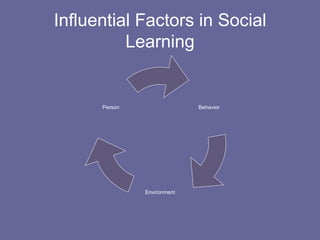
Influential Factors in Social Learning Behavior Environment Person
Reinforcement and Punishment Have an indirect effect on learning Influence extent to which individual exhibits a behavior Expectation of reinforcement influences cognitive processes that promote learning
Cognitive Factors in Social Learning Attention is a critical factor in learning Expectations about the consequences of future behaviors Can model from live or symbolic model Can learn without performance
Behaviors Learned? Many behaviors can be learned through modeling such as: Moral Behavior Aggression Caring
Conditions Necessary for Modeling to Occur Attention Retention Motor Reproduction Motivation
Effect of Modeling on Behavior Teaches new behaviors Influences frequency of previously learned behaviors Encourages previously forbidden behaviors Increases frequency of similar behaviors
Self-Efficacy More likely to engage in behaviors they believe they are capable of executing successfully More likely to put more effort in activities and behaviors they consider to be successful in achieving The higher the self-efficacy the better the student’s achievement
Self Regulation Teach person to reward himself after doing the needed behavior
Implications You can learn a great deal by observing others Describing the consequences can effectively increase/decrease behaviors Provides a faster more efficient means for teaching a new behavior Authority figures must model appropriate behaviors Should be exposed to a variety of models Work on developing self-efficacy Set realistic expectations
Research Use of a training program to enhance NICU nurses’ cognitive abilities for assessing preterm infant behaviors and offering supportive interventions
Process Used videotaped and personalized instruction to increase nurses’ cognitive abilities for assessing preterm infant behavioral signals and offering supportive care. Pre-test post-test quasi-experimental design 25 NICU nurses; intervention/control groups
Evaluation Video test questionnaire The increase in nurses’ cognitive abilities is the prerequisite for behavioral change, based on the assumptions of Bandura’s Social Cognitive Learning Theory.
The End ??????

Social Learning Theory

  • 1.
    Social Learning TheoryAlbert Bandura
  • 2.
    General Principles Peoplecan learn by observing the behavior of others Learning can occur without a change in behavior Cognition plays a role in learning Behaviorist Learning Theories=Social Learning Theories=Cognitive Learning Theories
  • 3.
    Environmental Reinforcement Observer reinforced by the model Observer reinforced by a third person Imitated behavior itself is reinforcing Vicarious reinforcement
  • 4.
    Influential Factors inSocial Learning Behavior Environment Person
  • 5.
    Reinforcement and PunishmentHave an indirect effect on learning Influence extent to which individual exhibits a behavior Expectation of reinforcement influences cognitive processes that promote learning
  • 6.
    Cognitive Factors inSocial Learning Attention is a critical factor in learning Expectations about the consequences of future behaviors Can model from live or symbolic model Can learn without performance
  • 7.
    Behaviors Learned? Manybehaviors can be learned through modeling such as: Moral Behavior Aggression Caring
  • 8.
    Conditions Necessary forModeling to Occur Attention Retention Motor Reproduction Motivation
  • 9.
    Effect of Modelingon Behavior Teaches new behaviors Influences frequency of previously learned behaviors Encourages previously forbidden behaviors Increases frequency of similar behaviors
  • 10.
    Self-Efficacy More likelyto engage in behaviors they believe they are capable of executing successfully More likely to put more effort in activities and behaviors they consider to be successful in achieving The higher the self-efficacy the better the student’s achievement
  • 11.
    Self Regulation Teachperson to reward himself after doing the needed behavior
  • 12.
    Implications You canlearn a great deal by observing others Describing the consequences can effectively increase/decrease behaviors Provides a faster more efficient means for teaching a new behavior Authority figures must model appropriate behaviors Should be exposed to a variety of models Work on developing self-efficacy Set realistic expectations
  • 13.
    Research Use ofa training program to enhance NICU nurses’ cognitive abilities for assessing preterm infant behaviors and offering supportive interventions
  • 14.
    Process Used videotapedand personalized instruction to increase nurses’ cognitive abilities for assessing preterm infant behavioral signals and offering supportive care. Pre-test post-test quasi-experimental design 25 NICU nurses; intervention/control groups
  • 15.
    Evaluation Video testquestionnaire The increase in nurses’ cognitive abilities is the prerequisite for behavioral change, based on the assumptions of Bandura’s Social Cognitive Learning Theory.
  • 16.