SocioculturalTheory
principles
Lev Vygotsky
MA. JOVELYN R. CANENET
MAT - English
Sociocultural theory grew from the work of
influential psychologist Lev Vygotsky, who
believed that parents, caregivers, peers, and the
culture at large were responsible for
developing higher order functions.
3 main principles
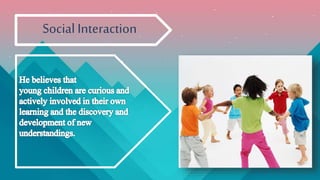
• Social Interaction
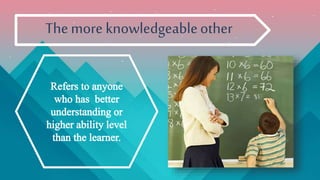
• The More Knowledgeable Other
• Zone of Proximal Development
SocialInteraction
SocialInteraction
Themore knowledgeableother
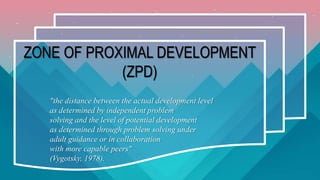
ZONE OF PROXIMAL DEVELOPMENT
(ZPD)
"the distance between the actual development level
as determined by independent problem
solving and the level of potential development
as determined through problem solving under
adult guidance or in collaboration
with more capable peers"
(Vygotsky, 1978).
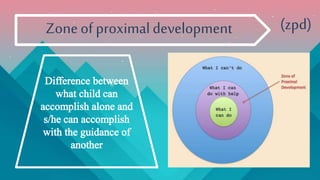
Zoneof proximaldevelopment (zpd)
Zoneof proximaldevelopment
Vygotsky sees
the ZPD as the area
where the most
sensitive instruction
or guidance should be
given, allowing the child to
develop skills they will then
use on their own,
developing higher mental
functions.
(zpd)
Zoneof proximaldevelopment
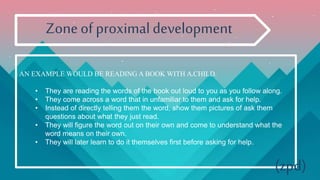
AN EXAMPLE WOULD BE READING A BOOK WITH A CHILD.
• They are reading the words of the book out loud to you as you follow along.
• They come across a word that in unfamiliar to them and ask for help.
• Instead of directly telling them the word, show them pictures of ask them
questions about what they just read.
• They will figure the word out on their own and come to understand what the
word means on their own.
• They will later learn to do it themselves first before asking for help.
(zpd)
Two Features of zpd
SCAFFOLDING
Appropriate assistance given by
the teacher to assist the learner
accomplish a task.
Two Features of zpd
SCAFFOLDING
Requires that an instructor shows example how to solve a
problem, while controlling the learning environment so that
students can take things step by step expanding their
knowledge without excessive frustration.
Two Features of zpd
RECIPROCAL TEACHING
A highly successful teaching method, it provides
an environment of open dialogue between student
and teacher which goes beyond a simple question
and answer session.
INTO THE CLASSROOM
• Peer to peer
• Parents/family
• Community
Teacher’s Role:
Identify goals that students need to meet and what work needs to be
accomplished. Provide higher level of assistance than peers who are able
demonstrate understanding.
Teacher’s Role:
Use the resource of family to help students attain their educational goals. Use
these members as the more competent individuals to assist the students,
thereby increasing their ZPD. Again, this fits into Vygotsky’s theory because it
utilizes the student’s strongest connection, that of family, to create scaffolding
that the student can build on to meet the identified goals. For ELLs, they are
also able to learn in their primary language.
• Bringing community members into the class introduces students
to a larger “family” than what they find when they go home.
• Accomplishes many of the same objectives as formal family
members, but provides extra scaffolding.
• Introduces students to new ways of thinking and problem solving
Teacher’s Role:
The same as utilizing formal family members.
1) Children construct their knowledge.
2) Development cannot be separated from its social
context.
3) Learning is mediated.
4) Language plays a central role in mental development.
CONCLUSION
 Sociocultural theory considers learning as a semiotic process
where participation in socially-mediated activities is essential.
 Social interaction emphasized that effective learning happens
through participation in social activities, making the social
context of learning crucial.
 Vgotsky theory was important in education since these works
provide tools for the development of individuals learning.
REFERENCES
 http://www.ceebl.manchester.ac.uk/events/archive/aligningcollaborati
velearning/Vygotsky.pdf
 https://www.simplypsychology.org/Zone-of-Proximal-
Development.html
 https://www.verywell.com/what-is-sociocultural-theory-2795088
© 2017

Sociocultural Theory in Reading

  • 1.
  • 2.
    Sociocultural theory grewfrom the work of influential psychologist Lev Vygotsky, who believed that parents, caregivers, peers, and the culture at large were responsible for developing higher order functions.
  • 3.
    3 main principles •Social Interaction • The More Knowledgeable Other • Zone of Proximal Development
  • 4.
  • 5.
  • 6.
  • 7.
    ZONE OF PROXIMALDEVELOPMENT (ZPD) "the distance between the actual development level as determined by independent problem solving and the level of potential development as determined through problem solving under adult guidance or in collaboration with more capable peers" (Vygotsky, 1978).
  • 8.
  • 9.
    Zoneof proximaldevelopment Vygotsky sees theZPD as the area where the most sensitive instruction or guidance should be given, allowing the child to develop skills they will then use on their own, developing higher mental functions. (zpd)
  • 10.
    Zoneof proximaldevelopment AN EXAMPLEWOULD BE READING A BOOK WITH A CHILD. • They are reading the words of the book out loud to you as you follow along. • They come across a word that in unfamiliar to them and ask for help. • Instead of directly telling them the word, show them pictures of ask them questions about what they just read. • They will figure the word out on their own and come to understand what the word means on their own. • They will later learn to do it themselves first before asking for help. (zpd)
  • 11.
    Two Features ofzpd SCAFFOLDING Appropriate assistance given by the teacher to assist the learner accomplish a task.
  • 12.
    Two Features ofzpd SCAFFOLDING Requires that an instructor shows example how to solve a problem, while controlling the learning environment so that students can take things step by step expanding their knowledge without excessive frustration.
  • 13.
    Two Features ofzpd RECIPROCAL TEACHING A highly successful teaching method, it provides an environment of open dialogue between student and teacher which goes beyond a simple question and answer session.
  • 14.
    INTO THE CLASSROOM •Peer to peer • Parents/family • Community
  • 15.
    Teacher’s Role: Identify goalsthat students need to meet and what work needs to be accomplished. Provide higher level of assistance than peers who are able demonstrate understanding.
  • 16.
    Teacher’s Role: Use theresource of family to help students attain their educational goals. Use these members as the more competent individuals to assist the students, thereby increasing their ZPD. Again, this fits into Vygotsky’s theory because it utilizes the student’s strongest connection, that of family, to create scaffolding that the student can build on to meet the identified goals. For ELLs, they are also able to learn in their primary language.
  • 17.
    • Bringing communitymembers into the class introduces students to a larger “family” than what they find when they go home. • Accomplishes many of the same objectives as formal family members, but provides extra scaffolding. • Introduces students to new ways of thinking and problem solving Teacher’s Role: The same as utilizing formal family members.
  • 18.
    1) Children constructtheir knowledge. 2) Development cannot be separated from its social context. 3) Learning is mediated. 4) Language plays a central role in mental development.
  • 19.
    CONCLUSION  Sociocultural theoryconsiders learning as a semiotic process where participation in socially-mediated activities is essential.  Social interaction emphasized that effective learning happens through participation in social activities, making the social context of learning crucial.  Vgotsky theory was important in education since these works provide tools for the development of individuals learning.
  • 20.

Editor's Notes

  • #2 Sociocultural theory focuses not only how adults and peers influence individual learning, but also on how cultural beliefs and attitudes impact how instruction and learning take place.
  • #7 This individual is someone who has a higher level of knowledge than the learner. It is the more knowledgeable other who provides the critical guidance and instruction during the sensitive learning period. While a child might not yet be capable of doing something on their own, they are able to perform the task with the assistance of a skilled instructor.
  • #8 For example: Teachers, Other adults, Advanced students, sometimes even computers.
  • #9 For example: Teachers, Other adults, Advanced students, sometimes even computers.
  • #10 For example: Teachers, Other adults, Advanced students, sometimes even computers.
  • #11 For example: Teachers, Other adults, Advanced students, sometimes even computers.
  • #12 When children are in this zone of proximal development, providing them with the appropriate assistance and tools, which he referred to as scaffolding, gives the student what they need to accomplish the new task or skill. Eventually, the scaffolding can be removed and the student will be able to complete the task independently.
  • #13 For example: Teachers, Other adults, Advanced students, sometimes even computers.
  • #14 For example: Teachers, Other adults, Advanced students, sometimes even computers.
  • #15 For example: Teachers, Other adults, Advanced students, sometimes even computers.
  • #16 For example: Teachers, Other adults, Advanced students, sometimes even computers.
  • #17 For example: Teachers, Other adults, Advanced students, sometimes even computers.
  • #18 For example: Teachers, Other adults, Advanced students, sometimes even computers.
  • #19 For example: Teachers, Other adults, Advanced students, sometimes even computers.
  • #20 For example: Teachers, Other adults, Advanced students, sometimes even computers.
  • #21 For example: Teachers, Other adults, Advanced students, sometimes even computers.