Chapter 13
Legal Reporting Requirements


                               2
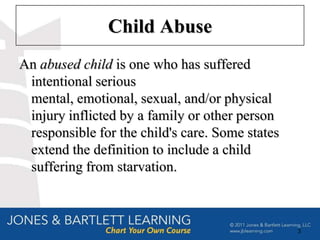
Child Abuse
An abused child is one who has suffered
 intentional serious
 mental, emotional, sexual, and/or physical
 injury inflicted by a family or other person
 responsible for the child's care. Some states
 extend the definition to include a child
 suffering from starvation.


                                                 3
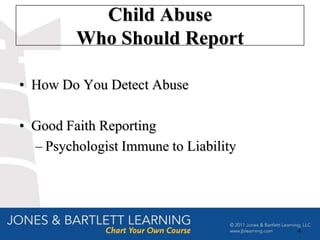
Child Abuse
         Who Should Report

• How Do You Detect Abuse

• Good Faith Reporting
  – Psychologist Immune to Liability


                                       4
Child Abuse – III
• Failure to Report Child Abuse
  – Psychologist’s Failure to Report Abuse

  – Nurse’s Failure to Document and Report

  – Physician Entitled to Immunity


                                             5
Elder Abuse
Elder abuse is any form of mistreatment that
  results in harm or loss to an older person. It
  can involve:
  –   physical abuse
  –   sexual abuse
  –   domestic violence
  –   psychological abuse
  –   financial abuse
  –   neglect: failure to provide needed care
                                                   6
National Center on Elder Abuse
The National Center on Elder Abuse
(NCEA), directed by the U.S. Administration
on Aging, is committed to helping
national, state, and local partners in the field be
fully prepared to ensure that older Americans
will live with
dignity, integrity, independence, and without
abuse, neglect, and exploitation.


                                                  7
Signs of Elder Abuse – I

• Unexplained or unexpected death
• Development of "pressure sores“
• Heavy medication & sedation used in place of
  adequate nursing staff
• Occurrence of broken bones
• Sudden emotional outbursts, agitation, or
  withdrawal


                                                 8
Signs of Abuse – II

• Bruises, welts, discoloration, burns, and so
  on
• Absence of hair and/or hemorrhaging below
  scalp
• Dehydration/malnourishment without illness
  related cause
• Hesitation to talk openly
• Implausible stories


                                             9
Signs of Abuse – III

• Unusual or inappropriate activity in bank
  accounts
• Signatures on checks & other written
  materials that do not resemble patient's
  signature
• Power of attorney given, or recent changes
  or creation of a will, when person is
  incapable of making such decisions


                                               10
Elder Abuse
          Signs of Abuse – IV
• Missing personal belongings such as
  silverware or jewelry
• An untreated medical condition
• Patient unable to speak for himself or
  herself, or see others, without presence of
  caregiver (suspected abuser)


                                                11
Preventing Abuse
          Policies & Procedures
• Prohibition of mistreatment
• Description of reporting procedures regarding
  alleged abuse
• Maintenance of evidence of alleged abuse
• Investigation of alleged abuse, & prevention of
  further potential abuse while investigation is in
  progress.


                                                  12
Elder Abuse
                Documentation – I
• Suspected abuse should be defined clearly &
  objectively.
   – Witnesses: Reporters of abuse must describe
     statements made by others as accurately as
     possible
      • what actions were taken, by
        whom, when, where, etc.
      • Info should be included about how witnesses
        may be contacted.


                                                      13
Elder Abuse
          Documentation – II
Photographs: It may be necessary to
 photograph wounds or injuries.
  • hospital emergency room or the police
    department can be asked to photograph in
    emergency situations.


                                           14
Communicable Diseases
• Reported to protect citizens from infectious
  diseases
• Reporting required by statutes


                                                 15
Births & Deaths

• Reportable by statute
• Necessary to maintain accurate census records


                                              16
Suspicious Deaths
• Referral to medical examiner
     • Violent deaths
     • Criminal activity

• Medical Examiner
    • Determines cause of death
    • Provides information for criminal
      investigation

                                          17
Health Care Quality Improvement Act
              of 1986

 Authorizes the National Practitioner Data
 Bank to collect & release information on the
 professional competence & conduct of health
 care practitioners.


                                                18
National Practitioner Data Bank - I

• Reporting requirements
• Required queries
• Required Report
• Data Bank Queries


                                       19
National Practitioner Data Bank - II

• Query Fees
• Data bank fees
• Penalties for failing to report
• Confidentiality of data bank information


                                             20
Incident Reporting
• Incident/Occurrence Reports Discoverable
• State Reportable Incidents
   – Incidents that have resulted in a patient’s serious
     injury or death
   – events such as fire, loss of emergency
     power, infection outbreaks, & strikes by
     employees.
• Incident reports should not be placed in the medical
  record.

                                                           21
Sentinel Events - I
• Joint Commission Reportable “sentinel events”
  include:
   – Events that result in
      • unanticipated death
      • major permanent loss of function


                                                  22
Sentinel Events - II
•   Suicide
•   Unanticipated death of a full term infant
•   Infant abduction
•   Rape
•   Hemolytic transfusion reaction
•   Surgery on the wrong patient or wrong body part


                                                      23
Root Cause Analysis – I

A process for identifying the basic or causal
factors that underlie the variation in
performance including the occurrence or
possible occurrence of a sentinel event.


                                                24
Root Cause Analysis – II
• Thorough
• Credible
• Investigation involves general & special
  causes
• Researching literature
• Searching for best practices
• . . . implementing & monitoring change


                                             25
Corporate Compliance Programs

Federal government’s initiative to investigate
& prosecute health care corporations for
criminal wrongdoing . . .


                                                 26
Elements of a Corporate Compliance
               Program
1.   Establishment of policies & procedures
2.   Appointment of a corporate compliance officer
3.   Communication of program to employees
4.   Implementation of program
5.   Consistent enforcement
6.   Provide for disciplinary action
7.   Modify compliance program as necessary


                                                     27
REVIEW QUESTIONS
1. What is child abuse?
2. Who should report child abuse?
3. Describe the signs of elder abuse.
4. Why was the Health Care Quality Improvement
Act of 1986 enacted?
5. Describe the purpose of the National
Practitioner Data Bank.


                                             28
REVIEW QUESTIONS, cont.
6. What is a sentinel event?

7. Discuss the process of conducting a root-cause
analysis.

8. Describe the basic elements of an effective
corporate compliance program.


                                                    29

5530: Chapter 13

  • 2.
  • 3.
    Child Abuse An abusedchild is one who has suffered intentional serious mental, emotional, sexual, and/or physical injury inflicted by a family or other person responsible for the child's care. Some states extend the definition to include a child suffering from starvation. 3
  • 4.
    Child Abuse Who Should Report • How Do You Detect Abuse • Good Faith Reporting – Psychologist Immune to Liability 4
  • 5.
    Child Abuse –III • Failure to Report Child Abuse – Psychologist’s Failure to Report Abuse – Nurse’s Failure to Document and Report – Physician Entitled to Immunity 5
  • 6.
    Elder Abuse Elder abuseis any form of mistreatment that results in harm or loss to an older person. It can involve: – physical abuse – sexual abuse – domestic violence – psychological abuse – financial abuse – neglect: failure to provide needed care 6
  • 7.
    National Center onElder Abuse The National Center on Elder Abuse (NCEA), directed by the U.S. Administration on Aging, is committed to helping national, state, and local partners in the field be fully prepared to ensure that older Americans will live with dignity, integrity, independence, and without abuse, neglect, and exploitation. 7
  • 8.
    Signs of ElderAbuse – I • Unexplained or unexpected death • Development of "pressure sores“ • Heavy medication & sedation used in place of adequate nursing staff • Occurrence of broken bones • Sudden emotional outbursts, agitation, or withdrawal 8
  • 9.
    Signs of Abuse– II • Bruises, welts, discoloration, burns, and so on • Absence of hair and/or hemorrhaging below scalp • Dehydration/malnourishment without illness related cause • Hesitation to talk openly • Implausible stories 9
  • 10.
    Signs of Abuse– III • Unusual or inappropriate activity in bank accounts • Signatures on checks & other written materials that do not resemble patient's signature • Power of attorney given, or recent changes or creation of a will, when person is incapable of making such decisions 10
  • 11.
    Elder Abuse Signs of Abuse – IV • Missing personal belongings such as silverware or jewelry • An untreated medical condition • Patient unable to speak for himself or herself, or see others, without presence of caregiver (suspected abuser) 11
  • 12.
    Preventing Abuse Policies & Procedures • Prohibition of mistreatment • Description of reporting procedures regarding alleged abuse • Maintenance of evidence of alleged abuse • Investigation of alleged abuse, & prevention of further potential abuse while investigation is in progress. 12
  • 13.
    Elder Abuse Documentation – I • Suspected abuse should be defined clearly & objectively. – Witnesses: Reporters of abuse must describe statements made by others as accurately as possible • what actions were taken, by whom, when, where, etc. • Info should be included about how witnesses may be contacted. 13
  • 14.
    Elder Abuse Documentation – II Photographs: It may be necessary to photograph wounds or injuries. • hospital emergency room or the police department can be asked to photograph in emergency situations. 14
  • 15.
    Communicable Diseases • Reportedto protect citizens from infectious diseases • Reporting required by statutes 15
  • 16.
    Births & Deaths •Reportable by statute • Necessary to maintain accurate census records 16
  • 17.
    Suspicious Deaths • Referralto medical examiner • Violent deaths • Criminal activity • Medical Examiner • Determines cause of death • Provides information for criminal investigation 17
  • 18.
    Health Care QualityImprovement Act of 1986 Authorizes the National Practitioner Data Bank to collect & release information on the professional competence & conduct of health care practitioners. 18
  • 19.
    National Practitioner DataBank - I • Reporting requirements • Required queries • Required Report • Data Bank Queries 19
  • 20.
    National Practitioner DataBank - II • Query Fees • Data bank fees • Penalties for failing to report • Confidentiality of data bank information 20
  • 21.
    Incident Reporting • Incident/OccurrenceReports Discoverable • State Reportable Incidents – Incidents that have resulted in a patient’s serious injury or death – events such as fire, loss of emergency power, infection outbreaks, & strikes by employees. • Incident reports should not be placed in the medical record. 21
  • 22.
    Sentinel Events -I • Joint Commission Reportable “sentinel events” include: – Events that result in • unanticipated death • major permanent loss of function 22
  • 23.
    Sentinel Events -II • Suicide • Unanticipated death of a full term infant • Infant abduction • Rape • Hemolytic transfusion reaction • Surgery on the wrong patient or wrong body part 23
  • 24.
    Root Cause Analysis– I A process for identifying the basic or causal factors that underlie the variation in performance including the occurrence or possible occurrence of a sentinel event. 24
  • 25.
    Root Cause Analysis– II • Thorough • Credible • Investigation involves general & special causes • Researching literature • Searching for best practices • . . . implementing & monitoring change 25
  • 26.
    Corporate Compliance Programs Federalgovernment’s initiative to investigate & prosecute health care corporations for criminal wrongdoing . . . 26
  • 27.
    Elements of aCorporate Compliance Program 1. Establishment of policies & procedures 2. Appointment of a corporate compliance officer 3. Communication of program to employees 4. Implementation of program 5. Consistent enforcement 6. Provide for disciplinary action 7. Modify compliance program as necessary 27
  • 28.
    REVIEW QUESTIONS 1. Whatis child abuse? 2. Who should report child abuse? 3. Describe the signs of elder abuse. 4. Why was the Health Care Quality Improvement Act of 1986 enacted? 5. Describe the purpose of the National Practitioner Data Bank. 28
  • 29.
    REVIEW QUESTIONS, cont. 6.What is a sentinel event? 7. Discuss the process of conducting a root-cause analysis. 8. Describe the basic elements of an effective corporate compliance program. 29