Chapter 14
Patient Rights & Responsibilities


                                    2
Patient Self-Determination Act

• Protection of a patient’s right to make
  decisions.
• Organizations required to observe, protect &
  promote patient rights.


                                                 3
Patient Rights – I
• Admission
  – Discrimination Prohibited
  – Government Facilities

• Timely Response to Care Needs

• Know One’s Rights
  – Bill of Rights


                                  4
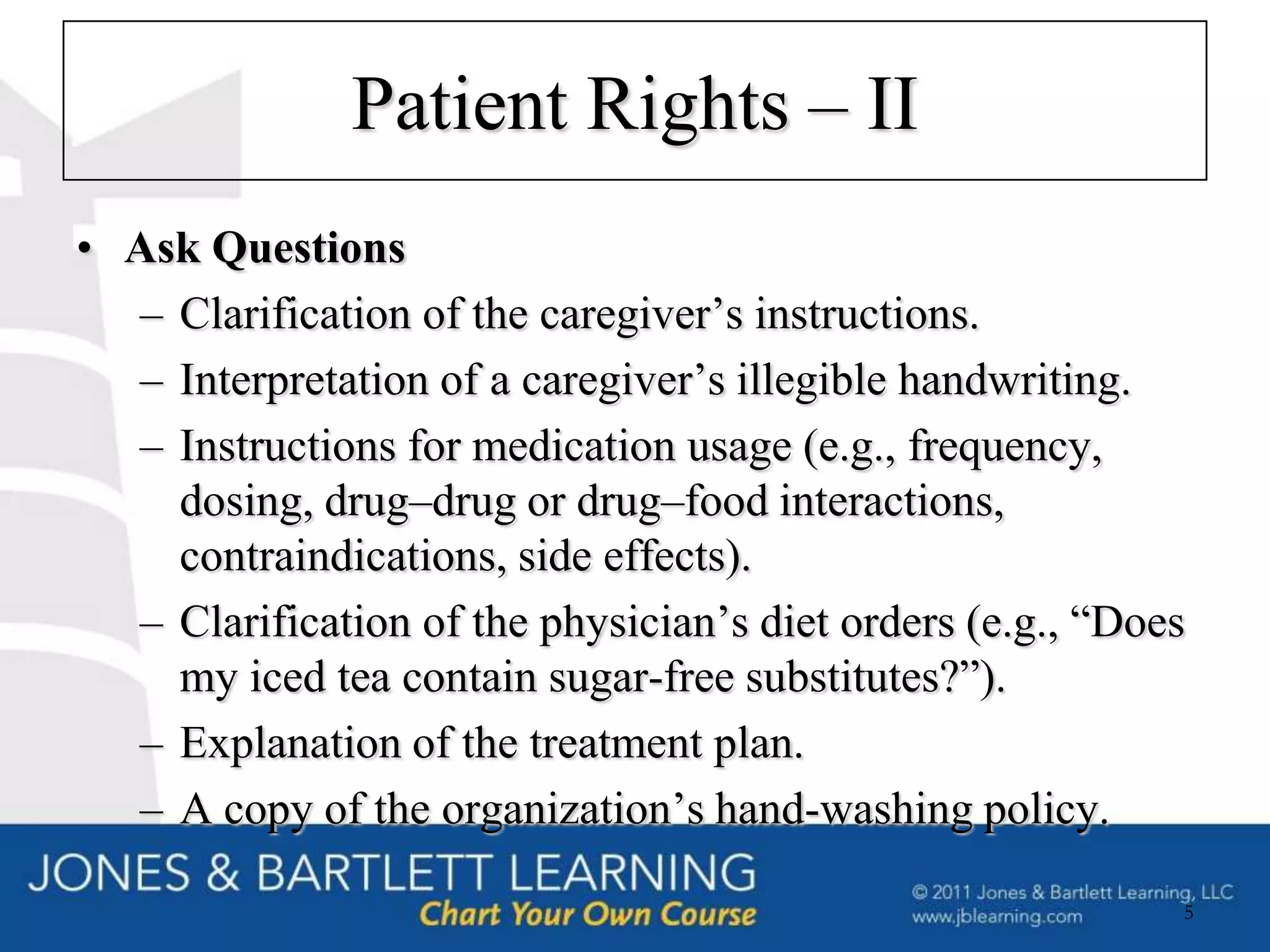
Patient Rights – II
• Ask Questions
  – Clarification of the caregiver’s instructions.
  – Interpretation of a caregiver’s illegible handwriting.
  – Instructions for medication usage (e.g., frequency,
    dosing, drug–drug or drug–food interactions,
    contraindications, side effects).
  – Clarification of the physician’s diet orders (e.g., “Does
    my iced tea contain sugar-free substitutes?”).
  – Explanation of the treatment plan.
  – A copy of the organization’s hand-washing policy.

                                                            5
Patient Rights – III
• A description of the hospital’s procedures to
  prevent wrong site surgery (e.g., the surgical site
  has been appropriately marked).
• The surgeon to draw an arrow pointing to the
  surgical site if a surgical site cannot be directly
  marked.
• The opportunity to provide the organization with a
  copy of any advance directives that may have been
  executed (e.g., living will).


                                                    6
Patient Rights – IV
• The right to appoint a surrogate decision maker
  should they become incapacitated.
• A second opinion.
• The opportunity to provide the organization with a
  copy of any advance directives that may have been
  executed (e.g., living will)
Patient Rights – V
•   clarification of diet orders
•   explanation of treatment plan
•   organization’s hand-washing policy
•   know procedures to prevent wrong site surgery
     • surgical site has been marked


                                                    8
Patient Rights – VI
•   Explanation of Rights
•   Know Hospital’s Adverse Events
•   Know Caregivers
•   Know 3rd Party Relationships
•   Participate in Care Decisions


                                     9
Patient Rights – VII
•   Informed Consent
•   Emergency Care
•   Have Special Needs Addressed
•   Compassionate Care
•   Timely Response to Care Needs


                                    10
Patient Rights – VIII
• Pain Management
   – describe location & severity of pain
   – discuss pain relief treatment options
   – work with health care caregivers to develop
     treatment plans
   – discuss concerns about taking pain medication/s.
   – alert caregivers of any allergies


                                                        11
Patient Rights – IX
• Pain Management, cont.
     – learn side effects associated with pain
       management
     – maintain record of effects of medications or
       other pain relief measures
     – participate in setting pain control goals
     – provide caregivers with info about pain control
       methods that have worked, or not worke
Patient Rights – X
• Refuse Treatment
   – Right to Refuse Blood Transfusion
• Access to Medical Records
• Execute Advance Directives
• Designate a Decision-Maker


                                         13
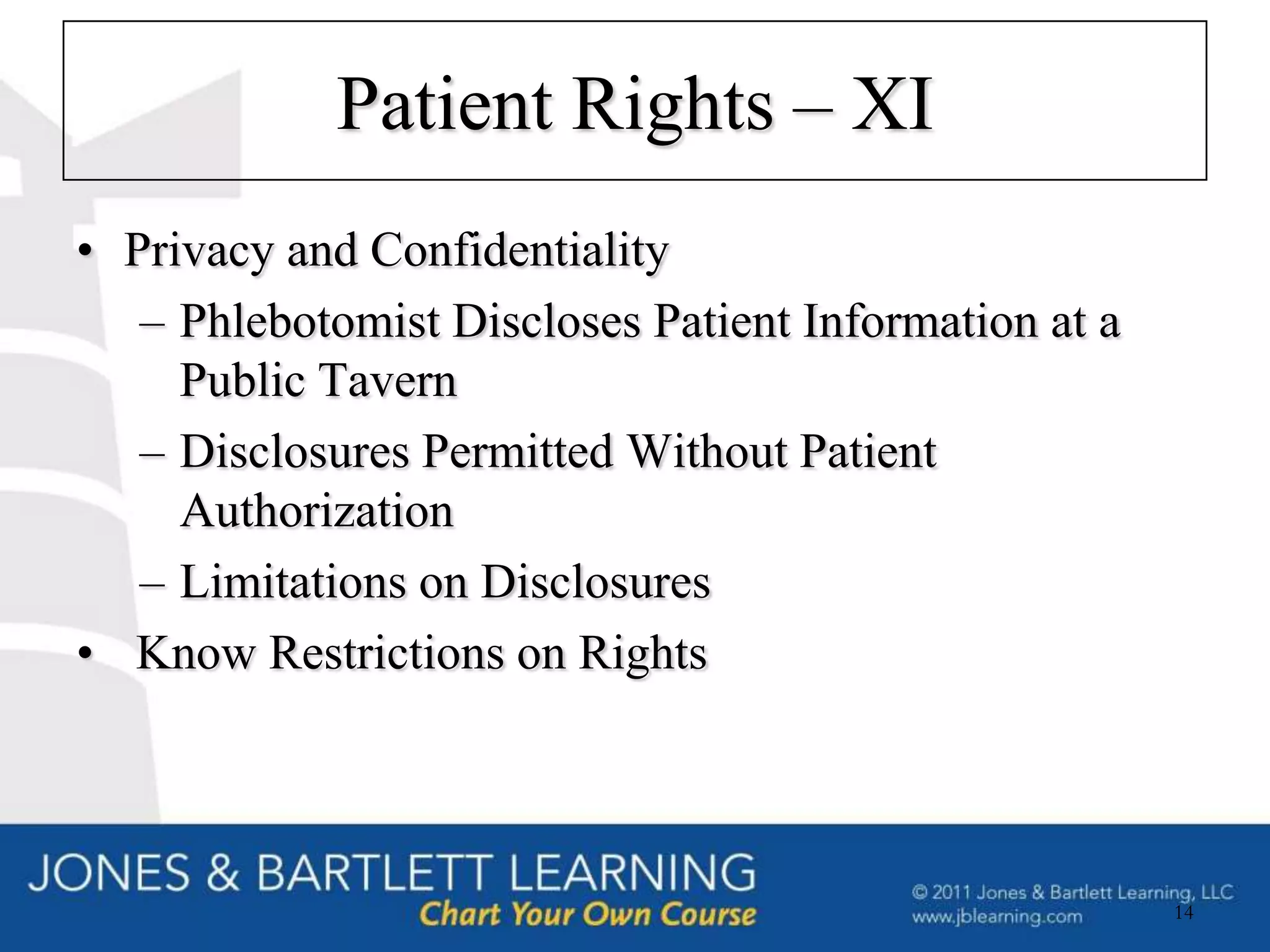
Patient Rights – XI
• Privacy and Confidentiality
   – Phlebotomist Discloses Patient Information at a
     Public Tavern
   – Disclosures Permitted Without Patient
     Authorization
   – Limitations on Disclosures
• Know Restrictions on Rights


                                                       14
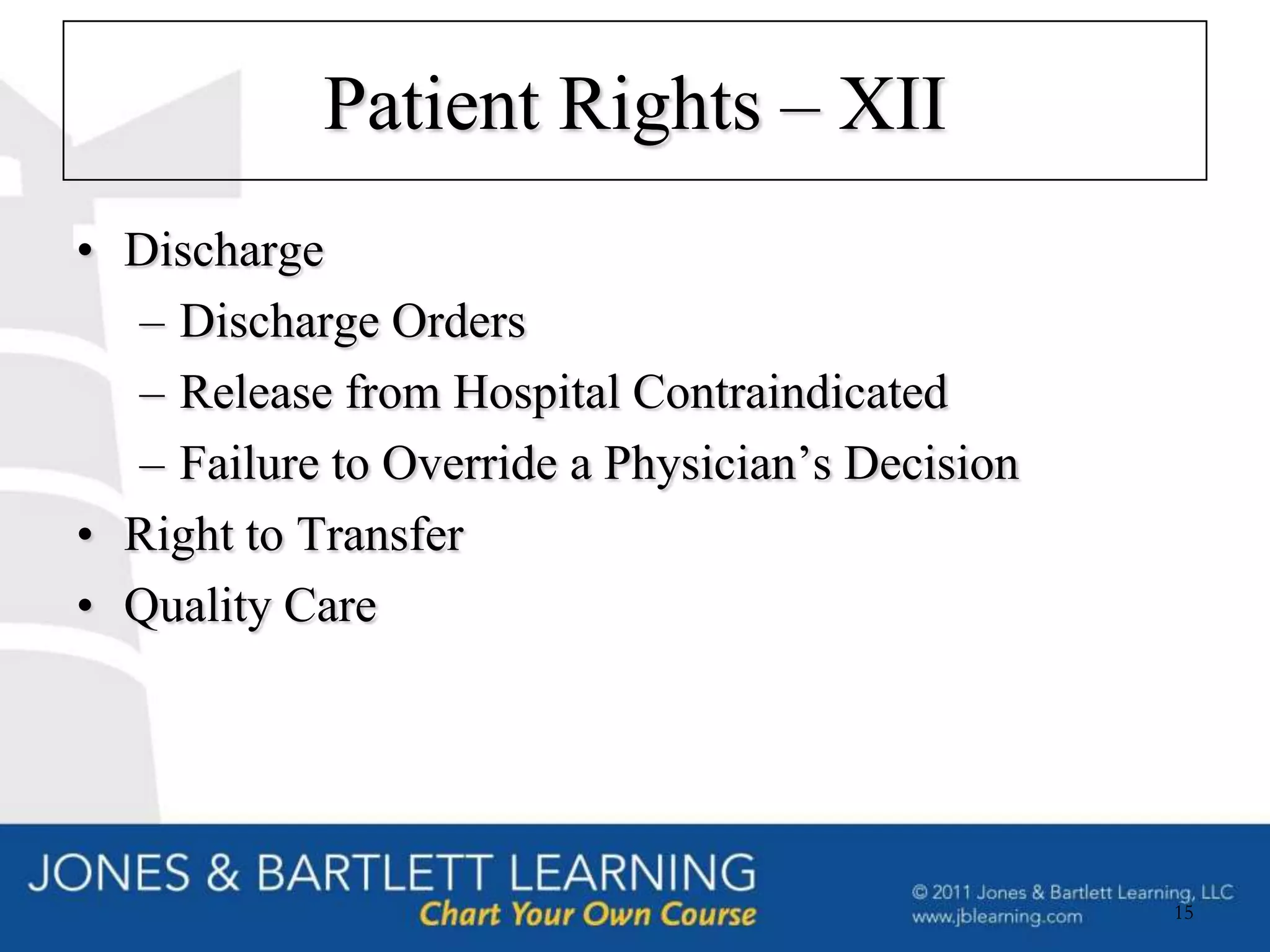
Patient Rights – XII
• Discharge
  – Discharge Orders
  – Release from Hospital Contraindicated
  – Failure to Override a Physician’s Decision
• Right to Transfer
• Quality Care


                                                 15
Patient Rights – XIII
•   Respect
•   Patient Advocacy
•   Help Prevent Medical Errors
•   20 Tips to Help Prevent medical Errors


                                             16
Agency for Healthcare Research & Quality
         Preventing Medical Errors -I
• Take responsibility for maximizing healthy habits
   – such exercising
   – not smoking
   – eating a healthy diet
• Be involved in health care decisions
• Work collaboratively with providers
   – developing & carrying out agreed-upon treatment
     plans


                                                       17
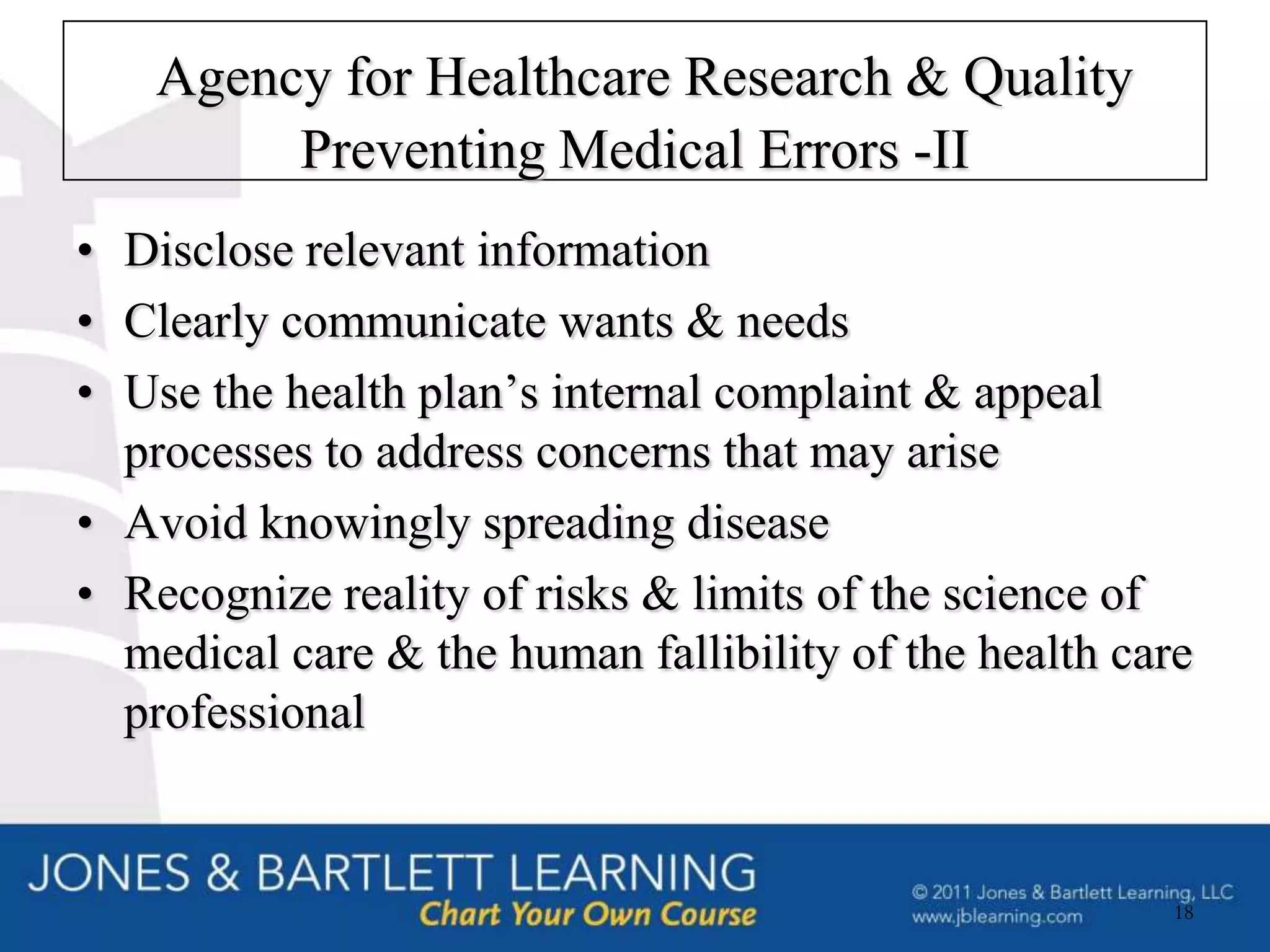
Agency for Healthcare Research & Quality
         Preventing Medical Errors -II
• Disclose relevant information
• Clearly communicate wants & needs
• Use the health plan’s internal complaint & appeal
  processes to address concerns that may arise
• Avoid knowingly spreading disease
• Recognize reality of risks & limits of the science of
  medical care & the human fallibility of the health care
  professional


                                                        18
Agency for Healthcare Research & Quality
        Preventing Medical Errors -III
• Be aware of a health care provider’s obligation to be
  reasonably efficient & equitable in providing care to
  other patients
• Become knowledgeable about health plan coverage &
  health plan options
• Show respect for other patients & health worker
• Make effort to meet financial obligations


                                                      19
Agency for Healthcare Research & Quality
        Preventing Medical Errors -IV
• Abide by administrative & operational procedures of
  health plans, healthcare providers, & government
  health benefit programs
• Report wrongdoing & fraud
Patient Responsibilities – I
• Recognize effect of lifestyle on one’s health
• Maintain a record of medications & their effects
• Keep appointments


                                                     21
Patient Responsibilities – II
• Provide full disclosure of all information relevant to
  one’s medical condition
     • Medical complaints
     • symptoms
     • past illnesses
     • treatments
     • surgical procedures
     • hospitalizations
     • medications
                                                           22
Patient Responsibilities – III
• Report unexpected changes in condition to
  caregivers
• Make it known whether or not you understand the
  plan of care
• Ask questions to seek clarification of concerns
• Follow treatment plan agreed upon


                                                23
Patient Responsibilities – IV
• Refrain from self-administration of medications
• Accept responsibility for the consequences of
  refusing treatment or not following instructions
• Be considerate of the rights of other
   – control of noise
   – smoking
   – limitation on number of visitors


                                                     24
Patient Responsibilities – V
• Be respectful of the property of others
• Speak up & ask questions
   – “What is this medication for?”
   – “What diet am I on?”
   – “Since you are going to change my dressing,
     did you wash your hands?”
• When in doubt, seek a second opinion.


                                                   25
Patient Responsibilities – VI
• Participate in marking the site of a surgical or
  other invasive procedure
• Make sure that the staff are aware of your
  preferences for care, including who your decision
  maker will be in the event that you become
  incapacitated.
• Understand caregiver instructions
• Follow an organization’s rules & regulations


                                                  26
REVIEW QUESTIONS - I
1. Describe the significance of the Patient Self-
Determination Act.
2. Describe the rights of patients as reviewed in this
chapter.
3. Describe the responsibilities of patients as
reviewed in this chapter.
4. Should a competent person have a right to refuse
treatment?
5. Why do you think a patient’s responsibilities are as
important as his or her rights?
                                                      27
REVIEW QUESTIONS - II
6. Should a hospital be able to assert whatever
interest the state itself may have in seeking to compel
an unwilling patient to undergo a routine, lifesaving
medical procedure? Explain.
7. Discuss the importance of the patient’s
responsibility to communicate to the staff any
symptoms he or she is experiencing.


                                                      28

5530: Chapter 14

  • 2.
    Chapter 14 Patient Rights& Responsibilities 2
  • 3.
    Patient Self-Determination Act •Protection of a patient’s right to make decisions. • Organizations required to observe, protect & promote patient rights. 3
  • 4.
    Patient Rights –I • Admission – Discrimination Prohibited – Government Facilities • Timely Response to Care Needs • Know One’s Rights – Bill of Rights 4
  • 5.
    Patient Rights –II • Ask Questions – Clarification of the caregiver’s instructions. – Interpretation of a caregiver’s illegible handwriting. – Instructions for medication usage (e.g., frequency, dosing, drug–drug or drug–food interactions, contraindications, side effects). – Clarification of the physician’s diet orders (e.g., “Does my iced tea contain sugar-free substitutes?”). – Explanation of the treatment plan. – A copy of the organization’s hand-washing policy. 5
  • 6.
    Patient Rights –III • A description of the hospital’s procedures to prevent wrong site surgery (e.g., the surgical site has been appropriately marked). • The surgeon to draw an arrow pointing to the surgical site if a surgical site cannot be directly marked. • The opportunity to provide the organization with a copy of any advance directives that may have been executed (e.g., living will). 6
  • 7.
    Patient Rights –IV • The right to appoint a surrogate decision maker should they become incapacitated. • A second opinion. • The opportunity to provide the organization with a copy of any advance directives that may have been executed (e.g., living will)
  • 8.
    Patient Rights –V • clarification of diet orders • explanation of treatment plan • organization’s hand-washing policy • know procedures to prevent wrong site surgery • surgical site has been marked 8
  • 9.
    Patient Rights –VI • Explanation of Rights • Know Hospital’s Adverse Events • Know Caregivers • Know 3rd Party Relationships • Participate in Care Decisions 9
  • 10.
    Patient Rights –VII • Informed Consent • Emergency Care • Have Special Needs Addressed • Compassionate Care • Timely Response to Care Needs 10
  • 11.
    Patient Rights –VIII • Pain Management – describe location & severity of pain – discuss pain relief treatment options – work with health care caregivers to develop treatment plans – discuss concerns about taking pain medication/s. – alert caregivers of any allergies 11
  • 12.
    Patient Rights –IX • Pain Management, cont. – learn side effects associated with pain management – maintain record of effects of medications or other pain relief measures – participate in setting pain control goals – provide caregivers with info about pain control methods that have worked, or not worke
  • 13.
    Patient Rights –X • Refuse Treatment – Right to Refuse Blood Transfusion • Access to Medical Records • Execute Advance Directives • Designate a Decision-Maker 13
  • 14.
    Patient Rights –XI • Privacy and Confidentiality – Phlebotomist Discloses Patient Information at a Public Tavern – Disclosures Permitted Without Patient Authorization – Limitations on Disclosures • Know Restrictions on Rights 14
  • 15.
    Patient Rights –XII • Discharge – Discharge Orders – Release from Hospital Contraindicated – Failure to Override a Physician’s Decision • Right to Transfer • Quality Care 15
  • 16.
    Patient Rights –XIII • Respect • Patient Advocacy • Help Prevent Medical Errors • 20 Tips to Help Prevent medical Errors 16
  • 17.
    Agency for HealthcareResearch & Quality Preventing Medical Errors -I • Take responsibility for maximizing healthy habits – such exercising – not smoking – eating a healthy diet • Be involved in health care decisions • Work collaboratively with providers – developing & carrying out agreed-upon treatment plans 17
  • 18.
    Agency for HealthcareResearch & Quality Preventing Medical Errors -II • Disclose relevant information • Clearly communicate wants & needs • Use the health plan’s internal complaint & appeal processes to address concerns that may arise • Avoid knowingly spreading disease • Recognize reality of risks & limits of the science of medical care & the human fallibility of the health care professional 18
  • 19.
    Agency for HealthcareResearch & Quality Preventing Medical Errors -III • Be aware of a health care provider’s obligation to be reasonably efficient & equitable in providing care to other patients • Become knowledgeable about health plan coverage & health plan options • Show respect for other patients & health worker • Make effort to meet financial obligations 19
  • 20.
    Agency for HealthcareResearch & Quality Preventing Medical Errors -IV • Abide by administrative & operational procedures of health plans, healthcare providers, & government health benefit programs • Report wrongdoing & fraud
  • 21.
    Patient Responsibilities –I • Recognize effect of lifestyle on one’s health • Maintain a record of medications & their effects • Keep appointments 21
  • 22.
    Patient Responsibilities –II • Provide full disclosure of all information relevant to one’s medical condition • Medical complaints • symptoms • past illnesses • treatments • surgical procedures • hospitalizations • medications 22
  • 23.
    Patient Responsibilities –III • Report unexpected changes in condition to caregivers • Make it known whether or not you understand the plan of care • Ask questions to seek clarification of concerns • Follow treatment plan agreed upon 23
  • 24.
    Patient Responsibilities –IV • Refrain from self-administration of medications • Accept responsibility for the consequences of refusing treatment or not following instructions • Be considerate of the rights of other – control of noise – smoking – limitation on number of visitors 24
  • 25.
    Patient Responsibilities –V • Be respectful of the property of others • Speak up & ask questions – “What is this medication for?” – “What diet am I on?” – “Since you are going to change my dressing, did you wash your hands?” • When in doubt, seek a second opinion. 25
  • 26.
    Patient Responsibilities –VI • Participate in marking the site of a surgical or other invasive procedure • Make sure that the staff are aware of your preferences for care, including who your decision maker will be in the event that you become incapacitated. • Understand caregiver instructions • Follow an organization’s rules & regulations 26
  • 27.
    REVIEW QUESTIONS -I 1. Describe the significance of the Patient Self- Determination Act. 2. Describe the rights of patients as reviewed in this chapter. 3. Describe the responsibilities of patients as reviewed in this chapter. 4. Should a competent person have a right to refuse treatment? 5. Why do you think a patient’s responsibilities are as important as his or her rights? 27
  • 28.
    REVIEW QUESTIONS -II 6. Should a hospital be able to assert whatever interest the state itself may have in seeking to compel an unwilling patient to undergo a routine, lifesaving medical procedure? Explain. 7. Discuss the importance of the patient’s responsibility to communicate to the staff any symptoms he or she is experiencing. 28