Chapter 21
Employment, Discipline,
    and Discharge


                          2
Employment-at-will Doctrine – I
• Employment-at-will doctrine provides employment is
  at will of employer or employee.
• Employment may be terminated either at any time
   – for any or no reason
   – unless a contract in place specifying terms &
     duration of employment.
• Historically, termination of employees for any reason
  widely accepted.


                                                      3
Employment-at-will Doctrine – II
• Growing trend toward a restricted application
  of the at-will employment rule whereby right
  of an employer to discharge at-will employee
  without cause
  – limited by either public policy considerations
  – or implied covenant of good faith & fair dealing.


                                                        4
“…obvious and indisputable fact that in a civilized
state where reciprocal legal rights & duties
abound, the words "at will" can never mean "without
limit or qualification," as so much of the discussion
and the briefs of the defendants imply; for in such a
state the rights of each person are necessarily &
inherently limited by the rights of others & the
interests of the public. An at will prerogative without
limits could be suffered only in an anarchy . . . .
                         Sides v. Duke Hosp.


                                                          5
Employment-at-will Doctrine – III

• Fairly balancing rights of employee & needs
  of organization complex objective
• Chapter provides some direction in this
  balancing act


                                                6
Employment-at-will Doctrine – IV

• Embroiled in combination of legislative
  enactments & judicial decisions.
• Some states more employer oriented.
  – e.g., New York
• Other states in harmony with constitutional
  rights of employee.
  – e.g., California


                                                7
Public Policy & Wrongful Discharge
• Public Policy
   – policy exception to employment-at-will doctrine
     provides employees may not be terminated for
     reasons contrary to public policy
   – public policy originates with legislative
     enactments


                                                       8
Public Policy Issues – I
• Age
• Race
• Color
• Religion
• Sex


                                     9
Public Policy Issues – II
• National origin
• Pregnancy
• Filing of safety violation complaints
  – e.g., OSHA

• Union membership


                                          10
Public Policy Issues – III
• Asserting Legal Rights
  Whistle-blowing
  Reporting Patient Abuse
      Child
     Elder


                                    11
Termination
•   “For Cause” in Employment Contracts
•   Financial Necessity
•   Hostile Attitude
•   Improper Billing Practice
•   Poor Work Performance
•   Alcoholism
•   Insubordinate Behavior

                                          12
Termination & Damages
• Damages can be awarded for
  Wrongful Discharge
      tort
      contract
  Emotional Distress
  Punitive Damages (not all cases)
     clear and convincing evidence
     employer acted with malice


                                      13
Retaliatory Discharge
• People in Power Can Abuse that Power
   Threats
   Abuse
   Intimidation
   Retaliatory Discharge
   Interference with Employment Activities
   Defamation Actions
      Case: Retaliatory Discharge & Emotional
       Distress

                                                 14
Fairness: The Ultimate Test

• Fairness is the Ultimate Question
• Implied Covenant of Good Faith


                                      15
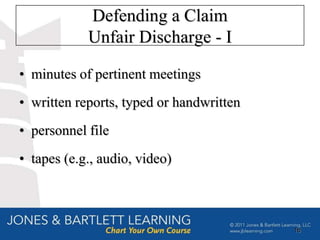
Defending a Claim
            Unfair Discharge - I

• minutes of pertinent meetings
• written reports, typed or handwritten
• personnel file
• tapes (e.g., audio, video)


                                          16
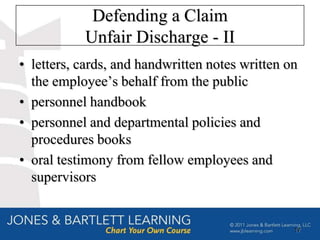
Defending a Claim
           Unfair Discharge - II
• letters, cards, and handwritten notes written on
  the employee’s behalf from the public
• personnel handbook
• personnel and departmental policies and
  procedures books
• oral testimony from fellow employees and
  supervisors


                                                 17
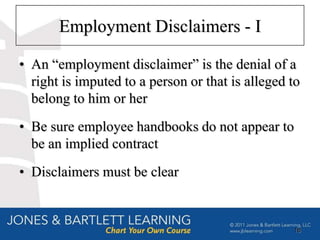
Employment Disclaimers - I

• An “employment disclaimer” is the denial of a
  right is imputed to a person or that is alleged to
  belong to him or her
• Be sure employee handbooks do not appear to
  be an implied contract
• Disclaimers must be clear


                                                  18
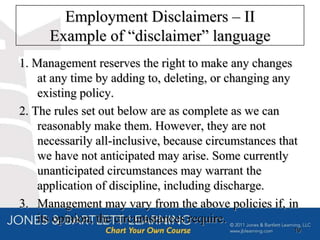
Employment Disclaimers – II
      Example of “disclaimer” language
1. Management reserves the right to make any changes
    at any time by adding to, deleting, or changing any
    existing policy.
2. The rules set out below are as complete as we can
    reasonably make them. However, they are not
    necessarily all-inclusive, because circumstances that
    we have not anticipated may arise. Some currently
    unanticipated circumstances may warrant the
    application of discipline, including discharge.
3. Management may vary from the above policies if, in
    its opinion, the circumstances require.
                                                        19
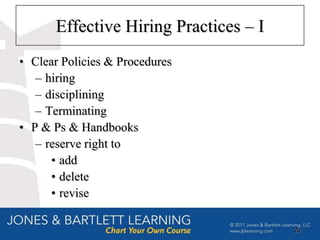
Effective Hiring Practices – I
• Clear Policies & Procedures
   – hiring
   – disciplining
   – Terminating
• P & Ps & Handbooks
   – reserve right to
      • add
      • delete
      • revise

                                       20
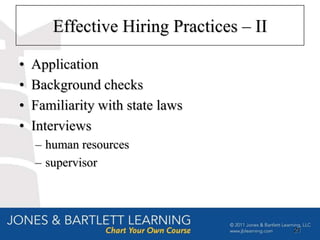
Effective Hiring Practices – II

•   Application
•   Background checks
•   Familiarity with state laws
•   Interviews
    – human resources
    – supervisor


                                         21
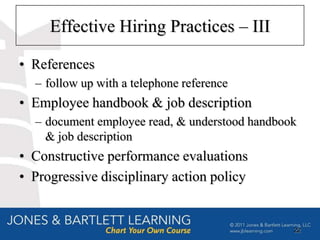
Effective Hiring Practices – III

• References
  – follow up with a telephone reference
• Employee handbook & job description
  – document employee read, & understood handbook
    & job description
• Constructive performance evaluations
• Progressive disciplinary action policy


                                                22
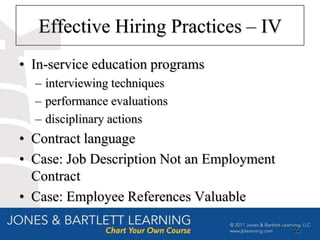
Effective Hiring Practices – IV
• In-service education programs
  – interviewing techniques
  – performance evaluations
  – disciplinary actions
• Contract language
• Case: Job Description Not an Employment
  Contract
• Case: Employee References Valuable

                                            23
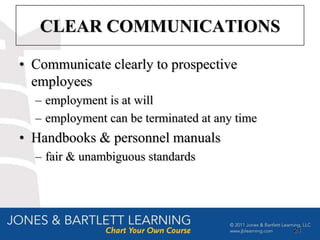
CLEAR COMMUNICATIONS

• Communicate clearly to prospective
  employees
  – employment is at will
  – employment can be terminated at any time
• Handbooks & personnel manuals
  – fair & unambiguous standards


                                               24
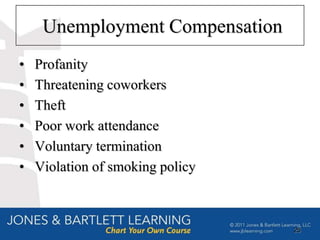
Unemployment Compensation
•   Profanity
•   Threatening coworkers
•   Theft
•   Poor work attendance
•   Voluntary termination
•   Violation of smoking policy


                                  25
REVIEW QUESTIONS - I
1. Discuss employment at-will doctrine.
2. Is employment-at-will doctrine appropriate
in today's society? Discuss your answer.
3. What are pros & cons of employment-at-
will doctrine?


                                                26
REVIEW QUESTIONS - II
4. What are public policy exceptions to
employment-at-will doctrine?
5. Discuss questions the employer (supervisor)
should ask prior to discharging an employee.
6. Discuss legitimate reasons for terminating
an employee.


                                                27
REVIEW QUESTIONS - III
7. Discuss why employment disclaimers are important
   to the employer.

8. Discuss what actions an employer can take in order to
   help reduce the necessity for discharging an
   employee.

9. Discuss under what conditions unemployment
   compensation can be denied to a claimant.


                                                      28

5530: Chapter 21

  • 2.
  • 3.
    Employment-at-will Doctrine –I • Employment-at-will doctrine provides employment is at will of employer or employee. • Employment may be terminated either at any time – for any or no reason – unless a contract in place specifying terms & duration of employment. • Historically, termination of employees for any reason widely accepted. 3
  • 4.
    Employment-at-will Doctrine –II • Growing trend toward a restricted application of the at-will employment rule whereby right of an employer to discharge at-will employee without cause – limited by either public policy considerations – or implied covenant of good faith & fair dealing. 4
  • 5.
    “…obvious and indisputablefact that in a civilized state where reciprocal legal rights & duties abound, the words "at will" can never mean "without limit or qualification," as so much of the discussion and the briefs of the defendants imply; for in such a state the rights of each person are necessarily & inherently limited by the rights of others & the interests of the public. An at will prerogative without limits could be suffered only in an anarchy . . . . Sides v. Duke Hosp. 5
  • 6.
    Employment-at-will Doctrine –III • Fairly balancing rights of employee & needs of organization complex objective • Chapter provides some direction in this balancing act 6
  • 7.
    Employment-at-will Doctrine –IV • Embroiled in combination of legislative enactments & judicial decisions. • Some states more employer oriented. – e.g., New York • Other states in harmony with constitutional rights of employee. – e.g., California 7
  • 8.
    Public Policy &Wrongful Discharge • Public Policy – policy exception to employment-at-will doctrine provides employees may not be terminated for reasons contrary to public policy – public policy originates with legislative enactments 8
  • 9.
    Public Policy Issues– I • Age • Race • Color • Religion • Sex 9
  • 10.
    Public Policy Issues– II • National origin • Pregnancy • Filing of safety violation complaints – e.g., OSHA • Union membership 10
  • 11.
    Public Policy Issues– III • Asserting Legal Rights Whistle-blowing Reporting Patient Abuse  Child Elder 11
  • 12.
    Termination • “For Cause” in Employment Contracts • Financial Necessity • Hostile Attitude • Improper Billing Practice • Poor Work Performance • Alcoholism • Insubordinate Behavior 12
  • 13.
    Termination & Damages •Damages can be awarded for Wrongful Discharge  tort  contract Emotional Distress Punitive Damages (not all cases) clear and convincing evidence employer acted with malice 13
  • 14.
    Retaliatory Discharge • Peoplein Power Can Abuse that Power Threats Abuse Intimidation Retaliatory Discharge Interference with Employment Activities Defamation Actions  Case: Retaliatory Discharge & Emotional Distress 14
  • 15.
    Fairness: The UltimateTest • Fairness is the Ultimate Question • Implied Covenant of Good Faith 15
  • 16.
    Defending a Claim Unfair Discharge - I • minutes of pertinent meetings • written reports, typed or handwritten • personnel file • tapes (e.g., audio, video) 16
  • 17.
    Defending a Claim Unfair Discharge - II • letters, cards, and handwritten notes written on the employee’s behalf from the public • personnel handbook • personnel and departmental policies and procedures books • oral testimony from fellow employees and supervisors 17
  • 18.
    Employment Disclaimers -I • An “employment disclaimer” is the denial of a right is imputed to a person or that is alleged to belong to him or her • Be sure employee handbooks do not appear to be an implied contract • Disclaimers must be clear 18
  • 19.
    Employment Disclaimers –II Example of “disclaimer” language 1. Management reserves the right to make any changes at any time by adding to, deleting, or changing any existing policy. 2. The rules set out below are as complete as we can reasonably make them. However, they are not necessarily all-inclusive, because circumstances that we have not anticipated may arise. Some currently unanticipated circumstances may warrant the application of discipline, including discharge. 3. Management may vary from the above policies if, in its opinion, the circumstances require. 19
  • 20.
    Effective Hiring Practices– I • Clear Policies & Procedures – hiring – disciplining – Terminating • P & Ps & Handbooks – reserve right to • add • delete • revise 20
  • 21.
    Effective Hiring Practices– II • Application • Background checks • Familiarity with state laws • Interviews – human resources – supervisor 21
  • 22.
    Effective Hiring Practices– III • References – follow up with a telephone reference • Employee handbook & job description – document employee read, & understood handbook & job description • Constructive performance evaluations • Progressive disciplinary action policy 22
  • 23.
    Effective Hiring Practices– IV • In-service education programs – interviewing techniques – performance evaluations – disciplinary actions • Contract language • Case: Job Description Not an Employment Contract • Case: Employee References Valuable 23
  • 24.
    CLEAR COMMUNICATIONS • Communicateclearly to prospective employees – employment is at will – employment can be terminated at any time • Handbooks & personnel manuals – fair & unambiguous standards 24
  • 25.
    Unemployment Compensation • Profanity • Threatening coworkers • Theft • Poor work attendance • Voluntary termination • Violation of smoking policy 25
  • 26.
    REVIEW QUESTIONS -I 1. Discuss employment at-will doctrine. 2. Is employment-at-will doctrine appropriate in today's society? Discuss your answer. 3. What are pros & cons of employment-at- will doctrine? 26
  • 27.
    REVIEW QUESTIONS -II 4. What are public policy exceptions to employment-at-will doctrine? 5. Discuss questions the employer (supervisor) should ask prior to discharging an employee. 6. Discuss legitimate reasons for terminating an employee. 27
  • 28.
    REVIEW QUESTIONS -III 7. Discuss why employment disclaimers are important to the employer. 8. Discuss what actions an employer can take in order to help reduce the necessity for discharging an employee. 9. Discuss under what conditions unemployment compensation can be denied to a claimant. 28