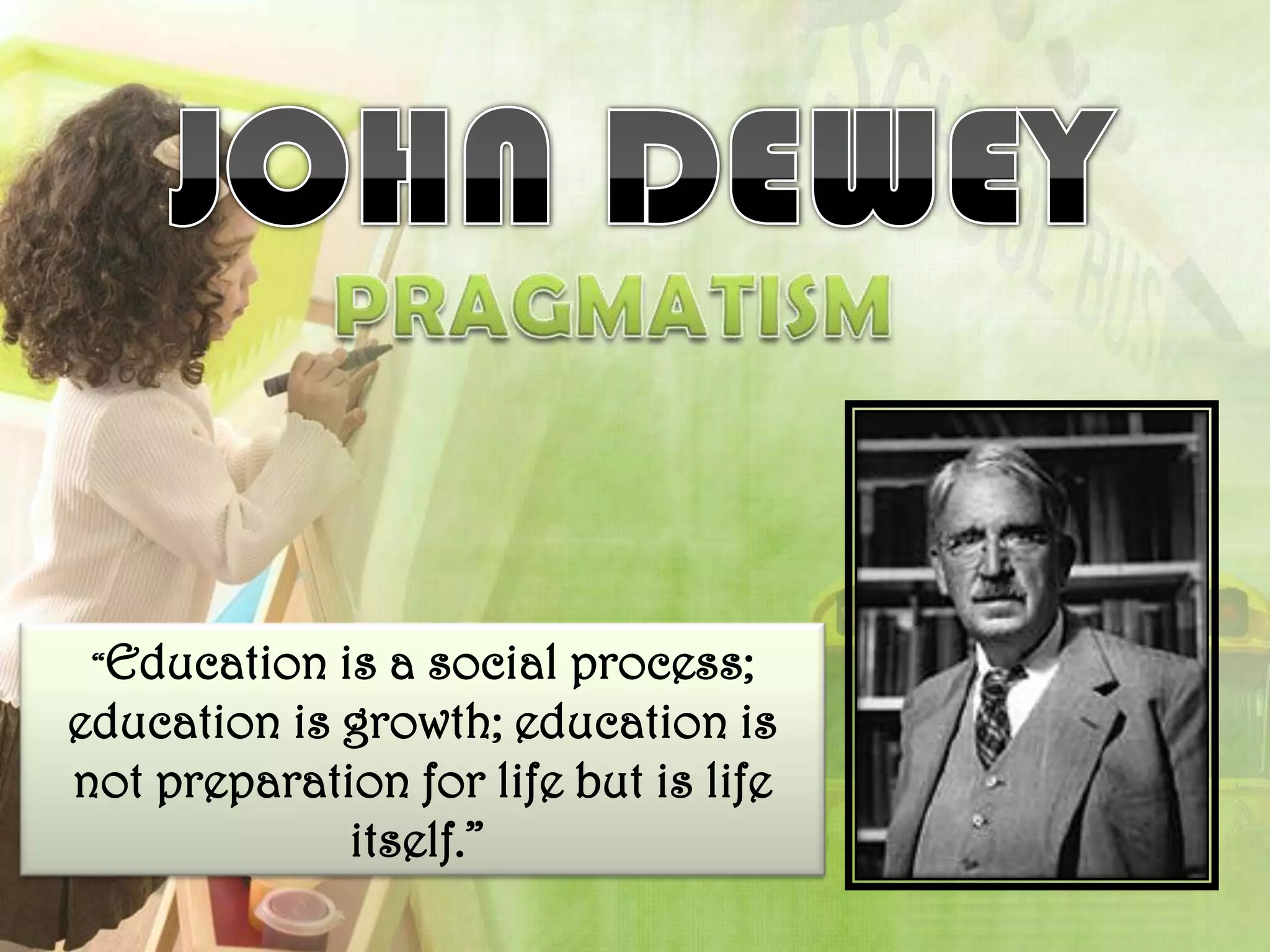
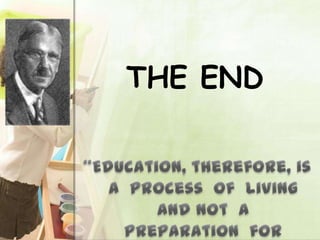
“Education  is a social process;
education is growth; education is
not preparation for life but is life
              itself.”
BIOGRAPHY
•   Born 1859, Burlington, Vermont, USA. Died 1952.
•   John was the third child.
•   At the age of fifth teen he graduated from high school.
•   He went to University of Vermont and he graduated second in his class at
    1878 with a major in philosophy.
•   Dewey read the works of Charles Darwin which had a great influence in
    Dewey's life works.
•   He is an American philosopher and regarded as the foremost educator of
    his day.
•   He is an educator who, with Charles Peirce and William James, was a
    founder of the school of philosophy known as "pragmatism."
•   A leader of the progressive movement in education in the United States.
•   He also wrote about many other topics, including
    experience, nature, art, logic, inquiry, democracy, and ethics.
•   Books :
      – "Democracy and Education" (1916)
      – "Logic" (1938)
      – "Experience and Education" (1938).
•   Rejected authoritarian teaching methods.

                          (adapted from the Concise Columbia Encyclopedia (1991) - Columbia University Press)
HIS VIEW ON EDUCATION
• Pragmatism (Knowledge that can be required
                  through human relationship with
                  the natural surroundings)


• Dewey believed that students should be
  involved in real-life tasks and challenges


• For Dewey, education also a broader social
  purpose
• Regarded education in a democracy as a tool
  to enable the citizen to integrate his or her
  culture and vocation usefully


• Nowadays, students are taken to fieldtrip,
  practice Physical Education(PE), learn
  Integrated Living Skill and Visual Art in their
  classes and getting involve in clubs( interact
  club, art club)
IMPACT
1. In one particular book, Democracy and
   Education, Dewey outlines education as a
   social process and describes the idea of
   school as a method for preparing students
   to function as members of a society.

2. He make a brief overview of historical
  educational theories and there role in
  shaping the structure of schools.
  “Any education given by a group tends to socialize its
   members, but the quality and value of the socialization
      depends upon the habits and aims of the group.”
• 3. His theory on educating a group to
  socialize are the idea that guided schools to
  create curriculums with learner outcomes in
  mind until today.
     “Diversity of stimulation means novelty, and novelty
                means challenge to thought.”


• 4. He used different modes of instruction is
  one way to keep the brain active, as shown
  in modern brain scans.

• John Dewey offers amazing insights into the
  nature of learning and the role of
  socialization throughout history helped in this
  new political era.
CONCLUSION
John Dewey introduced pragmatism which is a
knowledge that can be required through the
natural surroundings. This help student’s to be
more active and use their body to move
around. According in pragmatism it will be
easier, more interesting and more meaningful
to students because the lesson was planned
according to the requirement and interest. His
perspectives on education could serve as a
foundation for the future methods of the
learning process.
THE END

John dewey

  • 1.
    “Education isa social process; education is growth; education is not preparation for life but is life itself.”
  • 2.
    BIOGRAPHY • Born 1859, Burlington, Vermont, USA. Died 1952. • John was the third child. • At the age of fifth teen he graduated from high school. • He went to University of Vermont and he graduated second in his class at 1878 with a major in philosophy. • Dewey read the works of Charles Darwin which had a great influence in Dewey's life works. • He is an American philosopher and regarded as the foremost educator of his day. • He is an educator who, with Charles Peirce and William James, was a founder of the school of philosophy known as "pragmatism." • A leader of the progressive movement in education in the United States. • He also wrote about many other topics, including experience, nature, art, logic, inquiry, democracy, and ethics. • Books : – "Democracy and Education" (1916) – "Logic" (1938) – "Experience and Education" (1938). • Rejected authoritarian teaching methods. (adapted from the Concise Columbia Encyclopedia (1991) - Columbia University Press)
  • 3.
    HIS VIEW ONEDUCATION • Pragmatism (Knowledge that can be required through human relationship with the natural surroundings) • Dewey believed that students should be involved in real-life tasks and challenges • For Dewey, education also a broader social purpose
  • 4.
    • Regarded educationin a democracy as a tool to enable the citizen to integrate his or her culture and vocation usefully • Nowadays, students are taken to fieldtrip, practice Physical Education(PE), learn Integrated Living Skill and Visual Art in their classes and getting involve in clubs( interact club, art club)
  • 5.
    IMPACT 1. In oneparticular book, Democracy and Education, Dewey outlines education as a social process and describes the idea of school as a method for preparing students to function as members of a society. 2. He make a brief overview of historical educational theories and there role in shaping the structure of schools. “Any education given by a group tends to socialize its members, but the quality and value of the socialization depends upon the habits and aims of the group.”
  • 6.
    • 3. Histheory on educating a group to socialize are the idea that guided schools to create curriculums with learner outcomes in mind until today. “Diversity of stimulation means novelty, and novelty means challenge to thought.” • 4. He used different modes of instruction is one way to keep the brain active, as shown in modern brain scans. • John Dewey offers amazing insights into the nature of learning and the role of socialization throughout history helped in this new political era.
  • 7.
    CONCLUSION John Dewey introducedpragmatism which is a knowledge that can be required through the natural surroundings. This help student’s to be more active and use their body to move around. According in pragmatism it will be easier, more interesting and more meaningful to students because the lesson was planned according to the requirement and interest. His perspectives on education could serve as a foundation for the future methods of the learning process.
  • 8.