Presented to
Madam Darakhshan Siraj
Presented by
Sidra Majeed 2018-2339
Salma Ajmal 2018-2308
Aqsa Manzoor 2018-2311
Afrina Kinat 2018-2324
Maham Zulfiqar 2018-2332
BS.Ed 5th Semester (Morning)
University of the Punjab, Lahore
Course: School Community and Teacher
Meaning of social
interaction and socialization
Levels of social interaction
Elements of social
interaction
● Social contacts
● Communication
● Social attitudes and
values
Table of Contents
01
03
02
04
Meaning of social interaction and socialization
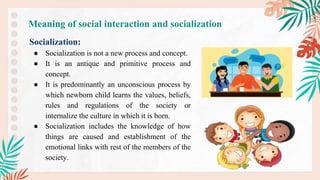
Socialization:
● Socialization is not a new process and concept.
● It is an antique and primitive process and
concept.
● It is predominantly an unconscious process by
which newborn child learns the values, beliefs,
rules and regulations of the society or
internalize the culture in which it is born.
● Socialization includes the knowledge of how
things are caused and establishment of the
emotional links with rest of the members of the
society.
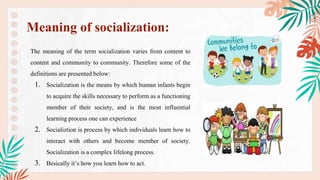
The meaning of the term socialization varies from content to
content and community to community. Therefore some of the
definitions are presented below:
1. Socialization is the means by which human infants begin
to acquire the skills necessary to perform as a functioning
member of their society, and is the most influential
learning process one can experience
2. Socializtion is process by which individuals learn how to
interact with others and become member of society.
Socialization is a complex lifelong process.
3. Besically it’s how you learn how to act.
Meaning of socialization:
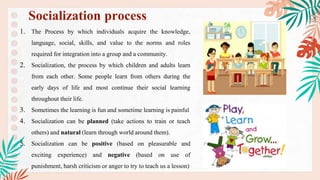
1. The Process by which individuals acquire the knowledge,
language, social, skills, and value to the norms and roles
required for integration into a group and a community.
2. Socialization, the process by which children and adults learn
from each other. Some people learn from others during the
early days of life and most continue their social learning
throughout their life.
3. Sometimes the learning is fun and sometime learning is painful
4. Socialization can be planned (take actions to train or teach
others) and natural (learn through world around them).
5. Socialization can be positive (based on pleasurable and
exciting experience) and negative (based on use of
punishment, harsh criticism or anger to try to teach us a lesson)
Socialization process
.
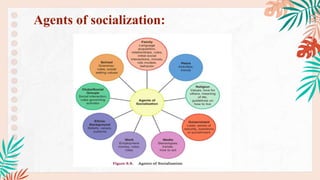
Agents of socialization:
 A social interaction or social relation is the way people talk and act with each other. It may include
interactions in a team, family or bureaucracy. It includes any relationship between two or more individuals. It
is a source of socialization and it characterizes all types of social relationships.
 Man is a social animal. It is difficult for him to live in isolation. They always live in groups. As members of
these groups they act in a certain manner. Their behavior is mutually affected. This interaction or mutual
activity is the essence of social life. Social life is not possible without interactions.
 According to Gillin “By social interaction we refer to social relations of all sorts in functions – dynamic social
relations of all kinds – whether such relations exist between individual and individual, between group and
group and group and individual, as the case may be”.
social interaction:
The opportunity of social interaction with others is very important
for the development of all children.
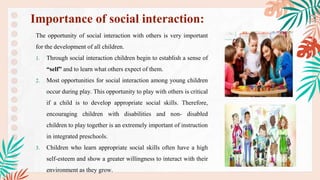
1. Through social interaction children begin to establish a sense of
“self” and to learn what others expect of them.
2. Most opportunities for social interaction among young children
occur during play. This opportunity to play with others is critical
if a child is to develop appropriate social skills. Therefore,
encouraging children with disabilities and non- disabled
children to play together is an extremely important of instruction
in integrated preschools.
3. Children who learn appropriate social skills often have a high
self-esteem and show a greater willingness to interact with their
environment as they grow.
Importance of social interaction:
1. Social Interaction between Two Individuals
2. Social Interaction between Individual and Group
3. Social Interaction between Group and Group
4. Social Interaction between Individual and Culture
Levels of social interaction
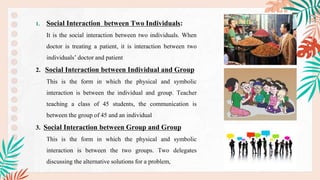
1. Social Interaction between Two Individuals:
It is the social interaction between two individuals. When
doctor is treating a patient, it is interaction between two
individuals’ doctor and patient
2. Social Interaction between Individual and Group
This is the form in which the physical and symbolic
interaction is between the individual and group. Teacher
teaching a class of 45 students, the communication is
between the group of 45 and an individual
3. Social Interaction between Group and Group
This is the form in which the physical and symbolic
interaction is between the two groups. Two delegates
discussing the alternative solutions for a problem,
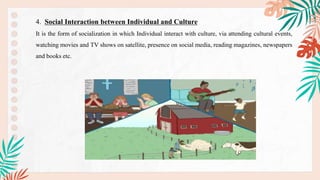
4. Social Interaction between Individual and Culture
It is the form of socialization in which Individual interact with culture, via attending cultural events,
watching movies and TV shows on satellite, presence on social media, reading magazines, newspapers
and books etc.
There are also some other different levels of interaction
1. Exchange
2. Conflict
3. Competition
4. Cooperation
5. Accommodation
Some other types of social interaction:
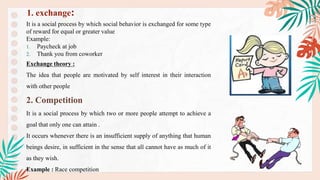
It is a social process by which social behavior is exchanged for some type
of reward for equal or greater value
Example:
1. Paycheck at job
2. Thank you from coworker
Exchange theory :
The idea that people are motivated by self interest in their interaction
with other people
2. Competition
It is a social process by which two or more people attempt to achieve a
goal that only one can attain .
It occurs whenever there is an insufficient supply of anything that human
beings desire, in sufficient in the sense that all cannot have as much of it
as they wish.
Example : Race competition
1. exchange:
 It is a social process in which people work together in order to
achieve shared goal
 The term ‘cooperation’ has been derived from two Latin words –
‘Co’ meaning ‘together and Operary meaning ‘to work’. Hence,
cooperation means working together for the achievement of a
common goal or goals.
Example :
Cricket team performance, Boys cooperate in games, men in business,
workers in production, and public officials in community controls and
so on, in an endless variety of beneficial activities that make possible
an integrated social life.
3. Cooperation:
4. Conflict:
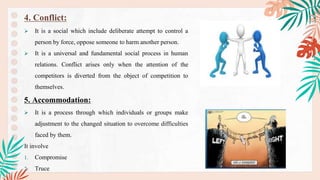
 It is a social which include deliberate attempt to control a
person by force, oppose someone to harm another person.
 It is a universal and fundamental social process in human
relations. Conflict arises only when the attention of the
competitors is diverted from the object of competition to
themselves.
5. Accommodation:
 It is a process through which individuals or groups make
adjustment to the changed situation to overcome difficulties
faced by them.
It involve
1. Compromise
2. Truce
.
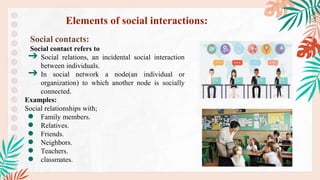
Social contacts:
Social contact refers to
➔ Social relations, an incidental social interaction
between individuals.
➔ In social network a node(an individual or
organization) to which another node is socially
connected.
Examples:
Social relationships with;
● Family members.
● Relatives.
● Friends.
● Neighbors.
● Teachers.
● classmates.
Elements of social interactions:
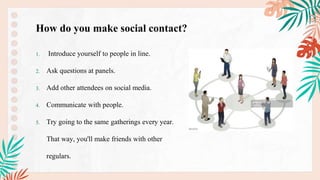
1. Introduce yourself to people in line.
2. Ask questions at panels.
3. Add other attendees on social media.
4. Communicate with people.
5. Try going to the same gatherings every year.
That way, you'll make friends with other
regulars.
How do you make social contact?
• Promotes better mental health
• Lower the risk of dementia(brain issues).
• Increases physical health.
• Gives a positive outlook on life.
• Improves mental sharpness.
• Gives strength to cope up with stress and life
challenges.
Importance of social contact:
Consequently;
 A person’s moral attitudes are dependent upon a contact among them to form the
society in which they live.
 Social contact makes a person social.
 Social contact is a way to communicate with people and a chance to represent yourself.
 As a society, we should be socially connected to each other so that in case of any issue
everyone stands like one society TOGETHER
 Social contact is also a means of awareness to the world.
Conti.
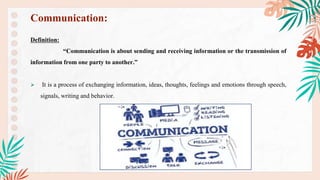
Definition:
“Communication is about sending and receiving information or the transmission of
information from one party to another.”
 It is a process of exchanging information, ideas, thoughts, feelings and emotions through speech,
signals, writing and behavior.
Communication:
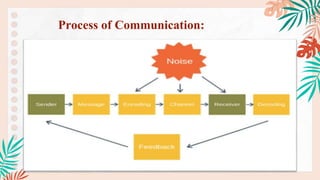
Process of Communication:
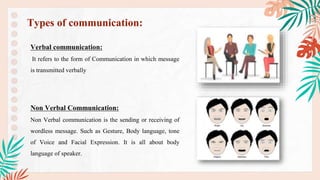
Verbal communication:
It refers to the form of Communication in which message
is transmitted verbally
Non Verbal Communication:
Non Verbal communication is the sending or receiving of
wordless message. Such as Gesture, Body language, tone
of Voice and Facial Expression. It is all about body
language of speaker.
Types of communication:
1. Intrapersonal Communication
2. Interpersonal Communication
3. Small Group Communication
4. One-to-group Communication
Types of communications
Intrapersonal communication:
 Communication that occur in your own mind.
 It is the basis of your feelings, biases and beliefs.
Example:
 When you make any kind of decision
 What to eat or wear
 When you think about something
Interpersonal communication:
“Communication between two people”
Examples:
• When you are talking to your friend
• A teacher and student discussion on assignment
• A patient and Doctor discussing a treatment
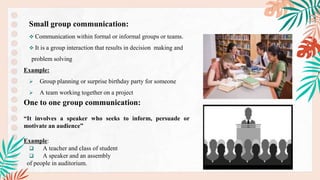
Small group communication:
 Communication within formal or informal groups or teams.
 It is a group interaction that results in decision making and
problem solving
Example:
 Group planning or surprise birthday party for someone
 A team working together on a project
One to one group communication:
“It involves a speaker who seeks to inform, persuade or
motivate an audience”
Example:
 A teacher and class of student
 A speaker and an assembly
of people in auditorium.
.
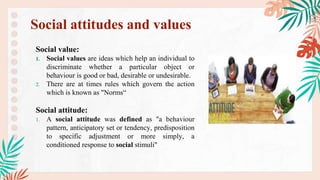
Social value:
1. Social values are ideas which help an individual to
discriminate whether a particular object or
behaviour is good or bad, desirable or undesirable.
2. There are at times rules which govern the action
which is known as "Norms“
Social attitude:
1. A social attitude was defined as "a behaviour
pattern, anticipatory set or tendency, predisposition
to specific adjustment or more simply, a
conditioned response to social stimuli"
Social attitudes and values
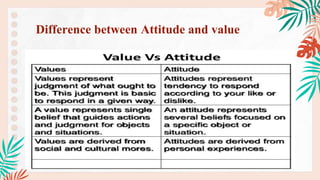
Difference between Attitude and value
 social interaction and socialization

social interaction and socialization

  • 2.
    Presented to Madam DarakhshanSiraj Presented by Sidra Majeed 2018-2339 Salma Ajmal 2018-2308 Aqsa Manzoor 2018-2311 Afrina Kinat 2018-2324 Maham Zulfiqar 2018-2332 BS.Ed 5th Semester (Morning) University of the Punjab, Lahore Course: School Community and Teacher
  • 3.
    Meaning of social interactionand socialization Levels of social interaction Elements of social interaction ● Social contacts ● Communication ● Social attitudes and values Table of Contents 01 03 02 04
  • 4.
    Meaning of socialinteraction and socialization Socialization: ● Socialization is not a new process and concept. ● It is an antique and primitive process and concept. ● It is predominantly an unconscious process by which newborn child learns the values, beliefs, rules and regulations of the society or internalize the culture in which it is born. ● Socialization includes the knowledge of how things are caused and establishment of the emotional links with rest of the members of the society.
  • 5.
    The meaning ofthe term socialization varies from content to content and community to community. Therefore some of the definitions are presented below: 1. Socialization is the means by which human infants begin to acquire the skills necessary to perform as a functioning member of their society, and is the most influential learning process one can experience 2. Socializtion is process by which individuals learn how to interact with others and become member of society. Socialization is a complex lifelong process. 3. Besically it’s how you learn how to act. Meaning of socialization:
  • 6.
    1. The Processby which individuals acquire the knowledge, language, social, skills, and value to the norms and roles required for integration into a group and a community. 2. Socialization, the process by which children and adults learn from each other. Some people learn from others during the early days of life and most continue their social learning throughout their life. 3. Sometimes the learning is fun and sometime learning is painful 4. Socialization can be planned (take actions to train or teach others) and natural (learn through world around them). 5. Socialization can be positive (based on pleasurable and exciting experience) and negative (based on use of punishment, harsh criticism or anger to try to teach us a lesson) Socialization process
  • 7.
  • 8.
     A socialinteraction or social relation is the way people talk and act with each other. It may include interactions in a team, family or bureaucracy. It includes any relationship between two or more individuals. It is a source of socialization and it characterizes all types of social relationships.  Man is a social animal. It is difficult for him to live in isolation. They always live in groups. As members of these groups they act in a certain manner. Their behavior is mutually affected. This interaction or mutual activity is the essence of social life. Social life is not possible without interactions.  According to Gillin “By social interaction we refer to social relations of all sorts in functions – dynamic social relations of all kinds – whether such relations exist between individual and individual, between group and group and group and individual, as the case may be”. social interaction:
  • 9.
    The opportunity ofsocial interaction with others is very important for the development of all children. 1. Through social interaction children begin to establish a sense of “self” and to learn what others expect of them. 2. Most opportunities for social interaction among young children occur during play. This opportunity to play with others is critical if a child is to develop appropriate social skills. Therefore, encouraging children with disabilities and non- disabled children to play together is an extremely important of instruction in integrated preschools. 3. Children who learn appropriate social skills often have a high self-esteem and show a greater willingness to interact with their environment as they grow. Importance of social interaction:
  • 10.
    1. Social Interactionbetween Two Individuals 2. Social Interaction between Individual and Group 3. Social Interaction between Group and Group 4. Social Interaction between Individual and Culture Levels of social interaction
  • 11.
    1. Social Interactionbetween Two Individuals: It is the social interaction between two individuals. When doctor is treating a patient, it is interaction between two individuals’ doctor and patient 2. Social Interaction between Individual and Group This is the form in which the physical and symbolic interaction is between the individual and group. Teacher teaching a class of 45 students, the communication is between the group of 45 and an individual 3. Social Interaction between Group and Group This is the form in which the physical and symbolic interaction is between the two groups. Two delegates discussing the alternative solutions for a problem,
  • 12.
    4. Social Interactionbetween Individual and Culture It is the form of socialization in which Individual interact with culture, via attending cultural events, watching movies and TV shows on satellite, presence on social media, reading magazines, newspapers and books etc.
  • 13.
    There are alsosome other different levels of interaction 1. Exchange 2. Conflict 3. Competition 4. Cooperation 5. Accommodation Some other types of social interaction:
  • 14.
    It is asocial process by which social behavior is exchanged for some type of reward for equal or greater value Example: 1. Paycheck at job 2. Thank you from coworker Exchange theory : The idea that people are motivated by self interest in their interaction with other people 2. Competition It is a social process by which two or more people attempt to achieve a goal that only one can attain . It occurs whenever there is an insufficient supply of anything that human beings desire, in sufficient in the sense that all cannot have as much of it as they wish. Example : Race competition 1. exchange:
  • 15.
     It isa social process in which people work together in order to achieve shared goal  The term ‘cooperation’ has been derived from two Latin words – ‘Co’ meaning ‘together and Operary meaning ‘to work’. Hence, cooperation means working together for the achievement of a common goal or goals. Example : Cricket team performance, Boys cooperate in games, men in business, workers in production, and public officials in community controls and so on, in an endless variety of beneficial activities that make possible an integrated social life. 3. Cooperation:
  • 16.
    4. Conflict:  Itis a social which include deliberate attempt to control a person by force, oppose someone to harm another person.  It is a universal and fundamental social process in human relations. Conflict arises only when the attention of the competitors is diverted from the object of competition to themselves. 5. Accommodation:  It is a process through which individuals or groups make adjustment to the changed situation to overcome difficulties faced by them. It involve 1. Compromise 2. Truce .
  • 17.
    Social contacts: Social contactrefers to ➔ Social relations, an incidental social interaction between individuals. ➔ In social network a node(an individual or organization) to which another node is socially connected. Examples: Social relationships with; ● Family members. ● Relatives. ● Friends. ● Neighbors. ● Teachers. ● classmates. Elements of social interactions:
  • 18.
    1. Introduce yourselfto people in line. 2. Ask questions at panels. 3. Add other attendees on social media. 4. Communicate with people. 5. Try going to the same gatherings every year. That way, you'll make friends with other regulars. How do you make social contact?
  • 19.
    • Promotes bettermental health • Lower the risk of dementia(brain issues). • Increases physical health. • Gives a positive outlook on life. • Improves mental sharpness. • Gives strength to cope up with stress and life challenges. Importance of social contact:
  • 20.
    Consequently;  A person’smoral attitudes are dependent upon a contact among them to form the society in which they live.  Social contact makes a person social.  Social contact is a way to communicate with people and a chance to represent yourself.  As a society, we should be socially connected to each other so that in case of any issue everyone stands like one society TOGETHER  Social contact is also a means of awareness to the world. Conti.
  • 21.
    Definition: “Communication is aboutsending and receiving information or the transmission of information from one party to another.”  It is a process of exchanging information, ideas, thoughts, feelings and emotions through speech, signals, writing and behavior. Communication:
  • 22.
  • 23.
    Verbal communication: It refersto the form of Communication in which message is transmitted verbally Non Verbal Communication: Non Verbal communication is the sending or receiving of wordless message. Such as Gesture, Body language, tone of Voice and Facial Expression. It is all about body language of speaker. Types of communication:
  • 24.
    1. Intrapersonal Communication 2.Interpersonal Communication 3. Small Group Communication 4. One-to-group Communication Types of communications
  • 25.
    Intrapersonal communication:  Communicationthat occur in your own mind.  It is the basis of your feelings, biases and beliefs. Example:  When you make any kind of decision  What to eat or wear  When you think about something Interpersonal communication: “Communication between two people” Examples: • When you are talking to your friend • A teacher and student discussion on assignment • A patient and Doctor discussing a treatment
  • 26.
    Small group communication: Communication within formal or informal groups or teams.  It is a group interaction that results in decision making and problem solving Example:  Group planning or surprise birthday party for someone  A team working together on a project One to one group communication: “It involves a speaker who seeks to inform, persuade or motivate an audience” Example:  A teacher and class of student  A speaker and an assembly of people in auditorium. .
  • 27.
    Social value: 1. Socialvalues are ideas which help an individual to discriminate whether a particular object or behaviour is good or bad, desirable or undesirable. 2. There are at times rules which govern the action which is known as "Norms“ Social attitude: 1. A social attitude was defined as "a behaviour pattern, anticipatory set or tendency, predisposition to specific adjustment or more simply, a conditioned response to social stimuli" Social attitudes and values
  • 28.