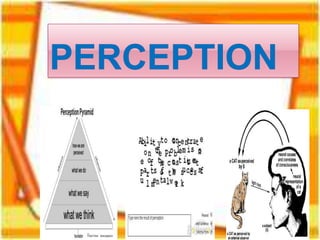
Perception is the process of receiving and understanding sensory information. There are two types of perception: internal perception which involves awareness of bodily sensations, and external perception which involves the five senses interacting with outside stimuli. For a stimulus to be perceived, it must exceed a sensory threshold. Psychological and environmental factors can influence perception. Gestalt psychologists believed perceptions form meaningful patterns according to principles like proximity, similarity, and continuity, while structuralists viewed perception as assembling discrete elements. Illusions distort actual stimuli while hallucinations involve perceiving something that is not real.