
gg
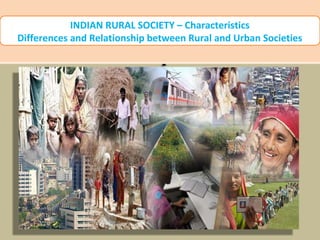
INDIAN RURAL SOCIETY – Characteristics
Differences and Relationship between Rural and Urban Societies
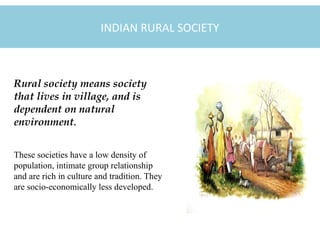
INDIAN RURAL SOCIETY
Rural society means society
that lives in village, and is
dependent on natural
environment.
These societies have a low density of
population, intimate group relationship
and are rich in culture and tradition. They
are socio-economically less developed.
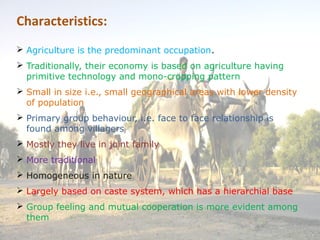
Characteristics:
 Agriculture is the predominant occupation.
 Traditionally, their economy is based on agriculture having
primitive technology and mono-cropping pattern
 Small in size i.e., small geographical areas with lower density
of population
 Primary group behaviour, i.e. face to face relationship is
found among villagers
 Mostly they live in joint family
 More traditional
 Homogeneous in nature
 Largely based on caste system, which has a hierarchial base
 Group feeling and mutual cooperation is more evident among
them
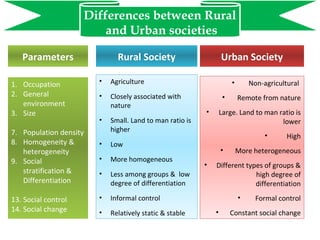
• Agriculture
• Closely associated with
nature
• Small. Land to man ratio is
higher
• Low
• More homogeneous
• Less among groups & low
degree of differentiation
• Informal control
• Relatively static & stable
• Non-agricultural
• Remote from nature
• Large. Land to man ratio is
lower
• High
• More heterogeneous
• Different types of groups &
high degree of
differentiation
• Formal control
• Constant social change
Differences between Rural
and Urban societies
Rural Society Urban SocietyParameters
1. Occupation
2. General
environment
3. Size
7. Population density
8. Homogeneity &
heterogeneity
9. Social
stratification &
Differentiation
13. Social control
14. Social change
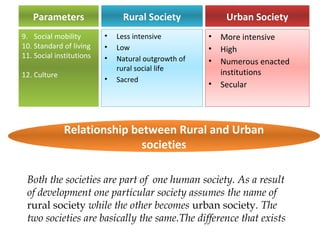
Parameters Rural Society Urban Society
9. Social mobility
10. Standard of living
11. Social institutions
12. Culture
• Less intensive
• Low
• Natural outgrowth of
rural social life
• Sacred
• More intensive
• High
• Numerous enacted
institutions
• Secular
Relationship between Rural and Urban
societies
Both the societies are part of one human society. As a result
of development one particular society assumes the name of
rural society while the other becomes urban society. The
two societies are basically the same.The difference that exists
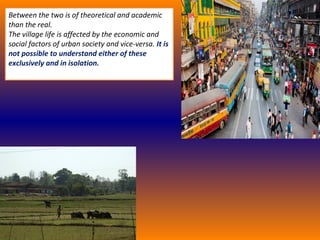
Between the two is of theoretical and academic
than the real.
The village life is affected by the economic and
social factors of urban society and vice-versa. It is
not possible to understand either of these
exclusively and in isolation.
PRESENTED BY
ANUP KUMAR

Indian rural society

  • 1.
    gg INDIAN RURAL SOCIETY– Characteristics Differences and Relationship between Rural and Urban Societies
  • 2.
    INDIAN RURAL SOCIETY Ruralsociety means society that lives in village, and is dependent on natural environment. These societies have a low density of population, intimate group relationship and are rich in culture and tradition. They are socio-economically less developed.
  • 3.
    Characteristics:  Agriculture isthe predominant occupation.  Traditionally, their economy is based on agriculture having primitive technology and mono-cropping pattern  Small in size i.e., small geographical areas with lower density of population  Primary group behaviour, i.e. face to face relationship is found among villagers  Mostly they live in joint family  More traditional  Homogeneous in nature  Largely based on caste system, which has a hierarchial base  Group feeling and mutual cooperation is more evident among them
  • 4.
    • Agriculture • Closelyassociated with nature • Small. Land to man ratio is higher • Low • More homogeneous • Less among groups & low degree of differentiation • Informal control • Relatively static & stable • Non-agricultural • Remote from nature • Large. Land to man ratio is lower • High • More heterogeneous • Different types of groups & high degree of differentiation • Formal control • Constant social change Differences between Rural and Urban societies Rural Society Urban SocietyParameters 1. Occupation 2. General environment 3. Size 7. Population density 8. Homogeneity & heterogeneity 9. Social stratification & Differentiation 13. Social control 14. Social change
  • 5.
    Parameters Rural SocietyUrban Society 9. Social mobility 10. Standard of living 11. Social institutions 12. Culture • Less intensive • Low • Natural outgrowth of rural social life • Sacred • More intensive • High • Numerous enacted institutions • Secular Relationship between Rural and Urban societies Both the societies are part of one human society. As a result of development one particular society assumes the name of rural society while the other becomes urban society. The two societies are basically the same.The difference that exists
  • 6.
    Between the twois of theoretical and academic than the real. The village life is affected by the economic and social factors of urban society and vice-versa. It is not possible to understand either of these exclusively and in isolation.
  • 7.