 Botanical name= Pachyrrhizus erosus
 Common name= Yam bean, Potato bean.
 Family= Leguminaceae
 Other name=Ahipa (South America)
Bunga (Philippainse)
Jicama (Mexico)
Ram-kaseru, Sankalu (India)
 The yam bean appears to have originated in
Mexico and Northern South America, in the head-
water region of the River Amazon and was
cultivated there in Pre-Columbian days.
 The Spaniards took it to the Philippines and it is
now cultivated and naturalised in the Philippines,
Cambodia, China, Indonesia, northern India as
well as in western and northern South America
and the Caribbean.
 A hairy twining herbaceous plant, woody at the base, trailing or
climbing to about 6 m.
 The leaves are alternate, trifoliate, with petioles 3-18 cm long
and ovate or rhomboidal leaflets
 which are toothed or lobed, about as broad as long, usually
large, in the range 4-20 cm.
 The flowers are in long axillary racemes, 1-5 borne in each of
several clusters along the peduncle; the petals are violet or
white, 1.5-2 cm long and broad.
 The pods are 7.5-15 cm long and about 1.5 cm broad,
flattened, almost smooth at maturity, containing 4-12 seeds
which are yellow, brown or red, almost square and flattened, 5-
10 mm in diameters.
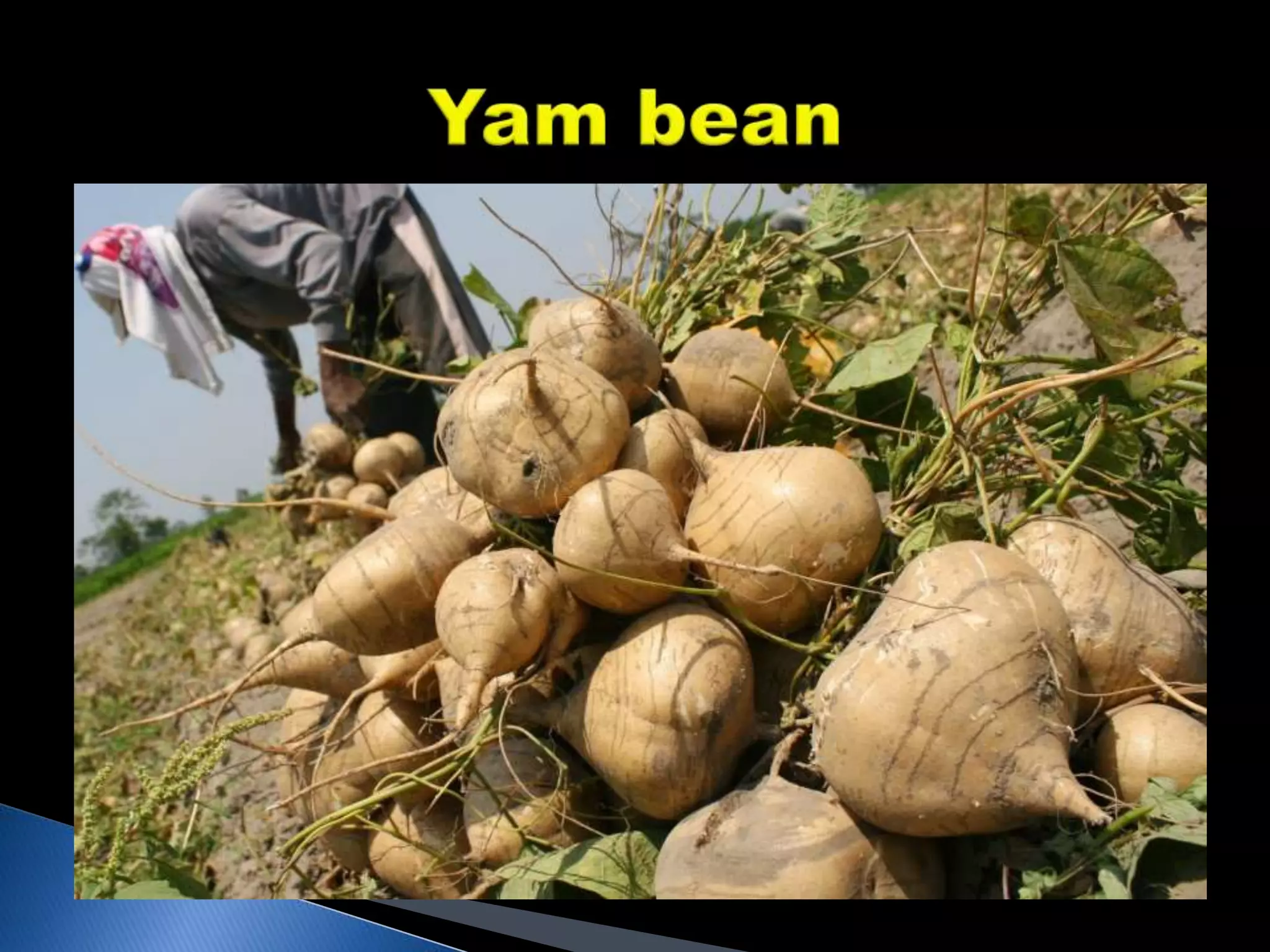
Tuberous roots, frequently turnip-shaped, are borne at the
base of the stem, and may be solitary or several, simple or
compound; normally they are about 10-15 cm in diameter.
This species shows considerable genetic variability, and
phenotypic studies have shown significant negative
correlation in some genotypes between root yield and days to
flowering, days to pod maturity and length of main stem.
A closely related species is P. tuberosus (Lam.) Spreng.,
which has entire leaflets, white flowers and longer pods,
usually 25-30 cm in length, with irritant hairs; the seeds are
kidney-shaped.
 Material-the yam bean is grown principally from seed, but it
can be grown from sprouted roots saved from the previous
crop.
 It has been recommended that this practice be followed to
maintain desirable characteristics in the plants.
 Method-the seeds are normally sown at the beginning of the
rains, either on the flat or in ridges; the latter gives better
results.
 Usually 2-3 seeds are placed in each hole and the plants
thinned out as necessary, or the seeds may be planted singly by
drill.
 The provision of bamboo trellises about 2.5 m high to support
the vines has been found beneficial, but is not essential.
 High yields, the application of a 12: 24: 12 NPK
fertiliser at the rate of 300-400 kg/ha before planting
has been recommended, followed by 200 kg/ha of
ammonium sulphate when the plants begin to climb.
 In addition, if the soil has been heavily cropped it is
suggested that it should receive 10 t/ha of compost or
FYM, about one month before planting.
 The yam bean is tolerant of various climates, but for
optimum yields it requires fairly high temperatures and a
moderate to high rainfall it grows well in the hot, wet
tropics.
 In Mexico, it is grown under irrigation and in the cooler
areas has a longer vegetative cycle.
 It is normally grown at altitudes below 1000 m.
 Soil-a well-cultivated sandy loam soil with adequate
drainage is essential.
 It will tolerate well-drained clay soils, but not heavy
soils liable to become waterlogged.
The crop is kept free from weeds and is often mulched to
help conserve soil moisture and prevent weed growth.
 Sometimes the plants are stopped or pruned in order to
encourage vegetative growth and the removal of the
flowers is reported to increase tuber yields and improve
their flavour.
 In the Philippines 20-25 kg/ha of seed is used for
planting, assuming a germination rate of 90-95 per
cent.
 In India, a higher seed rate, 50-70 kg/ha, is preferred.
 Field spacing-recommended seed spacing for India is
15 cm along rows 50 cm apart
 In the Philippines, a spacing of 10 cm in rows 15-20
cm apart is common practice, although it has been
shown experimentally that the yield of roots doubled
when a spacing of 15 x 15 cm was used.
 The crop normally reaches maturity in 5-8 months,
although in the warmer parts of Mexico a commercial
crop is obtained in about 3 months.
 If a seed crop is required, the growing period is
approximately 10 months.
 In Central America, the yam bean is reported to be subject
to attacks from the larvae of Thecla jebus and Ferrisia
virgata.
 In Mexico, the seeds are often attacked by weevils.
 In the Philippines, a mosaic disease has been noted, which
is caused by a systemic virus, transmitted through the seed
or root.
 A slight mottling or chlorosis and blistering of the leaves,
together with the production of very small tubers are
characteristic symptoms.
 A bacterial leaf spot caused by Pseudomonas syringae has
also been reported.
 The roots are usually dug manually, though with large-scale
production they are sometimes ploughed out.
 The tops are trimmed or removed entirely and the roots washed and
packed in baskets for market.
 Within 24 hours the creamy colour of the skin changes to a
purplish-brown, but this can be arrested if the roots are stored in the
dark at 9-10°C.
 They can be stored successfully for at least 2 months at
temperatures just above 0°C; older roots tend to store better than
tender immature ones.
 They can also be 'field-stored'; in Mexico, the normal practice is to
withhold irrigation water thus stopping growth and the roots remain
in good condition in the soil for 2-3 months.
 Just prior to lifting they are irrigated and absorb water, and can be
marketed in the usual way.
 Average yields of tuberous roots are about 7.5-20
t/ha, although yields as high as 95 t/ha have been
reported from the Philippines and Indonesia.
 Recent trials have shown considerable differences
from cultivar to cultivar and cv. Rajendra
Mishrikand-l has been reported from India to average
40 t/ha (twice the normal yield).
 The young tubers are eaten raw in salads, or cooked as a
vegetable, or in pickles and chutney.
 They are popular among the lower income groups in parts
of Latin America and the Caribbean.
 In the USA they are becoming increasingly used, both for
eating in their own right and as a substitute for Chinese
water chestnut.
 Subsidiary uses As the roots mature their starch content
increases and older roots are sometimes used as a source of
starch or for animal feeding.
 In China, the dried roots are reported to be used as a
cooling food for people with fever.
 Roots-the tuberous roots contain both starch and sugar
and are a moderately good source of ascorbic acid.
 Average figures for the edible portion have been
published as: energy 186-264 kJ/100 g; water 82.4-87.8
per cent; protein 1.5-2.4 per cent; fat 0.09-1.3 per cent;
carbohydrate 10.6-14.9 per cent; fibre 0.6-0.7 per cent;
ash 0.5 per cent; calcium 16-18 mg/100 g; iron 0.8-1.1
mg/100 g; thiamine 0.05-0.1 mg/100 g; riboflavin 0.02-
0.03 mg/100 g; niacin 0.2-0.3 mg/100 g; ascorbic acid
14-21 mg/100 g.
 Tuberous roots-which, as normally harvested, are 10-15
cm in diameter and weigh up to 2-2.5 kg: they have a
creamy surface and white, rather watery flesh. At this
stage they are crisp and succulent, with a pleasant,
sweet flavour. If left to grow they increase in size and
can reach 30 cm in diameter and weigh 5-18 kg, but
they become tough and unappetising. The tubers of P.
tuberosus are rather larger.
 Seed pods-the young seed pods of P. erosus are sometimes
eaten as a cooked vegetable, similarly to French beans, but
cannot so be used as the seeds develop.
 Seeds-the powdered seeds are sometimes used as an
insecticide or fish poison.
In Indonesia, the pulverised seeds mixed with sulphur are
applied to certain types of skin eruption.
 One half seed may be taken as a laxative, though it is stated
that if poisoning occurs coconut water will counteract it.
 It is, however, reported that the oil in the seeds resembles
cottonseed oil and may be used for cooking.
 Stems-the stems yield a tough fibre, which is
sometimes used for making fishing nets in Fiji.
 Animal feed-it has been reported that the whole plant is
sometimes used as fodder, and is best for this purpose
when harvested at the 50 per cent flowering stage.
however, the leaves and seeds are both toxic (the leaves
less so than the seeds) and grazing among mature plants
can be fatal to animals.
 The use of processed (mainly canned) roots is increasing,
both as a starchy food in its own right, and as a substitute
for Chinese water chestnut (Eleocharis dulcis).
 Very large tubers are woody and unsuitable; roots of about
10 cm diameter and weighing about I kg are preferable.
 The inner layers of the rind contain thick layers of fibrous
material which are difficult to remove mechanically, but Iye
peeling by immersion for about 10 minutes in 18 per cent
sodium hydroxide solution at 95-99°C appears to be
practicable.
 Discoloration of the surface of the peeled roots resulting
from this treatment may be removed by bleaching with
hydrogen peroxide.
 There is little information about production and trade in
yam beans, despite their popularity in parts of Latin
America and the Caribbean.
 There is some demand from the USA, mainly
California, for yam bean roots from Mexico, as they are
used as a substitute for the Chinese water chestnut.
Yam bean

Yam bean

  • 2.
     Botanical name=Pachyrrhizus erosus  Common name= Yam bean, Potato bean.  Family= Leguminaceae  Other name=Ahipa (South America) Bunga (Philippainse) Jicama (Mexico) Ram-kaseru, Sankalu (India)
  • 3.
     The yambean appears to have originated in Mexico and Northern South America, in the head- water region of the River Amazon and was cultivated there in Pre-Columbian days.  The Spaniards took it to the Philippines and it is now cultivated and naturalised in the Philippines, Cambodia, China, Indonesia, northern India as well as in western and northern South America and the Caribbean.
  • 4.
     A hairytwining herbaceous plant, woody at the base, trailing or climbing to about 6 m.  The leaves are alternate, trifoliate, with petioles 3-18 cm long and ovate or rhomboidal leaflets  which are toothed or lobed, about as broad as long, usually large, in the range 4-20 cm.  The flowers are in long axillary racemes, 1-5 borne in each of several clusters along the peduncle; the petals are violet or white, 1.5-2 cm long and broad.  The pods are 7.5-15 cm long and about 1.5 cm broad, flattened, almost smooth at maturity, containing 4-12 seeds which are yellow, brown or red, almost square and flattened, 5- 10 mm in diameters.
  • 5.
    Tuberous roots, frequentlyturnip-shaped, are borne at the base of the stem, and may be solitary or several, simple or compound; normally they are about 10-15 cm in diameter. This species shows considerable genetic variability, and phenotypic studies have shown significant negative correlation in some genotypes between root yield and days to flowering, days to pod maturity and length of main stem. A closely related species is P. tuberosus (Lam.) Spreng., which has entire leaflets, white flowers and longer pods, usually 25-30 cm in length, with irritant hairs; the seeds are kidney-shaped.
  • 6.
     Material-the yambean is grown principally from seed, but it can be grown from sprouted roots saved from the previous crop.  It has been recommended that this practice be followed to maintain desirable characteristics in the plants.  Method-the seeds are normally sown at the beginning of the rains, either on the flat or in ridges; the latter gives better results.  Usually 2-3 seeds are placed in each hole and the plants thinned out as necessary, or the seeds may be planted singly by drill.  The provision of bamboo trellises about 2.5 m high to support the vines has been found beneficial, but is not essential.
  • 7.
     High yields,the application of a 12: 24: 12 NPK fertiliser at the rate of 300-400 kg/ha before planting has been recommended, followed by 200 kg/ha of ammonium sulphate when the plants begin to climb.  In addition, if the soil has been heavily cropped it is suggested that it should receive 10 t/ha of compost or FYM, about one month before planting.
  • 8.
     The yambean is tolerant of various climates, but for optimum yields it requires fairly high temperatures and a moderate to high rainfall it grows well in the hot, wet tropics.  In Mexico, it is grown under irrigation and in the cooler areas has a longer vegetative cycle.  It is normally grown at altitudes below 1000 m.
  • 9.
     Soil-a well-cultivatedsandy loam soil with adequate drainage is essential.  It will tolerate well-drained clay soils, but not heavy soils liable to become waterlogged. The crop is kept free from weeds and is often mulched to help conserve soil moisture and prevent weed growth.  Sometimes the plants are stopped or pruned in order to encourage vegetative growth and the removal of the flowers is reported to increase tuber yields and improve their flavour.
  • 10.
     In thePhilippines 20-25 kg/ha of seed is used for planting, assuming a germination rate of 90-95 per cent.  In India, a higher seed rate, 50-70 kg/ha, is preferred.
  • 11.
     Field spacing-recommendedseed spacing for India is 15 cm along rows 50 cm apart  In the Philippines, a spacing of 10 cm in rows 15-20 cm apart is common practice, although it has been shown experimentally that the yield of roots doubled when a spacing of 15 x 15 cm was used.
  • 12.
     The cropnormally reaches maturity in 5-8 months, although in the warmer parts of Mexico a commercial crop is obtained in about 3 months.  If a seed crop is required, the growing period is approximately 10 months.
  • 13.
     In CentralAmerica, the yam bean is reported to be subject to attacks from the larvae of Thecla jebus and Ferrisia virgata.  In Mexico, the seeds are often attacked by weevils.  In the Philippines, a mosaic disease has been noted, which is caused by a systemic virus, transmitted through the seed or root.  A slight mottling or chlorosis and blistering of the leaves, together with the production of very small tubers are characteristic symptoms.  A bacterial leaf spot caused by Pseudomonas syringae has also been reported.
  • 14.
     The rootsare usually dug manually, though with large-scale production they are sometimes ploughed out.  The tops are trimmed or removed entirely and the roots washed and packed in baskets for market.  Within 24 hours the creamy colour of the skin changes to a purplish-brown, but this can be arrested if the roots are stored in the dark at 9-10°C.  They can be stored successfully for at least 2 months at temperatures just above 0°C; older roots tend to store better than tender immature ones.  They can also be 'field-stored'; in Mexico, the normal practice is to withhold irrigation water thus stopping growth and the roots remain in good condition in the soil for 2-3 months.  Just prior to lifting they are irrigated and absorb water, and can be marketed in the usual way.
  • 15.
     Average yieldsof tuberous roots are about 7.5-20 t/ha, although yields as high as 95 t/ha have been reported from the Philippines and Indonesia.  Recent trials have shown considerable differences from cultivar to cultivar and cv. Rajendra Mishrikand-l has been reported from India to average 40 t/ha (twice the normal yield).
  • 16.
     The youngtubers are eaten raw in salads, or cooked as a vegetable, or in pickles and chutney.  They are popular among the lower income groups in parts of Latin America and the Caribbean.  In the USA they are becoming increasingly used, both for eating in their own right and as a substitute for Chinese water chestnut.  Subsidiary uses As the roots mature their starch content increases and older roots are sometimes used as a source of starch or for animal feeding.  In China, the dried roots are reported to be used as a cooling food for people with fever.
  • 17.
     Roots-the tuberousroots contain both starch and sugar and are a moderately good source of ascorbic acid.  Average figures for the edible portion have been published as: energy 186-264 kJ/100 g; water 82.4-87.8 per cent; protein 1.5-2.4 per cent; fat 0.09-1.3 per cent; carbohydrate 10.6-14.9 per cent; fibre 0.6-0.7 per cent; ash 0.5 per cent; calcium 16-18 mg/100 g; iron 0.8-1.1 mg/100 g; thiamine 0.05-0.1 mg/100 g; riboflavin 0.02- 0.03 mg/100 g; niacin 0.2-0.3 mg/100 g; ascorbic acid 14-21 mg/100 g.
  • 18.
     Tuberous roots-which,as normally harvested, are 10-15 cm in diameter and weigh up to 2-2.5 kg: they have a creamy surface and white, rather watery flesh. At this stage they are crisp and succulent, with a pleasant, sweet flavour. If left to grow they increase in size and can reach 30 cm in diameter and weigh 5-18 kg, but they become tough and unappetising. The tubers of P. tuberosus are rather larger.
  • 19.
     Seed pods-theyoung seed pods of P. erosus are sometimes eaten as a cooked vegetable, similarly to French beans, but cannot so be used as the seeds develop.  Seeds-the powdered seeds are sometimes used as an insecticide or fish poison. In Indonesia, the pulverised seeds mixed with sulphur are applied to certain types of skin eruption.  One half seed may be taken as a laxative, though it is stated that if poisoning occurs coconut water will counteract it.  It is, however, reported that the oil in the seeds resembles cottonseed oil and may be used for cooking.
  • 20.
     Stems-the stemsyield a tough fibre, which is sometimes used for making fishing nets in Fiji.  Animal feed-it has been reported that the whole plant is sometimes used as fodder, and is best for this purpose when harvested at the 50 per cent flowering stage. however, the leaves and seeds are both toxic (the leaves less so than the seeds) and grazing among mature plants can be fatal to animals.
  • 21.
     The useof processed (mainly canned) roots is increasing, both as a starchy food in its own right, and as a substitute for Chinese water chestnut (Eleocharis dulcis).  Very large tubers are woody and unsuitable; roots of about 10 cm diameter and weighing about I kg are preferable.  The inner layers of the rind contain thick layers of fibrous material which are difficult to remove mechanically, but Iye peeling by immersion for about 10 minutes in 18 per cent sodium hydroxide solution at 95-99°C appears to be practicable.  Discoloration of the surface of the peeled roots resulting from this treatment may be removed by bleaching with hydrogen peroxide.
  • 22.
     There islittle information about production and trade in yam beans, despite their popularity in parts of Latin America and the Caribbean.  There is some demand from the USA, mainly California, for yam bean roots from Mexico, as they are used as a substitute for the Chinese water chestnut.