“SOCIALIZATION
ACROSS THE LIFE
CYCLE”
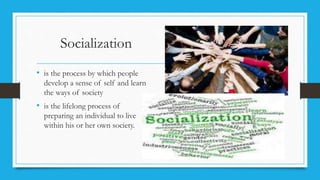
Socialization
• is the process by which people
develop a sense of self and learn
the ways of society
• is the lifelong process of
preparing an individual to live
within his or her own society.
Agents of socialization:
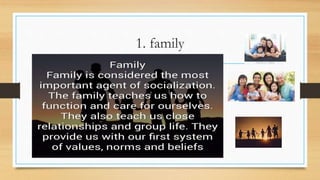
1. family
family
2. school
• school
3. Mass media
• It is a form of communication directed to
large audiences and includes TV, radio,
newspapers, and magazines. It entertain us
and shape our attitudes and values.
• Mass media bombards youth with
advertising while socializing other age group
to the music and style of the youth
subculture.
Stages/ Process of socialization:
1. oral stage
• It is a stage which begins from birth till one year.
• During this stage, the child cries for everything as
this is the only wat it can communicate its need.
• At the first year of its life, the child’s contact with
the outside world through the mouth and lips.
• Freud called this stage as “primary identification”.
• Crying and smiling are forms of early social
behavior.
2. Anal stage
• During this stage the child learns
that one cannot totally depend on
the mother for everything.
• The child undergoes toilet training
and acquires other skills.
• It is taught to distinguish between
wrong and right actions trough
system of reward and punishment.
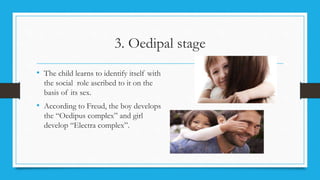
3. Oedipal stage
• The child learns to identify itself with
the social role ascribed to it on the
basis of its sex.
• According to Freud, the boy develops
the “Oedipus complex” and girl
develop “Electra complex”.
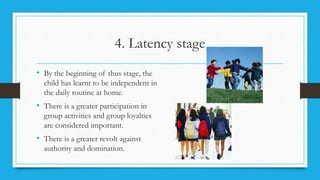
4. Latency stage
• By the beginning of thus stage, the
child has learnt to be independent in
the daily routine at home.
• There is a greater participation in
group activities and group loyalties
are considered important.
• There is a greater revolt against
authority and domination.
5. Adolescence stage
• This stage starts with the onset of puberty and
continue through the teenage years.
• The adolescent undergoes a number of physiological
changes.
• Boys and girls try to break free from parental control.
• The individual is more attracted to members of the
opposite sex.
• It is more generally to various recreational activities.
Work cited:
https://www.slideshare.net/SLazio-Maimone/socialization-
across-the-life-cycle
Thank u!!!!!!!

SOCIALIZATION

  • 1.
  • 2.
    Socialization • is theprocess by which people develop a sense of self and learn the ways of society • is the lifelong process of preparing an individual to live within his or her own society.
  • 3.
  • 4.
  • 5.
  • 6.
    3. Mass media •It is a form of communication directed to large audiences and includes TV, radio, newspapers, and magazines. It entertain us and shape our attitudes and values. • Mass media bombards youth with advertising while socializing other age group to the music and style of the youth subculture.
  • 7.
    Stages/ Process ofsocialization:
  • 8.
    1. oral stage •It is a stage which begins from birth till one year. • During this stage, the child cries for everything as this is the only wat it can communicate its need. • At the first year of its life, the child’s contact with the outside world through the mouth and lips. • Freud called this stage as “primary identification”. • Crying and smiling are forms of early social behavior.
  • 9.
    2. Anal stage •During this stage the child learns that one cannot totally depend on the mother for everything. • The child undergoes toilet training and acquires other skills. • It is taught to distinguish between wrong and right actions trough system of reward and punishment.
  • 10.
    3. Oedipal stage •The child learns to identify itself with the social role ascribed to it on the basis of its sex. • According to Freud, the boy develops the “Oedipus complex” and girl develop “Electra complex”.
  • 11.
    4. Latency stage •By the beginning of thus stage, the child has learnt to be independent in the daily routine at home. • There is a greater participation in group activities and group loyalties are considered important. • There is a greater revolt against authority and domination.
  • 12.
    5. Adolescence stage •This stage starts with the onset of puberty and continue through the teenage years. • The adolescent undergoes a number of physiological changes. • Boys and girls try to break free from parental control. • The individual is more attracted to members of the opposite sex. • It is more generally to various recreational activities.
  • 13.
  • 14.