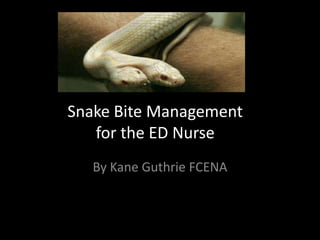
Snake Bite Management
for the ED Nurse
By Kane Guthrie FCENA
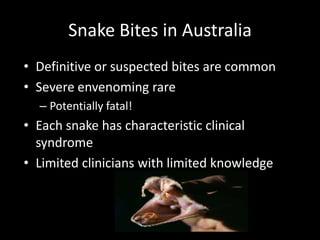
Snake Bites in Australia
• Definitive or suspected bites are common
• Severe envenoming rare
– Potentially fatal!
• Each snake has characteristic clinical
syndrome
• Limited clinicians with limited knowledge
Quiz
• How many poisonous snakes
do we have in Australia?
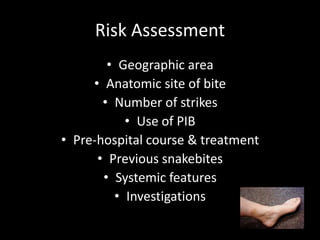
Risk Assessment
• Geographic area
• Anatomic site of bite
• Number of strikes
• Use of PIB
• Pre-hospital course & treatment
• Previous snakebites
• Systemic features
• Investigations
Physical Exam
• Vital Signs
• Mental Status
• Evidence of bite
• Lymphadenopathy
• Evidence of abnormal bleeding
• Signs of paralysis
• Respiratory Function
Investigations
• Whole blood clotting (resource limited)
• FBC
• Coagulation profile
• Fribrinogen, D-Dimer
• U & E, CK
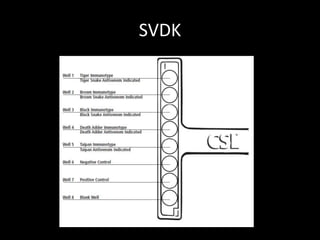
Snake Venom Detection Kit
• Dose not determine if envenomed or not!
• Useful test to:
– Confirm which one 5 groups responsible for
envenoming.
– Helps determine which antivenom is required.
– Best done in laboratory.
– Use bite site swabs or urine.
• Use geographic area & clinical exam
alongside!
SVDK
Clinical Effects
Non Specific:
• Nausea & vomiting
• Headache
• Abdominal Pain
• Diarrhoea
• Dizziness
• Collapse
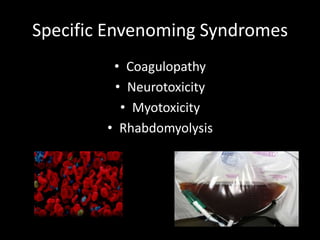
Specific Envenoming Syndromes
• Coagulopathy
• Neurotoxicity
• Myotoxicity
• Rhabdomyolysis
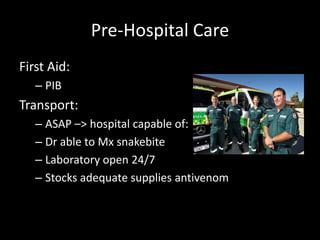
Pre-Hospital Care
First Aid:
– PIB
Transport:
– ASAP –> hospital capable of:
– Dr able to Mx snakebite
– Laboratory open 24/7
– Stocks adequate supplies antivenom
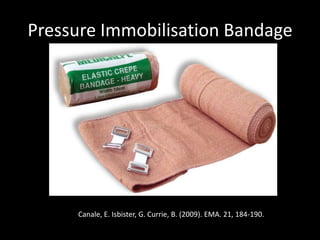
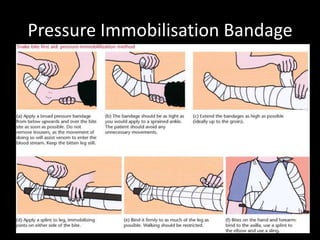
Pressure Immobilisation Bandage
Canale, E. Isbister, G. Currie, B. (2009). EMA. 21, 184-190.
Pressure Immobilisation Bandage
In-Hospital
• Resus Bay
• Get help – consider PIC 131126
• Determine if envenomed:
– History
– Physical exam
– Laboratory investigations/SVDK
• Determine if antivenom required
• Supportive care and treatment (ADT)
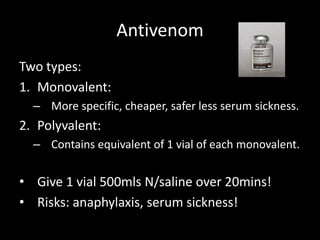
Antivenom
Two types:
1. Monovalent:
– More specific, cheaper, safer less serum sickness.
2. Polyvalent:
– Contains equivalent of 1 vial of each monovalent.
• Give 1 vial 500mls N/saline over 20mins!
• Risks: anaphylaxis, serum sickness!
Major Types: by Clinical Syndromes
5 major groups:
1. Brown Snakes
2. Tiger Snakes
3. Mulga/black snakes
4. Taipans
5. Death Adders
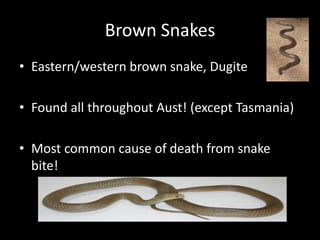
Brown Snakes
• Eastern/western brown snake, Dugite
• Found all throughout Aust! (except Tasmania)
• Most common cause of death from snake
bite!
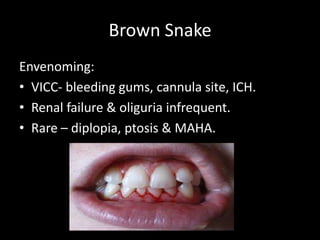
Brown Snake
Envenoming:
• VICC- bleeding gums, cannula site, ICH.
• Renal failure & oliguria infrequent.
• Rare – diplopia, ptosis & MAHA.
Brown Snake
Management:
1. PIB- Resus bay
2. Check Coag’s FBC and U&E
Signs of Envenomation:
• 1 vial of CSL brown snake antivenom
• Serial coag test to check if safe for D/C
• New recommendation only 1 vial!
• White, I. Buckley, N. (2012) Antivenom Update. Australian Prescriber (35, 5).
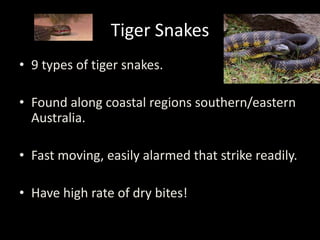
Tiger Snakes
• 9 types of tiger snakes.
• Found along coastal regions southern/eastern
Australia.
• Fast moving, easily alarmed that strike readily.
• Have high rate of dry bites!
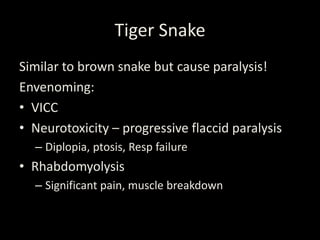
Tiger Snake
Similar to brown snake but cause paralysis!
Envenoming:
• VICC
• Neurotoxicity – progressive flaccid paralysis
– Diplopia, ptosis, Resp failure
• Rhabdomyolysis
– Significant pain, muscle breakdown
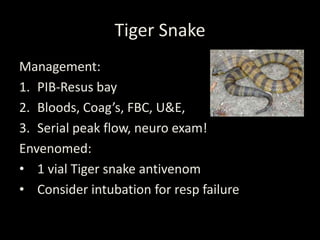
Tiger Snake
Management:
1. PIB-Resus bay
2. Bloods, Coag’s, FBC, U&E,
3. Serial peak flow, neuro exam!
Envenomed:
• 1 vial Tiger snake antivenom
• Consider intubation for resp failure
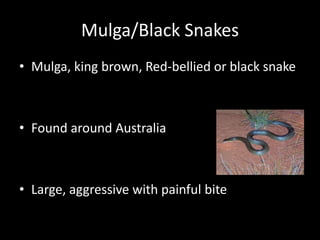
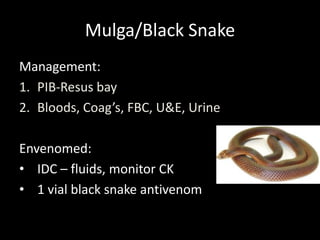
Mulga/Black Snakes
• Mulga, king brown, Red-bellied or black snake
• Found around Australia
• Large, aggressive with painful bite
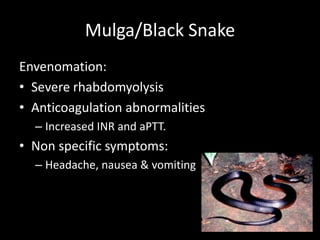
Mulga/Black Snake
Envenomation:
• Severe rhabdomyolysis
• Anticoagulation abnormalities
– Increased INR and aPTT.
• Non specific symptoms:
– Headache, nausea & vomiting
Mulga/Black Snake
Management:
1. PIB-Resus bay
2. Bloods, Coag’s, FBC, U&E, Urine
Envenomed:
• IDC – fluids, monitor CK
• 1 vial black snake antivenom
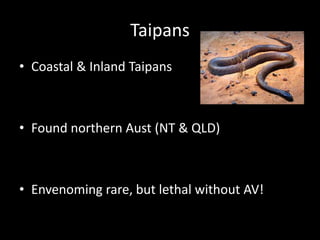
Taipans
• Coastal & Inland Taipans
• Found northern Aust (NT & QLD)
• Envenoming rare, but lethal without AV!
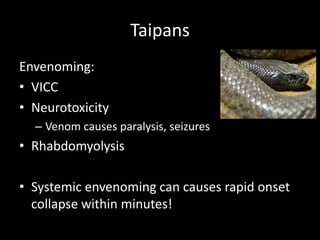
Taipans
Envenoming:
• VICC
• Neurotoxicity
– Venom causes paralysis, seizures
• Rhabdomyolysis
• Systemic envenoming can causes rapid onset
collapse within minutes!
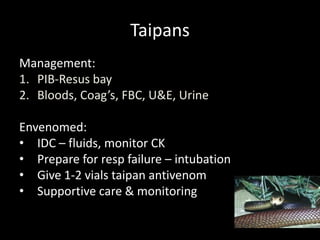
Taipans
Management:
1. PIB-Resus bay
2. Bloods, Coag’s, FBC, U&E, Urine
Envenomed:
• IDC – fluids, monitor CK
• Prepare for resp failure – intubation
• Give 1-2 vials taipan antivenom
• Supportive care & monitoring
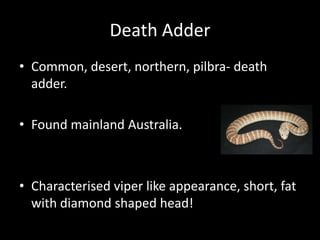
Death Adder
• Common, desert, northern, pilbra- death
adder.
• Found mainland Australia.
• Characterised viper like appearance, short, fat
with diamond shaped head!
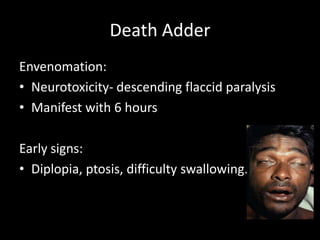
Death Adder
Envenomation:
• Neurotoxicity- descending flaccid paralysis
• Manifest with 6 hours
Early signs:
• Diplopia, ptosis, difficulty swallowing.
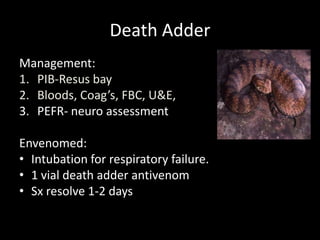
Death Adder
Management:
1. PIB-Resus bay
2. Bloods, Coag’s, FBC, U&E,
3. PEFR- neuro assessment
Envenomed:
• Intubation for respiratory failure.
• 1 vial death adder antivenom
• Sx resolve 1-2 days
Questions
Take Home Points
• PIB always!
• Envenomation is rare!
• 1 vial of antivenom is usually suffice!
• Make use of the experts!
Thank-you

Snake Bite Management for the ED Nurse

  • 1.
    Snake Bite Management forthe ED Nurse By Kane Guthrie FCENA
  • 2.
    Snake Bites inAustralia • Definitive or suspected bites are common • Severe envenoming rare – Potentially fatal! • Each snake has characteristic clinical syndrome • Limited clinicians with limited knowledge
  • 3.
    Quiz • How manypoisonous snakes do we have in Australia?
  • 4.
    Risk Assessment • Geographicarea • Anatomic site of bite • Number of strikes • Use of PIB • Pre-hospital course & treatment • Previous snakebites • Systemic features • Investigations
  • 5.
    Physical Exam • VitalSigns • Mental Status • Evidence of bite • Lymphadenopathy • Evidence of abnormal bleeding • Signs of paralysis • Respiratory Function
  • 6.
    Investigations • Whole bloodclotting (resource limited) • FBC • Coagulation profile • Fribrinogen, D-Dimer • U & E, CK
  • 7.
    Snake Venom DetectionKit • Dose not determine if envenomed or not! • Useful test to: – Confirm which one 5 groups responsible for envenoming. – Helps determine which antivenom is required. – Best done in laboratory. – Use bite site swabs or urine. • Use geographic area & clinical exam alongside!
  • 8.
  • 9.
    Clinical Effects Non Specific: •Nausea & vomiting • Headache • Abdominal Pain • Diarrhoea • Dizziness • Collapse
  • 10.
    Specific Envenoming Syndromes •Coagulopathy • Neurotoxicity • Myotoxicity • Rhabdomyolysis
  • 11.
    Pre-Hospital Care First Aid: –PIB Transport: – ASAP –> hospital capable of: – Dr able to Mx snakebite – Laboratory open 24/7 – Stocks adequate supplies antivenom
  • 12.
    Pressure Immobilisation Bandage Canale,E. Isbister, G. Currie, B. (2009). EMA. 21, 184-190.
  • 13.
  • 14.
    In-Hospital • Resus Bay •Get help – consider PIC 131126 • Determine if envenomed: – History – Physical exam – Laboratory investigations/SVDK • Determine if antivenom required • Supportive care and treatment (ADT)
  • 15.
    Antivenom Two types: 1. Monovalent: –More specific, cheaper, safer less serum sickness. 2. Polyvalent: – Contains equivalent of 1 vial of each monovalent. • Give 1 vial 500mls N/saline over 20mins! • Risks: anaphylaxis, serum sickness!
  • 16.
    Major Types: byClinical Syndromes 5 major groups: 1. Brown Snakes 2. Tiger Snakes 3. Mulga/black snakes 4. Taipans 5. Death Adders
  • 17.
    Brown Snakes • Eastern/westernbrown snake, Dugite • Found all throughout Aust! (except Tasmania) • Most common cause of death from snake bite!
  • 18.
    Brown Snake Envenoming: • VICC-bleeding gums, cannula site, ICH. • Renal failure & oliguria infrequent. • Rare – diplopia, ptosis & MAHA.
  • 19.
    Brown Snake Management: 1. PIB-Resus bay 2. Check Coag’s FBC and U&E Signs of Envenomation: • 1 vial of CSL brown snake antivenom • Serial coag test to check if safe for D/C • New recommendation only 1 vial! • White, I. Buckley, N. (2012) Antivenom Update. Australian Prescriber (35, 5).
  • 20.
    Tiger Snakes • 9types of tiger snakes. • Found along coastal regions southern/eastern Australia. • Fast moving, easily alarmed that strike readily. • Have high rate of dry bites!
  • 21.
    Tiger Snake Similar tobrown snake but cause paralysis! Envenoming: • VICC • Neurotoxicity – progressive flaccid paralysis – Diplopia, ptosis, Resp failure • Rhabdomyolysis – Significant pain, muscle breakdown
  • 22.
    Tiger Snake Management: 1. PIB-Resusbay 2. Bloods, Coag’s, FBC, U&E, 3. Serial peak flow, neuro exam! Envenomed: • 1 vial Tiger snake antivenom • Consider intubation for resp failure
  • 23.
    Mulga/Black Snakes • Mulga,king brown, Red-bellied or black snake • Found around Australia • Large, aggressive with painful bite
  • 24.
    Mulga/Black Snake Envenomation: • Severerhabdomyolysis • Anticoagulation abnormalities – Increased INR and aPTT. • Non specific symptoms: – Headache, nausea & vomiting
  • 25.
    Mulga/Black Snake Management: 1. PIB-Resusbay 2. Bloods, Coag’s, FBC, U&E, Urine Envenomed: • IDC – fluids, monitor CK • 1 vial black snake antivenom
  • 26.
    Taipans • Coastal &Inland Taipans • Found northern Aust (NT & QLD) • Envenoming rare, but lethal without AV!
  • 27.
    Taipans Envenoming: • VICC • Neurotoxicity –Venom causes paralysis, seizures • Rhabdomyolysis • Systemic envenoming can causes rapid onset collapse within minutes!
  • 28.
    Taipans Management: 1. PIB-Resus bay 2.Bloods, Coag’s, FBC, U&E, Urine Envenomed: • IDC – fluids, monitor CK • Prepare for resp failure – intubation • Give 1-2 vials taipan antivenom • Supportive care & monitoring
  • 29.
    Death Adder • Common,desert, northern, pilbra- death adder. • Found mainland Australia. • Characterised viper like appearance, short, fat with diamond shaped head!
  • 30.
    Death Adder Envenomation: • Neurotoxicity-descending flaccid paralysis • Manifest with 6 hours Early signs: • Diplopia, ptosis, difficulty swallowing.
  • 31.
    Death Adder Management: 1. PIB-Resusbay 2. Bloods, Coag’s, FBC, U&E, 3. PEFR- neuro assessment Envenomed: • Intubation for respiratory failure. • 1 vial death adder antivenom • Sx resolve 1-2 days
  • 32.
  • 33.
    Take Home Points •PIB always! • Envenomation is rare! • 1 vial of antivenom is usually suffice! • Make use of the experts!
  • 34.