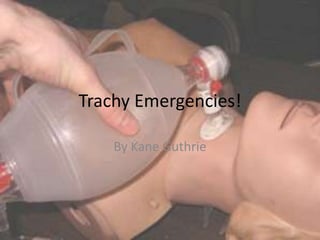
Trachy Emergencies!

    By Kane Guthrie
Objectives
•   A brief look at tracheostomy emergencies.
•   Indications for tracheostomy.
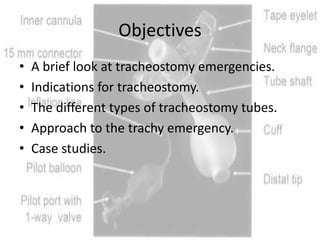
•   The different types of tracheostomy tubes.
•   Approach to the trachy emergency.
•   Case studies.
The Trachy!
Tracheotomy:
  ‘is a surgical incision into the trachea for the
         purpose of establishing an airway”

Tracheostomy
  ‘is the stoma (opening) that results from the
                   tracheotomy”
The Tube’s


• Tracheostomy tubes are devices that aid
  passage of air into the lungs for effective
                respirations.
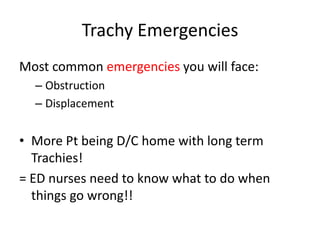
Trachy Emergencies
Most common emergencies you will face:
  – Obstruction
  – Displacement


• More Pt being D/C home with long term
  Trachies!
= ED nurses need to know what to do when
  things go wrong!!
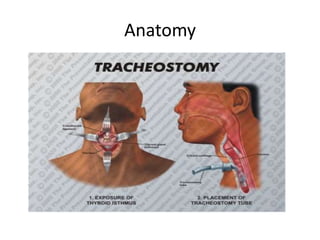
Anatomy
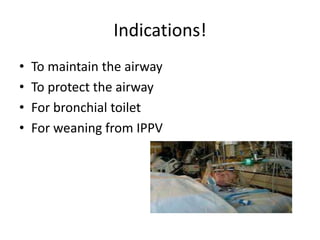
Indications!
•   To maintain the airway
•   To protect the airway
•   For bronchial toilet
•   For weaning from IPPV
Cautions & Contraindications
 •   Difficult anatomy
 •   Moderate coagulopathy
 •   Proximity to site of recent surgery or trauma
 •   Localised infection
 •   Severe gas exchange problems

Patients generally requiring an emergency trachy don’t have the luxury of having these
conditions corrected before hand!
Patient Benefits!
•   Less risk of long-term airway damage.
•   Patient comfort – no tube in mouth!
•   Some can eat & talk!
•   Tube more secure some patients can mobilise.
The Types!
Surgical:


Percutaneous:
Surgical
• Normally done electively (ICU,OT)
• Can be done @ bedside (emergently)
• 3-5cm incision 1 cm below cricoid
• Done under general or local anaesthetic.
Procedure
  – Dissection down to the trachea, surgical incision is
    made in “T” shape, between 2nd& 3 rd tracheal
    rings.
Percutaneous
• Done in emergency circumstance where
  theater is not an option.

Procedure:
  – No surgical incision required- opening is made via
    percutaneous “stab” into trachea.
Emergency
• Emergency circumstance requiring extreme
  measure to secure the airway
• Cricothroidotomy

• Procedure:
  – Percutaneous stab into trachea to provide an
    opening and allow ventilation.
  – Scalpel-bougie, Scalpel –finger, Ball point pen!
The Types
Cuffed:


Uncuffed:
The Types
1. Cuffed and uncuffed
2. Fenestrated and unfenestrated
3. Those with inner cannulas and those without
Cuffed Vs Uncuffed
• Used initially           • Used long term
• Reduces aspiration,      • Pt needs reasonable
  foreign matter in          bulbar function to clear
  airway.                    own secretions
• Prevents air escape in
  MV.
• Cuff pressure 15-
  25mmHg.
• Use in emergencies!
Fenestrated
Fenestrated:
• Has pre-cut opening in posterior aspect of
  tube.
• Facilitates air entry through the tube and
  allows speech.
• Has 2 tube’s one that allows suctioning, eating
  & during sleep, the other allows talking.
Inner cannula
• Have an inner tube that allows removal if
  becomes obstructed to allow removal &
  cleaning
• Reduce potentially life threatening
  complications.
• Increases the WOB.
The Size’s


             www.resusroom.com
Immediate Complications
•   Bleeding
•   Pneumothorax or pneumomedistinum
•   Injury to adjacent structures
•   Post obstructive APO
Early Complications
•   Bleeding RT - HT or coughing
•   Mucous Plugging
•   Tracheitis
•   Cellulitis
•   Displacement of tube- false passage
•   SubQ emphysema
•   Atelectasis
Late Complications
•   Swallowing problems
•   Tracheal stenosis
•   Tracheo-inominate artery fistula
•   Tracheoesophageal fistula
•   Granuloma formation
When to Suction?
• Course breath sounds (crackles)
• Noisy Breathing
• ∧or ∨ resp rate
• ∨ Sp02
• Copious secretions
• Pt attempting but unable to cough or clear
  secretions
• Distressed or agitation
Factors that can Contribute to
                Emergencies!
•   Overproduction of sputum
•   Coughing
•   Irritation of the trachea
•   Undue movement of the tube
•   Multiple suctioning attempts
•   Dry, hardened secretions –sputum plug
•   Cuff integrity compromised
•   Vomitus or aspiration of stomach contents
The Approach
• Is the tracheostomy tube displaced or
  obstructed?
• Is the tube cuffed or uncuffed?
• How old is the tract?
• What is the size of the tube?
• Why was the tube placed?
Case 1
•   28 male P1 ambulance
•   Known Quad with long term trachy.
•   P/C: ?Blocked trachy
•   0/A: Cyanosed lips, not moving air.
•   V/S: Spo2 70%, HR 145, GCS 8

What do you do?
Blocked Trachy
• Apply O2 to mouth and trachy
• Try Suctioning – remove inner cannula.
• Partial occlusion use saline Nebs,
  humidification, suctioning.
• If fail try BVM – push down occlusion into
  lungs.
• Change trachy tube or re-intubate!
The Blocked Trachy
Case 2
•   74 male known throat ca
•   Long term trachy - fenestrated
•   P/C Trachy fallen out
•   O/A: Mild resp distress, unable to talk/
•   V/S: RR 22, Spo2 90%, Bp 138/84,

• What do you do?
The Dislodged Trachy
• Completely dislodged vs. false passage!
• Most prevalent in newly created trachy!
• Occurs with forceful coughing and poorly
  secured trachy.
The Dislodged Trachy
• Replace with same size or smaller.
• May need trachy dilators and bougie to assist.
• Trachy set not available use small ETT.
• Check correct placement – pass suction
  catheter, Etco2, clinical improvement,
  auscultation, CXR.
• R/F to ENT.
Take Home Points
• Trachy emergencies generally uncommon!
• Have an approach!
• Know how to suction!
• Provide O2 to trachy and to mouth if
  distressed!
• Always change to cuffed tube in emergencies!
• Same size or smaller or just use an ETT!
Questions?
References:

• www.resusroom.com/
• SCGH- Tracheostomy Education package.
• Hess, D. (2005). Tracheostomy Tubes and Related
  Appliances. Respiratory Care. 50(4), 497-510.
• De Leyn, P. et.al. (2007). Tracheotomy: clinical
  review and guidelines. European journal of
  Cardio-thoracic surgery. 412-421.
• Jordan, S. & Gay, S. (2002).Tracheostomy
  Emergencies. American Journal of Nursing.
  102(3), 59-63.

Trachy Emergencies

  • 1.
    Trachy Emergencies! By Kane Guthrie
  • 2.
    Objectives • A brief look at tracheostomy emergencies. • Indications for tracheostomy. • The different types of tracheostomy tubes. • Approach to the trachy emergency. • Case studies.
  • 3.
    The Trachy! Tracheotomy: ‘is a surgical incision into the trachea for the purpose of establishing an airway” Tracheostomy ‘is the stoma (opening) that results from the tracheotomy”
  • 4.
    The Tube’s • Tracheostomytubes are devices that aid passage of air into the lungs for effective respirations.
  • 5.
    Trachy Emergencies Most commonemergencies you will face: – Obstruction – Displacement • More Pt being D/C home with long term Trachies! = ED nurses need to know what to do when things go wrong!!
  • 6.
  • 7.
    Indications! • To maintain the airway • To protect the airway • For bronchial toilet • For weaning from IPPV
  • 8.
    Cautions & Contraindications • Difficult anatomy • Moderate coagulopathy • Proximity to site of recent surgery or trauma • Localised infection • Severe gas exchange problems Patients generally requiring an emergency trachy don’t have the luxury of having these conditions corrected before hand!
  • 9.
    Patient Benefits! • Less risk of long-term airway damage. • Patient comfort – no tube in mouth! • Some can eat & talk! • Tube more secure some patients can mobilise.
  • 10.
  • 11.
    Surgical • Normally doneelectively (ICU,OT) • Can be done @ bedside (emergently) • 3-5cm incision 1 cm below cricoid • Done under general or local anaesthetic. Procedure – Dissection down to the trachea, surgical incision is made in “T” shape, between 2nd& 3 rd tracheal rings.
  • 12.
    Percutaneous • Done inemergency circumstance where theater is not an option. Procedure: – No surgical incision required- opening is made via percutaneous “stab” into trachea.
  • 13.
    Emergency • Emergency circumstancerequiring extreme measure to secure the airway • Cricothroidotomy • Procedure: – Percutaneous stab into trachea to provide an opening and allow ventilation. – Scalpel-bougie, Scalpel –finger, Ball point pen!
  • 14.
  • 15.
    The Types 1. Cuffedand uncuffed 2. Fenestrated and unfenestrated 3. Those with inner cannulas and those without
  • 16.
    Cuffed Vs Uncuffed •Used initially • Used long term • Reduces aspiration, • Pt needs reasonable foreign matter in bulbar function to clear airway. own secretions • Prevents air escape in MV. • Cuff pressure 15- 25mmHg. • Use in emergencies!
  • 17.
    Fenestrated Fenestrated: • Has pre-cutopening in posterior aspect of tube. • Facilitates air entry through the tube and allows speech. • Has 2 tube’s one that allows suctioning, eating & during sleep, the other allows talking.
  • 18.
    Inner cannula • Havean inner tube that allows removal if becomes obstructed to allow removal & cleaning • Reduce potentially life threatening complications. • Increases the WOB.
  • 19.
    The Size’s www.resusroom.com
  • 20.
    Immediate Complications • Bleeding • Pneumothorax or pneumomedistinum • Injury to adjacent structures • Post obstructive APO
  • 21.
    Early Complications • Bleeding RT - HT or coughing • Mucous Plugging • Tracheitis • Cellulitis • Displacement of tube- false passage • SubQ emphysema • Atelectasis
  • 22.
    Late Complications • Swallowing problems • Tracheal stenosis • Tracheo-inominate artery fistula • Tracheoesophageal fistula • Granuloma formation
  • 23.
    When to Suction? •Course breath sounds (crackles) • Noisy Breathing • ∧or ∨ resp rate • ∨ Sp02 • Copious secretions • Pt attempting but unable to cough or clear secretions • Distressed or agitation
  • 24.
    Factors that canContribute to Emergencies! • Overproduction of sputum • Coughing • Irritation of the trachea • Undue movement of the tube • Multiple suctioning attempts • Dry, hardened secretions –sputum plug • Cuff integrity compromised • Vomitus or aspiration of stomach contents
  • 25.
    The Approach • Isthe tracheostomy tube displaced or obstructed? • Is the tube cuffed or uncuffed? • How old is the tract? • What is the size of the tube? • Why was the tube placed?
  • 26.
    Case 1 • 28 male P1 ambulance • Known Quad with long term trachy. • P/C: ?Blocked trachy • 0/A: Cyanosed lips, not moving air. • V/S: Spo2 70%, HR 145, GCS 8 What do you do?
  • 27.
    Blocked Trachy • ApplyO2 to mouth and trachy • Try Suctioning – remove inner cannula. • Partial occlusion use saline Nebs, humidification, suctioning. • If fail try BVM – push down occlusion into lungs. • Change trachy tube or re-intubate!
  • 28.
  • 29.
    Case 2 • 74 male known throat ca • Long term trachy - fenestrated • P/C Trachy fallen out • O/A: Mild resp distress, unable to talk/ • V/S: RR 22, Spo2 90%, Bp 138/84, • What do you do?
  • 30.
    The Dislodged Trachy •Completely dislodged vs. false passage! • Most prevalent in newly created trachy! • Occurs with forceful coughing and poorly secured trachy.
  • 31.
    The Dislodged Trachy •Replace with same size or smaller. • May need trachy dilators and bougie to assist. • Trachy set not available use small ETT. • Check correct placement – pass suction catheter, Etco2, clinical improvement, auscultation, CXR. • R/F to ENT.
  • 33.
    Take Home Points •Trachy emergencies generally uncommon! • Have an approach! • Know how to suction! • Provide O2 to trachy and to mouth if distressed! • Always change to cuffed tube in emergencies! • Same size or smaller or just use an ETT!
  • 34.
  • 35.
    References: • www.resusroom.com/ • SCGH-Tracheostomy Education package. • Hess, D. (2005). Tracheostomy Tubes and Related Appliances. Respiratory Care. 50(4), 497-510. • De Leyn, P. et.al. (2007). Tracheotomy: clinical review and guidelines. European journal of Cardio-thoracic surgery. 412-421. • Jordan, S. & Gay, S. (2002).Tracheostomy Emergencies. American Journal of Nursing. 102(3), 59-63.