Snake and
Scorpion Bite
Prepared by:-
Amanuel G. (Bpharm, MSc)
Snakes
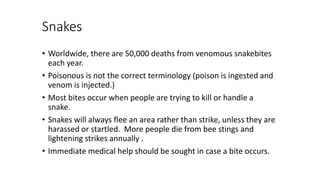
• Worldwide, there are 50,000 deaths from venomous snakebites
each year.
• Poisonous is not the correct terminology (poison is ingested and
venom is injected.)
• Most bites occur when people are trying to kill or handle a
snake.
• Snakes will always flee an area rather than strike, unless they are
harassed or startled. More people die from bee stings and
lightening strikes annually .
• Immediate medical help should be sought in case a bite occurs.
Classification of snakes
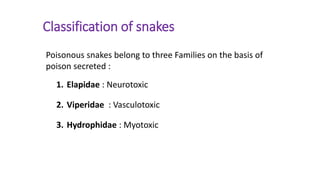
Poisonous snakes belong to three Families on the basis of
poison secreted :
1. Elapidae : Neurotoxic
2. Viperidae : Vasculotoxic
3. Hydrophidae : Myotoxic
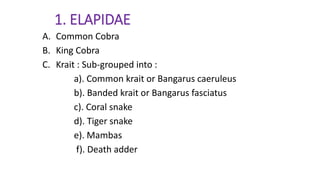
1. ELAPIDAE
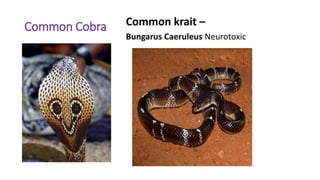
A. Common Cobra
B. King Cobra
C. Krait : Sub-grouped into :
a). Common krait or Bangarus caeruleus
b). Banded krait or Bangarus fasciatus
c). Coral snake
d). Tiger snake
e). Mambas
f). Death adder
Common Cobra Common krait –
Bungarus Caeruleus Neurotoxic
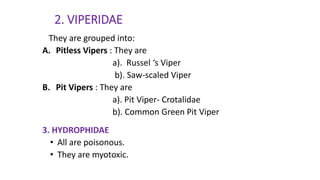
2. VIPERIDAE
They are grouped into:
A. Pitless Vipers : They are
a). Russel ‘s Viper
b). Saw-scaled Viper
B. Pit Vipers : They are
a). Pit Viper- Crotalidae
b). Common Green Pit Viper
3. HYDROPHIDAE
• All are poisonous.
• They are myotoxic.
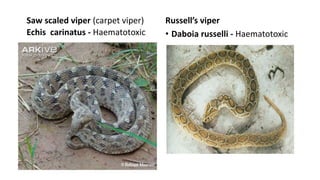
Saw scaled viper (carpet viper)
Echis carinatus - Haematotoxic
Russell’s viper
• Daboia russelli - Haematotoxic
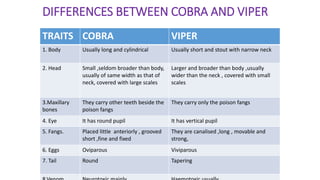
DIFFERENCES BETWEEN COBRA AND VIPER
TRAITS COBRA VIPER
1. Body Usually long and cylindrical Usually short and stout with narrow neck
2. Head Small ,seldom broader than body,
usually of same width as that of
neck, covered with large scales
Larger and broader than body ,usually
wider than the neck , covered with small
scales
3.Maxillary
bones
They carry other teeth beside the
poison fangs
They carry only the poison fangs
4. Eye It has round pupil It has vertical pupil
5. Fangs. Placed little anteriorly , grooved
short ,fine and fixed
They are canalised ,long , movable and
strong,
6. Eggs Oviparous Viviparous
7. Tail Round Tapering
Snake Bite and Snake Venom
• When a snake bites, it may excrete venom but this is
dependent on the type of snake – venomous or non
venomous.
• Snake Venom is a Toxin (Hematotoxin, Neurotoxin, or
Cytotoxin)
• It is a varied form of saliva and excreted through a
modified parotid salivary gland
• Located on each side of the skull, behind the eye
• Produced through a pumping mechanism from a sac that
stores the venom, proceeds through a channel, down a
tubular fang, hollow in the center to project the venom
SNAKE VENOM
Snake venoms are
• A combination of proteins and enzymes
• 90% protein by dry weight & most of these are
enzymes
• Have 25 different enzymes found in various venoms
and 10 of these occur frequently in most venoms
• Synergistic in effects: different venoms contain
different combinations of enzymes causing a more
potent effect than any of the individual effects (very
similar to drug synergism)
Composition of snake venom
Enzymes-
• phospholipase A2( Lecithinase), 5’-nucleotidase, collaginase, L-
aminoacid oxidase, protinases, hyaluronidase,
• Ach, Phospholipase-b (ellipdae)
• Endopeptidases, kininogenase, factor-X, prothrombin activating
enzyme (viper)
Non Enzyme Peptides :
• α- bungarotoxin,β- bungarotoxin, Crotoxin, Crotamine, Cardiotoxin.
Peptide- Pyroglutamyl peptide
Nucleoside-Adenine,Guanine,Inosine.
Lipid-Phospholipid,Cholestrol
Amine-Histamine, Serotonin, Spermin
Metal-Cu, Zn, Ni, Mg.
Mechanism of Toxicity of Venom
• The most common types of enzymes are proteolytic,
phospholipases and hyaluronidases
• Proteolytic Enzymes: digestive properties
• Phospholipases: degrade lipids
• Hyaluronidases: facilitates venom spread through out the body
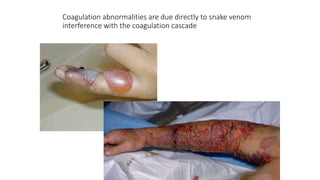
Coagulation abnormalities are due directly to snake venom
interference with the coagulation cascade
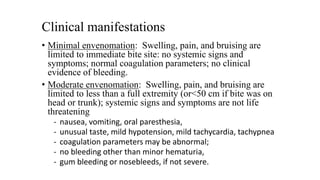
Clinical manifestations
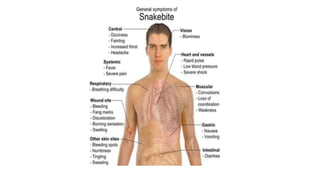
• Minimal envenomation: Swelling, pain, and bruising are
limited to immediate bite site: no systemic signs and
symptoms; normal coagulation parameters; no clinical
evidence of bleeding.
• Moderate envenomation: Swelling, pain, and bruising are
limited to less than a full extremity (or<50 cm if bite was on
head or trunk); systemic signs and symptoms are not life
threatening
‐ nausea, vomiting, oral paresthesia,
‐ unusual taste, mild hypotension, mild tachycardia, tachypnea
‐ coagulation parameters may be abnormal;
‐ no bleeding other than minor hematuria,
‐ gum bleeding or nosebleeds, if not severe.
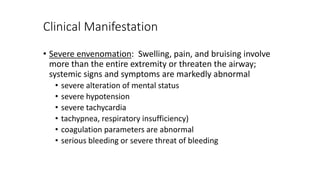
Clinical Manifestation
• Severe envenomation: Swelling, pain, and bruising involve
more than the entire extremity or threaten the airway;
systemic signs and symptoms are markedly abnormal
• severe alteration of mental status
• severe hypotension
• severe tachycardia
• tachypnea, respiratory insufficiency)
• coagulation parameters are abnormal
• serious bleeding or severe threat of bleeding
Treatment
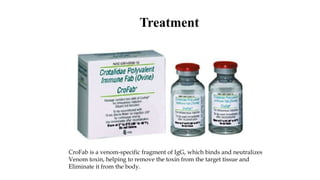
CroFab is a venom-specific fragment of IgG, which binds and neutralizes
Venom toxin, helping to remove the toxin from the target tissue and
Eliminate it from the body.
Dosing: Adult
Crotalid envenomation
• Initial dose: 4-6 vials, dependent upon patient response.
Treatment should begin within 6 hours of snakebite; monitor for
1 hour following infusion.
• Repeat with an additional 4-6 vials if control is not achieved with
initial dose.
• Continue to treat with 4-6 vial doses until complete arrest of
local manifestations, coagulation tests and systemic signs are
normal.
• Monitor closely.
Treatment cont…
Maintenance dose:
• Once control is achieved, administer 2 vials every 6
hours for up to 18 hours.
• Optimal dosing past 18 hours has not been established;
however, treatment may be continued if deemed
necessary based on the patient’s condition.
Reconstitution
• Reconstitute each vial with 10 mL sterile water for
injection and mix by gentle swirling. Further dilute total
dose in 250 ml NS: use within 4 hours of reconstitution.
Treatment cont…
European viper snake venom antiserum
• By IV injection or IV infusion
Child
• Initially 10ml for 1 dose, then 10ml after 1-2hrs if required, the
second dose should only be given if symptoms or systemic
envenoming persist after the first dose.
Adult
• Initially 10ml for 1 dose, then 10ml after 1-2hrs if required, the
second dose should only be given if symptoms or systemic
envenoming persist after the first dose.
Supportive therapy
• For Coagulopathy - if not reverse after ASV therapy
Fresh frozen plasma
Cryoprecipitate (fibrinogen, Factor VIII),
Fresh whole blood,
Platelet concentrate.
For Bulbar Paralysis & Resp. Failure-
• ASV alone not sufficient
• Tracheotomy, Endotrachial intubation,&
mechanical ventilation
• Inj. of neostigmine-50 to 100 microgram/kg/4hrs
as a continuous infusion
• Glycopyrrolate-0.25 mg can be given before
neostigmine in place of atropine
don’t cross blood brain barrier
• Care of bitten part-
Antibiotic prophylaxis & ATS injection
Adverse Reactions and Drug interactions
Adverse Reactions
• Cardiovascular: Hypotension
• Central nervous system: Chills
• Dermatologic: Pruritus, rash, urticaria
• Respiratory: Asthma, cough, dyspnea, wheezing
• Miscellaneous: Anaphylaxis, anaphylactoid reaction, hypersensitivity
reactions (5% to 19%), serum sickness (5%)
Drug Interactions
• There are no known significant interactions.
• Lactation: Excretion in breast milk unknown/use caution
Disease-related concerns
• CroFab should be used within 4-6 hours of snakebite to prevent
clinical deterioration and development of coagulation abnormalities.
• These are due directly to snake venom interference with the
coagulation cascade.
• Recurrent coagulopathy occurs in approximately 50% of patients and
may persist for 1-2 weeks or more.
• Repeat dosing may be indicated.
• Patients should be monitored for at least 1 week and evaluated for
other pre-existing conditions associated with bleeding disorders.
• In severe envenomations, a decrease in platelets may occur, lasting
hours to several days. Blood products are generally ineffective as they
are rapidly consumed by circulating venom.
Monitoring:
• Parameters: Vital signs, CBC, platelet count, prothrombin time,
aPTT, fibrinogen levels, fibrin split products, clot retraction,
bleeding and coagulation times, BUN, electrolytes, bilirubin, size
of bite area (repeat every 15-30 minutes); intake and output,
signs and symptoms of anaphylaxis/allergy.
• CBC, platelet counts, and clotting studies are evaluated at 6-hour
intervals until patient is stable.
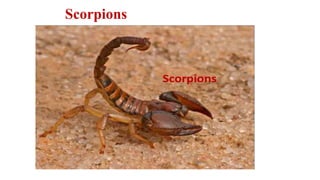
Scorpions
Scorpions
Introduction
• There are more than 1250 species of scorpions.
• Eight legged arthropods, have a hollow sting in the last
joint of their tail
• Venom is clear, colourless toxalbumen, and can be
classified as either neurotoxic or haemolytic.
• Toxicity is more than snake but only small quantity is
injected.
• Venom is potent autonomic stimulator resulting in the
release of massive amount of catecholamine from
adrenals.
• The mortality, except in children is negligible.
Signs And Symptoms
In case of haemolytic venom-
• reaction is mainly local and simulates the viper snake bite, but
the scorpion sting will have only one hole in the centre of
reddened area.
• The extremity will have pain and oedema.
Signs And Symptoms
In case of neurotoxic venom-
• Symptoms produced are similar to cobra bite.
• There are usually no mark reaction in local area.
• Nausea, vomiting, extreme restlessness, fever, paralysis,
• cardiac arrythmia, convulsions, coma and cyanosis,
• respiratory depression, and death may occur with in hours
from pulmonary oedema and cardiac failure.
• Diagnosis is confirmed by ELISA testing.
Treatment
• Immobilise the limb and apply a torniquet above the
location of sting
• Pack sting in ice, and incise and use suction, and wash
with weak solution of ammonia, borax or potassium
permanganate
• A local anaesthetic (2% novocaine or 5% cocaine) is
injected at site of pain
• To treat shock, 5% of 500ml of dextrose saline should be
given IV along with glucocorticoids
• Calcium gluconate 10 ml of 10% solution IM should be
given intravenously to combat muscular cramps.
• To prevent pulmonary edema, atropine sulphate should
be administered
Snake Bite Management.pptx

Snake Bite Management.pptx

  • 1.
    Snake and Scorpion Bite Preparedby:- Amanuel G. (Bpharm, MSc)
  • 2.
    Snakes • Worldwide, thereare 50,000 deaths from venomous snakebites each year. • Poisonous is not the correct terminology (poison is ingested and venom is injected.) • Most bites occur when people are trying to kill or handle a snake. • Snakes will always flee an area rather than strike, unless they are harassed or startled. More people die from bee stings and lightening strikes annually . • Immediate medical help should be sought in case a bite occurs.
  • 3.
    Classification of snakes Poisonoussnakes belong to three Families on the basis of poison secreted : 1. Elapidae : Neurotoxic 2. Viperidae : Vasculotoxic 3. Hydrophidae : Myotoxic
  • 4.
    1. ELAPIDAE A. CommonCobra B. King Cobra C. Krait : Sub-grouped into : a). Common krait or Bangarus caeruleus b). Banded krait or Bangarus fasciatus c). Coral snake d). Tiger snake e). Mambas f). Death adder
  • 5.
    Common Cobra Commonkrait – Bungarus Caeruleus Neurotoxic
  • 6.
    2. VIPERIDAE They aregrouped into: A. Pitless Vipers : They are a). Russel ‘s Viper b). Saw-scaled Viper B. Pit Vipers : They are a). Pit Viper- Crotalidae b). Common Green Pit Viper 3. HYDROPHIDAE • All are poisonous. • They are myotoxic.
  • 7.
    Saw scaled viper(carpet viper) Echis carinatus - Haematotoxic Russell’s viper • Daboia russelli - Haematotoxic
  • 8.
    DIFFERENCES BETWEEN COBRAAND VIPER TRAITS COBRA VIPER 1. Body Usually long and cylindrical Usually short and stout with narrow neck 2. Head Small ,seldom broader than body, usually of same width as that of neck, covered with large scales Larger and broader than body ,usually wider than the neck , covered with small scales 3.Maxillary bones They carry other teeth beside the poison fangs They carry only the poison fangs 4. Eye It has round pupil It has vertical pupil 5. Fangs. Placed little anteriorly , grooved short ,fine and fixed They are canalised ,long , movable and strong, 6. Eggs Oviparous Viviparous 7. Tail Round Tapering
  • 9.
    Snake Bite andSnake Venom • When a snake bites, it may excrete venom but this is dependent on the type of snake – venomous or non venomous. • Snake Venom is a Toxin (Hematotoxin, Neurotoxin, or Cytotoxin) • It is a varied form of saliva and excreted through a modified parotid salivary gland • Located on each side of the skull, behind the eye • Produced through a pumping mechanism from a sac that stores the venom, proceeds through a channel, down a tubular fang, hollow in the center to project the venom
  • 10.
    SNAKE VENOM Snake venomsare • A combination of proteins and enzymes • 90% protein by dry weight & most of these are enzymes • Have 25 different enzymes found in various venoms and 10 of these occur frequently in most venoms • Synergistic in effects: different venoms contain different combinations of enzymes causing a more potent effect than any of the individual effects (very similar to drug synergism)
  • 11.
    Composition of snakevenom Enzymes- • phospholipase A2( Lecithinase), 5’-nucleotidase, collaginase, L- aminoacid oxidase, protinases, hyaluronidase, • Ach, Phospholipase-b (ellipdae) • Endopeptidases, kininogenase, factor-X, prothrombin activating enzyme (viper) Non Enzyme Peptides : • α- bungarotoxin,β- bungarotoxin, Crotoxin, Crotamine, Cardiotoxin. Peptide- Pyroglutamyl peptide Nucleoside-Adenine,Guanine,Inosine. Lipid-Phospholipid,Cholestrol Amine-Histamine, Serotonin, Spermin Metal-Cu, Zn, Ni, Mg.
  • 12.
    Mechanism of Toxicityof Venom • The most common types of enzymes are proteolytic, phospholipases and hyaluronidases • Proteolytic Enzymes: digestive properties • Phospholipases: degrade lipids • Hyaluronidases: facilitates venom spread through out the body
  • 14.
    Coagulation abnormalities aredue directly to snake venom interference with the coagulation cascade
  • 15.
    Clinical manifestations • Minimalenvenomation: Swelling, pain, and bruising are limited to immediate bite site: no systemic signs and symptoms; normal coagulation parameters; no clinical evidence of bleeding. • Moderate envenomation: Swelling, pain, and bruising are limited to less than a full extremity (or<50 cm if bite was on head or trunk); systemic signs and symptoms are not life threatening ‐ nausea, vomiting, oral paresthesia, ‐ unusual taste, mild hypotension, mild tachycardia, tachypnea ‐ coagulation parameters may be abnormal; ‐ no bleeding other than minor hematuria, ‐ gum bleeding or nosebleeds, if not severe.
  • 16.
    Clinical Manifestation • Severeenvenomation: Swelling, pain, and bruising involve more than the entire extremity or threaten the airway; systemic signs and symptoms are markedly abnormal • severe alteration of mental status • severe hypotension • severe tachycardia • tachypnea, respiratory insufficiency) • coagulation parameters are abnormal • serious bleeding or severe threat of bleeding
  • 17.
    Treatment CroFab is avenom-specific fragment of IgG, which binds and neutralizes Venom toxin, helping to remove the toxin from the target tissue and Eliminate it from the body.
  • 18.
    Dosing: Adult Crotalid envenomation •Initial dose: 4-6 vials, dependent upon patient response. Treatment should begin within 6 hours of snakebite; monitor for 1 hour following infusion. • Repeat with an additional 4-6 vials if control is not achieved with initial dose. • Continue to treat with 4-6 vial doses until complete arrest of local manifestations, coagulation tests and systemic signs are normal. • Monitor closely.
  • 19.
    Treatment cont… Maintenance dose: •Once control is achieved, administer 2 vials every 6 hours for up to 18 hours. • Optimal dosing past 18 hours has not been established; however, treatment may be continued if deemed necessary based on the patient’s condition. Reconstitution • Reconstitute each vial with 10 mL sterile water for injection and mix by gentle swirling. Further dilute total dose in 250 ml NS: use within 4 hours of reconstitution.
  • 20.
    Treatment cont… European vipersnake venom antiserum • By IV injection or IV infusion Child • Initially 10ml for 1 dose, then 10ml after 1-2hrs if required, the second dose should only be given if symptoms or systemic envenoming persist after the first dose. Adult • Initially 10ml for 1 dose, then 10ml after 1-2hrs if required, the second dose should only be given if symptoms or systemic envenoming persist after the first dose.
  • 21.
    Supportive therapy • ForCoagulopathy - if not reverse after ASV therapy Fresh frozen plasma Cryoprecipitate (fibrinogen, Factor VIII), Fresh whole blood, Platelet concentrate.
  • 22.
    For Bulbar Paralysis& Resp. Failure- • ASV alone not sufficient • Tracheotomy, Endotrachial intubation,& mechanical ventilation • Inj. of neostigmine-50 to 100 microgram/kg/4hrs as a continuous infusion • Glycopyrrolate-0.25 mg can be given before neostigmine in place of atropine don’t cross blood brain barrier • Care of bitten part- Antibiotic prophylaxis & ATS injection
  • 23.
    Adverse Reactions andDrug interactions Adverse Reactions • Cardiovascular: Hypotension • Central nervous system: Chills • Dermatologic: Pruritus, rash, urticaria • Respiratory: Asthma, cough, dyspnea, wheezing • Miscellaneous: Anaphylaxis, anaphylactoid reaction, hypersensitivity reactions (5% to 19%), serum sickness (5%) Drug Interactions • There are no known significant interactions. • Lactation: Excretion in breast milk unknown/use caution
  • 24.
    Disease-related concerns • CroFabshould be used within 4-6 hours of snakebite to prevent clinical deterioration and development of coagulation abnormalities. • These are due directly to snake venom interference with the coagulation cascade. • Recurrent coagulopathy occurs in approximately 50% of patients and may persist for 1-2 weeks or more. • Repeat dosing may be indicated. • Patients should be monitored for at least 1 week and evaluated for other pre-existing conditions associated with bleeding disorders. • In severe envenomations, a decrease in platelets may occur, lasting hours to several days. Blood products are generally ineffective as they are rapidly consumed by circulating venom.
  • 25.
    Monitoring: • Parameters: Vitalsigns, CBC, platelet count, prothrombin time, aPTT, fibrinogen levels, fibrin split products, clot retraction, bleeding and coagulation times, BUN, electrolytes, bilirubin, size of bite area (repeat every 15-30 minutes); intake and output, signs and symptoms of anaphylaxis/allergy. • CBC, platelet counts, and clotting studies are evaluated at 6-hour intervals until patient is stable.
  • 26.
  • 27.
    Scorpions Introduction • There aremore than 1250 species of scorpions. • Eight legged arthropods, have a hollow sting in the last joint of their tail • Venom is clear, colourless toxalbumen, and can be classified as either neurotoxic or haemolytic. • Toxicity is more than snake but only small quantity is injected. • Venom is potent autonomic stimulator resulting in the release of massive amount of catecholamine from adrenals. • The mortality, except in children is negligible.
  • 28.
    Signs And Symptoms Incase of haemolytic venom- • reaction is mainly local and simulates the viper snake bite, but the scorpion sting will have only one hole in the centre of reddened area. • The extremity will have pain and oedema.
  • 29.
    Signs And Symptoms Incase of neurotoxic venom- • Symptoms produced are similar to cobra bite. • There are usually no mark reaction in local area. • Nausea, vomiting, extreme restlessness, fever, paralysis, • cardiac arrythmia, convulsions, coma and cyanosis, • respiratory depression, and death may occur with in hours from pulmonary oedema and cardiac failure. • Diagnosis is confirmed by ELISA testing.
  • 30.
    Treatment • Immobilise thelimb and apply a torniquet above the location of sting • Pack sting in ice, and incise and use suction, and wash with weak solution of ammonia, borax or potassium permanganate • A local anaesthetic (2% novocaine or 5% cocaine) is injected at site of pain • To treat shock, 5% of 500ml of dextrose saline should be given IV along with glucocorticoids • Calcium gluconate 10 ml of 10% solution IM should be given intravenously to combat muscular cramps. • To prevent pulmonary edema, atropine sulphate should be administered