A
PRESENTATION ON
ELEPHANTIASIS
BY GROUP TEN
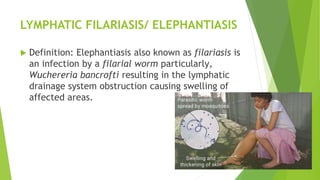
LYMPHATIC FILARIASIS/ ELEPHANTIASIS
 Definition: Elephantiasis also known as filariasis is
an infection by a filarial worm particularly,
Wuchereria bancrofti resulting in the lymphatic
drainage system obstruction causing swelling of
affected areas.
INCIDENCE
 It occurs globally but mostly in countries
with poor sanitation and very common in
West Africa. It is transmitted by a mosquito
bite. In Ghana Anopheles Gambei and an
funanestus species and man for
MODE OF TRANSMISSION
 Transmitted through the bit of infected anopheles
/ culex periodicity
 Reservoir: man
 Vector: culex  Anopheles mosquito, Anopheles
Gambei / funanestus

CAUSATIVE ORGANISM
Wuchereria bancrofti
Brugia malayi
Bancrofti timori
INCUBATION PERIOD
3-13 months, depending on ones’
immunity
SIGNS AND SYMPTOMS
 Hydrocele
 Adenitis (inflammation of gland)
 Lymphangitis (inflammation of lymph vessels)
 Fever
 Pain
 Breast lymphedema
 Elephantiasis usually is to the distal extremities mostly below the
knees
 Block lymph duct
 Arthritis
 Lesions of spermatic cord
IMAGES OF ELEPHANTIASIS
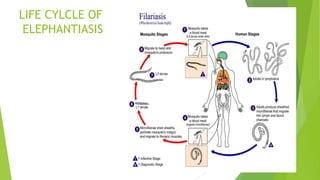
LIFE CYLCLE OF
ELEPHANTIASIS
Life cycle cont’d
 In West Africa, the disease is transmitted by culex and anopheles
species of mosquitoes. Infected microfilariae invade the lymphatic
system where they develop into adult worms within 3-12 months.
 Adult worms produce more microfilariae that remain in the lymphatic
systems or are carried into the blood stream. The mosquito is
infected when it ingested microfilarie during a blood meal, the
microfilaria develop into effective forms which invades the mouth
parts of the mosquitoes.
 An inflammatory process sets in due to the poor drainage caused by
the worms. Lymphatic inflammation leads to damage in the lymphatic
system leading to thickening and eventual blockage of lymph
drainage. The effected parts – the limbs, genitals – swells and
lymphatic becomes fibroses leading to elephantiasis.

DIAGNOSIS
 Definitive diagnosis can be made only by demonstration of the parasite –
adult worm in the lymphatics (rare), micro filariea trapped in tissues, or
microfilariae in blood, urine, hydrocele fluid
 Sampling for blood parasites should take into consideration the periodicity
(at night for nocturnally periodic parasites)
 Parasitological (staining with geimsa or hematoxylin)
 Molecular methods (amplification of Wu bancrofti specific DNA sequences
by PCR)
 Serological methods ( indirect FAT, Kits)
 Clinical (lymphangitis, manifestation of lymphstatis, eosinophilia etc
PREVENTION
 Albendazole, invermectin as prophylaxis
every 6-12 months.
 Insecticide treated bed nets
TREATMENT
 Ivermectin, Albendazole
 Dose.
 Surgery (excision of adventitious tissue, opening up
pathways for lymph flow.
 Antibiotics for bacterial infections
 Elevation of the limb and use of elastic pressure
bandages
NURISNG MANAGEMENT
 Monitor client’s vital signs particularly the
temperature
 Assess skin color and integrity. Note for
wounds, bleeding or any skin changes.
 Assess for any discomfort and pain.
 Provide wound care
 Elevate affected body area to reduce
swelling/
NURISNG MANAGEMENT CONT’D
 Administer medications if ordered and discuss them to the
client.
 Provide support to perform basic activities
 Encourage range of motion and simple exercise of the
affected extremities to stimulate lymphatic flow.
 Recognize client’s self –esteem needs
 Provide health teaching and information for continuity of
care
COMPLICATIONS
 Disfigurement of body part
 Disability
 Extreme swelling and necrosis
 Blindness
NB. Secondary infection is always possible if care is not
taken.
REFERENCES
 Lymphatic filariasis.(2018, February16). Retrieved from
http://www.who.int/news-
room/factsheets/detail/lymphatic-filariasis
 Parasites (2013, June 14) Retrieved from
http://www.cdc.gov/parasite/lympaticfilariasis

THANK YOU
END OF PRESENTATION

A presentation on Elephantiasis.pptx

  • 1.
  • 2.
    LYMPHATIC FILARIASIS/ ELEPHANTIASIS Definition: Elephantiasis also known as filariasis is an infection by a filarial worm particularly, Wuchereria bancrofti resulting in the lymphatic drainage system obstruction causing swelling of affected areas.
  • 3.
    INCIDENCE  It occursglobally but mostly in countries with poor sanitation and very common in West Africa. It is transmitted by a mosquito bite. In Ghana Anopheles Gambei and an funanestus species and man for
  • 4.
    MODE OF TRANSMISSION Transmitted through the bit of infected anopheles / culex periodicity  Reservoir: man  Vector: culex Anopheles mosquito, Anopheles Gambei / funanestus 
  • 5.
  • 6.
    INCUBATION PERIOD 3-13 months,depending on ones’ immunity
  • 7.
    SIGNS AND SYMPTOMS Hydrocele  Adenitis (inflammation of gland)  Lymphangitis (inflammation of lymph vessels)  Fever  Pain  Breast lymphedema  Elephantiasis usually is to the distal extremities mostly below the knees  Block lymph duct  Arthritis  Lesions of spermatic cord
  • 8.
  • 9.
  • 10.
    Life cycle cont’d In West Africa, the disease is transmitted by culex and anopheles species of mosquitoes. Infected microfilariae invade the lymphatic system where they develop into adult worms within 3-12 months.  Adult worms produce more microfilariae that remain in the lymphatic systems or are carried into the blood stream. The mosquito is infected when it ingested microfilarie during a blood meal, the microfilaria develop into effective forms which invades the mouth parts of the mosquitoes.  An inflammatory process sets in due to the poor drainage caused by the worms. Lymphatic inflammation leads to damage in the lymphatic system leading to thickening and eventual blockage of lymph drainage. The effected parts – the limbs, genitals – swells and lymphatic becomes fibroses leading to elephantiasis. 
  • 11.
    DIAGNOSIS  Definitive diagnosiscan be made only by demonstration of the parasite – adult worm in the lymphatics (rare), micro filariea trapped in tissues, or microfilariae in blood, urine, hydrocele fluid  Sampling for blood parasites should take into consideration the periodicity (at night for nocturnally periodic parasites)  Parasitological (staining with geimsa or hematoxylin)  Molecular methods (amplification of Wu bancrofti specific DNA sequences by PCR)  Serological methods ( indirect FAT, Kits)  Clinical (lymphangitis, manifestation of lymphstatis, eosinophilia etc
  • 12.
    PREVENTION  Albendazole, invermectinas prophylaxis every 6-12 months.  Insecticide treated bed nets
  • 13.
    TREATMENT  Ivermectin, Albendazole Dose.  Surgery (excision of adventitious tissue, opening up pathways for lymph flow.  Antibiotics for bacterial infections  Elevation of the limb and use of elastic pressure bandages
  • 14.
    NURISNG MANAGEMENT  Monitorclient’s vital signs particularly the temperature  Assess skin color and integrity. Note for wounds, bleeding or any skin changes.  Assess for any discomfort and pain.  Provide wound care  Elevate affected body area to reduce swelling/
  • 15.
    NURISNG MANAGEMENT CONT’D Administer medications if ordered and discuss them to the client.  Provide support to perform basic activities  Encourage range of motion and simple exercise of the affected extremities to stimulate lymphatic flow.  Recognize client’s self –esteem needs  Provide health teaching and information for continuity of care
  • 16.
    COMPLICATIONS  Disfigurement ofbody part  Disability  Extreme swelling and necrosis  Blindness NB. Secondary infection is always possible if care is not taken.
  • 17.
    REFERENCES  Lymphatic filariasis.(2018,February16). Retrieved from http://www.who.int/news- room/factsheets/detail/lymphatic-filariasis  Parasites (2013, June 14) Retrieved from http://www.cdc.gov/parasite/lympaticfilariasis 
  • 18.
    THANK YOU END OFPRESENTATION