Post Intubation Care.
 Caring for the Critically Ill Downstairs.
                               By: Kane Guthrie
Learning Points

 What we need to do post tube!

 Some simple pearls for providing excellent ED critical care
  management!

 How to prevent VAP & VILI!

 Some little pearls that can make a big difference to morbidity
  and mortality!
Case Study

 58 female

 Hx :COPD, smoker

 P/C SOB, febrile,
  productive cough
 O/E Severe resp distress

 CRX-severe pneumonia

 Get’s emergently
  intubated for resp failure!
Ok time for ICU…..

                      A call to the ICU
                        coordinator…..
                      Starts ranting there coffee
                        machines not
                        working, another nurse has
                        gone home sick with an
                        acute hang nail and they
                        have no bed’s for at least 6
                        hours.


                      Great!!!!!
ED Boarding!

                Pt’s spending more time in
                 ED!

                Lack of higher acuity beds!

                Should patient geography
                 determine the level of care
                 they receive?
ED Intubations & Mechanical Ventilation

 Make up about .05-1% of presentations.

 Average length of stay between 2-5 hours.

 What we do in this 2-5 hours can have drastic outcomes on
  morbidity and mortality.
The Ventilator.
Managing the Ventilator!

 Most common procedure in managing the critically ill.


The 3 goals of MV:

1.   Maintain systemic oxygenation.

2.   Improve ventilation.

3.   Decrease work of breathing.
Adjusting the Ventilator

 A crucial component to managing the critically ill.

Our aim is to:

 Limit ventilator induced lung injury.

 Prevent ventilator associated pneumonia.
What is Ventilator Induced Lung Injury?

 VILI = caused by direct damage by the action of MV.

 Results from volutrauma (high tidal volumes) and excessive use of
     oxygen.

 Also can cause:

1.   Atelectrauma: shear stress and injury to alveolar units.

2.   Barotrauma: extra alveolar air – PTX or Pnemomediastinum

3.   Biotrauma: SIRS mediated response from lungs causing MOF.
Preventing VILI – “Lung Protective
Settings”

 Lower tidal volumes (6ml/kg of ideal body weight) – decrease’s
   volutrauma.

 Adding in PEEP to reduce atelectrauma.

 Will need to allow for permissive hypercapnea.

 Elevated Co2 generally well tolerated except in head injury or ACS.

 Monitor Co2 and pH closely.

 pH <7.15 increase RR to max of 30-35 bpm, if fails increase TV by
   1ml-kg increments till pH increasing.
Preventing VILI – Measure Plateau
Pressure

 Estimate of end-inspiratory alveolar pressure.

 Provides information on lung compliance.

 Goal is to maintain plateau pressure <30 cm H20.

 If > 30cm H20 decrease tidal volume by 1-ml/kg increment
  until below <30cm H2O or volume reaches 4ml/kg.

 Patient with obstructive lung disease, decrease RR before TV.
Preventing VILI: Dial down the O2!

 Majority of ED patients managed with FiO2 100%.

 Hyperoxia can cause additional lung injury.

 Decrease FiO2 to <60% when clinically feasible- prevent
  oxygen toxicity.

 Aim for spo2 >90%

 Use PEEP to assist with oxygenation.
Preventing VAP

 Most common complication in ICU patients 27-47% of ICU
  acquired infections. .

 VAP results in:
   Prolonged MV.
   Increase ICU & hospital lengths of stay.
   Increased morbidity and mortality.
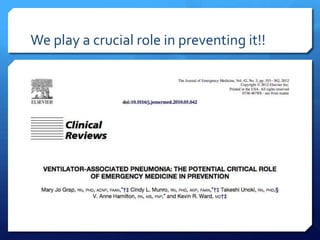
We play a crucial role in preventing it!!
Preventing VAP

 Intubated patients lying supine are @ high risk for asp
  pneumonia.

 The easiest intervention is to elevated the head of bed 30-45
  degrees.
Cuff Pressure
 Maintain cuff pressure between 25 -30cm H2O

 Ensure’s adequate cuff seal.

 Measure every 4 hours.


Other things:
 NGT

 Chlorhexadine mouthwash

 Stress ulcer prophylaxis.
Sedation & Analgesia

 We’re not that good at it.

 74% received inadequate or no anxiolysis.

 75% of patients received either inadequate or no analgesia.
Sedation and Analgesia

Poor sedation and analgesia results in:

 Increased catecholamine levels

 Produce immunosupression

 Hypercoaguability

 Myocardial ischaemia
Sedation & Analgesia Tips

 Analgesia first - always.

 Fentanyl – very cardiac stable – provides good analgesia.

 Propofol = excellent sedative but provides NO ANALGESIA!

 Ketamine excellent in the hypotensive patient, @ provides
   analgesia as well as disassociation.

 Benzo’s via continuous infusion can accumulate in tissues
   prolonging sedative effects.
Paralytics

 Provide comfort to us – not the patient.

 Repeated & indiscriminate use NMBAs should be avoided.

 Recurrent use results in “ICU acquired weakness”.

 Majority of patients adequate analgesia & sedation should
  suffice.
Monitoring Circulation!

 Monitoring the circulation system, focuses on:

1.   Blood pressure.

2.   Tissue perfusion.

3.   Intravascular volume.
Blood pressure

 Simplest means of monitoring global circulation.

 Critically ill = ART line!

 Art line essential when giving vasoactive medications.

 Focus on MAP 65mmHg and above.
Tissue Perfusion

 Hypoperfusion to tissues is difficult to assess.

Monitor:

 Urinary output
    (0.5mls/kg/hr).

 Lactate level
    >2mmol/litre possibility of circulatory dysfunction.

 Central venous oxygen saturation (ScvO2)
    Surrogate maker of O2 delivery and tissue perfusion.
Intravascular Volume.

 CVP unreliable is assessing fluid status & responsiveness.

 Inferior vena cava assessment- using ultrasound.
    Full non-collapsing IVC + Pt adequately filled.
Maintaining Circulation!

 Fluid resuscitate.

 Maintain adequate maintenance fluids.

 Remaining hypotension post this with signs of circulatory
  compromise?

 Time for Inotropes/Vassopressors.
Don’t forget VTE!

 DVT has been shown to develop within the first 24 hours in
     critically ill ICU patients.

 13-30% of ICU Pt’s develop DVT during hospital stay.

 The 2 simple things we can do:

1.    Heparin 5000U S/C

 TEDs

 Downfall -HITS
ABCDon’t Ever Forget the Glucose!

 Stress induced hyperglycaemia is common.

 Associated with increased mortality in ICU pt’s.

 Studies show “tight glucose control” isn’t the answer.

 Aim for a glucose 6-12 mmol.
Take Home Points!

 Knowing how to adjust the ventilator, can help adjust
  mortality rate in the critically ill!

 Sit the patient up, check the cuff pressure = decreases VAP!

 Analgesia before sedation always!

 DVT prophylaxis downstairs can make a difference upstairs!
Thank-you

Post Intubation Care

  • 1.
    Post Intubation Care. Caring for the Critically Ill Downstairs. By: Kane Guthrie
  • 2.
    Learning Points  Whatwe need to do post tube!  Some simple pearls for providing excellent ED critical care management!  How to prevent VAP & VILI!  Some little pearls that can make a big difference to morbidity and mortality!
  • 3.
    Case Study  58female  Hx :COPD, smoker  P/C SOB, febrile, productive cough  O/E Severe resp distress  CRX-severe pneumonia  Get’s emergently intubated for resp failure!
  • 4.
    Ok time forICU…..  A call to the ICU coordinator…..  Starts ranting there coffee machines not working, another nurse has gone home sick with an acute hang nail and they have no bed’s for at least 6 hours.  Great!!!!!
  • 5.
    ED Boarding!  Pt’s spending more time in ED!  Lack of higher acuity beds!  Should patient geography determine the level of care they receive?
  • 6.
    ED Intubations &Mechanical Ventilation  Make up about .05-1% of presentations.  Average length of stay between 2-5 hours.  What we do in this 2-5 hours can have drastic outcomes on morbidity and mortality.
  • 7.
  • 8.
    Managing the Ventilator! Most common procedure in managing the critically ill. The 3 goals of MV: 1. Maintain systemic oxygenation. 2. Improve ventilation. 3. Decrease work of breathing.
  • 9.
    Adjusting the Ventilator A crucial component to managing the critically ill. Our aim is to:  Limit ventilator induced lung injury.  Prevent ventilator associated pneumonia.
  • 10.
    What is VentilatorInduced Lung Injury?  VILI = caused by direct damage by the action of MV.  Results from volutrauma (high tidal volumes) and excessive use of oxygen.  Also can cause: 1. Atelectrauma: shear stress and injury to alveolar units. 2. Barotrauma: extra alveolar air – PTX or Pnemomediastinum 3. Biotrauma: SIRS mediated response from lungs causing MOF.
  • 11.
    Preventing VILI –“Lung Protective Settings”  Lower tidal volumes (6ml/kg of ideal body weight) – decrease’s volutrauma.  Adding in PEEP to reduce atelectrauma.  Will need to allow for permissive hypercapnea.  Elevated Co2 generally well tolerated except in head injury or ACS.  Monitor Co2 and pH closely.  pH <7.15 increase RR to max of 30-35 bpm, if fails increase TV by 1ml-kg increments till pH increasing.
  • 12.
    Preventing VILI –Measure Plateau Pressure  Estimate of end-inspiratory alveolar pressure.  Provides information on lung compliance.  Goal is to maintain plateau pressure <30 cm H20.  If > 30cm H20 decrease tidal volume by 1-ml/kg increment until below <30cm H2O or volume reaches 4ml/kg.  Patient with obstructive lung disease, decrease RR before TV.
  • 13.
    Preventing VILI: Dialdown the O2!  Majority of ED patients managed with FiO2 100%.  Hyperoxia can cause additional lung injury.  Decrease FiO2 to <60% when clinically feasible- prevent oxygen toxicity.  Aim for spo2 >90%  Use PEEP to assist with oxygenation.
  • 14.
    Preventing VAP  Mostcommon complication in ICU patients 27-47% of ICU acquired infections. .  VAP results in:  Prolonged MV.  Increase ICU & hospital lengths of stay.  Increased morbidity and mortality.
  • 15.
    We play acrucial role in preventing it!!
  • 16.
    Preventing VAP  Intubatedpatients lying supine are @ high risk for asp pneumonia.  The easiest intervention is to elevated the head of bed 30-45 degrees.
  • 17.
    Cuff Pressure  Maintaincuff pressure between 25 -30cm H2O  Ensure’s adequate cuff seal.  Measure every 4 hours. Other things:  NGT  Chlorhexadine mouthwash  Stress ulcer prophylaxis.
  • 18.
    Sedation & Analgesia We’re not that good at it.  74% received inadequate or no anxiolysis.  75% of patients received either inadequate or no analgesia.
  • 19.
    Sedation and Analgesia Poorsedation and analgesia results in:  Increased catecholamine levels  Produce immunosupression  Hypercoaguability  Myocardial ischaemia
  • 20.
    Sedation & AnalgesiaTips  Analgesia first - always.  Fentanyl – very cardiac stable – provides good analgesia.  Propofol = excellent sedative but provides NO ANALGESIA!  Ketamine excellent in the hypotensive patient, @ provides analgesia as well as disassociation.  Benzo’s via continuous infusion can accumulate in tissues prolonging sedative effects.
  • 21.
    Paralytics  Provide comfortto us – not the patient.  Repeated & indiscriminate use NMBAs should be avoided.  Recurrent use results in “ICU acquired weakness”.  Majority of patients adequate analgesia & sedation should suffice.
  • 22.
    Monitoring Circulation!  Monitoringthe circulation system, focuses on: 1. Blood pressure. 2. Tissue perfusion. 3. Intravascular volume.
  • 23.
    Blood pressure  Simplestmeans of monitoring global circulation.  Critically ill = ART line!  Art line essential when giving vasoactive medications.  Focus on MAP 65mmHg and above.
  • 24.
    Tissue Perfusion  Hypoperfusionto tissues is difficult to assess. Monitor:  Urinary output  (0.5mls/kg/hr).  Lactate level  >2mmol/litre possibility of circulatory dysfunction.  Central venous oxygen saturation (ScvO2)  Surrogate maker of O2 delivery and tissue perfusion.
  • 25.
    Intravascular Volume.  CVPunreliable is assessing fluid status & responsiveness.  Inferior vena cava assessment- using ultrasound.  Full non-collapsing IVC + Pt adequately filled.
  • 26.
    Maintaining Circulation!  Fluidresuscitate.  Maintain adequate maintenance fluids.  Remaining hypotension post this with signs of circulatory compromise?  Time for Inotropes/Vassopressors.
  • 27.
    Don’t forget VTE! DVT has been shown to develop within the first 24 hours in critically ill ICU patients.  13-30% of ICU Pt’s develop DVT during hospital stay.  The 2 simple things we can do: 1. Heparin 5000U S/C  TEDs  Downfall -HITS
  • 28.
    ABCDon’t Ever Forgetthe Glucose!  Stress induced hyperglycaemia is common.  Associated with increased mortality in ICU pt’s.  Studies show “tight glucose control” isn’t the answer.  Aim for a glucose 6-12 mmol.
  • 29.
    Take Home Points! Knowing how to adjust the ventilator, can help adjust mortality rate in the critically ill!  Sit the patient up, check the cuff pressure = decreases VAP!  Analgesia before sedation always!  DVT prophylaxis downstairs can make a difference upstairs!
  • 30.