STINGS & BITES
1
Snake-Bite
WHO’s list of Neglected Tropical Diseases - 2009
Antivenoms are Essential Drugs
WHO Recommendation
Curriculum of Medical Schools /Organisation of Special Training
Courses & other Educational Events.
2
3
4
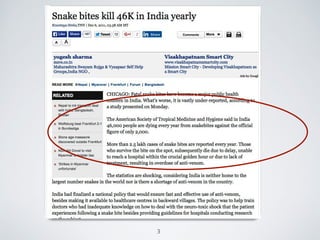
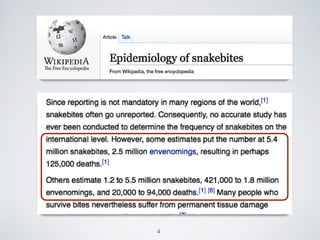
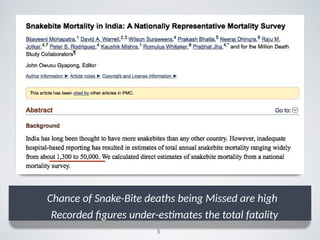
Chance of Snake-Bite deaths being Missed are high
Recorded figures under-estimates the total fatality
5
• WHO - 83000 bites per annum with 11000 deaths.
• India has a highest Snake Bite Mortality in the World
• Cause - Victim not reaching the hospital in time where
definite treatment can be administered
• Occupational Risk - farmers, plantation workers, herdsmen,
fishermen & other food producers.
• Measures to prevent the bites
• All snakes are predatory carnivores, none is vegetarian.
SNAKE-BITE
6
Peak Snake-Bite incidence is
during May-October.
7
• Elapidae: Common Cobra (Naja naja), king cobra common
krait
(Bungarus cerulus)
• Viperidae: Russell’s viper, saw called viper (Echis carinatus).
• Crotalidae: hump-nosed viper, (Hyphnale hyphnale)
• Hydrophidae : Sea Snakes
• Crotaloidae: Pit Vipers
• Collubridae : Non Poisonous snakes
SNAKES OF INDIA
• 236 species of snakes in India
• Most - Nonpoisonous : Panic Reaction & Local Injury,
• 13 known - Poisonous - [Highly Venomous “The Big Four”]
• Common Cobra (Naja naja),
• Common Krait (Bungarus caeruleus)
• Russell’s Viper (Dabiola russelii),
• Saw-scaled Viper (Echis carinatus)
Nonidentification humpnosed pit viper- life threatening
8
•
9
Snakes are elusive and reclusive. Contact is likely when humans move
into the snakes’ favoured habitat.
•
•
•
•
Rice fields in the case of Russell’s Vipers & Cobras
Rubber & Coffee plantations in the case of Malayan Pit Vipers
Peri-domestic species such as Cobras (roof spaces), under the floor
(Kraits) may bite people in their sleep
Nocturnally active snakes are trodden upon by
people walking along paths in the dark.
• Seasonal peaks of snake-bite incidence are usually associated with
increases in agricultural activity or seasonal rains, perhaps coinciding
with unusual movement and activity by snakes.
• The risk of envenoming after bites by venomous snakes varies
with the species but is on an average only about 50%.
• Bites in which the fangs pierce the skin but no envenoming
results are known as “Dry Bites”.
• Venom dosage per bite depends on the elapsed time since the
last bite, the threat perceived by the snake, and size of the prey.
Nostril pits respond to the heat emission of the prey, which may
enable the snake to vary the amount of venom delivered.
Dry Bites
10
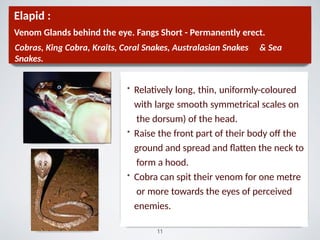
Elapid :
Venom Glands behind the eye. Fangs Short - Permanently erect.
Cobras, King Cobra, Kraits, Coral Snakes, Australasian Snakes & Sea
Snakes.
• Relatively long, thin, uniformly-coloured
with large smooth symmetrical scales on
the dorsum) of the head.
• Raise the front part of their body off the
ground and spread and flatten the neck to
form a hood.
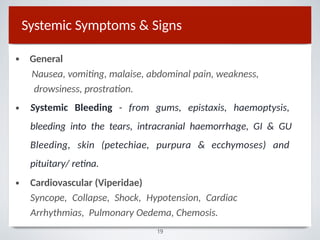
• Cobra can spit their venom for one metre
or more towards the eyes of perceived
enemies.
11
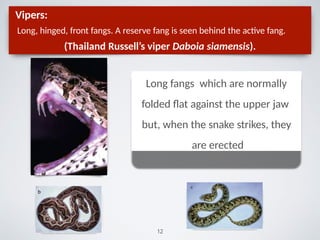
Vipers:
Long, hinged, front fangs. A reserve fang is seen behind the active fang.
(Thailand Russell’s viper Daboia siamensis).
Long fangs which are normally
folded flat against the upper jaw
but, when the snake strikes, they
are erected
12
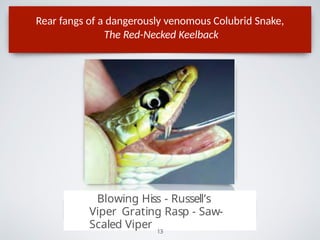
Rear fangs of a dangerously venomous Colubrid Snake,
The Red-Necked Keelback
Blowing Hiss - Russell’s
Viper Grating Rasp - Saw-
Scaled Viper 13
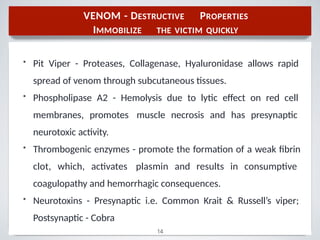
• Pit Viper - Proteases, Collagenase, Hyaluronidase allows rapid
spread of venom through subcutaneous tissues.
• Phospholipase A2 - Hemolysis due to lytic effect on red cell
membranes, promotes muscle necrosis and has presynaptic
neurotoxic activity.
• Thrombogenic enzymes - promote the formation of a weak fibrin
clot, which, activates plasmin and results in consumptive
coagulopathy and hemorrhagic consequences.
• Neurotoxins - Presynaptic i.e. Common Krait & Russell’s viper;
Postsynaptic - Cobra
VENOM - DESTRUCTIVE PROPERTIES
IMMOBILIZE THE VICTIM QUICKLY
14
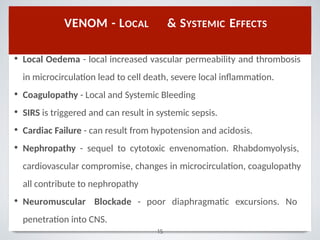
• Local Oedema - local increased vascular permeability and thrombosis
in microcirculation lead to cell death, severe local inflammation.
• Coagulopathy - Local and Systemic Bleeding
• SIRS is triggered and can result in systemic sepsis.
• Cardiac Failure - can result from hypotension and acidosis.
• Nephropathy - sequel to cytotoxic envenomation. Rhabdomyolysis,
cardiovascular compromise, changes in microcirculation, coagulopathy
all contribute to nephropathy
• Neuromuscular Blockade - poor diaphragmatic excursions. No
penetration into CNS.
VENOM - LOCAL & SYSTEMIC EFFECTS
15
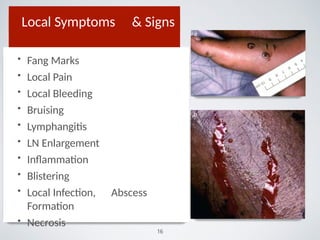
Local Symptoms & Signs
• Fang Marks
• Local Pain
• Local Bleeding
• Bruising
• Lymphangitis
• LN Enlargement
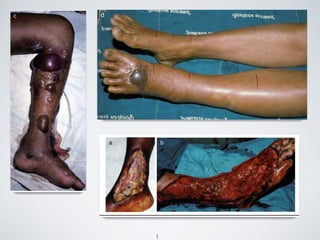
• Inflammation
• Blistering
• Local Infection, Abscess
Formation
• Necrosis
16
1
18
Systemic Symptoms & Signs
•
19
•
General
Nausea, vomiting, malaise, abdominal pain, weakness,
drowsiness, prostration.
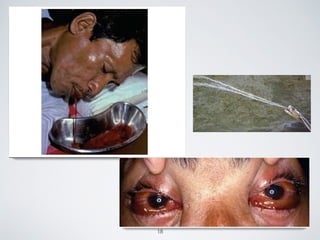
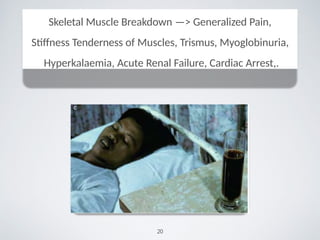
Systemic Bleeding - from gums, epistaxis, haemoptysis,
bleeding into the tears, intracranial haemorrhage, GI & GU
Bleeding, skin (petechiae, purpura & ecchymoses) and
pituitary/ retina.
• Cardiovascular (Viperidae)
Syncope, Collapse, Shock, Hypotension, Cardiac
Arrhythmias, Pulmonary Oedema, Chemosis.
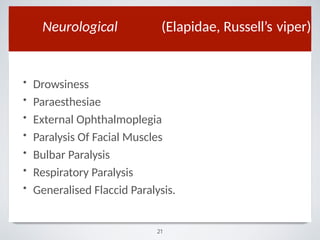
Skeletal Muscle Breakdown —> Generalized Pain,
Stiffness Tenderness of Muscles, Trismus, Myoglobinuria,
Hyperkalaemia, Acute Renal Failure, Cardiac Arrest,.
20
Neurological (Elapidae, Russell’s viper)
• Drowsiness
• Paraesthesiae
• External Ophthalmoplegia
• Paralysis Of Facial Muscles
• Bulbar Paralysis
• Respiratory Paralysis
• Generalised Flaccid Paralysis.
21
22
Local envenoming (swelling etc.) with bleeding/
clotting disturbances = Viperidae (all species)
SYNDROME 1
23
• Local envenoming (swelling etc.) with bleeding/clotting
disturbances, shock or acute kidney injury = Russell’s viper
(hump-nosed pit viper in Sri Lanka and SW India)
• With conjunctival oedema (chemosis) and acute pituitary
insufficiency = Russell’s viper - Myanmar
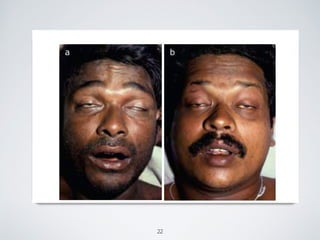
• With ptosis, external ophthalmoplegia, facial paralysis etc
and dark brown urine = Russell’s viper - Sri Lanka and South
India
•
SYNDROME 2
24
Local envenoming (swelling etc.) with paralysis
= Cobra or king Cobra
SYNDROME 3
25
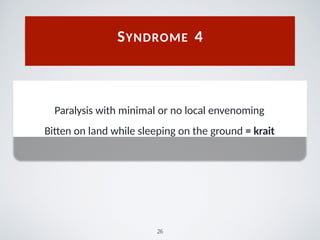
Paralysis with minimal or no local envenoming
Bitten on land while sleeping on the ground = krait
SYNDROME 4
26
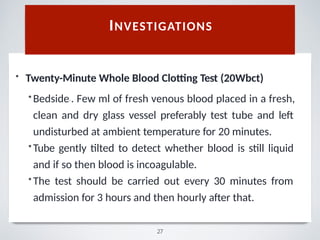
• Twenty-Minute Whole Blood Clotting Test (20Wbct)
• Bedside1-. Few ml of fresh venous blood placed in a fresh,
clean and dry glass vessel preferably test tube and left
undisturbed at ambient temperature for 20 minutes.
• Tube gently tilted to detect whether blood is still liquid
and if so then blood is incoagulable.
• The test should be carried out every 30 minutes from
admission for 3 hours and then hourly after that.
INVESTIGATIONS
27
•
•
•
•
•
•
•
•
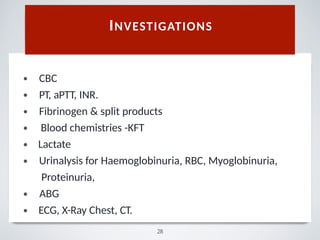
CBC
PT, aPTT, INR.
Fibrinogen & split products
Blood chemistries -KFT
Lactate
Urinalysis for Haemoglobinuria, RBC, Myoglobinuria,
Proteinuria,
ABG
ECG, X-Ray Chest, CT.
INVESTIGATIONS
28
SNAKE VENOM DETECTION KIT
✤
✤
✤
✤
Australia - Snake Venom Detection
Kits. Rapid two step enzyme
immunoassay in which wells are
coated with antibodies to the various
snake venoms.
A swab from bite site (most reliable),
blood or urine helps to select the
type of snake antivenom which may
have to be used.
Primary purpose: To choose the
specific antivenom if required.
29
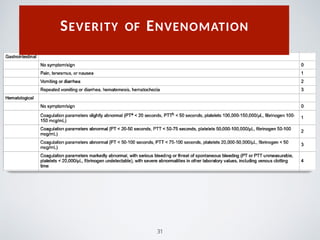
SEVERITY OF ENVENOMATION
30
SEVERITY OF ENVENOMATION
31
SEVERITY OF ENVENOMATION
32
ANTISNAKE VENOM
MODERATE & SEVERE SNAKE BITES
33
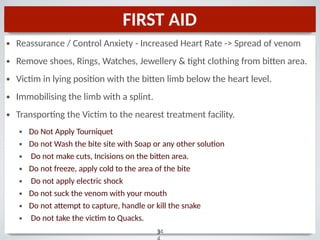
FIRST AID
•
•
•
•
•
3
34
Reassurance / Control Anxiety - Increased Heart Rate -> Spread of venom
Remove shoes, Rings, Watches, Jewellery & tight clothing from bitten area.
Victim in lying position with the bitten limb below the heart level.
Immobilising the limb with a splint.
Transporting the Victim to the nearest treatment facility.
•
•
•
•
•
•
•
•
Do Not Apply Tourniquet
Do not Wash the bite site with Soap or any other solution
Do not make cuts, Incisions on the bitten area.
Do not freeze, apply cold to the area of the bite
Do not apply electric shock
Do not suck the venom with your mouth
Do not attempt to capture, handle or kill the snake
Do not take the victim to Quacks.
SNAKE BITE TREATMENT PROTOCOLS
OBSERVATION for 24 hours - Must.
AB C- Airway Breathing
Circulation
35
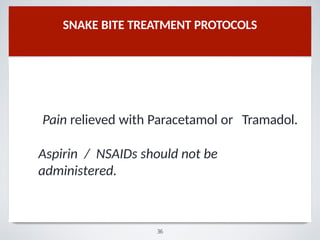
SNAKE BITE TREATMENT PROTOCOLS
Pain relieved with Paracetamol or Tramadol.
Aspirin / NSAIDs should not be
administered.
36
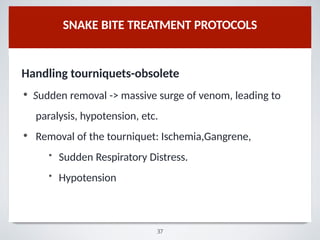
SNAKE BITE TREATMENT PROTOCOLS
Handling tourniquets-obsolete
• Sudden removal -> massive surge of venom, leading to
paralysis, hypotension, etc.
• Removal of the tourniquet: Ischemia,Gangrene,
• Sudden Respiratory Distress.
• Hypotension
37
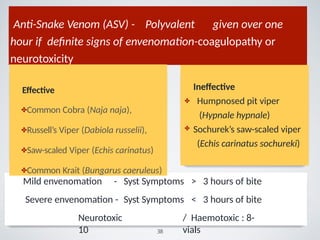
Anti-Snake Venom (ASV) - Polyvalent given over one
hour if definite signs of envenomation-coagulopathy or
neurotoxicity
Mild envenomation - Syst Symptoms > 3 hours of bite
Severe envenomation - Syst Symptoms < 3 hours of bite
Neurotoxic / Haemotoxic : 8-
10 vials
✤
✤
Ineffective
Humpnosed pit viper
(Hypnale hypnale)
Sochurek’s saw-scaled viper
(Echis carinatus sochureki)
Effective
✤Common Cobra (Naja naja),
✤Russell’s Viper (Dabiola russelii),
✤Saw-scaled Viper (Echis carinatus)
✤Common Krait (Bungarus caeruleus)
38
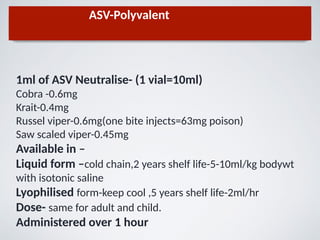
ASV-Polyvalent
1ml of ASV Neutralise- (1 vial=10ml)
Cobra -0.6mg
Krait-0.4mg
Russel viper-0.6mg(one bite injects=63mg poison)
Saw scaled viper-0.45mg
Available in –
Liquid form –cold chain,2 years shelf life-5-10ml/kg bodywt
with isotonic saline
Lyophilised form-keep cool ,5 years shelf life-2ml/hr
Dose- same for adult and child.
Administered over 1 hour
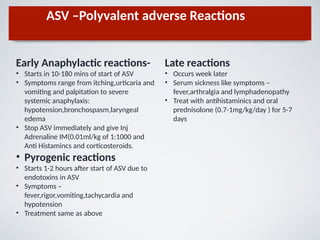
ASV –Polyvalent adverse Reactions
Early Anaphylactic reactions-
• Starts in 10-180 mins of start of ASV
• Symptoms range from itching,urticaria and
vomiting and palpitation to severe
systemic anaphylaxis:
hypotension,bronchospasm,laryngeal
edema
• Stop ASV immediately and give Inj
Adrenaline IM(0.01ml/kg of 1:1000 and
Anti Histamincs and corticosteroids.
• Pyrogenic reactions
• Starts 1-2 hours after start of ASV due to
endotoxins in ASV
• Symptoms –
fever,rigor,vomiting,tachycardia and
hypotension
• Treatment same as above
Late reactions
• Occurs week later
• Serum sickness like symptoms –
fever,arthralgia and lymphadenopathy
• Treat with antihistaminics and oral
prednisolone (0.7-1mg/kg/day ) for 5-7
days
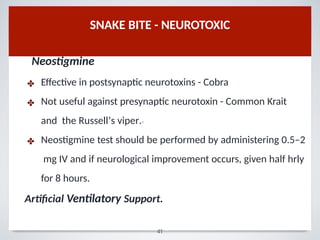
Neostigmine
✤
✤
✤
Effective in postsynaptic neurotoxins - Cobra
Not useful against presynaptic neurotoxin - Common Krait
and the Russell’s viper.15
Neostigmine test should be performed by administering 0.5–2
mg IV and if neurological improvement occurs, given half hrly
for 8 hours.
Artificial Ventilatory Support.
SNAKE BITE - NEUROTOXIC
41
• At Secondary & Tertiary care level, multiple protocols are being
followed for polyvalent anti-snake venom (ASV) administration,
predominantly based on western textbooks.
• Government of India, Health and Family Welfare Department has
prepared a National Snakebite Management Protocol to provide
doctors and lay people with the best possible, evidence-based
approach to deal with this problem in country.
S N A K E - B I T E
42
STINGS
43
Hemiscorpion lepturus.
Scorpion Sting
• Scorpion envenomation - important public health hazard in
tropical & sub-tropical regions.
• Out of 1500 scorpion species -30 of medical
importance.
• Found in dry, hot environments
• Nocturnal, hiding during the day under stones, wood or
tree barks.
• Occupational hazards for farmers, farm labourers, villagers,
migrating population and hunters
• March to June & September to October.
• Endemic areas - western Maharashtra, Karnataka, Andhra
Pradesh, Saurashtra and Tamil Nadu.
44
Bark of trees, Dry firewood, Cow dung, Piles of Bricks,
Paddy husk, Beddings, Loose tiles of Hut, In the shoes,
Pockets of trousers and shirt, Carving & Crevices of
Windows / Doors.
45
✤
✤
✤
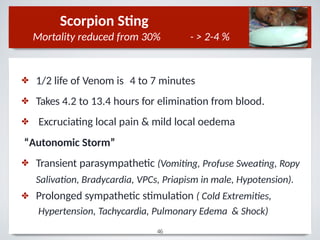
1/2 life of Venom is 4 to 7 minutes
Takes 4.2 to 13.4 hours for elimination from blood.
Excruciating local pain & mild local oedema
“Autonomic Storm”
✤
✤
Transient parasympathetic (Vomiting, Profuse Sweating, Ropy
Salivation, Bradycardia, VPCs, Priapism in male, Hypotension).
Prolonged sympathetic stimulation ( Cold Extremities,
Hypertension, Tachycardia, Pulmonary Edema & Shock)
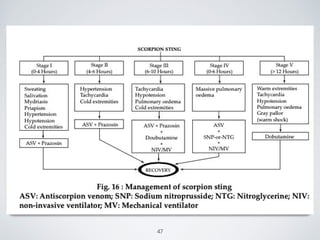
Scorpion Sting
Mortality reduced from 30% - > 2-4 %
46
47
Delay in reporting to hospital
✤ Excessive administration of fluids, atropine —>increase the
severity of pulmonary edema.
✤ Steroids increase the necrotizing effects of circulating
catecholamines & O2 demand of myocardium.
✤ Digitalis enhances already increased myocardial contraction
✤ Antihistamines and venom both act synergistically by
inhibiting Ca+ dependent potassium activating channels lead
ing to QTc prolongation and sudden death.
Causes of High Fatality - Scorpion Sting
48
Bee & Wasp Stings - Allergic Reactions
✤ Bee when bites loses its stinger
✤ Bee injects about50
mcg of venom
✤ Bee venom contains melittin —>
local inflammation & spread
✤ Bee stingers should be removed,
since the venom sac remains
attached when the bee flies off
and can continue to inject
venom for some time.
✤
✤
✤
Wasp when bites retains the
stinger
Wasp injects 2 - 15 mcg of
venom, but as it can do it many
times.
Enzymes that break down cell
membranes, trigger release of
p r o d u c i n g
a intense
allergic
h i s t a m i n
e , moderate
reaction
✤ Contain neurotransmitters like
acetylcholine and serotonin,
which get nerves firing.
49
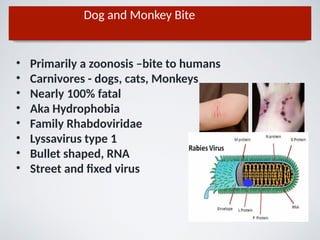
Dog and Monkey Bite
• Primarily a zoonosis –bite to humans
• Carnivores - dogs, cats, Monkeys
• Nearly 100% fatal
• Aka Hydrophobia
• Family Rhabdoviridae
• Lyssavirus type 1
• Bullet shaped, RNA
• Street and fixed virus
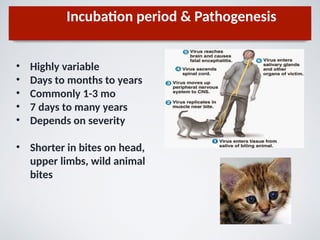
Incubation period & Pathogenesis
• Highly variable
• Days to months to years
• Commonly 1-3 mo
• 7 days to many years
• Depends on severity
• Shorter in bites on head,
upper limbs, wild animal
bites
Clinical features of Rabies
• Prodromal – fever,
headache, tingling at
bite site, 3-4 days (only
specific)
• Widespread excitation
sensory, motor,
sympathetic, mental
systems
• Aerophobia,
hydrophobia
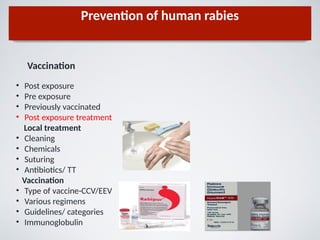
Prevention of human rabies
Vaccination
• Post exposure
• Pre exposure
• Previously vaccinated
• Post exposure treatment
Local treatment
• Cleaning
• Chemicals
• Suturing
• Antibiotics/ TT
Vaccination
• Type of vaccine-CCV/EEV
• Various regimens
• Guidelines/ categories
• Immunoglobulin
First Aid for Animal Bites(Dog,Cat and Monkey)
• Clean the wound with soap and water for 5-10 mins
• Rinse with water under pressure for 5-10 mins
• Control bleeding
• Cover wound with sterile dressing and bandage
• Victim should see Doctor or visit emergency dept Start rabies
treatment immediately
• Kill animal and transport entire body to a vet for rabies testing and
wear gloves to avoid infected saliva
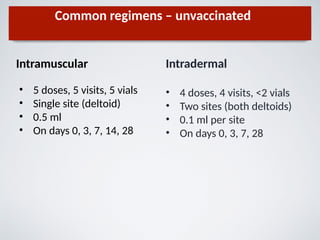
Common regimens – unvaccinated
Intramuscular Intradermal
• 4 doses, 4 visits, <2 vials
• Two sites (both deltoids)
• 0.1 ml per site
• On days 0, 3, 7, 28
• 5 doses, 5 visits, 5 vials
• Single site (deltoid)
• 0.5 ml
• On days 0, 3, 7, 14, 28
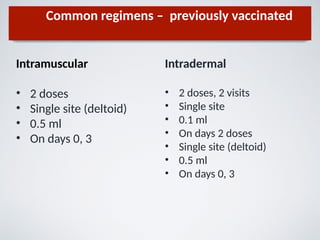
Common regimens – previously vaccinated
Intramuscular
• 2 doses
• Single site (deltoid)
• 0.5 ml
• On days 0, 3
Intradermal
• 2 doses, 2 visits
• Single site
• 0.1 ml
• On days 2 doses
• Single site (deltoid)
• 0.5 ml
• On days 0, 3
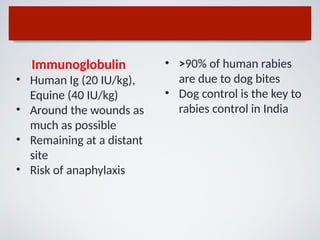
Immunoglobulin
• Human Ig (20 IU/kg),
Equine (40 IU/kg)
• Around the wounds as
much as possible
• Remaining at a distant
site
• Risk of anaphylaxis
• >90% of human rabies
are due to dog bites
• Dog control is the key to
rabies control in India
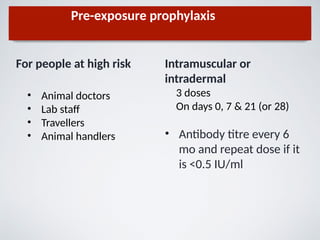
Pre-exposure prophylaxis
For people at high risk
• Animal doctors
• Lab staff
• Travellers
• Animal handlers
Intramuscular or
intradermal
3 doses
On days 0, 7 & 21 (or 28)
• Antibody titre every 6
mo and repeat dose if it
is <0.5 IU/ml

Snake Bite and stings.pptx emergency aid

  • 1.
  • 2.
    Snake-Bite WHO’s list ofNeglected Tropical Diseases - 2009 Antivenoms are Essential Drugs WHO Recommendation Curriculum of Medical Schools /Organisation of Special Training Courses & other Educational Events. 2
  • 3.
  • 4.
  • 5.
    Chance of Snake-Bitedeaths being Missed are high Recorded figures under-estimates the total fatality 5
  • 6.
    • WHO -83000 bites per annum with 11000 deaths. • India has a highest Snake Bite Mortality in the World • Cause - Victim not reaching the hospital in time where definite treatment can be administered • Occupational Risk - farmers, plantation workers, herdsmen, fishermen & other food producers. • Measures to prevent the bites • All snakes are predatory carnivores, none is vegetarian. SNAKE-BITE 6
  • 7.
    Peak Snake-Bite incidenceis during May-October. 7 • Elapidae: Common Cobra (Naja naja), king cobra common krait (Bungarus cerulus) • Viperidae: Russell’s viper, saw called viper (Echis carinatus). • Crotalidae: hump-nosed viper, (Hyphnale hyphnale) • Hydrophidae : Sea Snakes • Crotaloidae: Pit Vipers • Collubridae : Non Poisonous snakes
  • 8.
    SNAKES OF INDIA •236 species of snakes in India • Most - Nonpoisonous : Panic Reaction & Local Injury, • 13 known - Poisonous - [Highly Venomous “The Big Four”] • Common Cobra (Naja naja), • Common Krait (Bungarus caeruleus) • Russell’s Viper (Dabiola russelii), • Saw-scaled Viper (Echis carinatus) Nonidentification humpnosed pit viper- life threatening 8
  • 9.
    • 9 Snakes are elusiveand reclusive. Contact is likely when humans move into the snakes’ favoured habitat. • • • • Rice fields in the case of Russell’s Vipers & Cobras Rubber & Coffee plantations in the case of Malayan Pit Vipers Peri-domestic species such as Cobras (roof spaces), under the floor (Kraits) may bite people in their sleep Nocturnally active snakes are trodden upon by people walking along paths in the dark. • Seasonal peaks of snake-bite incidence are usually associated with increases in agricultural activity or seasonal rains, perhaps coinciding with unusual movement and activity by snakes.
  • 10.
    • The riskof envenoming after bites by venomous snakes varies with the species but is on an average only about 50%. • Bites in which the fangs pierce the skin but no envenoming results are known as “Dry Bites”. • Venom dosage per bite depends on the elapsed time since the last bite, the threat perceived by the snake, and size of the prey. Nostril pits respond to the heat emission of the prey, which may enable the snake to vary the amount of venom delivered. Dry Bites 10
  • 11.
    Elapid : Venom Glandsbehind the eye. Fangs Short - Permanently erect. Cobras, King Cobra, Kraits, Coral Snakes, Australasian Snakes & Sea Snakes. • Relatively long, thin, uniformly-coloured with large smooth symmetrical scales on the dorsum) of the head. • Raise the front part of their body off the ground and spread and flatten the neck to form a hood. • Cobra can spit their venom for one metre or more towards the eyes of perceived enemies. 11
  • 12.
    Vipers: Long, hinged, frontfangs. A reserve fang is seen behind the active fang. (Thailand Russell’s viper Daboia siamensis). Long fangs which are normally folded flat against the upper jaw but, when the snake strikes, they are erected 12
  • 13.
    Rear fangs ofa dangerously venomous Colubrid Snake, The Red-Necked Keelback Blowing Hiss - Russell’s Viper Grating Rasp - Saw- Scaled Viper 13
  • 14.
    • Pit Viper- Proteases, Collagenase, Hyaluronidase allows rapid spread of venom through subcutaneous tissues. • Phospholipase A2 - Hemolysis due to lytic effect on red cell membranes, promotes muscle necrosis and has presynaptic neurotoxic activity. • Thrombogenic enzymes - promote the formation of a weak fibrin clot, which, activates plasmin and results in consumptive coagulopathy and hemorrhagic consequences. • Neurotoxins - Presynaptic i.e. Common Krait & Russell’s viper; Postsynaptic - Cobra VENOM - DESTRUCTIVE PROPERTIES IMMOBILIZE THE VICTIM QUICKLY 14
  • 15.
    • Local Oedema- local increased vascular permeability and thrombosis in microcirculation lead to cell death, severe local inflammation. • Coagulopathy - Local and Systemic Bleeding • SIRS is triggered and can result in systemic sepsis. • Cardiac Failure - can result from hypotension and acidosis. • Nephropathy - sequel to cytotoxic envenomation. Rhabdomyolysis, cardiovascular compromise, changes in microcirculation, coagulopathy all contribute to nephropathy • Neuromuscular Blockade - poor diaphragmatic excursions. No penetration into CNS. VENOM - LOCAL & SYSTEMIC EFFECTS 15
  • 16.
    Local Symptoms &Signs • Fang Marks • Local Pain • Local Bleeding • Bruising • Lymphangitis • LN Enlargement • Inflammation • Blistering • Local Infection, Abscess Formation • Necrosis 16
  • 17.
  • 18.
  • 19.
    Systemic Symptoms &Signs • 19 • General Nausea, vomiting, malaise, abdominal pain, weakness, drowsiness, prostration. Systemic Bleeding - from gums, epistaxis, haemoptysis, bleeding into the tears, intracranial haemorrhage, GI & GU Bleeding, skin (petechiae, purpura & ecchymoses) and pituitary/ retina. • Cardiovascular (Viperidae) Syncope, Collapse, Shock, Hypotension, Cardiac Arrhythmias, Pulmonary Oedema, Chemosis.
  • 20.
    Skeletal Muscle Breakdown—> Generalized Pain, Stiffness Tenderness of Muscles, Trismus, Myoglobinuria, Hyperkalaemia, Acute Renal Failure, Cardiac Arrest,. 20
  • 21.
    Neurological (Elapidae, Russell’sviper) • Drowsiness • Paraesthesiae • External Ophthalmoplegia • Paralysis Of Facial Muscles • Bulbar Paralysis • Respiratory Paralysis • Generalised Flaccid Paralysis. 21
  • 22.
  • 23.
    Local envenoming (swellingetc.) with bleeding/ clotting disturbances = Viperidae (all species) SYNDROME 1 23
  • 24.
    • Local envenoming(swelling etc.) with bleeding/clotting disturbances, shock or acute kidney injury = Russell’s viper (hump-nosed pit viper in Sri Lanka and SW India) • With conjunctival oedema (chemosis) and acute pituitary insufficiency = Russell’s viper - Myanmar • With ptosis, external ophthalmoplegia, facial paralysis etc and dark brown urine = Russell’s viper - Sri Lanka and South India • SYNDROME 2 24
  • 25.
    Local envenoming (swellingetc.) with paralysis = Cobra or king Cobra SYNDROME 3 25
  • 26.
    Paralysis with minimalor no local envenoming Bitten on land while sleeping on the ground = krait SYNDROME 4 26
  • 27.
    • Twenty-Minute WholeBlood Clotting Test (20Wbct) • Bedside1-. Few ml of fresh venous blood placed in a fresh, clean and dry glass vessel preferably test tube and left undisturbed at ambient temperature for 20 minutes. • Tube gently tilted to detect whether blood is still liquid and if so then blood is incoagulable. • The test should be carried out every 30 minutes from admission for 3 hours and then hourly after that. INVESTIGATIONS 27
  • 28.
    • • • • • • • • CBC PT, aPTT, INR. Fibrinogen& split products Blood chemistries -KFT Lactate Urinalysis for Haemoglobinuria, RBC, Myoglobinuria, Proteinuria, ABG ECG, X-Ray Chest, CT. INVESTIGATIONS 28
  • 29.
    SNAKE VENOM DETECTIONKIT ✤ ✤ ✤ ✤ Australia - Snake Venom Detection Kits. Rapid two step enzyme immunoassay in which wells are coated with antibodies to the various snake venoms. A swab from bite site (most reliable), blood or urine helps to select the type of snake antivenom which may have to be used. Primary purpose: To choose the specific antivenom if required. 29
  • 30.
  • 31.
  • 32.
  • 33.
    ANTISNAKE VENOM MODERATE &SEVERE SNAKE BITES 33
  • 34.
    FIRST AID • • • • • 3 34 Reassurance /Control Anxiety - Increased Heart Rate -> Spread of venom Remove shoes, Rings, Watches, Jewellery & tight clothing from bitten area. Victim in lying position with the bitten limb below the heart level. Immobilising the limb with a splint. Transporting the Victim to the nearest treatment facility. • • • • • • • • Do Not Apply Tourniquet Do not Wash the bite site with Soap or any other solution Do not make cuts, Incisions on the bitten area. Do not freeze, apply cold to the area of the bite Do not apply electric shock Do not suck the venom with your mouth Do not attempt to capture, handle or kill the snake Do not take the victim to Quacks.
  • 35.
    SNAKE BITE TREATMENTPROTOCOLS OBSERVATION for 24 hours - Must. AB C- Airway Breathing Circulation 35
  • 36.
    SNAKE BITE TREATMENTPROTOCOLS Pain relieved with Paracetamol or Tramadol. Aspirin / NSAIDs should not be administered. 36
  • 37.
    SNAKE BITE TREATMENTPROTOCOLS Handling tourniquets-obsolete • Sudden removal -> massive surge of venom, leading to paralysis, hypotension, etc. • Removal of the tourniquet: Ischemia,Gangrene, • Sudden Respiratory Distress. • Hypotension 37
  • 38.
    Anti-Snake Venom (ASV)- Polyvalent given over one hour if definite signs of envenomation-coagulopathy or neurotoxicity Mild envenomation - Syst Symptoms > 3 hours of bite Severe envenomation - Syst Symptoms < 3 hours of bite Neurotoxic / Haemotoxic : 8- 10 vials ✤ ✤ Ineffective Humpnosed pit viper (Hypnale hypnale) Sochurek’s saw-scaled viper (Echis carinatus sochureki) Effective ✤Common Cobra (Naja naja), ✤Russell’s Viper (Dabiola russelii), ✤Saw-scaled Viper (Echis carinatus) ✤Common Krait (Bungarus caeruleus) 38
  • 39.
    ASV-Polyvalent 1ml of ASVNeutralise- (1 vial=10ml) Cobra -0.6mg Krait-0.4mg Russel viper-0.6mg(one bite injects=63mg poison) Saw scaled viper-0.45mg Available in – Liquid form –cold chain,2 years shelf life-5-10ml/kg bodywt with isotonic saline Lyophilised form-keep cool ,5 years shelf life-2ml/hr Dose- same for adult and child. Administered over 1 hour
  • 40.
    ASV –Polyvalent adverseReactions Early Anaphylactic reactions- • Starts in 10-180 mins of start of ASV • Symptoms range from itching,urticaria and vomiting and palpitation to severe systemic anaphylaxis: hypotension,bronchospasm,laryngeal edema • Stop ASV immediately and give Inj Adrenaline IM(0.01ml/kg of 1:1000 and Anti Histamincs and corticosteroids. • Pyrogenic reactions • Starts 1-2 hours after start of ASV due to endotoxins in ASV • Symptoms – fever,rigor,vomiting,tachycardia and hypotension • Treatment same as above Late reactions • Occurs week later • Serum sickness like symptoms – fever,arthralgia and lymphadenopathy • Treat with antihistaminics and oral prednisolone (0.7-1mg/kg/day ) for 5-7 days
  • 41.
    Neostigmine ✤ ✤ ✤ Effective in postsynapticneurotoxins - Cobra Not useful against presynaptic neurotoxin - Common Krait and the Russell’s viper.15 Neostigmine test should be performed by administering 0.5–2 mg IV and if neurological improvement occurs, given half hrly for 8 hours. Artificial Ventilatory Support. SNAKE BITE - NEUROTOXIC 41
  • 42.
    • At Secondary& Tertiary care level, multiple protocols are being followed for polyvalent anti-snake venom (ASV) administration, predominantly based on western textbooks. • Government of India, Health and Family Welfare Department has prepared a National Snakebite Management Protocol to provide doctors and lay people with the best possible, evidence-based approach to deal with this problem in country. S N A K E - B I T E 42
  • 43.
  • 44.
    Hemiscorpion lepturus. Scorpion Sting •Scorpion envenomation - important public health hazard in tropical & sub-tropical regions. • Out of 1500 scorpion species -30 of medical importance. • Found in dry, hot environments • Nocturnal, hiding during the day under stones, wood or tree barks. • Occupational hazards for farmers, farm labourers, villagers, migrating population and hunters • March to June & September to October. • Endemic areas - western Maharashtra, Karnataka, Andhra Pradesh, Saurashtra and Tamil Nadu. 44
  • 45.
    Bark of trees,Dry firewood, Cow dung, Piles of Bricks, Paddy husk, Beddings, Loose tiles of Hut, In the shoes, Pockets of trousers and shirt, Carving & Crevices of Windows / Doors. 45
  • 46.
    ✤ ✤ ✤ 1/2 life ofVenom is 4 to 7 minutes Takes 4.2 to 13.4 hours for elimination from blood. Excruciating local pain & mild local oedema “Autonomic Storm” ✤ ✤ Transient parasympathetic (Vomiting, Profuse Sweating, Ropy Salivation, Bradycardia, VPCs, Priapism in male, Hypotension). Prolonged sympathetic stimulation ( Cold Extremities, Hypertension, Tachycardia, Pulmonary Edema & Shock) Scorpion Sting Mortality reduced from 30% - > 2-4 % 46
  • 47.
  • 48.
    Delay in reportingto hospital ✤ Excessive administration of fluids, atropine —>increase the severity of pulmonary edema. ✤ Steroids increase the necrotizing effects of circulating catecholamines & O2 demand of myocardium. ✤ Digitalis enhances already increased myocardial contraction ✤ Antihistamines and venom both act synergistically by inhibiting Ca+ dependent potassium activating channels lead ing to QTc prolongation and sudden death. Causes of High Fatality - Scorpion Sting 48
  • 49.
    Bee & WaspStings - Allergic Reactions ✤ Bee when bites loses its stinger ✤ Bee injects about50 mcg of venom ✤ Bee venom contains melittin —> local inflammation & spread ✤ Bee stingers should be removed, since the venom sac remains attached when the bee flies off and can continue to inject venom for some time. ✤ ✤ ✤ Wasp when bites retains the stinger Wasp injects 2 - 15 mcg of venom, but as it can do it many times. Enzymes that break down cell membranes, trigger release of p r o d u c i n g a intense allergic h i s t a m i n e , moderate reaction ✤ Contain neurotransmitters like acetylcholine and serotonin, which get nerves firing. 49
  • 51.
    Dog and MonkeyBite • Primarily a zoonosis –bite to humans • Carnivores - dogs, cats, Monkeys • Nearly 100% fatal • Aka Hydrophobia • Family Rhabdoviridae • Lyssavirus type 1 • Bullet shaped, RNA • Street and fixed virus
  • 52.
    Incubation period &Pathogenesis • Highly variable • Days to months to years • Commonly 1-3 mo • 7 days to many years • Depends on severity • Shorter in bites on head, upper limbs, wild animal bites
  • 53.
    Clinical features ofRabies • Prodromal – fever, headache, tingling at bite site, 3-4 days (only specific) • Widespread excitation sensory, motor, sympathetic, mental systems • Aerophobia, hydrophobia
  • 54.
    Prevention of humanrabies Vaccination • Post exposure • Pre exposure • Previously vaccinated • Post exposure treatment Local treatment • Cleaning • Chemicals • Suturing • Antibiotics/ TT Vaccination • Type of vaccine-CCV/EEV • Various regimens • Guidelines/ categories • Immunoglobulin
  • 55.
    First Aid forAnimal Bites(Dog,Cat and Monkey) • Clean the wound with soap and water for 5-10 mins • Rinse with water under pressure for 5-10 mins • Control bleeding • Cover wound with sterile dressing and bandage • Victim should see Doctor or visit emergency dept Start rabies treatment immediately • Kill animal and transport entire body to a vet for rabies testing and wear gloves to avoid infected saliva
  • 56.
    Common regimens –unvaccinated Intramuscular Intradermal • 4 doses, 4 visits, <2 vials • Two sites (both deltoids) • 0.1 ml per site • On days 0, 3, 7, 28 • 5 doses, 5 visits, 5 vials • Single site (deltoid) • 0.5 ml • On days 0, 3, 7, 14, 28
  • 57.
    Common regimens –previously vaccinated Intramuscular • 2 doses • Single site (deltoid) • 0.5 ml • On days 0, 3 Intradermal • 2 doses, 2 visits • Single site • 0.1 ml • On days 2 doses • Single site (deltoid) • 0.5 ml • On days 0, 3
  • 58.
    Immunoglobulin • Human Ig(20 IU/kg), Equine (40 IU/kg) • Around the wounds as much as possible • Remaining at a distant site • Risk of anaphylaxis • >90% of human rabies are due to dog bites • Dog control is the key to rabies control in India
  • 59.
    Pre-exposure prophylaxis For peopleat high risk • Animal doctors • Lab staff • Travellers • Animal handlers Intramuscular or intradermal 3 doses On days 0, 7 & 21 (or 28) • Antibody titre every 6 mo and repeat dose if it is <0.5 IU/ml