Triage
SHREYA YADAV
Nursing tutor
Definition of Triage
• Triage is the term derived from the French verb trier
meaning to sort or to choose
It’s the process by which patients classified according
to the type and urgency of their conditions to get
the Right patient to the Right place at the Right
time with the Right care provider
Triage Categories
• Non disaster: To provide the best care
for each individual patient.
• Multi casualty/disaster: To provide the
most effective care for the greatest
number of patients.
Non disaster-
The primary objectives of an ED triage
are to-
2. Identify patients requiring immediate
care.
3. Determine the appropriate area
for treatment
4. Facilitate patient flow through the ED
and avoid unnecessary congestion.
2.Provide continued assessment and
reassessment of arriving and waiting
patients.
3.Provide information and referrals
to patients and families.
4.Allay patient and family anxiety
and enhance public relations.
Disaster
•
Definition: an incident, either natural or human-
made, that produces patients in numbers needing
services beyond immediately available resources.
May involve a large no. of patients or a small no. of
patients if their needs place significant demands on
resources.
The key to successful disaster management is to
provide care to those who are in greatest need first
and just as importantly, not provide care to to those
who have little or no chance of survival. Correct
triage is essential to accomplish this goal
•
Disaster
The triage team
Triage of Victims
- first victims to arrive are frequently
not the most seriously injured.
Critical patients
Fatally Injured Patients
Non critical patients
Contaminated patients
Types of E.D. triage
system
•
•
•
Type 1: Traffic Director
Type 2: Spot Check
Type 3: Comprehensive
• Two-tiered systems: intial screening by RN
who greets each patients on arrival, perform
a primary survey and determine whether the
patient is able to wait for further assessment
by a second triage nurse.
Divide tasks among staff members, internal
triage and external triage
•
Triage levels
1 Resuscitation
2 Emergent
3 urgent
4 less urgent
5 Non urgent
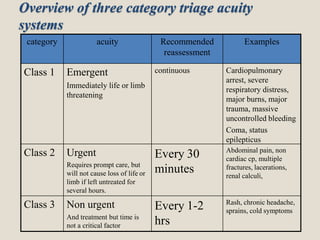
Overview of three category triage acuity
systems
category acuity Recommended
reassessment
Examples
Class 1 Emergent
Immediately life or limb
threatening
continuous Cardiopulmonary
arrest, severe
respiratory distress,
major burns, major
trauma, massive
uncontrolled bleeding
Coma, status
epilepticus
Class 2 Urgent
Requires prompt care, but
will not cause loss of life or
limb if left untreated for
several hours.
Every 30
minutes
Abdominal pain, non
cardiac cp, multiple
fractures, lacerations,
renal calculi,
Class 3 Non urgent
And treatment but time is
not a critical factor
Every 1-2
hrs
Rash, chronic headache,
sprains, cold symptoms
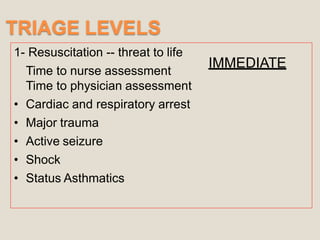
TRIAGE LEVELS
IMMEDIATE
1- Resuscitation -- threat to life
Time to nurse assessment
Time to physician assessment
• Cardiac and respiratory arrest
• Major trauma
• Active seizure
• Shock
• Status Asthmatics
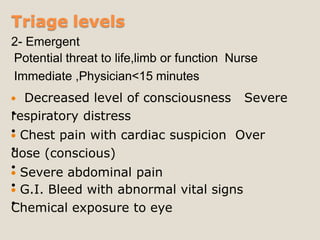
Triage levels
 Decreased level of consciousness Severe
respiratory distress
 Chest pain with cardiac suspicion Over
dose (conscious)
 Severe abdominal pain
 G.I. Bleed with abnormal vital signs
Chemical exposure to eye
2- Emergent
Potential threat to life,limb or function Nurse
Immediate ,Physician<15 minutes
•
•
•
•
•
•
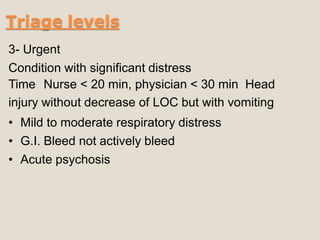
Triage levels
3- Urgent
Condition with significant distress
Time Nurse < 20 min, physician < 30 min Head
injury without decrease of LOC but with vomiting
• Mild to moderate respiratory distress
• G.I. Bleed not actively bleed
• Acute psychosis
Triage levels
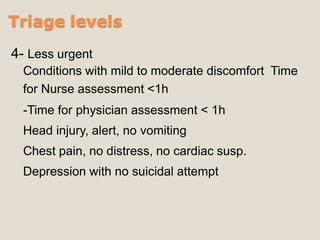
4- Less urgent
Conditions with mild to moderate discomfort Time
for Nurse assessment <1h
-Time for physician assessment < 1h
Head injury, alert, no vomiting
Chest pain, no distress, no cardiac susp.
Depression with no suicidal attempt
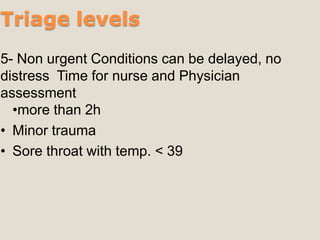
Triage levels
5- Non urgent Conditions can be delayed, no
distress Time for nurse and Physician
assessment
•more than 2h
• Minor trauma
• Sore throat with temp. < 39
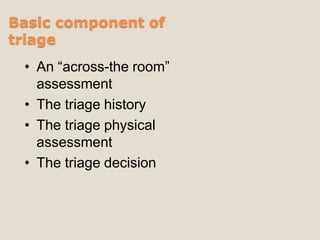
Basic component of
triage
• An “across-the room”
assessment
• The triage history
• The triage physical
assessment
• The triage decision
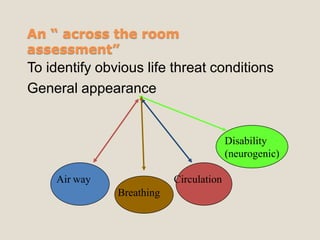
An “ across the room
assessment”
To identify obvious life threat conditions
General appearance
Air way
Breathing
Circulation
Disability
(neurogenic)
Characteristics of triage
nurse
• Extensive knowledge to emergency
medical treatment
• Adequate training and
competent skills,language,
terminology
• Ability to use the critical thinker process
• Good decision maker
Role of triage nurse
•
•
•
Greet patients and identify your self.
Maintain privacy and confidentiality
Visualize all incoming patients even
while interviewing others.
Maintain good communication between triage
and treatment area
maintain excellent communication with
waiting area.
Use all resources to maintain high standard of
care.
•
•
•
Role of triage
nurse
• Teaching -use of thermometer, first aid
avoid lecturing.
• Crowd control.
• Telephone.
• Communicate with team leader and
seek feed back on decisions.
Importance of re
triage
• Reassess the patient within 1-2hours of initial
triage and continue to re assess on a regular
basis, patients who may have presented
without cardinal signs of severe illness may
develop them during long waits.
•The last person in along line at triage may
have a serious medical problem that requires
immediate attention
•Patient should wait no longer than 5 minutes
for triage
If in doubt about a category, choose the higher
acuity to avoid under triaging a patient

Triage ppt

  • 1.
  • 2.
    Definition of Triage •Triage is the term derived from the French verb trier meaning to sort or to choose It’s the process by which patients classified according to the type and urgency of their conditions to get the Right patient to the Right place at the Right time with the Right care provider
  • 3.
    Triage Categories • Nondisaster: To provide the best care for each individual patient. • Multi casualty/disaster: To provide the most effective care for the greatest number of patients.
  • 4.
    Non disaster- The primaryobjectives of an ED triage are to- 2. Identify patients requiring immediate care. 3. Determine the appropriate area for treatment 4. Facilitate patient flow through the ED and avoid unnecessary congestion.
  • 5.
    2.Provide continued assessmentand reassessment of arriving and waiting patients. 3.Provide information and referrals to patients and families. 4.Allay patient and family anxiety and enhance public relations.
  • 6.
    Disaster • Definition: an incident,either natural or human- made, that produces patients in numbers needing services beyond immediately available resources. May involve a large no. of patients or a small no. of patients if their needs place significant demands on resources. The key to successful disaster management is to provide care to those who are in greatest need first and just as importantly, not provide care to to those who have little or no chance of survival. Correct triage is essential to accomplish this goal •
  • 7.
    Disaster The triage team Triageof Victims - first victims to arrive are frequently not the most seriously injured. Critical patients Fatally Injured Patients Non critical patients Contaminated patients
  • 8.
    Types of E.D.triage system • • • Type 1: Traffic Director Type 2: Spot Check Type 3: Comprehensive • Two-tiered systems: intial screening by RN who greets each patients on arrival, perform a primary survey and determine whether the patient is able to wait for further assessment by a second triage nurse. Divide tasks among staff members, internal triage and external triage •
  • 9.
    Triage levels 1 Resuscitation 2Emergent 3 urgent 4 less urgent 5 Non urgent
  • 10.
    Overview of threecategory triage acuity systems category acuity Recommended reassessment Examples Class 1 Emergent Immediately life or limb threatening continuous Cardiopulmonary arrest, severe respiratory distress, major burns, major trauma, massive uncontrolled bleeding Coma, status epilepticus Class 2 Urgent Requires prompt care, but will not cause loss of life or limb if left untreated for several hours. Every 30 minutes Abdominal pain, non cardiac cp, multiple fractures, lacerations, renal calculi, Class 3 Non urgent And treatment but time is not a critical factor Every 1-2 hrs Rash, chronic headache, sprains, cold symptoms
  • 11.
    TRIAGE LEVELS IMMEDIATE 1- Resuscitation-- threat to life Time to nurse assessment Time to physician assessment • Cardiac and respiratory arrest • Major trauma • Active seizure • Shock • Status Asthmatics
  • 12.
    Triage levels  Decreasedlevel of consciousness Severe respiratory distress  Chest pain with cardiac suspicion Over dose (conscious)  Severe abdominal pain  G.I. Bleed with abnormal vital signs Chemical exposure to eye 2- Emergent Potential threat to life,limb or function Nurse Immediate ,Physician<15 minutes • • • • • •
  • 13.
    Triage levels 3- Urgent Conditionwith significant distress Time Nurse < 20 min, physician < 30 min Head injury without decrease of LOC but with vomiting • Mild to moderate respiratory distress • G.I. Bleed not actively bleed • Acute psychosis
  • 14.
    Triage levels 4- Lessurgent Conditions with mild to moderate discomfort Time for Nurse assessment <1h -Time for physician assessment < 1h Head injury, alert, no vomiting Chest pain, no distress, no cardiac susp. Depression with no suicidal attempt
  • 15.
    Triage levels 5- Nonurgent Conditions can be delayed, no distress Time for nurse and Physician assessment •more than 2h • Minor trauma • Sore throat with temp. < 39
  • 16.
    Basic component of triage •An “across-the room” assessment • The triage history • The triage physical assessment • The triage decision
  • 17.
    An “ acrossthe room assessment” To identify obvious life threat conditions General appearance Air way Breathing Circulation Disability (neurogenic)
  • 18.
    Characteristics of triage nurse •Extensive knowledge to emergency medical treatment • Adequate training and competent skills,language, terminology • Ability to use the critical thinker process • Good decision maker
  • 19.
    Role of triagenurse • • • Greet patients and identify your self. Maintain privacy and confidentiality Visualize all incoming patients even while interviewing others. Maintain good communication between triage and treatment area maintain excellent communication with waiting area. Use all resources to maintain high standard of care. • • •
  • 20.
    Role of triage nurse •Teaching -use of thermometer, first aid avoid lecturing. • Crowd control. • Telephone. • Communicate with team leader and seek feed back on decisions.
  • 21.
    Importance of re triage •Reassess the patient within 1-2hours of initial triage and continue to re assess on a regular basis, patients who may have presented without cardinal signs of severe illness may develop them during long waits.
  • 22.
    •The last personin along line at triage may have a serious medical problem that requires immediate attention •Patient should wait no longer than 5 minutes for triage If in doubt about a category, choose the higher acuity to avoid under triaging a patient