PRESENTATION
ON
POISONING
PRESENTED BY:
Md. Mahbub Rion
DHAKA INTERNATIONAL UNIVERSITY
INTRODUCTION
DRUG POISONING
ANIMAL AND PLANT POISONING
HOUSEHOLD & INDUSTRIAL POISONING
ARSENIC POISONING
CONCLUSION
Presentation Flow
POISON
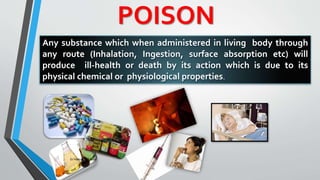
Any substance which when administered in living body through
any route (Inhalation, Ingestion, surface absorption etc) will
produce ill-health or death by its action which is due to its
physical chemical or physiological properties.
Dr Hemanth S Naik
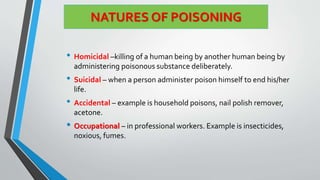
NATURES OF POISONING
• Homicidal –killing of a human being by another human being by
administering poisonous substance deliberately.
• Suicidal – when a person administer poison himself to end his/her
life.
• Accidental – example is household poisons, nail polish remover,
acetone.
• Occupational – in professional workers. Example is insecticides,
noxious, fumes.
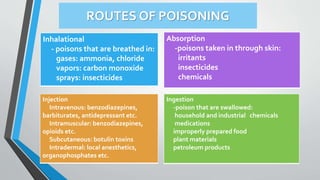
ROUTES OF POISONING
Inhalational
- poisons that are breathed in:
gases: ammonia, chloride
vapors: carbon monoxide
sprays: insecticides
Ingestion
-poison that are swallowed:
household and industrial chemicals
medications
improperly prepared food
plant materials
petroleum products
Injection
Intravenous: benzodiazepines,
barbiturates, antidepressant etc.
Intramuscular: benzodiazepines,
opioids etc.
Subcutaneous: botulin toxins
Intradermal: local anesthetics,
organophosphates etc.
Absorption
-poisons taken in through skin:
irritants
insecticides
chemicals
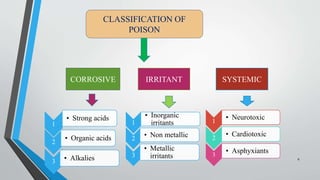
CLASSIFICATION OF
POISON
CORROSIVE IRRITANT SYSTEMIC
1
• Inorganic
irritants
2 • Non metallic
3
• Metallic
irritants
1
• Neurotoxic
2
• Cardiotoxic
3
• Asphyxiants
1
• Strong acids
2
• Organic acids
3 • Alkalies 6
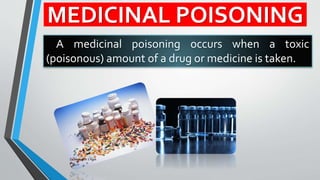
MEDICINAL POISONING
A medicinal poisoning occurs when a toxic
(poisonous) amount of a drug or medicine is taken.
Dr Hemanth S Naik
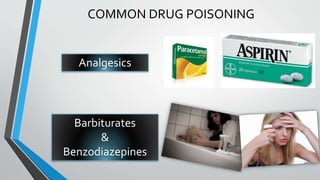
COMMON DRUG POISONING
Analgesics
Barbiturates
&
Benzodiazepines
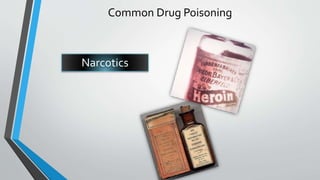
Common Drug Poisoning
Narcotics
HOUSEHOLD POISONING
Household poisons are poisoning that occur by exposure to home
products, specially happened by children(because they don't know it
is, or mimickers to adults),and by adult (accidental, mistakes).
cosmetics and personal care products
cleaning substances and laundry products
pain medicine
foreign bodies such as toys, coins, thermometers
topical preparations
EXAMPLE
INDUSTRIAL POISON
Various chemical compounds that are used in industry and
have a harmful effect on the human body.
EXAMPLE
Asbestos
Lead
Mercury
Nitrates
Phosphates
Sulphur etc.
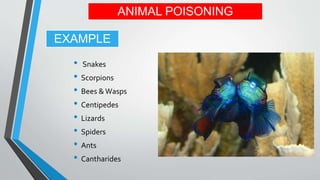
• Snakes
• Scorpions
• Bees &Wasps
• Centipedes
• Lizards
• Spiders
• Ants
• Cantharides
EXAMPLE
ANIMAL POISONING
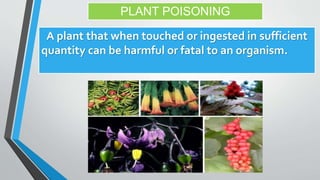
A plant that when touched or ingested in sufficient
quantity can be harmful or fatal to an organism.
PLANT POISONING
1. Tobacco
2. Oleander
3. Rosary Pea
4. Castor Bean
5. White Snakeroot
6. Deadly Nightshade
7. Water Hemlock
7 OFTHE WORLD’S DEADLIEST PLANTS
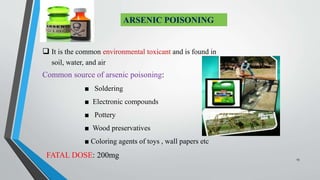
ARSENIC POISONING
 It is the common environmental toxicant and is found in
soil, water, and air
Common source of arsenic poisoning:
■ Soldering
■ Electronic compounds
■ Pottery
■ Wood preservatives
■ Coloring agents of toys , wall papers etc
FATAL DOSE: 200mg 15
TEST AND INVESTIGATIONS
Investigations may include blood tests and an
Electrocardiogram. A blood test can be used to check the
levels of chemicals and glucose in a person’s blood. They
may be used to perform a toxicology screen (tests to
determine how many drugs or medication a person has
taken) and a liver function test (which indicates how
damaged the liver is).
CONCLUSION
TREATMENT
Activated charcoal – charcoal binds to the poison and stops it from
being further absorbed into the blood.
Antidotes – these are substances that either prevent the poison from
working or reverse the effects of the poison.
Sedatives – these may be given if the person is agitated.
Ventilator – these may also be given if the person is agitated.
Anti- epileptic medicine – this may be used if the person has seizures.
REFERENCE
• NelsonTextbook of Pediatrics, 18th ed.
Copyright © 2007 Saunders, An Imprint of Elsevier
• Up to date
• World Health Organization:
• Michael JB, Sztanjnkrycer MD. Deadly pediatric poisons: nine common agents that
kill at low doses. Emergency Medicine Clinics of North America 2004; (22): 1019-1050
• ‘First aid international , fractures, Poisons.’
http://www.firstaidinternational.com.au/poisons%20bites%20stings.htm Retrieved: 5-
8-08
ANY QUESTION ?
THANKYOU
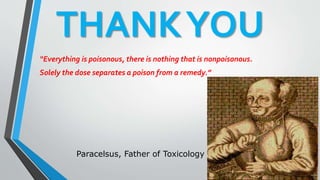
“Everything is poisonous, there is nothing that is nonpoisonous.
Solely the dose separates a poison from a remedy.”
Paracelsus, Father of Toxicology

Poisoning

  • 1.
    PRESENTATION ON POISONING PRESENTED BY: Md. MahbubRion DHAKA INTERNATIONAL UNIVERSITY
  • 2.
    INTRODUCTION DRUG POISONING ANIMAL ANDPLANT POISONING HOUSEHOLD & INDUSTRIAL POISONING ARSENIC POISONING CONCLUSION Presentation Flow
  • 3.
    POISON Any substance whichwhen administered in living body through any route (Inhalation, Ingestion, surface absorption etc) will produce ill-health or death by its action which is due to its physical chemical or physiological properties. Dr Hemanth S Naik
  • 4.
    NATURES OF POISONING •Homicidal –killing of a human being by another human being by administering poisonous substance deliberately. • Suicidal – when a person administer poison himself to end his/her life. • Accidental – example is household poisons, nail polish remover, acetone. • Occupational – in professional workers. Example is insecticides, noxious, fumes.
  • 5.
    ROUTES OF POISONING Inhalational -poisons that are breathed in: gases: ammonia, chloride vapors: carbon monoxide sprays: insecticides Ingestion -poison that are swallowed: household and industrial chemicals medications improperly prepared food plant materials petroleum products Injection Intravenous: benzodiazepines, barbiturates, antidepressant etc. Intramuscular: benzodiazepines, opioids etc. Subcutaneous: botulin toxins Intradermal: local anesthetics, organophosphates etc. Absorption -poisons taken in through skin: irritants insecticides chemicals
  • 6.
    CLASSIFICATION OF POISON CORROSIVE IRRITANTSYSTEMIC 1 • Inorganic irritants 2 • Non metallic 3 • Metallic irritants 1 • Neurotoxic 2 • Cardiotoxic 3 • Asphyxiants 1 • Strong acids 2 • Organic acids 3 • Alkalies 6
  • 7.
    MEDICINAL POISONING A medicinalpoisoning occurs when a toxic (poisonous) amount of a drug or medicine is taken. Dr Hemanth S Naik
  • 8.
  • 9.
  • 10.
    HOUSEHOLD POISONING Household poisonsare poisoning that occur by exposure to home products, specially happened by children(because they don't know it is, or mimickers to adults),and by adult (accidental, mistakes). cosmetics and personal care products cleaning substances and laundry products pain medicine foreign bodies such as toys, coins, thermometers topical preparations EXAMPLE
  • 11.
    INDUSTRIAL POISON Various chemicalcompounds that are used in industry and have a harmful effect on the human body. EXAMPLE Asbestos Lead Mercury Nitrates Phosphates Sulphur etc.
  • 12.
    • Snakes • Scorpions •Bees &Wasps • Centipedes • Lizards • Spiders • Ants • Cantharides EXAMPLE ANIMAL POISONING
  • 13.
    A plant thatwhen touched or ingested in sufficient quantity can be harmful or fatal to an organism. PLANT POISONING
  • 14.
    1. Tobacco 2. Oleander 3.Rosary Pea 4. Castor Bean 5. White Snakeroot 6. Deadly Nightshade 7. Water Hemlock 7 OFTHE WORLD’S DEADLIEST PLANTS
  • 15.
    ARSENIC POISONING  Itis the common environmental toxicant and is found in soil, water, and air Common source of arsenic poisoning: ■ Soldering ■ Electronic compounds ■ Pottery ■ Wood preservatives ■ Coloring agents of toys , wall papers etc FATAL DOSE: 200mg 15
  • 16.
    TEST AND INVESTIGATIONS Investigationsmay include blood tests and an Electrocardiogram. A blood test can be used to check the levels of chemicals and glucose in a person’s blood. They may be used to perform a toxicology screen (tests to determine how many drugs or medication a person has taken) and a liver function test (which indicates how damaged the liver is). CONCLUSION
  • 17.
    TREATMENT Activated charcoal –charcoal binds to the poison and stops it from being further absorbed into the blood. Antidotes – these are substances that either prevent the poison from working or reverse the effects of the poison. Sedatives – these may be given if the person is agitated. Ventilator – these may also be given if the person is agitated. Anti- epileptic medicine – this may be used if the person has seizures.
  • 18.
    REFERENCE • NelsonTextbook ofPediatrics, 18th ed. Copyright © 2007 Saunders, An Imprint of Elsevier • Up to date • World Health Organization: • Michael JB, Sztanjnkrycer MD. Deadly pediatric poisons: nine common agents that kill at low doses. Emergency Medicine Clinics of North America 2004; (22): 1019-1050 • ‘First aid international , fractures, Poisons.’ http://www.firstaidinternational.com.au/poisons%20bites%20stings.htm Retrieved: 5- 8-08
  • 19.
  • 20.
    THANKYOU “Everything is poisonous,there is nothing that is nonpoisonous. Solely the dose separates a poison from a remedy.” Paracelsus, Father of Toxicology