Introduction
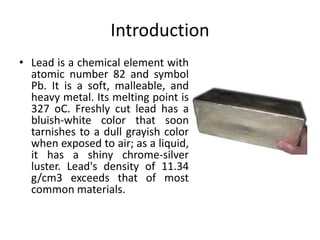
• Lead is a chemical element with
atomic number 82 and symbol
Pb. It is a soft, malleable, and
heavy metal. Its melting point is
327 oC. Freshly cut lead has a
bluish-white color that soon
tarnishes to a dull grayish color
when exposed to air; as a liquid,
it has a shiny chrome-silver
luster. Lead's density of 11.34
g/cm3 exceeds that of most
common materials.
Introduction
• Lead is a dense, soft, low-melting metal. It is an important
component of batteries, and about 75% of the world's lead
production is consumed by the battery industry. Lead is the densest
common metal except for gold, and this quality makes it effective in
sound barriers and as a shield against X-rays. It is also added to
paints, and it makes a long-lasting roofing material.
• Lead is also commonly used in glass and enamel. In television
picture tubes and computer video display terminals, lead helps
block radiation, and the inner, though not the outer, portion of the
common light bulb is made of leaded glass. Lead also increases the
strength and brilliance of crystal glassware. Lead is used to make
bearings and solder, and it is important in rubber production and oil
refining.
Lead mining
• Lead metal can be classified as either primary or secondary. Primary
lead is produced directly from mined lead ore whereas secondary
lead is produced from scrap lead products (such as automobile
batteries) which have been recycled. Total annual production is
approximately 8 million tonnes, half of which is primary lead. It is
rare to find pure deposits of lead in nature though.
• The majority of the deposits are mixtures of minerals, hence lead
ore is usually obtained as a byproduct of other metal mining such as
zinc, silver or copper. In fact, lead ore is a main source of silver and
contributes substantially towards the world's total output. The most
common lead ore is galena (PbS), which contains 86.6% lead. Other
common varieties include cerussite (PbCO3) and angelsite (PbSO4).
Concentration
• After the ore is removed from the mine, it is
treated at a concentrating mill. Concentrating
means to remove the waste rock from the
lead. To begin, the ore must be crushed into
very small pieces. The ore is ground at the
mill, leaving it in particles with diameters of
0.1 millimeter or less.
Flotation
• The principal lead ore, galena, is properly known as lead sulfide,
and sulfur makes up a substantial portion of the mineral. The
flotation process collects the sulfur-bearing portions of the ore,
which also contains the valuable metal.
• First, the finely crushed ore is diluted with water and then poured
into a tank called a flotation cell. The ground ore and water mixture
is called slurry. One percent pine oil or a similar chemical is then
added to the slurry in the tank.
• The tank then agitates, shaking the mixture violently. The pine oil
attracts the sulfide particles. Then air is bubbled through the
mixture. This causes the sulfide particles to form an oily froth at the
top of the tank. The waste rock, which is called gangue, sinks to the
bottom. he concentrate at this point contains from 80% lead, with
large amounts of other impurities, mostly sulfur and zinc.
Roasting
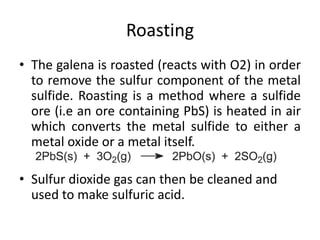
• The galena is roasted (reacts with O2) in order
to remove the sulfur component of the metal
sulfide. Roasting is a method where a sulfide
ore (i.e an ore containing PbS) is heated in air
which converts the metal sulfide to either a
metal oxide or a metal itself.
• Sulfur dioxide gas can then be cleaned and
used to make sulfuric acid.
Sintering
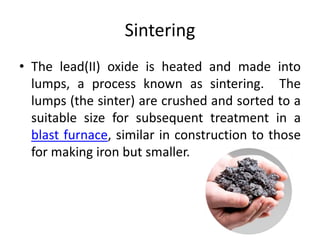
• The lead(II) oxide is heated and made into
lumps, a process known as sintering. The
lumps (the sinter) are crushed and sorted to a
suitable size for subsequent treatment in a
blast furnace, similar in construction to those
for making iron but smaller.
Smelting
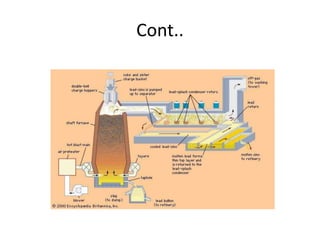
• The graded sinter (each lump about the size of a fist) is
mixed with approximately 7% of its mass in coke and
limestone. The coke is added for two purposes, one as
the reducing agent and the other as a source of heat
when it reacts with the air which, as in the
manufacture of iron is pumped into the furnace. The
limestone provides material for the flux containing the
impurities, the slag. The mixture is fed into the top of
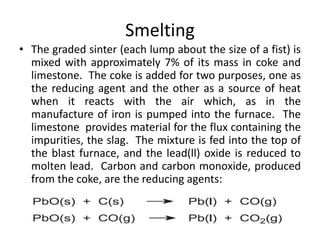
the blast furnace, and the lead(ll) oxide is reduced to
molten lead. Carbon and carbon monoxide, produced
from the coke, are the reducing agents:
Smelting
• The molten lead is tapped off from the base of
the furnace and either cast into, typically, 4 tonne
ingots or put into a 'holding kettle' which keeps
the metal molten for the refining process.
• The product contains about 99.5% lead, the
remaining 0.5% being mostly antimony and silver
with smaller amounts of other metals, including
gold. Because it contains silver and gold at this
stage, the lead is referred to as bullion lead.
Cont..
Refining
• The molten lead as it comes from the blast furnace is from
95-98% pure. It must be further refined to remove
impurities, because commercial lead must be 99-99.999%
pure.
• To refine the bullion, it is kept in the drossing kettle at a
temperature just above its melting point, about 626°F
(330°C). At this temperature, any copper left in the bullion
rises to the top of the kettle and forms a scum or dross
which can be skimmed off. Gold and silver can be removed
from the bullion by adding to it a small quantity of zinc. The
gold and silver dissolves more easily in zinc than in lead,
and when the bullion is cooled slightly, a zinc dross rises to
the top, bringing the other metals with it.
Cont…
• The Parkes process is a pyrometallurgical industrial process
for removing silver from lead during the production of
bullion. It is an example of liquid–liquid extraction.
• The process takes advantage of two liquid-state properties
of zinc. The first is that zinc is immiscible with lead, and the
other is that silver is 3000 times more soluble in zinc than it
is in lead. When zinc is added to liquid lead that contains
silver as a contaminant, the silver preferentially migrates
into the zinc. Because the zinc is immiscible in the lead it
remains in a separate layer and is easily removed. The zinc-
silver solution is then heated until the zinc vaporizes,
leaving nearly pure silver. If gold is present in the liquid
lead, it can also be removed and isolated by the same
process.
Product
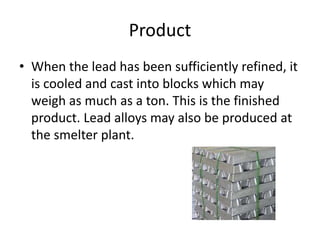
• When the lead has been sufficiently refined, it
is cooled and cast into blocks which may
weigh as much as a ton. This is the finished
product. Lead alloys may also be produced at
the smelter plant.
Byproducts/Waste
• Lead refining produces several byproducts. The gangue, or
waste rock, accumulates as the ore is concentrated. Most
of the minerals have been removed from the rock, so this
waste is not considered by the industry to be an
environmental hazard. It can be pumped into a disposal
pond, which resembles a natural lake. Sulfuric acid is the
major byproduct of the smelting process. Sulfur dioxide gas
is released when the ore is roasted at the sinter plant. To
protect the atmosphere, fumes and smoke are captured,
and the air released by the plant is first cleaned. The sulfur
dioxide is collected at a separate acid plant, and converted
to sulfuric acid. The refinery can sell this acid as well as its
primary product, the lead itself.
Byproducts/Waste
• Air pollution can result from lead processing as well. The
smelter requires a "bag house," that is, a separate facility to
filter and vacuum the fumes so that lead is not released
into the atmosphere. Nevertheless, lead particles do reach
the atmosphere, and in the United States, federal
regulations attempt to control how much is allowable. Most
of the solid waste product produced by the smelting
process is a dense, glassy substance called slag. This
contains traces of lead as well as zinc and copper. The slag
is more toxic than the gangue, and it must be stored
securely and monitored so that it does not escape into the
environment or come in contact with populations.
•

Extraction of Lead

  • 2.
    Introduction • Lead isa chemical element with atomic number 82 and symbol Pb. It is a soft, malleable, and heavy metal. Its melting point is 327 oC. Freshly cut lead has a bluish-white color that soon tarnishes to a dull grayish color when exposed to air; as a liquid, it has a shiny chrome-silver luster. Lead's density of 11.34 g/cm3 exceeds that of most common materials.
  • 3.
    Introduction • Lead isa dense, soft, low-melting metal. It is an important component of batteries, and about 75% of the world's lead production is consumed by the battery industry. Lead is the densest common metal except for gold, and this quality makes it effective in sound barriers and as a shield against X-rays. It is also added to paints, and it makes a long-lasting roofing material. • Lead is also commonly used in glass and enamel. In television picture tubes and computer video display terminals, lead helps block radiation, and the inner, though not the outer, portion of the common light bulb is made of leaded glass. Lead also increases the strength and brilliance of crystal glassware. Lead is used to make bearings and solder, and it is important in rubber production and oil refining.
  • 4.
    Lead mining • Leadmetal can be classified as either primary or secondary. Primary lead is produced directly from mined lead ore whereas secondary lead is produced from scrap lead products (such as automobile batteries) which have been recycled. Total annual production is approximately 8 million tonnes, half of which is primary lead. It is rare to find pure deposits of lead in nature though. • The majority of the deposits are mixtures of minerals, hence lead ore is usually obtained as a byproduct of other metal mining such as zinc, silver or copper. In fact, lead ore is a main source of silver and contributes substantially towards the world's total output. The most common lead ore is galena (PbS), which contains 86.6% lead. Other common varieties include cerussite (PbCO3) and angelsite (PbSO4).
  • 5.
    Concentration • After theore is removed from the mine, it is treated at a concentrating mill. Concentrating means to remove the waste rock from the lead. To begin, the ore must be crushed into very small pieces. The ore is ground at the mill, leaving it in particles with diameters of 0.1 millimeter or less.
  • 6.
    Flotation • The principallead ore, galena, is properly known as lead sulfide, and sulfur makes up a substantial portion of the mineral. The flotation process collects the sulfur-bearing portions of the ore, which also contains the valuable metal. • First, the finely crushed ore is diluted with water and then poured into a tank called a flotation cell. The ground ore and water mixture is called slurry. One percent pine oil or a similar chemical is then added to the slurry in the tank. • The tank then agitates, shaking the mixture violently. The pine oil attracts the sulfide particles. Then air is bubbled through the mixture. This causes the sulfide particles to form an oily froth at the top of the tank. The waste rock, which is called gangue, sinks to the bottom. he concentrate at this point contains from 80% lead, with large amounts of other impurities, mostly sulfur and zinc.
  • 7.
    Roasting • The galenais roasted (reacts with O2) in order to remove the sulfur component of the metal sulfide. Roasting is a method where a sulfide ore (i.e an ore containing PbS) is heated in air which converts the metal sulfide to either a metal oxide or a metal itself. • Sulfur dioxide gas can then be cleaned and used to make sulfuric acid.
  • 8.
    Sintering • The lead(II)oxide is heated and made into lumps, a process known as sintering. The lumps (the sinter) are crushed and sorted to a suitable size for subsequent treatment in a blast furnace, similar in construction to those for making iron but smaller.
  • 9.
    Smelting • The gradedsinter (each lump about the size of a fist) is mixed with approximately 7% of its mass in coke and limestone. The coke is added for two purposes, one as the reducing agent and the other as a source of heat when it reacts with the air which, as in the manufacture of iron is pumped into the furnace. The limestone provides material for the flux containing the impurities, the slag. The mixture is fed into the top of the blast furnace, and the lead(ll) oxide is reduced to molten lead. Carbon and carbon monoxide, produced from the coke, are the reducing agents:
  • 10.
    Smelting • The moltenlead is tapped off from the base of the furnace and either cast into, typically, 4 tonne ingots or put into a 'holding kettle' which keeps the metal molten for the refining process. • The product contains about 99.5% lead, the remaining 0.5% being mostly antimony and silver with smaller amounts of other metals, including gold. Because it contains silver and gold at this stage, the lead is referred to as bullion lead.
  • 11.
  • 12.
    Refining • The moltenlead as it comes from the blast furnace is from 95-98% pure. It must be further refined to remove impurities, because commercial lead must be 99-99.999% pure. • To refine the bullion, it is kept in the drossing kettle at a temperature just above its melting point, about 626°F (330°C). At this temperature, any copper left in the bullion rises to the top of the kettle and forms a scum or dross which can be skimmed off. Gold and silver can be removed from the bullion by adding to it a small quantity of zinc. The gold and silver dissolves more easily in zinc than in lead, and when the bullion is cooled slightly, a zinc dross rises to the top, bringing the other metals with it.
  • 13.
    Cont… • The Parkesprocess is a pyrometallurgical industrial process for removing silver from lead during the production of bullion. It is an example of liquid–liquid extraction. • The process takes advantage of two liquid-state properties of zinc. The first is that zinc is immiscible with lead, and the other is that silver is 3000 times more soluble in zinc than it is in lead. When zinc is added to liquid lead that contains silver as a contaminant, the silver preferentially migrates into the zinc. Because the zinc is immiscible in the lead it remains in a separate layer and is easily removed. The zinc- silver solution is then heated until the zinc vaporizes, leaving nearly pure silver. If gold is present in the liquid lead, it can also be removed and isolated by the same process.
  • 14.
    Product • When thelead has been sufficiently refined, it is cooled and cast into blocks which may weigh as much as a ton. This is the finished product. Lead alloys may also be produced at the smelter plant.
  • 15.
    Byproducts/Waste • Lead refiningproduces several byproducts. The gangue, or waste rock, accumulates as the ore is concentrated. Most of the minerals have been removed from the rock, so this waste is not considered by the industry to be an environmental hazard. It can be pumped into a disposal pond, which resembles a natural lake. Sulfuric acid is the major byproduct of the smelting process. Sulfur dioxide gas is released when the ore is roasted at the sinter plant. To protect the atmosphere, fumes and smoke are captured, and the air released by the plant is first cleaned. The sulfur dioxide is collected at a separate acid plant, and converted to sulfuric acid. The refinery can sell this acid as well as its primary product, the lead itself.
  • 16.
    Byproducts/Waste • Air pollutioncan result from lead processing as well. The smelter requires a "bag house," that is, a separate facility to filter and vacuum the fumes so that lead is not released into the atmosphere. Nevertheless, lead particles do reach the atmosphere, and in the United States, federal regulations attempt to control how much is allowable. Most of the solid waste product produced by the smelting process is a dense, glassy substance called slag. This contains traces of lead as well as zinc and copper. The slag is more toxic than the gangue, and it must be stored securely and monitored so that it does not escape into the environment or come in contact with populations. •