Welcome To My Presentation
Presented by,
Md. Ibrahim Khalil
Id:16173207095
Intake:19th
Section :02
Topic: Smart Textile
Introduction
 Smart textile introduces a shift from passive Functionality
to active behavior
 It is The result of the integration of microelectronics in
textile to endow materials with new properties.
 The production of smart textile is now a reality after a
successful marriage of traditional textile and clothing
technology with other branches of science like material
science, structural mechanics, sensor and actuator
technology, advance processing technology ,
communication, artificial intelligence ,biology etc.
Definition
 Smart textile are defined as textiles that can sense and react via an active control
mechanism to environmental conditions or stimuli from mechanical, thermal, chemical,
electrical or magnetic sources
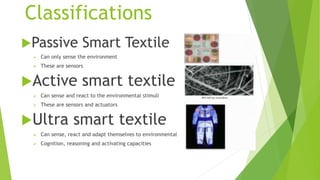
Classifications
Passive Smart Textile
 Can only sense the environment
 These are sensors
Active smart textile
 Can sense and react to the environmental stimuli
 These are sensors and actuators
Ultra smart textile
 Can sense, react and adapt themselves to environmental
 Cognition, reasoning and activating capacities
Function of smart textiles
 Sensing
 Data processing
 Actuation
 Storage
 Communication
Sensing
 Basically, sensing is the function of transforming a signal into another signal
that can be read and understood by a predefined reader which can be a real
device or a person.
 For real devices all the signals should be ultimately converted into electrical
ones.
 Thermocouple, quantum tunneling composite(based on soft switch
technology), fibre bragg grating sensors( basically optical fibres) are used to
convert the signals into electrical ones.
Data Processing
 Data processing is one of the component that are required only when active
proccssing is necessary
 Problems need to be overcome before imparting textile material for this
function are: fastness to washing , deformation, interconnection, etc.
 So far, pieces of electronics are used for data processing which are now
available in miniaturized and even in a flexible form.
Actuation
 Actuators respond to an impulse resulting from sensor function possibly data
processing.
 Actuators make things move , release substances ,make noise and many
more.
 Shape memory material, drug supply system(emitting substances) are the best
suiting examples in this field
Storage
 Sensing , data processing , actuation, communication, they usually need
energy , mostly electrical energy.
 For efficient energy management there should be an appropriate combination
of energy supply and energy storage capacity.
 Here sources of energy are –instance body heat, mechanical motion (elastic
from deformation of the fabrics, kinetic from body motion),radiation etc.
 Phase change materials or pcm acts as energy storage .
Communication
 It may be required
 Within one element of a suit ------ optical fibers, conductive yarns
 Between the individual element within the suit------optical fibers, conductive
yarns
 From the wearer to the suit to pass instruction------- optical fibres
 From the suit to the wearer or his environment to pass information ----
wireless connection i.e. antenna manufactured in textile material
Smart materials used
 Thermos regulating material
 Chromic materials
 luminescent materials
 Conductive material
 Voltaic materials
 Electronic textiles
 Etc.………
Thermo Regulating material
 Paraffin phase change material
 Acts as a storage of heat in garments
 Provide a thermal balance between the heat generated
by the body while engaging in a sport and the heat
released into the environment.
 PCMs are applied either in spinning or during chemical
finishing of textiles like coating, lamination etc.
PCM in textile
Chromic Materials
 Change their color reversibly According to external
environmental conditions
 Photochromic :external stimulus is light.
 Thermochromics : external stimulus is heat.
 Electrochromic : external stimulus is Electricity.
 Piezorochromic : external stimulus is pressure.
 Solvatechromic : external stimulus is liquid or gas.
Luminescent materials
 Emits lights according to external environmental conditions
 Photoluminescence: external stimulus is light
 Electroluminescent : external stimulus is electricity
 ChemioLuminescen : external stimulus is a chemical reaction
 Triboluminescence: external stimulus is friction
Conduction materials
 Function: it conducts electricity.
 Properties: light, weight, flexible, cost com
With ability to be crimped, soldered and
Subjected to textile processing.
 Preparation: it can be made by filling synthetic
Fibers with carbon or metal particles, coating
Fibers whit conductive polymers or using conductive fibres.
Voltaic materials
 Storage of energy for electronic parts
 Use of solar cells
 Photovoltaic materials possess the property
to generate electric current by means of a light
excitation.
 Research under way to produce and store electricity
from body movements and wrist rotation
Electronic textiles
 These are materials with electronic
functionality and at the same time
textile characteristics.
 Advantage: light weight, durable , washable ,
integratable with human body.
 Examples-----
 Smart shirt
 The sensory baby vest
 The respibelt
 The wearable computer
Any Question
Thank You For listening

Smart textile

  • 1.
    Welcome To MyPresentation Presented by, Md. Ibrahim Khalil Id:16173207095 Intake:19th Section :02
  • 2.
  • 3.
    Introduction  Smart textileintroduces a shift from passive Functionality to active behavior  It is The result of the integration of microelectronics in textile to endow materials with new properties.  The production of smart textile is now a reality after a successful marriage of traditional textile and clothing technology with other branches of science like material science, structural mechanics, sensor and actuator technology, advance processing technology , communication, artificial intelligence ,biology etc.
  • 4.
    Definition  Smart textileare defined as textiles that can sense and react via an active control mechanism to environmental conditions or stimuli from mechanical, thermal, chemical, electrical or magnetic sources
  • 5.
    Classifications Passive Smart Textile Can only sense the environment  These are sensors Active smart textile  Can sense and react to the environmental stimuli  These are sensors and actuators Ultra smart textile  Can sense, react and adapt themselves to environmental  Cognition, reasoning and activating capacities
  • 6.
    Function of smarttextiles  Sensing  Data processing  Actuation  Storage  Communication
  • 7.
    Sensing  Basically, sensingis the function of transforming a signal into another signal that can be read and understood by a predefined reader which can be a real device or a person.  For real devices all the signals should be ultimately converted into electrical ones.  Thermocouple, quantum tunneling composite(based on soft switch technology), fibre bragg grating sensors( basically optical fibres) are used to convert the signals into electrical ones.
  • 8.
    Data Processing  Dataprocessing is one of the component that are required only when active proccssing is necessary  Problems need to be overcome before imparting textile material for this function are: fastness to washing , deformation, interconnection, etc.  So far, pieces of electronics are used for data processing which are now available in miniaturized and even in a flexible form.
  • 9.
    Actuation  Actuators respondto an impulse resulting from sensor function possibly data processing.  Actuators make things move , release substances ,make noise and many more.  Shape memory material, drug supply system(emitting substances) are the best suiting examples in this field
  • 10.
    Storage  Sensing ,data processing , actuation, communication, they usually need energy , mostly electrical energy.  For efficient energy management there should be an appropriate combination of energy supply and energy storage capacity.  Here sources of energy are –instance body heat, mechanical motion (elastic from deformation of the fabrics, kinetic from body motion),radiation etc.  Phase change materials or pcm acts as energy storage .
  • 11.
    Communication  It maybe required  Within one element of a suit ------ optical fibers, conductive yarns  Between the individual element within the suit------optical fibers, conductive yarns  From the wearer to the suit to pass instruction------- optical fibres  From the suit to the wearer or his environment to pass information ---- wireless connection i.e. antenna manufactured in textile material
  • 12.
    Smart materials used Thermos regulating material  Chromic materials  luminescent materials  Conductive material  Voltaic materials  Electronic textiles  Etc.………
  • 13.
    Thermo Regulating material Paraffin phase change material  Acts as a storage of heat in garments  Provide a thermal balance between the heat generated by the body while engaging in a sport and the heat released into the environment.  PCMs are applied either in spinning or during chemical finishing of textiles like coating, lamination etc. PCM in textile
  • 14.
    Chromic Materials  Changetheir color reversibly According to external environmental conditions  Photochromic :external stimulus is light.  Thermochromics : external stimulus is heat.  Electrochromic : external stimulus is Electricity.  Piezorochromic : external stimulus is pressure.  Solvatechromic : external stimulus is liquid or gas.
  • 15.
    Luminescent materials  Emitslights according to external environmental conditions  Photoluminescence: external stimulus is light  Electroluminescent : external stimulus is electricity  ChemioLuminescen : external stimulus is a chemical reaction  Triboluminescence: external stimulus is friction
  • 16.
    Conduction materials  Function:it conducts electricity.  Properties: light, weight, flexible, cost com With ability to be crimped, soldered and Subjected to textile processing.  Preparation: it can be made by filling synthetic Fibers with carbon or metal particles, coating Fibers whit conductive polymers or using conductive fibres.
  • 17.
    Voltaic materials  Storageof energy for electronic parts  Use of solar cells  Photovoltaic materials possess the property to generate electric current by means of a light excitation.  Research under way to produce and store electricity from body movements and wrist rotation
  • 18.
    Electronic textiles  Theseare materials with electronic functionality and at the same time textile characteristics.  Advantage: light weight, durable , washable , integratable with human body.  Examples-----  Smart shirt  The sensory baby vest  The respibelt  The wearable computer
  • 19.
  • 20.