MD SOHEL KHAN
Department of textile Engineering
Port city International
University
SPANDEX FIBRE
1. Spandex or elastane is a synthetic fiber known for its
exceptional elasticity.
2. It is strong, but less durable than its major non-synthetic
competitor, natural Latex.
3. It is a polyurethane-polyurea copolymer that was developed in
1959 by chemists C. L. Sandquist and Joseph Shiversat DuPont's
Benger Laboratory inWaynesboro,Virginia.
4. When first introduced, it revolutionized many areas of
the clothing industry.
History
 Development of spandex was started during WorldWar II.
 In 1940, the first polyurethane elastomers were produced.
 More stretchable nylons or in making lightweight garments.
 Farbenfabriken Bayer, earned a German patent for his synthesis in
1952.
 Du Pont used the brand name Lycra and began full scale
manufacture in 1962.
 They are currently the world leader in the production of spandex
fibers.
Raw materials
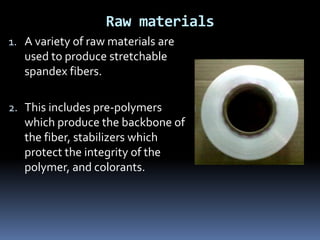
1. A variety of raw materials are
used to produce stretchable
spandex fibers.
2. This includes pre-polymers
which produce the backbone of
the fiber, stabilizers which
protect the integrity of the
polymer, and colorants.
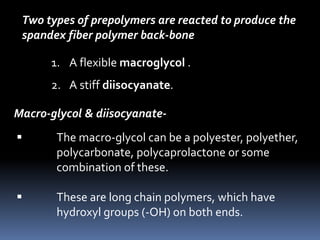
Two types of prepolymers are reacted to produce the
spandex fiber polymer back-bone
1. A flexible macroglycol .
2. A stiff diisocyanate.
Macro-glycol & diisocyanate-
 The macro-glycol can be a polyester, polyether,
polycarbonate, polycaprolactone or some
combination of these.
 These are long chain polymers, which have
hydroxyl groups (-OH) on both ends.
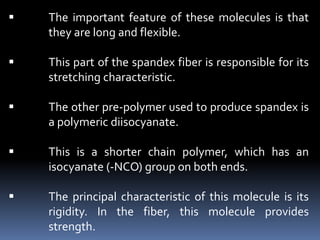
 The important feature of these molecules is that
they are long and flexible.
 This part of the spandex fiber is responsible for its
stretching characteristic.
 The other pre-polymer used to produce spandex is
a polymeric diisocyanate.
 This is a shorter chain polymer, which has an
isocyanate (-NCO) group on both ends.
 The principal characteristic of this molecule is its
rigidity. In the fiber, this molecule provides
strength.
Spinning process
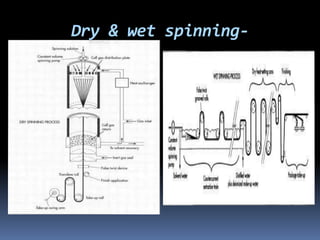
There are two types of spinning are available for
spandex, these are-
 Dry-spinning process.
 Wet-spinning process.
Spinning techniques
Groups (-OH) on the macroglycols react with the
isocyanates.
Each molecule gets added on to the end of another
molecule, and a long chain polymer is formed.
A catalyst such as diazobicyclooctane & low
molecular weight amines must be used.
Stabilizers are added to protect the fibers.
Antioxidants
Additives must also be added.
Dry & wet spinning-
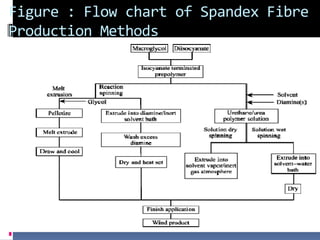
Figure : Flow chart of Spandex Fibre
Production Methods
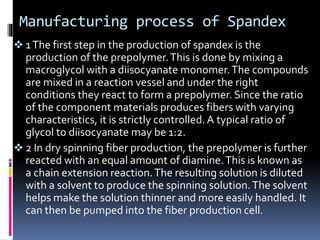
Manufacturing process of Spandex
 1The first step in the production of spandex is the
production of the prepolymer.This is done by mixing a
macroglycol with a diisocyanate monomer.The compounds
are mixed in a reaction vessel and under the right
conditions they react to form a prepolymer. Since the ratio
of the component materials produces fibers with varying
characteristics, it is strictly controlled. A typical ratio of
glycol to diisocyanate may be 1:2.
 2 In dry spinning fiber production, the prepolymer is further
reacted with an equal amount of diamine.This is known as
a chain extension reaction.The resulting solution is diluted
with a solvent to produce the spinning solution.The solvent
helps make the solution thinner and more easily handled. It
can then be pumped into the fiber production cell.
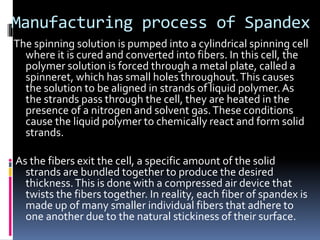
Manufacturing process of Spandex
The spinning solution is pumped into a cylindrical spinning cell
where it is cured and converted into fibers. In this cell, the
polymer solution is forced through a metal plate, called a
spinneret, which has small holes throughout.This causes
the solution to be aligned in strands of liquid polymer. As
the strands pass through the cell, they are heated in the
presence of a nitrogen and solvent gas.These conditions
cause the liquid polymer to chemically react and form solid
strands.
As the fibers exit the cell, a specific amount of the solid
strands are bundled together to produce the desired
thickness.This is done with a compressed air device that
twists the fibers together. In reality, each fiber of spandex is
made up of many smaller individual fibers that adhere to
one another due to the natural stickiness of their surface.
Quality Control-
1. To ensure the quality of the spandex fibers, manufacturers
monitor the product during each phase of production.
2. Inspections begin with the evaluation of the incoming raw
materials.Various chemical and physical characteristics are
tested.
For example,
the pH, specific gravity, and viscosity of the disocyanate
may be checked.Additionally, appearance, color, and odor
can also be evaluated. Only by having strict quality control
checks on the starting materials can the manufacturer be
sure that they will produce a consistent end product. After
production, the spandex fibers are also tested.These tests
may include those that evaluate fiber elasticity, resilience
and absorbency.
Spandex Fiber Characteristics-
1. Generally, can be stretched more than 500%
without breaking.
2. Stronger, more durable and higher retractive
force than rubber.
3. Lightweight, soft and smooth.
4. Heat-settable — facilitates transforming
puckered fabrics into flat fabrics, or flat fabrics
into permanent rounded shapes
5. Dyeable
6. Resistant to deterioration by body oils,
perspiration, lotions or detergents
7. Available in fiber diameters ranging from 10
denier to 2500 denier
Uses of Spandex fiber
 athletic, aerobic
 exercise apparel
 swimsuits
 ski pants
 disco jean
 hosiery
 socks
 surgical hose
 Home furnishings
General Spandex Fiber Care Tips-
 Do not use chlorine bleach on any fabric containing
spandex. Use oxygen or sodium perborate type
bleach
 Rise thoroughly
 Drip dry. If machine dried, use low temperature
 Hand or machine wash in lukewarm water
 Ironing, if required, should be done rapidly. Do not
leave the iron too long in one position. Use low
temperatures setting. (For specific instructions, refer to
garment's sewn-in care label)
THANKYOU

Spandex fiber

  • 1.
    MD SOHEL KHAN Departmentof textile Engineering Port city International University
  • 2.
  • 3.
    1. Spandex orelastane is a synthetic fiber known for its exceptional elasticity. 2. It is strong, but less durable than its major non-synthetic competitor, natural Latex. 3. It is a polyurethane-polyurea copolymer that was developed in 1959 by chemists C. L. Sandquist and Joseph Shiversat DuPont's Benger Laboratory inWaynesboro,Virginia. 4. When first introduced, it revolutionized many areas of the clothing industry.
  • 4.
    History  Development ofspandex was started during WorldWar II.  In 1940, the first polyurethane elastomers were produced.  More stretchable nylons or in making lightweight garments.  Farbenfabriken Bayer, earned a German patent for his synthesis in 1952.  Du Pont used the brand name Lycra and began full scale manufacture in 1962.  They are currently the world leader in the production of spandex fibers.
  • 5.
    Raw materials 1. Avariety of raw materials are used to produce stretchable spandex fibers. 2. This includes pre-polymers which produce the backbone of the fiber, stabilizers which protect the integrity of the polymer, and colorants.
  • 6.
    Two types ofprepolymers are reacted to produce the spandex fiber polymer back-bone 1. A flexible macroglycol . 2. A stiff diisocyanate. Macro-glycol & diisocyanate-  The macro-glycol can be a polyester, polyether, polycarbonate, polycaprolactone or some combination of these.  These are long chain polymers, which have hydroxyl groups (-OH) on both ends.
  • 7.
     The importantfeature of these molecules is that they are long and flexible.  This part of the spandex fiber is responsible for its stretching characteristic.  The other pre-polymer used to produce spandex is a polymeric diisocyanate.  This is a shorter chain polymer, which has an isocyanate (-NCO) group on both ends.  The principal characteristic of this molecule is its rigidity. In the fiber, this molecule provides strength.
  • 8.
    Spinning process There aretwo types of spinning are available for spandex, these are-  Dry-spinning process.  Wet-spinning process.
  • 9.
    Spinning techniques Groups (-OH)on the macroglycols react with the isocyanates. Each molecule gets added on to the end of another molecule, and a long chain polymer is formed. A catalyst such as diazobicyclooctane & low molecular weight amines must be used. Stabilizers are added to protect the fibers. Antioxidants Additives must also be added.
  • 10.
    Dry & wetspinning-
  • 11.
    Figure : Flowchart of Spandex Fibre Production Methods
  • 12.
    Manufacturing process ofSpandex  1The first step in the production of spandex is the production of the prepolymer.This is done by mixing a macroglycol with a diisocyanate monomer.The compounds are mixed in a reaction vessel and under the right conditions they react to form a prepolymer. Since the ratio of the component materials produces fibers with varying characteristics, it is strictly controlled. A typical ratio of glycol to diisocyanate may be 1:2.  2 In dry spinning fiber production, the prepolymer is further reacted with an equal amount of diamine.This is known as a chain extension reaction.The resulting solution is diluted with a solvent to produce the spinning solution.The solvent helps make the solution thinner and more easily handled. It can then be pumped into the fiber production cell.
  • 13.
    Manufacturing process ofSpandex The spinning solution is pumped into a cylindrical spinning cell where it is cured and converted into fibers. In this cell, the polymer solution is forced through a metal plate, called a spinneret, which has small holes throughout.This causes the solution to be aligned in strands of liquid polymer. As the strands pass through the cell, they are heated in the presence of a nitrogen and solvent gas.These conditions cause the liquid polymer to chemically react and form solid strands. As the fibers exit the cell, a specific amount of the solid strands are bundled together to produce the desired thickness.This is done with a compressed air device that twists the fibers together. In reality, each fiber of spandex is made up of many smaller individual fibers that adhere to one another due to the natural stickiness of their surface.
  • 14.
    Quality Control- 1. Toensure the quality of the spandex fibers, manufacturers monitor the product during each phase of production. 2. Inspections begin with the evaluation of the incoming raw materials.Various chemical and physical characteristics are tested. For example, the pH, specific gravity, and viscosity of the disocyanate may be checked.Additionally, appearance, color, and odor can also be evaluated. Only by having strict quality control checks on the starting materials can the manufacturer be sure that they will produce a consistent end product. After production, the spandex fibers are also tested.These tests may include those that evaluate fiber elasticity, resilience and absorbency.
  • 15.
    Spandex Fiber Characteristics- 1.Generally, can be stretched more than 500% without breaking. 2. Stronger, more durable and higher retractive force than rubber. 3. Lightweight, soft and smooth. 4. Heat-settable — facilitates transforming puckered fabrics into flat fabrics, or flat fabrics into permanent rounded shapes 5. Dyeable 6. Resistant to deterioration by body oils, perspiration, lotions or detergents 7. Available in fiber diameters ranging from 10 denier to 2500 denier
  • 16.
    Uses of Spandexfiber  athletic, aerobic  exercise apparel  swimsuits  ski pants  disco jean  hosiery  socks  surgical hose  Home furnishings
  • 17.
    General Spandex FiberCare Tips-  Do not use chlorine bleach on any fabric containing spandex. Use oxygen or sodium perborate type bleach  Rise thoroughly  Drip dry. If machine dried, use low temperature  Hand or machine wash in lukewarm water  Ironing, if required, should be done rapidly. Do not leave the iron too long in one position. Use low temperatures setting. (For specific instructions, refer to garment's sewn-in care label)
  • 18.