Smart Textile
Presentation on
Presented
By
Name: Shawan Roy
ID: 11122107023
Intake: 5th
Section: 01
B.Sc. In Textile Engineering, BUBT
To
Md. Mahabub Hasan
Lecturer,
Department of Textile Engineering,
BUBT
Smart textile
• Smart textiles means intelligent textiles.
• During the last decade, textiles have entered a new era, the one
of smart textiles.
• It can sense and react to environmental condition or stimuli.
• It can also sense and respond in a predetermined way.
Components
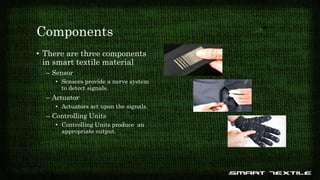
• There are three components
in smart textile material
– Sensor
• Sensors provide a nerve system
to detect signals.
– Actuator
• Actuators act upon the signals.
– Controlling Units
• Controlling Units produce an
appropriate output.
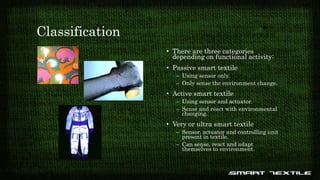
Classification
• There are three categories
depending on functional activity:
• Passive smart textile
– Using sensor only.
– Only sense the environment change.
• Active smart textile
– Using sensor and actuator.
– Sense and react with environmental
changing.
• Very or ultra smart textile
– Sensor, actuator and controlling unit
present in textile.
– Can sense, react and adapt
themselves to environment.
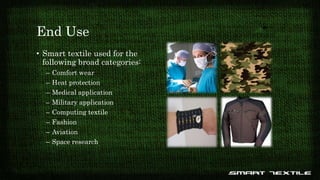
End Use
• Smart textile used for the
following broad categories:
– Comfort wear
– Heat protection
– Medical application
– Military application
– Computing textile
– Fashion
– Aviation
– Space research
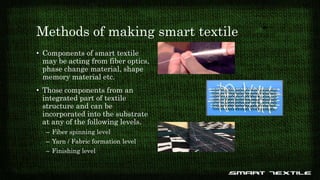
Methods of making smart textile
• Components of smart textile
may be acting from fiber optics,
phase change material, shape
memory material etc.
• Those components from an
integrated part of textile
structure and can be
incorporated into the substrate
at any of the following levels.
– Fiber spinning level
– Yarn / Fabric formation level
– Finishing level
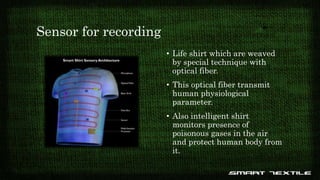
Sensor for recording
• Life shirt which are weaved
by special technique with
optical fiber.
• This optical fiber transmit
human physiological
parameter.
• Also intelligent shirt
monitors presence of
poisonous gases in the air
and protect human body from
it.
Sensor for recording
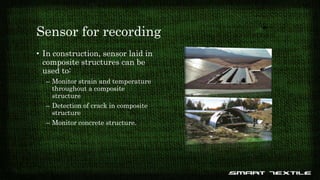
• In construction, sensor laid in
composite structures can be
used to:
– Monitor strain and temperature
throughout a composite
structure
– Detection of crack in composite
structure
– Monitor concrete structure.
What Lies Ahead?
• The range and variety of high performance textiles that have been developed
to meet present and future requirements are now considerable.
• They should include tera and nano scale magnitudes, complexity, cognition
and holism.
• Fibers are relentlessly replacing traditional materials in many more
applications. From super-absorbent diapers, to artificial organs, to
construction materials for moon-based space stations.
• Biological tissues and organs, like ears and noses, are grown from textile
scaffolds made from bio-degradable fibers.
• Integrated with nano-materials, textiles are imparted with very high energy
absorption capacity and other functions such as stain proofing, abrasion
resistance, light emission, etc.
• In future Smart textile have artificial intelligence brain.
Presentation on Smart Textile

Presentation on Smart Textile

  • 1.
  • 2.
    Presented By Name: Shawan Roy ID:11122107023 Intake: 5th Section: 01 B.Sc. In Textile Engineering, BUBT To Md. Mahabub Hasan Lecturer, Department of Textile Engineering, BUBT
  • 3.
    Smart textile • Smarttextiles means intelligent textiles. • During the last decade, textiles have entered a new era, the one of smart textiles. • It can sense and react to environmental condition or stimuli. • It can also sense and respond in a predetermined way.
  • 4.
    Components • There arethree components in smart textile material – Sensor • Sensors provide a nerve system to detect signals. – Actuator • Actuators act upon the signals. – Controlling Units • Controlling Units produce an appropriate output.
  • 5.
    Classification • There arethree categories depending on functional activity: • Passive smart textile – Using sensor only. – Only sense the environment change. • Active smart textile – Using sensor and actuator. – Sense and react with environmental changing. • Very or ultra smart textile – Sensor, actuator and controlling unit present in textile. – Can sense, react and adapt themselves to environment.
  • 6.
    End Use • Smarttextile used for the following broad categories: – Comfort wear – Heat protection – Medical application – Military application – Computing textile – Fashion – Aviation – Space research
  • 7.
    Methods of makingsmart textile • Components of smart textile may be acting from fiber optics, phase change material, shape memory material etc. • Those components from an integrated part of textile structure and can be incorporated into the substrate at any of the following levels. – Fiber spinning level – Yarn / Fabric formation level – Finishing level
  • 8.
    Sensor for recording •Life shirt which are weaved by special technique with optical fiber. • This optical fiber transmit human physiological parameter. • Also intelligent shirt monitors presence of poisonous gases in the air and protect human body from it.
  • 9.
    Sensor for recording •In construction, sensor laid in composite structures can be used to: – Monitor strain and temperature throughout a composite structure – Detection of crack in composite structure – Monitor concrete structure.
  • 10.
    What Lies Ahead? •The range and variety of high performance textiles that have been developed to meet present and future requirements are now considerable. • They should include tera and nano scale magnitudes, complexity, cognition and holism. • Fibers are relentlessly replacing traditional materials in many more applications. From super-absorbent diapers, to artificial organs, to construction materials for moon-based space stations. • Biological tissues and organs, like ears and noses, are grown from textile scaffolds made from bio-degradable fibers. • Integrated with nano-materials, textiles are imparted with very high energy absorption capacity and other functions such as stain proofing, abrasion resistance, light emission, etc. • In future Smart textile have artificial intelligence brain.