
WHAT IS SMART TEXTILE?
SMART TEXTILES REFER TO MATERIALS THAT COMBINE TRADITIONAL TEXTILE
COMPONENTS WITH ADVANCED TECHNOLOGIES TO PROVIDE ADDITIONAL
FUNCTIONALITIES.
THESE TEXTILES HAVE THE ABILITY TO SENSE, REACT, AND ADAPT TO CHANGES IN THEIR
ENVIRONMENT OR USER INPUTS.
IT’S ALSO KNOWN AS SMART FABRICS OR E-TEXTILES.
EXAMPLE: SMART CLOTHING, SMART FOOTWEAR, HEATING GARMENTS, WEARABLE
FITNESS TRACKERS ETC.
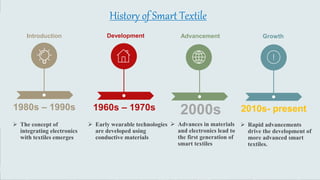
History of Smart Textile
1980s – 1990s 1960s – 1970s
 The concept of
integrating electronics
with textiles emerges
Development
Introduction Advancement Growth
 Early wearable technologies
are developed using
conductive materials
2000s
 Advances in materials
and electronics lead to
the first generation of
smart textiles
2010s- present
 Rapid advancements
drive the development of
more advanced smart
textiles.
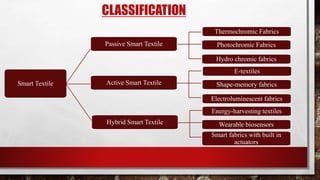
CLASSIFICATION
Smart Textile
Passive Smart Textile
Active Smart Textile
Hybrid Smart Textile
Thermochromic Fabrics
Photochromic Fabrics
Hydro chromic fabrics
E-textiles
Shape-memory fabrics
Electroluminescent fabrics
Energy-harvesting textiles
Wearable biosensors
Smart fabrics with built in
actuators
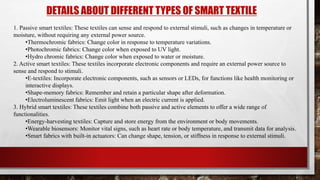
1. Passive smart textiles: These textiles can sense and respond to external stimuli, such as changes in temperature or
moisture, without requiring any external power source.
•Thermochromic fabrics: Change color in response to temperature variations.
•Photochromic fabrics: Change color when exposed to UV light.
•Hydro chromic fabrics: Change color when exposed to water or moisture.
2. Active smart textiles: These textiles incorporate electronic components and require an external power source to
sense and respond to stimuli.
•E-textiles: Incorporate electronic components, such as sensors or LEDs, for functions like health monitoring or
interactive displays.
•Shape-memory fabrics: Remember and retain a particular shape after deformation.
•Electroluminescent fabrics: Emit light when an electric current is applied.
3. Hybrid smart textiles: These textiles combine both passive and active elements to offer a wide range of
functionalities.
•Energy-harvesting textiles: Capture and store energy from the environment or body movements.
•Wearable biosensors: Monitor vital signs, such as heart rate or body temperature, and transmit data for analysis.
•Smart fabrics with built-in actuators: Can change shape, tension, or stiffness in response to external stimuli.
DETAILS ABOUT DIFFERENT TYPES OF SMART TEXTILE
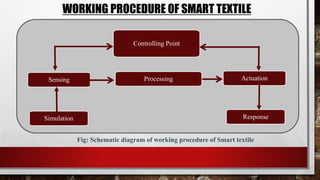
Sensing Processing
Simulation
Controlling Point
Actuation
Response
Fig: Schematic diagram of working procedure of Smart textile
WORKING PROCEDURE OF SMART TEXTILE
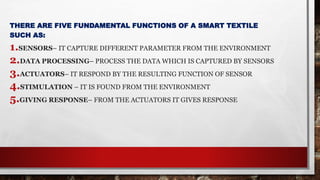
THERE ARE FIVE FUNDAMENTAL FUNCTIONS OF A SMART TEXTILE
SUCH AS:
1.SENSORS– IT CAPTURE DIFFERENT PARAMETER FROM THE ENVIRONMENT
2.DATA PROCESSING– PROCESS THE DATA WHICH IS CAPTURED BY SENSORS
3.ACTUATORS– IT RESPOND BY THE RESULTING FUNCTION OF SENSOR
4.STIMULATION – IT IS FOUND FROM THE ENVIRONMENT
5.GIVING RESPONSE– FROM THE ACTUATORS IT GIVES RESPONSE
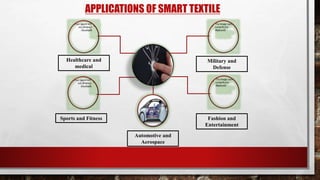
APPLICATIONS OF SMART TEXTILE
Healthcare and
medical
Sports and Fitness
Military and
Defense
Fashion and
Entertainment
Automotive and
Aerospace
APPLICATION OF SMART TEXTILE (DESCRIPTION)
Health care: Smart textile is already used for health care. The high-technology into textiles, gives us
opportunity for Personal Health care. The concept of personalized healthcare empowers one for own
healthcare. Wearable devices allow physiological signals. Thus daily life becomes so much pain free.
Life belt: Life belt plays a significant role in medical sector. It’s a valuable decision support tool. Basically
life belt is a trans-abdominal wearable device. To avoid the frequent visit of additional patients the remote
health monitoring provided by this.
Defense: Smart textile is also used for defense. In extreme conditions or situations there is a need for real
time information technology to increase the protection and survivability of the people working in those
conditions. However, smart textile is done it rapidly and safely.
Life Jacket: Like life belt life jacket is also a medical device which always monitoring blood pressure or the
heart rate. All the information is transferred to a computer and which is read by a medical staff.
Hypertension and blood pressure can be calculated by life jacket.
Entertainment Wear: Smart textile plays an important role for entertainment wear. These types of wear
have special color, heat and light consuming power. These wears have special effect when the dancer moves.
So it will make more fabulous to the audiences.
CHALLENGES AND CONSIDERATION
 Cost Implication
 Data privacy and security
 Work-force adaption
 Accuracy of sensors performance in terms of sensitivity and durability
 Washability and durability
 Environmental impact
IMPACT ON BANGLADESH
1.Market diversification: Smart textiles offer opportunities to diversify product offerings beyond traditional
garments, attracting customers with innovative and high-value products.
2.Value addition: Smart textiles provide additional functionalities, allowing Bangladesh to offer products with
enhanced performance and convenience.
3.Improved productivity: Smart textile technologies streamline manufacturing processes, increasing
productivity and reducing costs.
4.Sustainability: Smart textiles incorporate eco-friendly materials and technologies, supporting Bangladesh's
sustainability goals.
5.Job creation and skill development: Smart textiles require skilled professionals, creating new job
opportunities and promoting skill development.
6.Technological advancement: Embracing smart textiles encourages research, development, and innovation in
the industry.
7.International collaborations: Smart textiles attract collaborations with global technology companies,
facilitating knowledge exchange and market access.
IMPORTANCE OF SMART TEXTILE
1. Enhanced functionality: Smart textiles offer enhanced functionality by integrating technology
and sensors into fabrics, enabling various effective features.
2. Improved comfort: Smart textiles can provide improved comfort by regulating body
temperature, managing moisture, or adjusting fabric properties based on environmental conditions.
3. Health monitoring: Smart textiles enable the monitoring of vital signs and health parameters,
facilitating early detection of health issues and promoting preventive healthcare.
4. Sustainability: Smart textiles can contribute to sustainability efforts by incorporating eco-
friendly materials, promoting energy efficiency, or facilitating recycling and reuse.
5. Performance enhancement: Smart textiles can enhance performance in sports or athletic
activities.
6. Fashion and aesthetics: Smart textiles offer new possibilities for creative expression in fashion
and design, enabling interactive and dynamic garments.
7. Industry innovation: Smart textiles drive innovation and contribute to advancements in various
industries by introducing new functionalities and improving existing products and services.
CONCLUSION
In conclusion, smart textiles have emerged as a game-changer in the textile industry, offering a wide range of
possibilities for innovation and value creation. Their applications span across various sectors, including
healthcare, sports, fashion, and automotive, enabling advanced features.
The importance of smart textiles lies in their ability to enhance performance, comfort, and convenience for
users. They provide improved functionality, real-time data monitoring, and personalized experiences. Smart
textiles also contribute to sustainability.
However, the widespread adoption of smart textiles in Bangladesh is still in its early stages, mainly due to
factors such as limited awareness, cost considerations, and infrastructure challenges. To fully leverage the
potential of smart textiles, it is crucial for stakeholders in Bangladesh to invest in research and development,
foster industry-academia collaborations, and create an enabling environment for innovation and technology
integration.
REFERENCES
1. Google
2. Wikipedia
3. ChatGPT (openai.com)
4. Textile Learner: One stop solution for textiles
Copy right © by Saif Uddin (saifuddinarafat.blogspot.com)

Smart Textile.pptx

  • 1.
    WHAT IS SMARTTEXTILE? SMART TEXTILES REFER TO MATERIALS THAT COMBINE TRADITIONAL TEXTILE COMPONENTS WITH ADVANCED TECHNOLOGIES TO PROVIDE ADDITIONAL FUNCTIONALITIES. THESE TEXTILES HAVE THE ABILITY TO SENSE, REACT, AND ADAPT TO CHANGES IN THEIR ENVIRONMENT OR USER INPUTS. IT’S ALSO KNOWN AS SMART FABRICS OR E-TEXTILES. EXAMPLE: SMART CLOTHING, SMART FOOTWEAR, HEATING GARMENTS, WEARABLE FITNESS TRACKERS ETC.
  • 2.
    History of SmartTextile 1980s – 1990s 1960s – 1970s  The concept of integrating electronics with textiles emerges Development Introduction Advancement Growth  Early wearable technologies are developed using conductive materials 2000s  Advances in materials and electronics lead to the first generation of smart textiles 2010s- present  Rapid advancements drive the development of more advanced smart textiles.
  • 3.
    CLASSIFICATION Smart Textile Passive SmartTextile Active Smart Textile Hybrid Smart Textile Thermochromic Fabrics Photochromic Fabrics Hydro chromic fabrics E-textiles Shape-memory fabrics Electroluminescent fabrics Energy-harvesting textiles Wearable biosensors Smart fabrics with built in actuators
  • 4.
    1. Passive smarttextiles: These textiles can sense and respond to external stimuli, such as changes in temperature or moisture, without requiring any external power source. •Thermochromic fabrics: Change color in response to temperature variations. •Photochromic fabrics: Change color when exposed to UV light. •Hydro chromic fabrics: Change color when exposed to water or moisture. 2. Active smart textiles: These textiles incorporate electronic components and require an external power source to sense and respond to stimuli. •E-textiles: Incorporate electronic components, such as sensors or LEDs, for functions like health monitoring or interactive displays. •Shape-memory fabrics: Remember and retain a particular shape after deformation. •Electroluminescent fabrics: Emit light when an electric current is applied. 3. Hybrid smart textiles: These textiles combine both passive and active elements to offer a wide range of functionalities. •Energy-harvesting textiles: Capture and store energy from the environment or body movements. •Wearable biosensors: Monitor vital signs, such as heart rate or body temperature, and transmit data for analysis. •Smart fabrics with built-in actuators: Can change shape, tension, or stiffness in response to external stimuli. DETAILS ABOUT DIFFERENT TYPES OF SMART TEXTILE
  • 5.
    Sensing Processing Simulation Controlling Point Actuation Response Fig:Schematic diagram of working procedure of Smart textile WORKING PROCEDURE OF SMART TEXTILE
  • 6.
    THERE ARE FIVEFUNDAMENTAL FUNCTIONS OF A SMART TEXTILE SUCH AS: 1.SENSORS– IT CAPTURE DIFFERENT PARAMETER FROM THE ENVIRONMENT 2.DATA PROCESSING– PROCESS THE DATA WHICH IS CAPTURED BY SENSORS 3.ACTUATORS– IT RESPOND BY THE RESULTING FUNCTION OF SENSOR 4.STIMULATION – IT IS FOUND FROM THE ENVIRONMENT 5.GIVING RESPONSE– FROM THE ACTUATORS IT GIVES RESPONSE
  • 7.
    APPLICATIONS OF SMARTTEXTILE Healthcare and medical Sports and Fitness Military and Defense Fashion and Entertainment Automotive and Aerospace
  • 8.
    APPLICATION OF SMARTTEXTILE (DESCRIPTION) Health care: Smart textile is already used for health care. The high-technology into textiles, gives us opportunity for Personal Health care. The concept of personalized healthcare empowers one for own healthcare. Wearable devices allow physiological signals. Thus daily life becomes so much pain free. Life belt: Life belt plays a significant role in medical sector. It’s a valuable decision support tool. Basically life belt is a trans-abdominal wearable device. To avoid the frequent visit of additional patients the remote health monitoring provided by this. Defense: Smart textile is also used for defense. In extreme conditions or situations there is a need for real time information technology to increase the protection and survivability of the people working in those conditions. However, smart textile is done it rapidly and safely. Life Jacket: Like life belt life jacket is also a medical device which always monitoring blood pressure or the heart rate. All the information is transferred to a computer and which is read by a medical staff. Hypertension and blood pressure can be calculated by life jacket. Entertainment Wear: Smart textile plays an important role for entertainment wear. These types of wear have special color, heat and light consuming power. These wears have special effect when the dancer moves. So it will make more fabulous to the audiences.
  • 9.
    CHALLENGES AND CONSIDERATION Cost Implication  Data privacy and security  Work-force adaption  Accuracy of sensors performance in terms of sensitivity and durability  Washability and durability  Environmental impact
  • 10.
    IMPACT ON BANGLADESH 1.Marketdiversification: Smart textiles offer opportunities to diversify product offerings beyond traditional garments, attracting customers with innovative and high-value products. 2.Value addition: Smart textiles provide additional functionalities, allowing Bangladesh to offer products with enhanced performance and convenience. 3.Improved productivity: Smart textile technologies streamline manufacturing processes, increasing productivity and reducing costs. 4.Sustainability: Smart textiles incorporate eco-friendly materials and technologies, supporting Bangladesh's sustainability goals. 5.Job creation and skill development: Smart textiles require skilled professionals, creating new job opportunities and promoting skill development. 6.Technological advancement: Embracing smart textiles encourages research, development, and innovation in the industry. 7.International collaborations: Smart textiles attract collaborations with global technology companies, facilitating knowledge exchange and market access.
  • 11.
    IMPORTANCE OF SMARTTEXTILE 1. Enhanced functionality: Smart textiles offer enhanced functionality by integrating technology and sensors into fabrics, enabling various effective features. 2. Improved comfort: Smart textiles can provide improved comfort by regulating body temperature, managing moisture, or adjusting fabric properties based on environmental conditions. 3. Health monitoring: Smart textiles enable the monitoring of vital signs and health parameters, facilitating early detection of health issues and promoting preventive healthcare. 4. Sustainability: Smart textiles can contribute to sustainability efforts by incorporating eco- friendly materials, promoting energy efficiency, or facilitating recycling and reuse. 5. Performance enhancement: Smart textiles can enhance performance in sports or athletic activities. 6. Fashion and aesthetics: Smart textiles offer new possibilities for creative expression in fashion and design, enabling interactive and dynamic garments. 7. Industry innovation: Smart textiles drive innovation and contribute to advancements in various industries by introducing new functionalities and improving existing products and services.
  • 12.
    CONCLUSION In conclusion, smarttextiles have emerged as a game-changer in the textile industry, offering a wide range of possibilities for innovation and value creation. Their applications span across various sectors, including healthcare, sports, fashion, and automotive, enabling advanced features. The importance of smart textiles lies in their ability to enhance performance, comfort, and convenience for users. They provide improved functionality, real-time data monitoring, and personalized experiences. Smart textiles also contribute to sustainability. However, the widespread adoption of smart textiles in Bangladesh is still in its early stages, mainly due to factors such as limited awareness, cost considerations, and infrastructure challenges. To fully leverage the potential of smart textiles, it is crucial for stakeholders in Bangladesh to invest in research and development, foster industry-academia collaborations, and create an enabling environment for innovation and technology integration.
  • 13.
    REFERENCES 1. Google 2. Wikipedia 3.ChatGPT (openai.com) 4. Textile Learner: One stop solution for textiles Copy right © by Saif Uddin (saifuddinarafat.blogspot.com)