On
Eco-Tech
Submitted To
Md. Yousuf Ali
(Lecturer)
Department of Textile Engineering
(BUBT)
Submitted by:-
Md. Tarikul Islam
Intake:19,Section:02
Department of Textile Engineering
Bangladesh University of Business & Technology
The textile industry is considered as the most ecologically
harmful industry in the world. The Eco-problems in textile
industry occur during some production processes and are
carried forward right to the finished product. In the production
process like bleaching and then dyeing, the subsequent fabric
makes a toxin that swells into our ecosystem.Therefore the
need for eco-textiles is felt.Green textiles refer to clothing and
other accessories that are designed to use the organic and
recycled material.
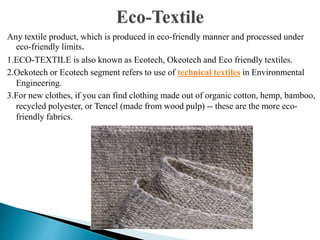
Any textile product, which is produced in eco-friendly manner and processed under
eco-friendly limits.
1.ECO-TEXTILE is also known as Ecotech, Okeotech and Eco friendly textiles.
2.Oekotech or Ecotech segment refers to use of technical textiles in Environmental
Engineering.
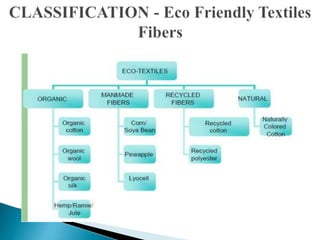
3.For new clothes, if you can find clothing made out of organic cotton, hemp, bamboo,
recycled polyester, or Tencel (made from wood pulp) -- these are the more eco-
friendly fabrics.
 Need to believe in environmental sustainability taking
incremental steps in supply chain processes to make it happen.
 Need to be aware about the social, economical and ecological
benefits of environmentally sustainable product development
processes.
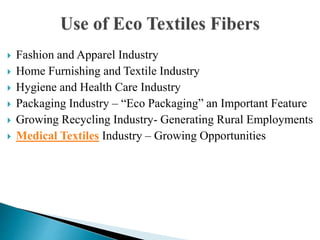
 Fashion and Apparel Industry
 Home Furnishing and Textile Industry
 Hygiene and Health Care Industry
 Packaging Industry – “Eco Packaging” an Important Feature
 Growing Recycling Industry- Generating Rural Employments
 Medical Textiles Industry – Growing Opportunities
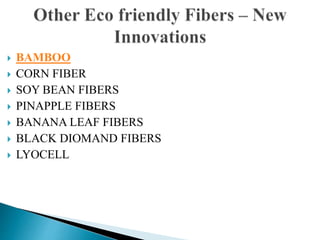
 BAMBOO
 CORN FIBER
 SOY BEAN FIBERS
 PINAPPLE FIBERS
 BANANA LEAF FIBERS
 BLACK DIOMAND FIBERS
 LYOCELL
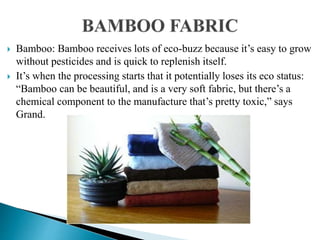
 Bamboo: Bamboo receives lots of eco-buzz because it’s easy to grow
without pesticides and is quick to replenish itself.
 It’s when the processing starts that it potentially loses its eco status:
“Bamboo can be beautiful, and is a very soft fabric, but there’s a
chemical component to the manufacture that’s pretty toxic,” says
Grand.
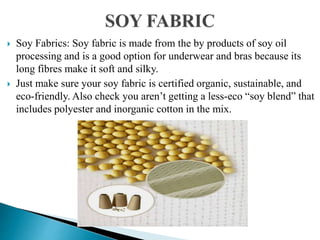
 Soy Fabrics: Soy fabric is made from the by products of soy oil
processing and is a good option for underwear and bras because its
long fibres make it soft and silky.
 Just make sure your soy fabric is certified organic, sustainable, and
eco-friendly. Also check you aren’t getting a less-eco “soy blend” that
includes polyester and inorganic cotton in the mix.
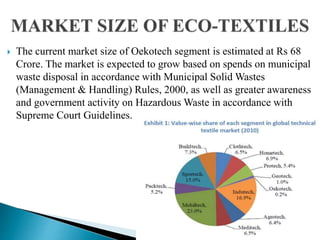
 The current market size of Oekotech segment is estimated at Rs 68
Crore. The market is expected to grow based on spends on municipal
waste disposal in accordance with Municipal Solid Wastes
(Management & Handling) Rules, 2000, as well as greater awareness
and government activity on Hazardous Waste in accordance with
Supreme Court Guidelines.
Eco Tech
Eco Tech

Eco Tech

  • 1.
  • 2.
    Submitted To Md. YousufAli (Lecturer) Department of Textile Engineering (BUBT) Submitted by:- Md. Tarikul Islam Intake:19,Section:02 Department of Textile Engineering Bangladesh University of Business & Technology
  • 3.
    The textile industryis considered as the most ecologically harmful industry in the world. The Eco-problems in textile industry occur during some production processes and are carried forward right to the finished product. In the production process like bleaching and then dyeing, the subsequent fabric makes a toxin that swells into our ecosystem.Therefore the need for eco-textiles is felt.Green textiles refer to clothing and other accessories that are designed to use the organic and recycled material.
  • 4.
    Any textile product,which is produced in eco-friendly manner and processed under eco-friendly limits. 1.ECO-TEXTILE is also known as Ecotech, Okeotech and Eco friendly textiles. 2.Oekotech or Ecotech segment refers to use of technical textiles in Environmental Engineering. 3.For new clothes, if you can find clothing made out of organic cotton, hemp, bamboo, recycled polyester, or Tencel (made from wood pulp) -- these are the more eco- friendly fabrics.
  • 5.
     Need tobelieve in environmental sustainability taking incremental steps in supply chain processes to make it happen.  Need to be aware about the social, economical and ecological benefits of environmentally sustainable product development processes.
  • 6.
     Fashion andApparel Industry  Home Furnishing and Textile Industry  Hygiene and Health Care Industry  Packaging Industry – “Eco Packaging” an Important Feature  Growing Recycling Industry- Generating Rural Employments  Medical Textiles Industry – Growing Opportunities
  • 8.
     BAMBOO  CORNFIBER  SOY BEAN FIBERS  PINAPPLE FIBERS  BANANA LEAF FIBERS  BLACK DIOMAND FIBERS  LYOCELL
  • 9.
     Bamboo: Bambooreceives lots of eco-buzz because it’s easy to grow without pesticides and is quick to replenish itself.  It’s when the processing starts that it potentially loses its eco status: “Bamboo can be beautiful, and is a very soft fabric, but there’s a chemical component to the manufacture that’s pretty toxic,” says Grand.
  • 10.
     Soy Fabrics:Soy fabric is made from the by products of soy oil processing and is a good option for underwear and bras because its long fibres make it soft and silky.  Just make sure your soy fabric is certified organic, sustainable, and eco-friendly. Also check you aren’t getting a less-eco “soy blend” that includes polyester and inorganic cotton in the mix.
  • 11.
     The currentmarket size of Oekotech segment is estimated at Rs 68 Crore. The market is expected to grow based on spends on municipal waste disposal in accordance with Municipal Solid Wastes (Management & Handling) Rules, 2000, as well as greater awareness and government activity on Hazardous Waste in accordance with Supreme Court Guidelines.