BY
RIDHM
18BT010715
INTRODUCTION
□ Electronic textiles, are fabrics that can function electrically as
electronics and behave physically as textiles.
□ Which enable computing ,digital components and electronics to
be embedded in them.
□ Use textile manufacturing techniques.
.
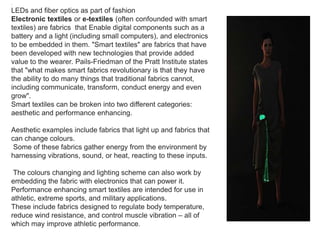
LEDs and fiber optics as part of fashion
Electronic textiles or e-textiles (often confounded with smart
textiles) are fabrics that Enable digital components such as a
battery and a light (including small computers), and electronics
to be embedded in them. "Smart textiles" are fabrics that have
been developed with new technologies that provide added
value to the wearer. Pails-Friedman of the Pratt Institute states
that "what makes smart fabrics revolutionary is that they have
the ability to do many things that traditional fabrics cannot,
including communicate, transform, conduct energy and even
grow".
Smart textiles can be broken into two different categories:
aesthetic and performance enhancing.
Aesthetic examples include fabrics that light up and fabrics that
can change colours.
Some of these fabrics gather energy from the environment by
harnessing vibrations, sound, or heat, reacting to these inputs.
The colours changing and lighting scheme can also work by
embedding the fabric with electronics that can power it.
Performance enhancing smart textiles are intended for use in
athletic, extreme sports, and military applications.
These include fabrics designed to regulate body temperature,
reduce wind resistance, and control muscle vibration – all of
which may improve athletic performance.
HISTOR
Y
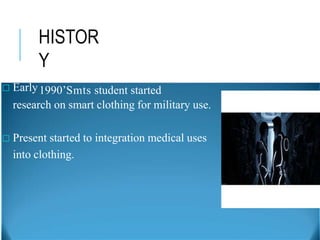
□ Early
research on smart clothing for military use.
□ Present started to integration medical uses
into clothing.
1990’Smts student started
CURRENT
TECHNOLOGIES
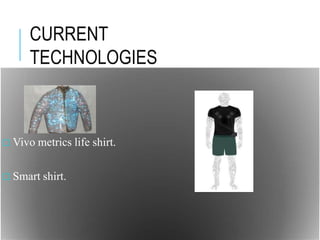
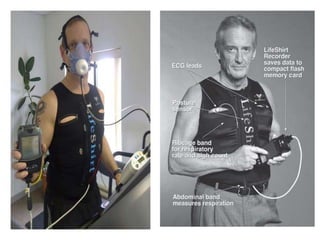
□ Vivo metrics life shirt.
□ Smart shirt.
LIMITATION OF
CURRENT TEXTILE
PRODUCT
TECHNOLOGY
Not waterproof.
 Low strength
 Can be uncomfortable in Harsh environment.
 Cost :if it is ,there are additional costs that need to
be covered.
DESIGN ISSUES FOR
WEARABLE
S
□ Human body and motion.
□ Networking.
□ Power consumption.
□ Environment issues
□ Software execution.
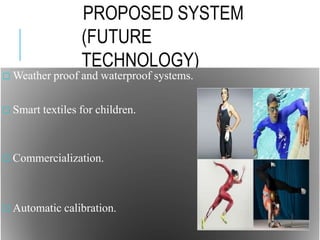
PROPOSED SYSTEM
(FUTURE
TECHNOLOGY)
□ Weather proof and waterproof systems.
□ Smart textiles for children.
□ Commercialization.
□ Automatic calibration.
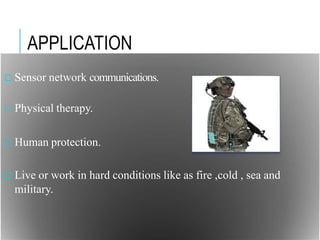
APPLICATION
□ Sensor network communications.
□ Physical therapy.
□ Human protection.
□ Live or work in hard conditions like as fire ,cold , sea and
military.
ADVANTAGES
□ Flexible
□ Large surface area for sensing.
□ Invisible to other.
□ Cheap manufacturing.
□ Elastic and extendable.
CONCLUSION
□ ‘Electronic textile’ is a result of the convergence of
microelectronics with textiles.
□ Surrounding us in our daily life.
□ Used in clothing ,home textiles ,military, medicals etc.

E TEXTILES

  • 1.
  • 2.
    INTRODUCTION □ Electronic textiles,are fabrics that can function electrically as electronics and behave physically as textiles. □ Which enable computing ,digital components and electronics to be embedded in them. □ Use textile manufacturing techniques.
  • 3.
    . LEDs and fiberoptics as part of fashion Electronic textiles or e-textiles (often confounded with smart textiles) are fabrics that Enable digital components such as a battery and a light (including small computers), and electronics to be embedded in them. "Smart textiles" are fabrics that have been developed with new technologies that provide added value to the wearer. Pails-Friedman of the Pratt Institute states that "what makes smart fabrics revolutionary is that they have the ability to do many things that traditional fabrics cannot, including communicate, transform, conduct energy and even grow". Smart textiles can be broken into two different categories: aesthetic and performance enhancing. Aesthetic examples include fabrics that light up and fabrics that can change colours. Some of these fabrics gather energy from the environment by harnessing vibrations, sound, or heat, reacting to these inputs. The colours changing and lighting scheme can also work by embedding the fabric with electronics that can power it. Performance enhancing smart textiles are intended for use in athletic, extreme sports, and military applications. These include fabrics designed to regulate body temperature, reduce wind resistance, and control muscle vibration – all of which may improve athletic performance.
  • 4.
    HISTOR Y □ Early research onsmart clothing for military use. □ Present started to integration medical uses into clothing. 1990’Smts student started
  • 5.
    CURRENT TECHNOLOGIES □ Vivo metricslife shirt. □ Smart shirt.
  • 7.
    LIMITATION OF CURRENT TEXTILE PRODUCT TECHNOLOGY Notwaterproof.  Low strength  Can be uncomfortable in Harsh environment.  Cost :if it is ,there are additional costs that need to be covered.
  • 8.
    DESIGN ISSUES FOR WEARABLE S □Human body and motion. □ Networking. □ Power consumption. □ Environment issues □ Software execution.
  • 9.
    PROPOSED SYSTEM (FUTURE TECHNOLOGY) □ Weatherproof and waterproof systems. □ Smart textiles for children. □ Commercialization. □ Automatic calibration.
  • 10.
    APPLICATION □ Sensor networkcommunications. □ Physical therapy. □ Human protection. □ Live or work in hard conditions like as fire ,cold , sea and military.
  • 11.
    ADVANTAGES □ Flexible □ Largesurface area for sensing. □ Invisible to other. □ Cheap manufacturing. □ Elastic and extendable.
  • 12.
    CONCLUSION □ ‘Electronic textile’is a result of the convergence of microelectronics with textiles. □ Surrounding us in our daily life. □ Used in clothing ,home textiles ,military, medicals etc.