i
Government College of Engineering and
Technology
Chak Bhalwal, Jammu
Seminar Report
on
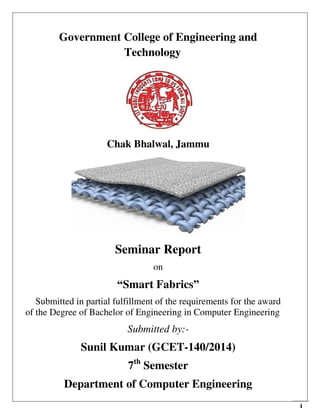
“Smart Fabrics”
Submitted in partial fulfillment of the requirements for the award
of the Degree of Bachelor of Engineering in Computer Engineering
Submitted by:-
Sunil Kumar (GCET-140/2014)
7th
Semester
Department of Computer Engineering
ii
Government College of Engineering and
Technology
CERTIFICATE
This is to certify that the seminar report titled “SMART
FABRICS” by SUNIL KUMAR has been successfully completed
in partial fulfillment of the award of Bachelor of Engineering in
Computer Engineering from University Of Jammu.
Dr. Simmi Dutta
Head Of Department
Deptt. Of Computer Engineering
iii
ACKNOWLEDGEMENT
I would like to express my sincere gratitude to all those who provided
me the necessary support, motivation and guidance to complete the
seminar report. Very special thanks to my family for my never ending
support. I also extend my wholehearted appreciation to all my teachers
especially “Dr. Simmi Dutta” (HOD of Computer Department in
GCET, Jammu) for supporting me and for being a constant source of
guidance and inspiration. I would like to thank Ms. Heena Gupta for the
necessary guidance in making this report.
Sunil Kumar
GCET/151/2014
iv
Abstract
Humans are close to textiles more than anything, and certainly we carry it most, other than
anything. The last few decades have shown enormous growth in the development of wireless
communication technologies, nanoengineering, information technologies, and miniaturization of
electronic devices. These developments draw the attention of researchers to envisage the
significant characteristics of these advancements to the belongings with whom we are most close
to. Researchers are now evaluating the new ideas and possibilities to functionalize this ‘natural
necessity feature of human beings’ with emerging technologies into different arrays of human
life especially in the Medical and Healthcare management - as mobile monitoring of health care,
protection from life risk factors, life style management, rehabilitation and into other facilitation
of our lives, by Hybridizing the Smart or Intelligent Technology in Textiles. The aim of this
paper is to describe the analysis on how ‘Smart’, ‘intelligent’ or ‘active’ materials and textiles
are being incorporated in the healthcare sector to aid diagnostics, recording and transmitting of
bio-physiological signals or ambulatory tele-monitoring of the body vitals, by encompassing the
core concepts of smart materials under the light of the recent developments and projects.
Smart and interactive textiles are fibrous structures that are capable of sensing, actuating,
generating/storing power and/or communicating. Research and development towards wearable
textile-based personal systems allowing e.g. health monitoring, protection & safety, and healthy
lifestyle gained strong interest during the last 10 years. Smart fabrics and interactive textile
wearable systems regroup activities along two different and complementary approaches i.e.
"application pull" and "technology push". This includes personal health management through
integration, validation, and use of smart clothing and other networked mobile devices as well as
projects targeting the full integration of sensors/actuators, energy sources, processing and
communication within the clothes to enable personal applications such as protection/safety,
emergency and healthcare. so here in case of smart textiles we are using the conductive fibers
such as metal yarn. This paper includes the origin and introduction of smart textile and integrated
wearable electronics for sport wear, industrial purpose, automotive & entertainment applications,
healthcare & safety. military, public sectors, and new developments in smart textiles.
CONTENTS
CERTIFICATE Ii
ACKNOWLEDGEMENT Iii
ABSTRACT
1. INTRODUCTION
1.1 SMART MATERIAL & ITS CLASSIFICATION
2. TYES OF SMART FABRICS
3. MATERIALS
3.1 METAL FIBERS
3.2 CONDUCTIVE INKS
3.3 OPTICAL FIBERS
3.4 COATING WITH NANO-PARTICLES
3.5 ORGANIC SEMICONDUCTORS
3.6 SHAPE MEMORY MATERIALS
3.7 CHROMIC MATERIALS
4. WORKING
5. APPLICATIONS
5.1 TEMPERATURE SENSITIVE FABRICS
5.2 HEALTH MONITORING FABRICS
5.3 EMERGENCY FABRICS
5.4 FASHION AND ENTERTAINMENT
5.5 MILITARTY/DEFENCE
5.6 SPORTSWEAR
5.7 TRANSPORT AND AUTOMAOTIVE USE
Iv
1-2
3
4-7
8-9
10-13
6. SOME INNOVATIVE SMART FABRICS
6.1 CUTECIRCUIT
6.1.1 KINETIC DRESS
6.1.2 M DRESS
6.1.3 HUG SHIRT
6.1.4 GALAXY DRESS
6.1.5 Tshirt OS
6.2 MUSICAL JACKET
6.3 WI-FI DETECTOR T-SHIRT
6.4 DIGITAL T-SHIRTS
6.5 SPACE SUIT
6.6 SMART MILITARY UNIFORM
6.7 SMART SHIRT
6.7.1 APPLICATIONS OF SMART SHIRT
6.8 TOUCH SENSITIVE FABRICS
14-27
7. FUTURE DEVELOPMENTS
7.1 NEW TECHNOLOGIES FOR INNOVATIVE
SPORTSWEAR
28-29
8. CONCLUSION 30
9. REFERENCES 31
1
1. INTRODUCTION
The original function of textiles was to shield man from cold and rain. Later on in history
aesthetic aspects also came to play a role in clothing. Much more recently a new generation of
textiles has arisen; smart and interactive textiles. Interactive textiles are a relatively new
discipline in the textile sector. They are active materials that have sensing and actuation
properties. Their potential is enormous. one could think of smart clothing that makes us feel
comfortable at all times, during any activity and in any environmental conditions, a suit that
protects and monitors, that warns in case of danger and even helps to treat diseases and injuries.
Such clothing could be used from the moment we are born till the end of our life. Some of the
more important efforts include applications that Aid in patient health monitoring through sensor
embedded garments that track and record biometric data, Helps to improve athletic performance
both by analyzing sensor data and adapting to changing conditions. So as to improve
performance over the time .Provides environmental sensing and communication technologies for
military defense and other security personals .Present new structural and decorative solutions
for fashion design. The world is distinctly rising towards the new era, an era of smart and
intelligent discoveries; problem solving and creativity − the smart automobile vehicles (cars,
metro system), intelligent jets, smart homes and amongst from many of such aristocratic
paradigms, the ‘Smart and Intelligent Textiles’. Before going further, a clarification of the term
and definition of smart and intelligent textile is essential.
There is a substantive difference between the terms, ‘Smart’ and ‘Intelligent’, Smart materials or
textiles can be defined as the materials and structures which have sense or can sense the
environmental conditions or stimuli, whereas intelligent textiles can be defined as textile
structures which not only can sense but can also react and respond to environmental conditions
or stimuli . These stimuli as well as response , could be thermal, chemical, mechanical, electric,
magnetic or from other source .
2
1.1 SMART MATERIAL & ITS CLASSIFICATION
“Smart material" is a generic term for a material that in some way reacts to its environment.
Smart materials can be classified in many different ways, for example depending on their
transforming function: property change capability, energy change capability, discrete
size/location or reversibility. Smart materials can also be classified depending on their behavior
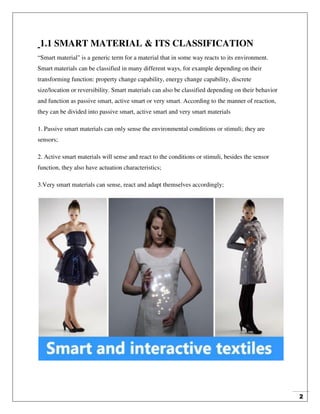
and function as passive smart, active smart or very smart. According to the manner of reaction,
they can be divided into passive smart, active smart and very smart materials
1. Passive smart materials can only sense the environmental conditions or stimuli; they are
sensors;
2. Active smart materials will sense and react to the conditions or stimuli, besides the sensor
function, they also have actuation characteristics;
3.Very smart materials can sense, react and adapt themselves accordingly;
3
2. TYPES OF SMART FABRICS
Smart textiles can be broken into two different categories:
 Aesthetic
 Performance enhancing
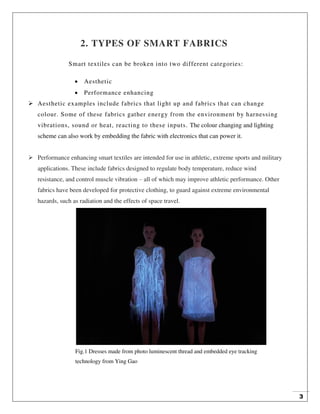
 Aesthetic examples include fabrics that light up and fabrics that can change
colour. Some of these fabrics gather energy from the environment by harnessing
vibrations, sound or heat, reacting to these inputs. The colour changing and lighting
scheme can also work by embedding the fabric with electronics that can power it.
 Performance enhancing smart textiles are intended for use in athletic, extreme sports and military
applications. These include fabrics designed to regulate body temperature, reduce wind
resistance, and control muscle vibration – all of which may improve athletic performance. Other
fabrics have been developed for protective clothing, to guard against extreme environmental
hazards, such as radiation and the effects of space travel.
Fig.1 Dresses made from photo luminescent thread and embedded eye tracking
technology from Ying Gao
4
3. MATERIALS
For years the textile industry has been weaving metallic yarns into fabrics for decorative
purposes. The first conductive fabric we explored was silk organza which contains two types of
fibers. On the warp is a plain silk thread. Running in the other direction on the weft is a silk
thread wrapped in thin copper foil. This metallic yarn is prepared just like cloth-core telephone
wire, and is highly conductive. The silk fiber core has a high tensile strength and can withstand
high temperatures, allowing the yarn to be sewn or embroidered with industrial machinery. The
spacing between these fibers also permits them to be individually addressed, so a strip of this
fabric can function like a ribbon cable. This sort of cloth has been woven in India for at least a
century, for ornamental purposes, using silver, gold, and other metals. Circuits fabricated on
organza only need to be protected from folding contact with themselves, which can be
accomplished by coating, supporting or backing the fabric with an insulating layer which can
also be cloth. Also, circuits formed in this fashion have many degrees of flexibility (i.e. they can
be wadded up), as compared to the single degree of flexibility that conventional substrates can
provide. There are also conductive yarns manufactured specifically for producing filters for the
processing of fine powders. These yarns have conductive and cloth fibers interspersed
throughout. Varying the ratio of the two constituent fibers leads to differences in resistivity.
These fibers can be sewn to create conductive traces and resistive elements. While some
components such as resistors, capacitors, and coils can be sewn out of fabric, there is still a need
to attach other components to the fabric. This can be done by soldering directly onto the metallic
yarn. Surface mount LEDs, crystals, piezo transducers, and other surface mount components
with pads spaced more than 0.100 inch apart are easy to solder into the fabric. Once components
are attached, their connections to the metallic yarn may need to be mechanically strengthened.
This can be achieved with an acrylic or other flexible coating. Components with ordinary leads
can be sewn directly into circuits on fabric, and specially shaped feet could be developed to
facilitate this process. Gripper snaps make excellent connectors between the fabric and
electronics. Since the snap pierces the yarn it creates a surprisingly robust electrical contact. It
also provides a good surface to solder to. In this way subsystems can be easily snapped into
clothing or removed for washing.
5
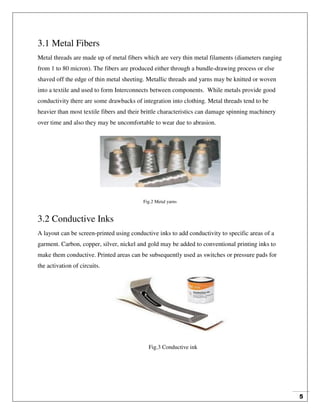
3.1 Metal Fibers
Metal threads are made up of metal fibers which are very thin metal filaments (diameters ranging
from 1 to 80 micron). The fibers are produced either through a bundle-drawing process or else
shaved off the edge of thin metal sheeting. Metallic threads and yarns may be knitted or woven
into a textile and used to form Interconnects between components. While metals provide good
conductivity there are some drawbacks of integration into clothing. Metal threads tend to be
heavier than most textile fibers and their brittle characteristics can damage spinning machinery
over time and also they may be uncomfortable to wear due to abrasion.
Fig.2 Metal yarns
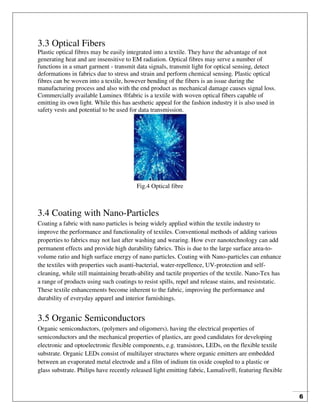
3.2 Conductive Inks
A layout can be screen-printed using conductive inks to add conductivity to specific areas of a
garment. Carbon, copper, silver, nickel and gold may be added to conventional printing inks to
make them conductive. Printed areas can be subsequently used as switches or pressure pads for
the activation of circuits.
Fig.3 Conductive ink
6
3.3 Optical Fibers
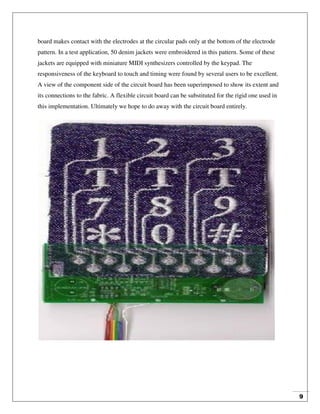
Plastic optical fibres may be easily integrated into a textile. They have the advantage of not
generating heat and are insensitive to EM radiation. Optical fibres may serve a number of
functions in a smart garment - transmit data signals, transmit light for optical sensing, detect
deformations in fabrics due to stress and strain and perform chemical sensing. Plastic optical
fibres can be woven into a textile, however bending of the fibers is an issue during the
manufacturing process and also with the end product as mechanical damage causes signal loss.
Commercially available Luminex ®fabric is a textile with woven optical fibers capable of
emitting its own light. While this has aesthetic appeal for the fashion industry it is also used in
safety vests and potential to be used for data transmission.
Fig.4 Optical fibre
3.4 Coating with Nano-Particles
Coating a fabric with nano particles is being widely applied within the textile industry to
improve the performance and functionality of textiles. Conventional methods of adding various
properties to fabrics may not last after washing and wearing. How ever nanotechnology can add
permanent effects and provide high durability fabrics. This is due to the large surface area-to-
volume ratio and high surface energy of nano particles. Coating with Nano-particles can enhance
the textiles with properties such asanti-bacterial, water-repellence, UV-protection and self-
cleaning, while still maintaining breath-ability and tactile properties of the textile. Nano-Tex has
a range of products using such coatings to resist spills, repel and release stains, and resiststatic.
These textile enhancements become inherent to the fabric, improving the performance and
durability of everyday apparel and interior furnishings.
3.5 Organic Semiconductors
Organic semiconductors, (polymers and oligomers), having the electrical properties of
semiconductors and the mechanical properties of plastics, are good candidates for developing
electronic and optoelectronic flexible components, e.g. transistors, LEDs, on the flexible textile
substrate. Organic LEDs consist of multilayer structures where organic emitters are embedded
between an evaporated metal electrode and a film of indium tin oxide coupled to a plastic or
glass substrate. Philips have recently released light emitting fabric, Lumalive®, featuring flexible
7
arrays of fully integrated colored LEDs. These light-emitting textiles can carry dynamic
messages, graphics, or multicolored surfaces.
3.6 Shape Memory Materials
SMMs can deform from the current shape to a previously set shape, usually due to the action of
heat. a strip of metal is heated with a lighter and finds its original shape. In garments the scale is
smaller. When these SSMs are activated (at a certain activation temperature), the air gaps
between close layers of clothing are increased. This is to give better insulation and protection
against extremes of heat or cold. In clothing, the temperatures for the shape memory effect to be
activated should be near body temperature.
SM Polymers are more flexible than the alloys. Thermoplastic polyurethane films have been
made which can be put in between layers of clothing. When the temperature of the outer layer of
clothing has fallen sufficiently, the film responds so that the air gap between the layers of
clothing becomes broader. This out-of-plane deformation must be strong enough to resist the
weight of the clothing and the movements of the wearer. If the outer layer of clothing becomes
warmer, the deformation must be reversed. Some alloys are capable of a two-way activation,
triggered by changeable weather and varying physical activity.
3.7 Chromic Materials
Chromic Materials are also called chameleon fibres, because they can change their color
according to external conditions. These materials have mostly used in fashion, to create funny
color changing designs. Because of this, some people fear that the chromic materials will be a
short boom. But the accuracy and endurance of the materials are all the time being improved.
8
4. WORKING
Several circuits have been built on and with fabric to date, including busses to connect various
digital devices, microcontroller systems that sense proximity and touch, and all-fabric keyboards
and touchpads. In the microcontroller circuit shown in Figure 1, a PIC16C84 microcontroller and
its supporting components are soldered directly onto a square of fabric. The circuit uses the
bidirectional I/O pins on the PIC to control LEDs and to sense touch along the length of the
fabric, while providing musical feedback to reinforce the sense of interaction. Building systems
in this way is easy because components can be soldered directly onto the conductive yarn. The
addressability of conductors in the fabric make it a good material for prototyping, and it can
simply be cut where signals lines are to terminate.
One kind of fabric keyboard uses pieced conductive and nonconductive fabric, sewn together
like a quilt to make a row- and column-addressable structure. The quilted conductive columns
are insulated from the conductive rows with a soft, thick fabric, like felt, velvet, or quilt batting.
Holes in the insulating fabric layer allow the row and column conductors to make contact with
each other when pressed. This insulation also provides a rewardingly springy, button-like
mechanical effect. Contact is made to each row and column with a gripper snap, and each snap is
soldered to a wire which leads to the keyboard encoding circuitry. This keyboard can be wadded
up, thrown in the wash, and even used as a potholder if desired. Such row-and-column structures
can also be made by embroidering or silk-screening the contact traces.
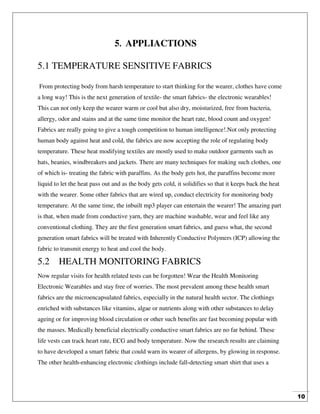
All-fabric capacitive keyboard:- Keyboards can also be made in a single layer of fabric using
capacitive sensing [Baxter97], where an array of embroidered or silk-screened electrodes make
up the points of contact. A finger's contact with an electrode can be sensed by measuring the
increase in the electrode's total capacitance. It is worth noting that this can be done with a single
bidirectional digital I/O pin per electrode, and a leakage resistor sewn in highly resistive yarn.
Capacitive sensing arrays can also be used to tell how well a piece of clothing fits the wearer,
because the signal varies with pressure. The keypad shown here has been mass produced using
ordinary embroidery techniques and mildly conductive thread. The result is a keypad that is
flexible, durable, and responsive to touch. A printed circuit board supports the components
necessary to do capacitive sensing and output keypress events as a serial data stream. The circuit
9
board makes contact with the electrodes at the circular pads only at the bottom of the electrode
pattern. In a test application, 50 denim jackets were embroidered in this pattern. Some of these
jackets are equipped with miniature MIDI synthesizers controlled by the keypad. The
responsiveness of the keyboard to touch and timing were found by several users to be excellent.
A view of the component side of the circuit board has been superimposed to show its extent and
its connections to the fabric. A flexible circuit board can be substituted for the rigid one used in
this implementation. Ultimately we hope to do away with the circuit board entirely.
10
5. APPLIACTIONS
5.1 TEMPERATURE SENSITIVE FABRICS
From protecting body from harsh temperature to start thinking for the wearer, clothes have come
a long way! This is the next generation of textile- the smart fabrics- the electronic wearables!
This can not only keep the wearer warm or cool but also dry, moisturized, free from bacteria,
allergy, odor and stains and at the same time monitor the heart rate, blood count and oxygen!
Fabrics are really going to give a tough competition to human intelligence!.Not only protecting
human body against heat and cold, the fabrics are now accepting the role of regulating body
temperature. These heat modifying textiles are mostly used to make outdoor garments such as
hats, beanies, windbreakers and jackets. There are many techniques for making such clothes, one
of which is- treating the fabric with paraffins. As the body gets hot, the paraffins become more
liquid to let the heat pass out and as the body gets cold, it solidifies so that it keeps back the heat
with the wearer. Some other fabrics that are wired up, conduct electricity for monitoring body
temperature. At the same time, the inbuilt mp3 player can entertain the wearer! The amazing part
is that, when made from conductive yarn, they are machine washable, wear and feel like any
conventional clothing. They are the first generation smart fabrics, and guess what, the second
generation smart fabrics will be treated with Inherently Conductive Polymers (ICP) allowing the
fabric to transmit energy to heat and cool the body.
5.2 HEALTH MONITORING FABRICS
Now regular visits for health related tests can be forgotten! Wear the Health Monitoring
Electronic Wearables and stay free of worries. The most prevalent among these health smart
fabrics are the microencapsulated fabrics, especially in the natural health sector. The clothings
enriched with substances like vitamins, algae or nutrients along with other substances to delay
ageing or for improving blood circulation or other such benefits are fast becoming popular with
the masses. Medically beneficial electrically conductive smart fabrics are no far behind. These
life vests can track heart rate, ECG and body temperature. Now the research results are claiming
to have developed a smart fabric that could warn its wearer of allergens, by glowing in response.
The other health-enhancing electronic clothings include fall-detecting smart shirt that uses a
11
built-in motion-detection hardware to detect if the user has fallen and can't get up. Really useful
for older people! Then there is underwear having sensors woven into the fabric to detect heart
rate. Some of them can even dial emergency number if they detect a problem. Now, that's called
a real smart fabric!!
Shirt for measuring rehabilitation
5.3 EMERGENCY FABRICS
Although the health monitoring fabrics are in a way emergency fabrics only, yet certain other
developments in the field of smart fabrics are in the pipeline that can really be called Disaster
wear! A system is being developed to monitor the wearer and the outside environment which can
be helpful for rescue workers like fire fighters. Some projects are aiming at stretchable
electronics by developing conducting substrates within the very weave of fabric, which will
allow sensors to move with the body. Many researches are aimed at using optical fibers because
of their potential flexibility and their capacity to use light both as an information carrier and a
sensor in itself. It can find applications in oximetry – a smart non-invasive way to measure the
oxygen content of blood. Some projects are targeting at developing sensors which can measure
body fluids like sweat, too, which will be very useful in sport wears. It will be able to measure
the conductivity, electrolyte level, temperature and pH of the users' sweat, all very useful
indicators for sporting applications.
12
5.4 FASHION AND ENTERTAINMENT
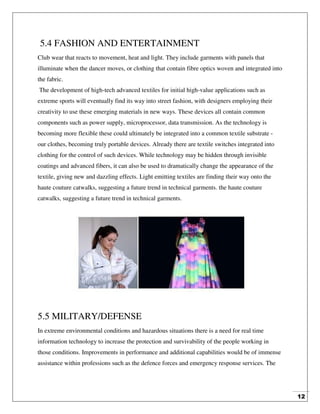
Club wear that reacts to movement, heat and light. They include garments with panels that
illuminate when the dancer moves, or clothing that contain fibre optics woven and integrated into
the fabric.
The development of high-tech advanced textiles for initial high-value applications such as
extreme sports will eventually find its way into street fashion, with designers employing their
creativity to use these emerging materials in new ways. These devices all contain common
components such as power supply, microprocessor, data transmission. As the technology is
becoming more flexible these could ultimately be integrated into a common textile substrate -
our clothes, becoming truly portable devices. Already there are textile switches integrated into
clothing for the control of such devices. While technology may be hidden through invisible
coatings and advanced fibers, it can also be used to dramatically change the appearance of the
textile, giving new and dazzling effects. Light emitting textiles are finding their way onto the
haute couture catwalks, suggesting a future trend in technical garments. the haute couture
catwalks, suggesting a future trend in technical garments.
5.5 MILITARY/DEFENSE
In extreme environmental conditions and hazardous situations there is a need for real time
information technology to increase the protection and survivability of the people working in
those conditions. Improvements in performance and additional capabilities would be of immense
assistance within professions such as the defence forces and emergency response services. The
13
requirements for such situations are to monitor vital signs and ease injuries while also monitoring
environment hazards such as toxic gases. Wireless communication to a central unit allows
medics to conduct remote triage of casualties to help them respond more rapidly and safely.
5.6 SPORTSWEAR
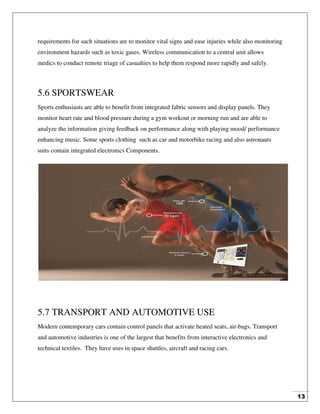
Sports enthusiasts are able to benefit from integrated fabric sensors and display panels. They
monitor heart rate and blood pressure during a gym workout or morning run and are able to
analyze the information giving feedback on performance along with playing mood/ performance
enhancing music. Some sports clothing such as car and motorbike racing and also astronauts
suits contain integrated electronics Components.
5.7 TRANSPORT AND AUTOMOTIVE USE
Modern contemporary cars contain control panels that activate heated seats, air-bags. Transport
and automotive industries is one of the largest that benefits from interactive electronics and
technical textiles. They have uses in space shuttles, aircraft and racing cars.
14
6. SOME INNOVATIVE SMART FABRICS
6.1 CUTECIRCUIT
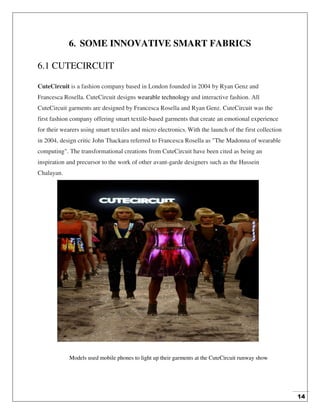
CuteCircuit is a fashion company based in London founded in 2004 by Ryan Genz and
Francesca Rosella. CuteCircuit designs wearable technology and interactive fashion. All
CuteCircuit garments are designed by Francesca Rosella and Ryan Genz. CuteCircuit was the
first fashion company offering smart textile-based garments that create an emotional experience
for their wearers using smart textiles and micro electronics. With the launch of the first collection
in 2004, design critic John Thackara referred to Francesca Rosella as "The Madonna of wearable
computing". The transformational creations from CuteCircuit have been cited as being an
inspiration and precursor to the work of other avant-garde designers such as the Hussein
Chalayan.
Models used mobile phones to light up their garments at the CuteCircuit runway show
15
COLLECTIONS OF CUTECIRCUIT
6.1.1 KINETIC DRESS
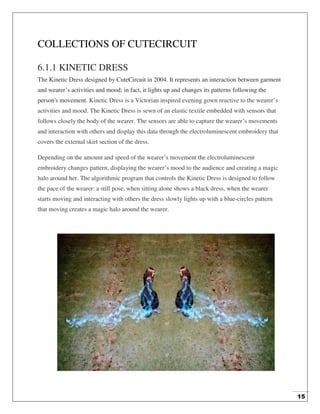
The Kinetic Dress designed by CuteCircuit in 2004. It represents an interaction between garment
and wearer’s activities and mood; in fact, it lights up and changes its patterns following the
person's movement. Kinetic Dress is a Victorian inspired evening gown reactive to the wearer’s
activities and mood. The Kinetic Dress is sewn of an elastic textile embedded with sensors that
follows closely the body of the wearer. The sensors are able to capture the wearer’s movements
and interaction with others and display this data through the electroluminescent embroidery that
covers the external skirt section of the dress.
Depending on the amount and speed of the wearer’s movement the electroluminescent
embroidery changes pattern, displaying the wearer’s mood to the audience and creating a magic
halo around her. The algorithmic program that controls the Kinetic Dress is designed to follow
the pace of the wearer: a still pose, when sitting alone shows a black dress, when the wearer
starts moving and interacting with others the dress slowly lights up with a blue-circles pattern
that moving creates a magic halo around the wearer.
16
6.1.2 M DRESS
In 2008 CuteCircuit designed the M Dress that accepts a standard SIM card and allows to make
and receive calls anytime, everywhere, without having to carry a cellular phone.
The wearer inserts their usual SIM card in the small slot underneath the label and the dress is
ready to be used. CuteCircuit introduced special gesture recognition software to allow the M-
Dress to work in an easy and intuitive way. The M-Dress accepts a standard SIM card and allows
the wearer to receive and make calls without carrying a cellular phone in their pocket or purse.
Simplicity is elegance. The M-Dress (Mobile Phone Dress) was designed after our research
showed that very often phone calls are missed because mobile phones are quite awkward to
carry, especially for women, that have garments with small or no pockets. To allow women to
stay connected while remaining stylish, CuteCircuit designed the M- Dress. A mobile phone in
its own right but built out of soft circuitry. The wearer inserts their usual SIM card in the small
slot underneath the label and the dress is ready to be used, having the same phone number as
your usual phone.
When the dress rings, the simple gesture of bringing your hand to the ear will allow the sensor to
open the call and when done talking the gesture of releasing the hand downwards will close the
call.CuteCircuit introduced special gesture recognition software to allow the M-Dress to work in
an easy and intuitive way.
6.1.3 HUG SHIRT
The Hug Shirt is a shirt that makes people send hugs over distance. The HugShirt was invented
by Francesca Rosella and Ryan Genz the co-founders of CuteCircuit. Embedded in the Hug Shirt
there are sensors that feel the strength, duration, and location of the touch, the skin warmth and
the heartbeat rate of the sender and actuators that recreate the sensation of touch, warmth and
emotion of the hug to the Hug Shirt™ of the distant loved one.
The Hug Shirt was invented in 2002 and it has been awarded as one of the Best Inventions of the
Year by Time Magazine in 2006. The Hug Shirt™ connects Bluetooth to any Smartphone thanks
to the HugShirt App. The Hug Shirt™ records a hug like you would record a movie and delivers
the data to your mobile via Bluetooth through the App and then your hug is transmitted over the
network to your friend’s phone and it is seamlessly transmitted via Bluetooth to their Hug Shirt.
Sending hugs is as easy as sending a text message or chatting, and you are able to send hugs
while you are on the move, in the same way and to the same places you are able to make phone
calls (Rome to Tokyo or New York to Paris). The Hug Shirt is not meant to replace human
17
contact, but to make you happy if you are away for business or other reasons and you miss your
friends and loved ones. It also has some very interesting applications in the medical field with
the elderly and children. And it is fun to use and very soft. Adults, such as busy travellers
and elderly people living far away from their families, deprived of tactile contact for a long
period of time will tell you just how depressing it feels.
HOW DOES IT WORKS
When touching the red areas on your Hug Shirt your mobile phone receives the sensors data via
Bluetooth (hug pressure, skin temperature, heartbeat rate, time you are hugging for, etc) and then
delivers it to the other person which wears a Hug Shirt as well. Requests from many different
companies to buy such Hug Shirts leaded CuteCircuit to the plan to look for production and
commercialization of the Hug Shirt.
The military sees the usefulness in the Hug Shirt by allowing their soldiers to exchange hugs
with their loved ones far away at home. This can help to improve the moral of the troops. Great
idea, enabled by the fantastic concept and design of the Hugh Shirt. The Hug shirts don’t have
any assigned phone number, all the data goes from the sensors Bluetooth to your mobile phone
and your mobile phone delivers the hug data to your friend’s phone which is then transmitted via
his/her Bluetooth enable phone to his or her shirt! So you both need such a shirt to exchange
hugs.
18
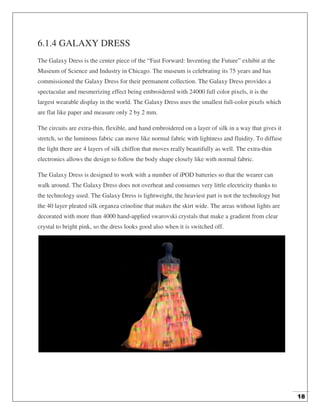
6.1.4 GALAXY DRESS
The Galaxy Dress is the center piece of the “Fast Forward: Inventing the Future” exhibit at the
Museum of Science and Industry in Chicago. The museum is celebrating its 75 years and has
commissioned the Galaxy Dress for their permanent collection. The Galaxy Dress provides a
spectacular and mesmerizing effect being embroidered with 24000 full color pixels, it is the
largest wearable display in the world. The Galaxy Dress uses the smallest full-color pixels which
are flat like paper and measure only 2 by 2 mm.
The circuits are extra-thin, flexible, and hand embroidered on a layer of silk in a way that gives it
stretch, so the luminous fabric can move like normal fabric with lightness and fluidity. To diffuse
the light there are 4 layers of silk chiffon that moves really beautifully as well. The extra-thin
electronics allows the design to follow the body shape closely like with normal fabric.
The Galaxy Dress is designed to work with a number of iPOD batteries so that the wearer can
walk around. The Galaxy Dress does not overheat and consumes very little electricity thanks to
the technology used. The Galaxy Dress is lightweight, the heaviest part is not the technology but
the 40 layer pleated silk organza crinoline that makes the skirt wide. The areas without lights are
decorated with more than 4000 hand-applied swarovski crystals that make a gradient from clear
crystal to bright pink, so the dress looks good also when it is switched off.
19
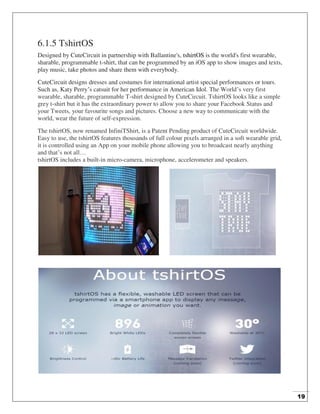
6.1.5 TshirtOS
Designed by CuteCircuit in partnership with Ballantine's, tshirtOS is the world's first wearable,
sharable, programmable t-shirt, that can be programmed by an iOS app to show images and texts,
play music, take photos and share them with everybody.
CuteCircuit designs dresses and costumes for international artist special performances or tours.
Such as, Katy Perry’s catsuit for her performance in American Idol. The World’s very first
wearable, sharable, programmable T-shirt designed by CuteCircuit. TshirtOS looks like a simple
grey t-shirt but it has the extraordinary power to allow you to share your Facebook Status and
your Tweets, your favourite songs and pictures. Choose a new way to communicate with the
world, wear the future of self-expression.
The tshirtOS, now renamed InfiniTShirt, is a Patent Pending product of CuteCircuit worldwide.
Easy to use, the tshirtOS features thousands of full colour pixels arranged in a soft wearable grid,
it is controlled using an App on your mobile phone allowing you to broadcast nearly anything
and that’s not all…
tshirtOS includes a built-in micro-camera, microphone, accelerometer and speakers.
20
6.2 MUSICAL JACKET
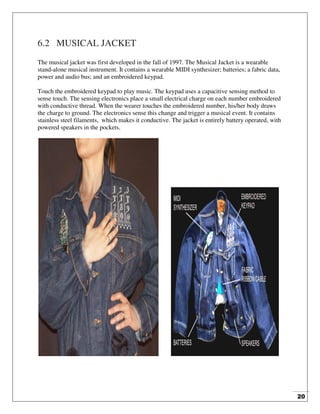
The musical jacket was first developed in the fall of 1997. The Musical Jacket is a wearable
stand-alone musical instrument. It contains a wearable MIDI synthesizer; batteries; a fabric data,
power and audio bus; and an embroidered keypad.
Touch the embroidered keypad to play music. The keypad uses a capacitive sensing method to
sense touch. The sensing electronics place a small electrical charge on each number embroidered
with conductive thread. When the wearer touches the embroidered number, his/her body draws
the charge to ground. The electronics sense this change and trigger a musical event. It contains
stainless steel filaments, which makes it conductive. The jacket is entirely battery operated, with
powered speakers in the pockets.
21
6.3 WI-FI DETECTOR T-SHIRT
Wifi T-Shirts is a great novelty t-shirt that would make an excellent gift for any
technophile, the WiFi detector T-Shirt also makes the ideal promotional item or giveaway
for companies in the Internet or telecoms sector. There’s now no need to crack open your
laptop or walk around waving your PDA about to find out if there’s a WiFi signal in the
vicinity as this stylish T-shirt displays the current WiFi signal strength in your
surroundings to everyone around you. Glowing bars on the front of the shirt dynamically
change as the WiFi signal strength fluctuates. Perfect for finding the best places to access
WiFi in Coffee Shops or when out and about, and even in your own home or workplace,
the WiFi Detector T-Shirt shows the connections that are floating about in the airwaves
all around you.
Washing Instructions
1. Carefully peel animated decal from front of T-Shirt
2. Unplug ribbon connector behind decal and remove decal
3. Unplug battery pack and remove it
4. You can leave the ribbon cable inside the shirt
22
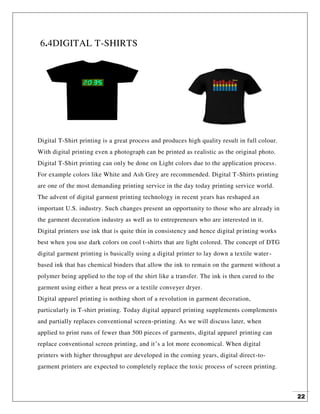
6.4DIGITAL T-SHIRTS
Digital T-Shirt printing is a great process and produces high quality result in full colour.
With digital printing even a photograph can be printed as realistic as the original photo.
Digital T-Shirt printing can only be done on Light colors due to the application process.
For example colors like White and Ash Grey are recommended. Digital T-Shirts printing
are one of the most demanding printing service in the day today printing service world.
The advent of digital garment printing technology in recent years has reshaped an
important U.S. industry. Such changes present an opportunity to those who are already in
the garment decoration industry as well as to entrepreneurs who are interested in it.
Digital printers use ink that is quite thin in consistency and hence digital printing works
best when you use dark colors on cool t-shirts that are light colored. The concept of DTG
digital garment printing is basically using a digital printer to lay down a textile water-
based ink that has chemical binders that allow the ink to remain on the garment without a
polymer being applied to the top of the shirt like a transfer. The ink is then cured to the
garment using either a heat press or a textile conveyer dryer.
Digital apparel printing is nothing short of a revolution in garment decoration,
particularly in T-shirt printing. Today digital apparel printing supplements complements
and partially replaces conventional screen-printing. As we will discuss later, when
applied to print runs of fewer than 500 pieces of garments, digital apparel printing can
replace conventional screen printing, and it’s a lot more economical. When digital
printers with higher throughput are developed in the coming years, digital direct-to-
garment printers are expected to completely replace the toxic process of screen printing.
23
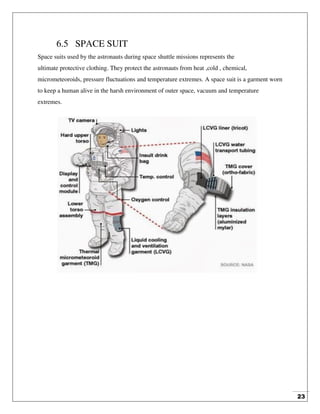
6.5 SPACE SUIT
Space suits used by the astronauts during space shuttle missions represents the
ultimate protective clothing. They protect the astronauts from heat ,cold , chemical,
micrometeoroids, pressure fluctuations and temperature extremes. A space suit is a garment worn
to keep a human alive in the harsh environment of outer space, vacuum and temperature
extremes.
24
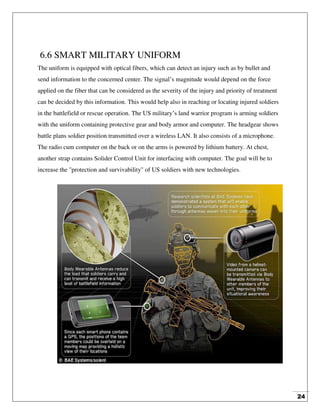
6.6 SMART MILITARY UNIFORM
The uniform is equipped with optical fibers, which can detect an injury such as by bullet and
send information to the concerned center. The signal’s magnitude would depend on the force
applied on the fiber that can be considered as the severity of the injury and priority of treatment
can be decided by this information. This would help also in reaching or locating injured soldiers
in the battlefield or rescue operation. The US military’s land warrior program is arming soldiers
with the uniform containing protective gear and body armor and computer. The headgear shows
battle plans soldier position transmitted over a wireless LAN. It also consists of a microphone.
The radio cum computer on the back or on the arms is powered by lithium battery. At chest,
another strap contains Solider Control Unit for interfacing with computer. The goal will be to
increase the "protection and survivability" of US soldiers with new technologies.
25
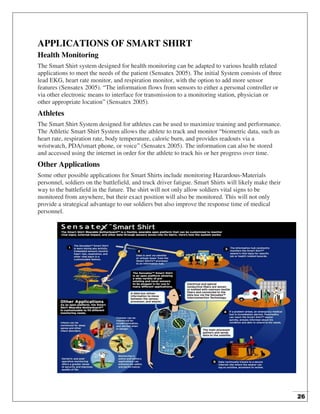
6.7 SMART SHIRT
This shirt is equipped with motion sensors; it can provide feedback about the wearer’s
movements or postures. Such information is helpful in rehabilitation or sport applications, where
it is important that certain movements are executed correctly. For example, rehabilitation
exercises need to be performed in clearly a defined motion sequence, with the correct speed and
a defined amount of repetitions.
The life shirt system is a comfortable garment that can be worn under normal uniform and it can
automatically and continuously monitor over 40 physical signs such as respiratory rate,
ventilation, swallow counts, arterial pulse wave, and heart rate. The Smart Shirt is manufactured
by Sensatex, but was developed by the Georgia Institute of Technology and originally funded by
the US military's 21st Century Land Warrior Program and the Defense Advance Research
Projects Agency (Bowie 2000). The shirt contains sensors that can be used to monitor vital signs
such as heart rate, EKG, respiration, and blood pressure. The Smart Shirt uses what the company
calls interconnection technology that involves networking sensing, monitoring, and information
processing devices (Sensatex 2005). Information from the optical sensing and electrical
conducting fibers in the shirt are sent to a “transmitter at the base of the shirt where it is stored on
a memory chip or sent to your doctor, coach, or personal server via a wireless network like
Bluetooth, RF, wLAN, or cellular network”.
26
APPLICATIONS OF SMART SHIRT
Health Monitoring
The Smart Shirt system designed for health monitoring can be adapted to various health related
applications to meet the needs of the patient (Sensatex 2005). The initial System consists of three
lead EKG, heart rate monitor, and respiration monitor, with the option to add more sensor
features (Sensatex 2005). “The information flows from sensors to either a personal controller or
via other electronic means to interface for transmission to a monitoring station, physician or
other appropriate location” (Sensatex 2005).
Athletes
The Smart Shirt System designed for athletes can be used to maximize training and performance.
The Athletic Smart Shirt System allows the athlete to track and monitor “biometric data, such as
heart rate, respiration rate, body temperature, caloric burn, and provides readouts via a
wristwatch, PDA/smart phone, or voice” (Sensatex 2005). The information can also be stored
and accessed using the internet in order for the athlete to track his or her progress over time.
Other Applications
Some other possible applications for Smart Shirts include monitoring Hazardous-Materials
personnel, soldiers on the battlefield, and truck driver fatigue. Smart Shirts will likely make their
way to the battlefield in the future. The shirt will not only allow soldiers vital signs to be
monitored from anywhere, but their exact position will also be monitored. This will not only
provide a strategical advantage to our soldiers but also improve the response time of medical
personnel.
27
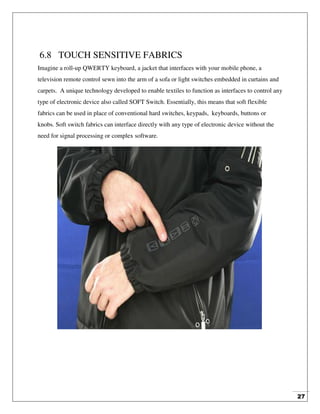
6.8 TOUCH SENSITIVE FABRICS
Imagine a roll-up QWERTY keyboard, a jacket that interfaces with your mobile phone, a
television remote control sewn into the arm of a sofa or light switches embedded in curtains and
carpets. A unique technology developed to enable textiles to function as interfaces to control any
type of electronic device also called SOFT Switch. Essentially, this means that soft flexible
fabrics can be used in place of conventional hard switches, keypads, keyboards, buttons or
knobs. Soft switch fabrics can interface directly with any type of electronic device without the
need for signal processing or complex software.
28
7. FUTURE DEVELOPMENTS
Further developments in interactive and wearable electronics include garments and clothing that
contain Lumalive textiles that are able to transmit messages/advertisements. They have the
ability to change colour, and contain LED’s incorporated within the clothing. Phillips the
electronics company behind these latest innovations is planning to develop fabrics with Lumalive
technology that will allow soft furnishings such as cushions, curtains etc. to transform/ alter
colour and illuminate consecutively enhancing mood and atmosphere of their surroundings.
To take the next step towards electronic clothing (made of electronic textiles) research has to be
carried out in the following areas:
Clothing technology for manufacturing testing under wearing conditions and washing/cleaning
treatments investigation of reliability. We have seen that electronics can not only be attached to
textiles but also realized in form of textile structures. Today, some performances cannot be
compared with conventional computer technology. There are also some limitations concerning
mass production and reliability. In the future it could become quite difficult to clearly separate
electronic textiles from the afore mentioned method of miniaturization plus attachment, because
computers could be miniaturized until they are molecule-sized. In this case ‘attachment’ to fibres
or fabrics would also lead to what we define as electronic textiles.
Plastic was a revolution, and nano-technology will probably be the next big change. There are a
lot of thoughts about what could be done if we were able to manipulate, rearrange and build from
molecules and atoms. Having a machine that changes a bicycle tire into meat, self-cleaning
carpets, changing state from rigid to flexible and vice versa.
7.1 NEW TECHNOLOGIES FOR INNOVATIVE
SPORTSWEAR
New product developments in sportswear not only make garments look and fit better, they also
help athletes perform better. Many of these require uses of new or specialist technology within
the manufacture of the garments, not just the materials they were made from. The market leaders
present these specialist technologies at Texprocess.
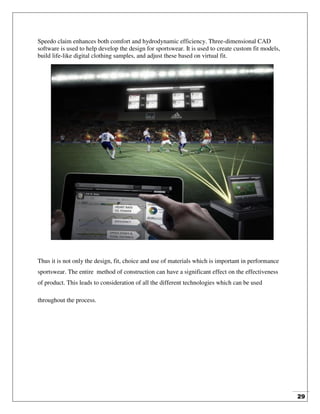
Smart textiles are an example. The Adidas miCoach Elite System has been introduced to football
to help with coaching and game monitoring. For the Olympics, Speedo introduced its Fastskin
Racing System which combines the swimsuit, cap and goggles into a unified system, which
29
Speedo claim enhances both comfort and hydrodynamic efficiency. Three-dimensional CAD
software is used to help develop the design for sportswear. It is used to create custom fit models,
build life-like digital clothing samples, and adjust these based on virtual fit.
Thus it is not only the design, fit, choice and use of materials which is important in performance
sportswear. The entire method of construction can have a significant effect on the effectiveness
of product. This leads to consideration of all the different technologies which can be used
throughout the process.
30
8. CONCLUSION
We have shown how to combine conventional sewing and electronics techniques with a novel
class of materials to create interactive digital devices. All of the input devices can be made by
seamstresses or clothing factories, entirely from fabric. These textile based sensors, buttons, and
switches are easy to scale in size. They also can conform to any desired shape, which is a great
advantage over most existing, delicate touch sensors that must remain flat to work at all.
Subsystems can be connected together using ordinary textile snaps and fasteners. Finally, most
of what has been described can be thrown in the wash if soiled by coffee, food, or sand at the
beach. Previously smart textiles were presented as imaginary products and used in very limited
areas. After scientific efforts and development phases, nowadays smart textiles are an implanted
customer interest and are presented as the future of the textile industry. Now many commercial
products are available and, as it have been presented in this article. A lot of scientists are
developing new solutions, ideas and concrete products with the emerging demand of smart
textiles in various phases of life. The global markets of smart textiles are expected to reach USD
1500 million according to new study of Grant View Research, Inc.
31
9. REFERENCES
 https://en.wikipedia.org
 http://www.technicaltextile.net
 http://fashion.bodi.me/top-5-smart-fabrics-intelligent-clothing/
 https://www.wearabletechnologyinsights.com
 http://www.indiantextilejournal.com
 http://cutecircuit.com
 http://www.thinkgeek.com

Seminar report on topic Smart Fabrics by Sunil Bandotra

  • 1.
    i Government College ofEngineering and Technology Chak Bhalwal, Jammu Seminar Report on “Smart Fabrics” Submitted in partial fulfillment of the requirements for the award of the Degree of Bachelor of Engineering in Computer Engineering Submitted by:- Sunil Kumar (GCET-140/2014) 7th Semester Department of Computer Engineering
  • 2.
    ii Government College ofEngineering and Technology CERTIFICATE This is to certify that the seminar report titled “SMART FABRICS” by SUNIL KUMAR has been successfully completed in partial fulfillment of the award of Bachelor of Engineering in Computer Engineering from University Of Jammu. Dr. Simmi Dutta Head Of Department Deptt. Of Computer Engineering
  • 3.
    iii ACKNOWLEDGEMENT I would liketo express my sincere gratitude to all those who provided me the necessary support, motivation and guidance to complete the seminar report. Very special thanks to my family for my never ending support. I also extend my wholehearted appreciation to all my teachers especially “Dr. Simmi Dutta” (HOD of Computer Department in GCET, Jammu) for supporting me and for being a constant source of guidance and inspiration. I would like to thank Ms. Heena Gupta for the necessary guidance in making this report. Sunil Kumar GCET/151/2014
  • 4.
    iv Abstract Humans are closeto textiles more than anything, and certainly we carry it most, other than anything. The last few decades have shown enormous growth in the development of wireless communication technologies, nanoengineering, information technologies, and miniaturization of electronic devices. These developments draw the attention of researchers to envisage the significant characteristics of these advancements to the belongings with whom we are most close to. Researchers are now evaluating the new ideas and possibilities to functionalize this ‘natural necessity feature of human beings’ with emerging technologies into different arrays of human life especially in the Medical and Healthcare management - as mobile monitoring of health care, protection from life risk factors, life style management, rehabilitation and into other facilitation of our lives, by Hybridizing the Smart or Intelligent Technology in Textiles. The aim of this paper is to describe the analysis on how ‘Smart’, ‘intelligent’ or ‘active’ materials and textiles are being incorporated in the healthcare sector to aid diagnostics, recording and transmitting of bio-physiological signals or ambulatory tele-monitoring of the body vitals, by encompassing the core concepts of smart materials under the light of the recent developments and projects. Smart and interactive textiles are fibrous structures that are capable of sensing, actuating, generating/storing power and/or communicating. Research and development towards wearable textile-based personal systems allowing e.g. health monitoring, protection & safety, and healthy lifestyle gained strong interest during the last 10 years. Smart fabrics and interactive textile wearable systems regroup activities along two different and complementary approaches i.e. "application pull" and "technology push". This includes personal health management through integration, validation, and use of smart clothing and other networked mobile devices as well as projects targeting the full integration of sensors/actuators, energy sources, processing and communication within the clothes to enable personal applications such as protection/safety, emergency and healthcare. so here in case of smart textiles we are using the conductive fibers such as metal yarn. This paper includes the origin and introduction of smart textile and integrated wearable electronics for sport wear, industrial purpose, automotive & entertainment applications, healthcare & safety. military, public sectors, and new developments in smart textiles.
  • 5.
    CONTENTS CERTIFICATE Ii ACKNOWLEDGEMENT Iii ABSTRACT 1.INTRODUCTION 1.1 SMART MATERIAL & ITS CLASSIFICATION 2. TYES OF SMART FABRICS 3. MATERIALS 3.1 METAL FIBERS 3.2 CONDUCTIVE INKS 3.3 OPTICAL FIBERS 3.4 COATING WITH NANO-PARTICLES 3.5 ORGANIC SEMICONDUCTORS 3.6 SHAPE MEMORY MATERIALS 3.7 CHROMIC MATERIALS 4. WORKING 5. APPLICATIONS 5.1 TEMPERATURE SENSITIVE FABRICS 5.2 HEALTH MONITORING FABRICS 5.3 EMERGENCY FABRICS 5.4 FASHION AND ENTERTAINMENT 5.5 MILITARTY/DEFENCE 5.6 SPORTSWEAR 5.7 TRANSPORT AND AUTOMAOTIVE USE Iv 1-2 3 4-7 8-9 10-13
  • 6.
    6. SOME INNOVATIVESMART FABRICS 6.1 CUTECIRCUIT 6.1.1 KINETIC DRESS 6.1.2 M DRESS 6.1.3 HUG SHIRT 6.1.4 GALAXY DRESS 6.1.5 Tshirt OS 6.2 MUSICAL JACKET 6.3 WI-FI DETECTOR T-SHIRT 6.4 DIGITAL T-SHIRTS 6.5 SPACE SUIT 6.6 SMART MILITARY UNIFORM 6.7 SMART SHIRT 6.7.1 APPLICATIONS OF SMART SHIRT 6.8 TOUCH SENSITIVE FABRICS 14-27 7. FUTURE DEVELOPMENTS 7.1 NEW TECHNOLOGIES FOR INNOVATIVE SPORTSWEAR 28-29 8. CONCLUSION 30 9. REFERENCES 31
  • 7.
    1 1. INTRODUCTION The originalfunction of textiles was to shield man from cold and rain. Later on in history aesthetic aspects also came to play a role in clothing. Much more recently a new generation of textiles has arisen; smart and interactive textiles. Interactive textiles are a relatively new discipline in the textile sector. They are active materials that have sensing and actuation properties. Their potential is enormous. one could think of smart clothing that makes us feel comfortable at all times, during any activity and in any environmental conditions, a suit that protects and monitors, that warns in case of danger and even helps to treat diseases and injuries. Such clothing could be used from the moment we are born till the end of our life. Some of the more important efforts include applications that Aid in patient health monitoring through sensor embedded garments that track and record biometric data, Helps to improve athletic performance both by analyzing sensor data and adapting to changing conditions. So as to improve performance over the time .Provides environmental sensing and communication technologies for military defense and other security personals .Present new structural and decorative solutions for fashion design. The world is distinctly rising towards the new era, an era of smart and intelligent discoveries; problem solving and creativity − the smart automobile vehicles (cars, metro system), intelligent jets, smart homes and amongst from many of such aristocratic paradigms, the ‘Smart and Intelligent Textiles’. Before going further, a clarification of the term and definition of smart and intelligent textile is essential. There is a substantive difference between the terms, ‘Smart’ and ‘Intelligent’, Smart materials or textiles can be defined as the materials and structures which have sense or can sense the environmental conditions or stimuli, whereas intelligent textiles can be defined as textile structures which not only can sense but can also react and respond to environmental conditions or stimuli . These stimuli as well as response , could be thermal, chemical, mechanical, electric, magnetic or from other source .
  • 8.
    2 1.1 SMART MATERIAL& ITS CLASSIFICATION “Smart material" is a generic term for a material that in some way reacts to its environment. Smart materials can be classified in many different ways, for example depending on their transforming function: property change capability, energy change capability, discrete size/location or reversibility. Smart materials can also be classified depending on their behavior and function as passive smart, active smart or very smart. According to the manner of reaction, they can be divided into passive smart, active smart and very smart materials 1. Passive smart materials can only sense the environmental conditions or stimuli; they are sensors; 2. Active smart materials will sense and react to the conditions or stimuli, besides the sensor function, they also have actuation characteristics; 3.Very smart materials can sense, react and adapt themselves accordingly;
  • 9.
    3 2. TYPES OFSMART FABRICS Smart textiles can be broken into two different categories:  Aesthetic  Performance enhancing  Aesthetic examples include fabrics that light up and fabrics that can change colour. Some of these fabrics gather energy from the environment by harnessing vibrations, sound or heat, reacting to these inputs. The colour changing and lighting scheme can also work by embedding the fabric with electronics that can power it.  Performance enhancing smart textiles are intended for use in athletic, extreme sports and military applications. These include fabrics designed to regulate body temperature, reduce wind resistance, and control muscle vibration – all of which may improve athletic performance. Other fabrics have been developed for protective clothing, to guard against extreme environmental hazards, such as radiation and the effects of space travel. Fig.1 Dresses made from photo luminescent thread and embedded eye tracking technology from Ying Gao
  • 10.
    4 3. MATERIALS For yearsthe textile industry has been weaving metallic yarns into fabrics for decorative purposes. The first conductive fabric we explored was silk organza which contains two types of fibers. On the warp is a plain silk thread. Running in the other direction on the weft is a silk thread wrapped in thin copper foil. This metallic yarn is prepared just like cloth-core telephone wire, and is highly conductive. The silk fiber core has a high tensile strength and can withstand high temperatures, allowing the yarn to be sewn or embroidered with industrial machinery. The spacing between these fibers also permits them to be individually addressed, so a strip of this fabric can function like a ribbon cable. This sort of cloth has been woven in India for at least a century, for ornamental purposes, using silver, gold, and other metals. Circuits fabricated on organza only need to be protected from folding contact with themselves, which can be accomplished by coating, supporting or backing the fabric with an insulating layer which can also be cloth. Also, circuits formed in this fashion have many degrees of flexibility (i.e. they can be wadded up), as compared to the single degree of flexibility that conventional substrates can provide. There are also conductive yarns manufactured specifically for producing filters for the processing of fine powders. These yarns have conductive and cloth fibers interspersed throughout. Varying the ratio of the two constituent fibers leads to differences in resistivity. These fibers can be sewn to create conductive traces and resistive elements. While some components such as resistors, capacitors, and coils can be sewn out of fabric, there is still a need to attach other components to the fabric. This can be done by soldering directly onto the metallic yarn. Surface mount LEDs, crystals, piezo transducers, and other surface mount components with pads spaced more than 0.100 inch apart are easy to solder into the fabric. Once components are attached, their connections to the metallic yarn may need to be mechanically strengthened. This can be achieved with an acrylic or other flexible coating. Components with ordinary leads can be sewn directly into circuits on fabric, and specially shaped feet could be developed to facilitate this process. Gripper snaps make excellent connectors between the fabric and electronics. Since the snap pierces the yarn it creates a surprisingly robust electrical contact. It also provides a good surface to solder to. In this way subsystems can be easily snapped into clothing or removed for washing.
  • 11.
    5 3.1 Metal Fibers Metalthreads are made up of metal fibers which are very thin metal filaments (diameters ranging from 1 to 80 micron). The fibers are produced either through a bundle-drawing process or else shaved off the edge of thin metal sheeting. Metallic threads and yarns may be knitted or woven into a textile and used to form Interconnects between components. While metals provide good conductivity there are some drawbacks of integration into clothing. Metal threads tend to be heavier than most textile fibers and their brittle characteristics can damage spinning machinery over time and also they may be uncomfortable to wear due to abrasion. Fig.2 Metal yarns 3.2 Conductive Inks A layout can be screen-printed using conductive inks to add conductivity to specific areas of a garment. Carbon, copper, silver, nickel and gold may be added to conventional printing inks to make them conductive. Printed areas can be subsequently used as switches or pressure pads for the activation of circuits. Fig.3 Conductive ink
  • 12.
    6 3.3 Optical Fibers Plasticoptical fibres may be easily integrated into a textile. They have the advantage of not generating heat and are insensitive to EM radiation. Optical fibres may serve a number of functions in a smart garment - transmit data signals, transmit light for optical sensing, detect deformations in fabrics due to stress and strain and perform chemical sensing. Plastic optical fibres can be woven into a textile, however bending of the fibers is an issue during the manufacturing process and also with the end product as mechanical damage causes signal loss. Commercially available Luminex ®fabric is a textile with woven optical fibers capable of emitting its own light. While this has aesthetic appeal for the fashion industry it is also used in safety vests and potential to be used for data transmission. Fig.4 Optical fibre 3.4 Coating with Nano-Particles Coating a fabric with nano particles is being widely applied within the textile industry to improve the performance and functionality of textiles. Conventional methods of adding various properties to fabrics may not last after washing and wearing. How ever nanotechnology can add permanent effects and provide high durability fabrics. This is due to the large surface area-to- volume ratio and high surface energy of nano particles. Coating with Nano-particles can enhance the textiles with properties such asanti-bacterial, water-repellence, UV-protection and self- cleaning, while still maintaining breath-ability and tactile properties of the textile. Nano-Tex has a range of products using such coatings to resist spills, repel and release stains, and resiststatic. These textile enhancements become inherent to the fabric, improving the performance and durability of everyday apparel and interior furnishings. 3.5 Organic Semiconductors Organic semiconductors, (polymers and oligomers), having the electrical properties of semiconductors and the mechanical properties of plastics, are good candidates for developing electronic and optoelectronic flexible components, e.g. transistors, LEDs, on the flexible textile substrate. Organic LEDs consist of multilayer structures where organic emitters are embedded between an evaporated metal electrode and a film of indium tin oxide coupled to a plastic or glass substrate. Philips have recently released light emitting fabric, Lumalive®, featuring flexible
  • 13.
    7 arrays of fullyintegrated colored LEDs. These light-emitting textiles can carry dynamic messages, graphics, or multicolored surfaces. 3.6 Shape Memory Materials SMMs can deform from the current shape to a previously set shape, usually due to the action of heat. a strip of metal is heated with a lighter and finds its original shape. In garments the scale is smaller. When these SSMs are activated (at a certain activation temperature), the air gaps between close layers of clothing are increased. This is to give better insulation and protection against extremes of heat or cold. In clothing, the temperatures for the shape memory effect to be activated should be near body temperature. SM Polymers are more flexible than the alloys. Thermoplastic polyurethane films have been made which can be put in between layers of clothing. When the temperature of the outer layer of clothing has fallen sufficiently, the film responds so that the air gap between the layers of clothing becomes broader. This out-of-plane deformation must be strong enough to resist the weight of the clothing and the movements of the wearer. If the outer layer of clothing becomes warmer, the deformation must be reversed. Some alloys are capable of a two-way activation, triggered by changeable weather and varying physical activity. 3.7 Chromic Materials Chromic Materials are also called chameleon fibres, because they can change their color according to external conditions. These materials have mostly used in fashion, to create funny color changing designs. Because of this, some people fear that the chromic materials will be a short boom. But the accuracy and endurance of the materials are all the time being improved.
  • 14.
    8 4. WORKING Several circuitshave been built on and with fabric to date, including busses to connect various digital devices, microcontroller systems that sense proximity and touch, and all-fabric keyboards and touchpads. In the microcontroller circuit shown in Figure 1, a PIC16C84 microcontroller and its supporting components are soldered directly onto a square of fabric. The circuit uses the bidirectional I/O pins on the PIC to control LEDs and to sense touch along the length of the fabric, while providing musical feedback to reinforce the sense of interaction. Building systems in this way is easy because components can be soldered directly onto the conductive yarn. The addressability of conductors in the fabric make it a good material for prototyping, and it can simply be cut where signals lines are to terminate. One kind of fabric keyboard uses pieced conductive and nonconductive fabric, sewn together like a quilt to make a row- and column-addressable structure. The quilted conductive columns are insulated from the conductive rows with a soft, thick fabric, like felt, velvet, or quilt batting. Holes in the insulating fabric layer allow the row and column conductors to make contact with each other when pressed. This insulation also provides a rewardingly springy, button-like mechanical effect. Contact is made to each row and column with a gripper snap, and each snap is soldered to a wire which leads to the keyboard encoding circuitry. This keyboard can be wadded up, thrown in the wash, and even used as a potholder if desired. Such row-and-column structures can also be made by embroidering or silk-screening the contact traces. All-fabric capacitive keyboard:- Keyboards can also be made in a single layer of fabric using capacitive sensing [Baxter97], where an array of embroidered or silk-screened electrodes make up the points of contact. A finger's contact with an electrode can be sensed by measuring the increase in the electrode's total capacitance. It is worth noting that this can be done with a single bidirectional digital I/O pin per electrode, and a leakage resistor sewn in highly resistive yarn. Capacitive sensing arrays can also be used to tell how well a piece of clothing fits the wearer, because the signal varies with pressure. The keypad shown here has been mass produced using ordinary embroidery techniques and mildly conductive thread. The result is a keypad that is flexible, durable, and responsive to touch. A printed circuit board supports the components necessary to do capacitive sensing and output keypress events as a serial data stream. The circuit
  • 15.
    9 board makes contactwith the electrodes at the circular pads only at the bottom of the electrode pattern. In a test application, 50 denim jackets were embroidered in this pattern. Some of these jackets are equipped with miniature MIDI synthesizers controlled by the keypad. The responsiveness of the keyboard to touch and timing were found by several users to be excellent. A view of the component side of the circuit board has been superimposed to show its extent and its connections to the fabric. A flexible circuit board can be substituted for the rigid one used in this implementation. Ultimately we hope to do away with the circuit board entirely.
  • 16.
    10 5. APPLIACTIONS 5.1 TEMPERATURESENSITIVE FABRICS From protecting body from harsh temperature to start thinking for the wearer, clothes have come a long way! This is the next generation of textile- the smart fabrics- the electronic wearables! This can not only keep the wearer warm or cool but also dry, moisturized, free from bacteria, allergy, odor and stains and at the same time monitor the heart rate, blood count and oxygen! Fabrics are really going to give a tough competition to human intelligence!.Not only protecting human body against heat and cold, the fabrics are now accepting the role of regulating body temperature. These heat modifying textiles are mostly used to make outdoor garments such as hats, beanies, windbreakers and jackets. There are many techniques for making such clothes, one of which is- treating the fabric with paraffins. As the body gets hot, the paraffins become more liquid to let the heat pass out and as the body gets cold, it solidifies so that it keeps back the heat with the wearer. Some other fabrics that are wired up, conduct electricity for monitoring body temperature. At the same time, the inbuilt mp3 player can entertain the wearer! The amazing part is that, when made from conductive yarn, they are machine washable, wear and feel like any conventional clothing. They are the first generation smart fabrics, and guess what, the second generation smart fabrics will be treated with Inherently Conductive Polymers (ICP) allowing the fabric to transmit energy to heat and cool the body. 5.2 HEALTH MONITORING FABRICS Now regular visits for health related tests can be forgotten! Wear the Health Monitoring Electronic Wearables and stay free of worries. The most prevalent among these health smart fabrics are the microencapsulated fabrics, especially in the natural health sector. The clothings enriched with substances like vitamins, algae or nutrients along with other substances to delay ageing or for improving blood circulation or other such benefits are fast becoming popular with the masses. Medically beneficial electrically conductive smart fabrics are no far behind. These life vests can track heart rate, ECG and body temperature. Now the research results are claiming to have developed a smart fabric that could warn its wearer of allergens, by glowing in response. The other health-enhancing electronic clothings include fall-detecting smart shirt that uses a
  • 17.
    11 built-in motion-detection hardwareto detect if the user has fallen and can't get up. Really useful for older people! Then there is underwear having sensors woven into the fabric to detect heart rate. Some of them can even dial emergency number if they detect a problem. Now, that's called a real smart fabric!! Shirt for measuring rehabilitation 5.3 EMERGENCY FABRICS Although the health monitoring fabrics are in a way emergency fabrics only, yet certain other developments in the field of smart fabrics are in the pipeline that can really be called Disaster wear! A system is being developed to monitor the wearer and the outside environment which can be helpful for rescue workers like fire fighters. Some projects are aiming at stretchable electronics by developing conducting substrates within the very weave of fabric, which will allow sensors to move with the body. Many researches are aimed at using optical fibers because of their potential flexibility and their capacity to use light both as an information carrier and a sensor in itself. It can find applications in oximetry – a smart non-invasive way to measure the oxygen content of blood. Some projects are targeting at developing sensors which can measure body fluids like sweat, too, which will be very useful in sport wears. It will be able to measure the conductivity, electrolyte level, temperature and pH of the users' sweat, all very useful indicators for sporting applications.
  • 18.
    12 5.4 FASHION ANDENTERTAINMENT Club wear that reacts to movement, heat and light. They include garments with panels that illuminate when the dancer moves, or clothing that contain fibre optics woven and integrated into the fabric. The development of high-tech advanced textiles for initial high-value applications such as extreme sports will eventually find its way into street fashion, with designers employing their creativity to use these emerging materials in new ways. These devices all contain common components such as power supply, microprocessor, data transmission. As the technology is becoming more flexible these could ultimately be integrated into a common textile substrate - our clothes, becoming truly portable devices. Already there are textile switches integrated into clothing for the control of such devices. While technology may be hidden through invisible coatings and advanced fibers, it can also be used to dramatically change the appearance of the textile, giving new and dazzling effects. Light emitting textiles are finding their way onto the haute couture catwalks, suggesting a future trend in technical garments. the haute couture catwalks, suggesting a future trend in technical garments. 5.5 MILITARY/DEFENSE In extreme environmental conditions and hazardous situations there is a need for real time information technology to increase the protection and survivability of the people working in those conditions. Improvements in performance and additional capabilities would be of immense assistance within professions such as the defence forces and emergency response services. The
  • 19.
    13 requirements for suchsituations are to monitor vital signs and ease injuries while also monitoring environment hazards such as toxic gases. Wireless communication to a central unit allows medics to conduct remote triage of casualties to help them respond more rapidly and safely. 5.6 SPORTSWEAR Sports enthusiasts are able to benefit from integrated fabric sensors and display panels. They monitor heart rate and blood pressure during a gym workout or morning run and are able to analyze the information giving feedback on performance along with playing mood/ performance enhancing music. Some sports clothing such as car and motorbike racing and also astronauts suits contain integrated electronics Components. 5.7 TRANSPORT AND AUTOMOTIVE USE Modern contemporary cars contain control panels that activate heated seats, air-bags. Transport and automotive industries is one of the largest that benefits from interactive electronics and technical textiles. They have uses in space shuttles, aircraft and racing cars.
  • 20.
    14 6. SOME INNOVATIVESMART FABRICS 6.1 CUTECIRCUIT CuteCircuit is a fashion company based in London founded in 2004 by Ryan Genz and Francesca Rosella. CuteCircuit designs wearable technology and interactive fashion. All CuteCircuit garments are designed by Francesca Rosella and Ryan Genz. CuteCircuit was the first fashion company offering smart textile-based garments that create an emotional experience for their wearers using smart textiles and micro electronics. With the launch of the first collection in 2004, design critic John Thackara referred to Francesca Rosella as "The Madonna of wearable computing". The transformational creations from CuteCircuit have been cited as being an inspiration and precursor to the work of other avant-garde designers such as the Hussein Chalayan. Models used mobile phones to light up their garments at the CuteCircuit runway show
  • 21.
    15 COLLECTIONS OF CUTECIRCUIT 6.1.1KINETIC DRESS The Kinetic Dress designed by CuteCircuit in 2004. It represents an interaction between garment and wearer’s activities and mood; in fact, it lights up and changes its patterns following the person's movement. Kinetic Dress is a Victorian inspired evening gown reactive to the wearer’s activities and mood. The Kinetic Dress is sewn of an elastic textile embedded with sensors that follows closely the body of the wearer. The sensors are able to capture the wearer’s movements and interaction with others and display this data through the electroluminescent embroidery that covers the external skirt section of the dress. Depending on the amount and speed of the wearer’s movement the electroluminescent embroidery changes pattern, displaying the wearer’s mood to the audience and creating a magic halo around her. The algorithmic program that controls the Kinetic Dress is designed to follow the pace of the wearer: a still pose, when sitting alone shows a black dress, when the wearer starts moving and interacting with others the dress slowly lights up with a blue-circles pattern that moving creates a magic halo around the wearer.
  • 22.
    16 6.1.2 M DRESS In2008 CuteCircuit designed the M Dress that accepts a standard SIM card and allows to make and receive calls anytime, everywhere, without having to carry a cellular phone. The wearer inserts their usual SIM card in the small slot underneath the label and the dress is ready to be used. CuteCircuit introduced special gesture recognition software to allow the M- Dress to work in an easy and intuitive way. The M-Dress accepts a standard SIM card and allows the wearer to receive and make calls without carrying a cellular phone in their pocket or purse. Simplicity is elegance. The M-Dress (Mobile Phone Dress) was designed after our research showed that very often phone calls are missed because mobile phones are quite awkward to carry, especially for women, that have garments with small or no pockets. To allow women to stay connected while remaining stylish, CuteCircuit designed the M- Dress. A mobile phone in its own right but built out of soft circuitry. The wearer inserts their usual SIM card in the small slot underneath the label and the dress is ready to be used, having the same phone number as your usual phone. When the dress rings, the simple gesture of bringing your hand to the ear will allow the sensor to open the call and when done talking the gesture of releasing the hand downwards will close the call.CuteCircuit introduced special gesture recognition software to allow the M-Dress to work in an easy and intuitive way. 6.1.3 HUG SHIRT The Hug Shirt is a shirt that makes people send hugs over distance. The HugShirt was invented by Francesca Rosella and Ryan Genz the co-founders of CuteCircuit. Embedded in the Hug Shirt there are sensors that feel the strength, duration, and location of the touch, the skin warmth and the heartbeat rate of the sender and actuators that recreate the sensation of touch, warmth and emotion of the hug to the Hug Shirt™ of the distant loved one. The Hug Shirt was invented in 2002 and it has been awarded as one of the Best Inventions of the Year by Time Magazine in 2006. The Hug Shirt™ connects Bluetooth to any Smartphone thanks to the HugShirt App. The Hug Shirt™ records a hug like you would record a movie and delivers the data to your mobile via Bluetooth through the App and then your hug is transmitted over the network to your friend’s phone and it is seamlessly transmitted via Bluetooth to their Hug Shirt. Sending hugs is as easy as sending a text message or chatting, and you are able to send hugs while you are on the move, in the same way and to the same places you are able to make phone calls (Rome to Tokyo or New York to Paris). The Hug Shirt is not meant to replace human
  • 23.
    17 contact, but tomake you happy if you are away for business or other reasons and you miss your friends and loved ones. It also has some very interesting applications in the medical field with the elderly and children. And it is fun to use and very soft. Adults, such as busy travellers and elderly people living far away from their families, deprived of tactile contact for a long period of time will tell you just how depressing it feels. HOW DOES IT WORKS When touching the red areas on your Hug Shirt your mobile phone receives the sensors data via Bluetooth (hug pressure, skin temperature, heartbeat rate, time you are hugging for, etc) and then delivers it to the other person which wears a Hug Shirt as well. Requests from many different companies to buy such Hug Shirts leaded CuteCircuit to the plan to look for production and commercialization of the Hug Shirt. The military sees the usefulness in the Hug Shirt by allowing their soldiers to exchange hugs with their loved ones far away at home. This can help to improve the moral of the troops. Great idea, enabled by the fantastic concept and design of the Hugh Shirt. The Hug shirts don’t have any assigned phone number, all the data goes from the sensors Bluetooth to your mobile phone and your mobile phone delivers the hug data to your friend’s phone which is then transmitted via his/her Bluetooth enable phone to his or her shirt! So you both need such a shirt to exchange hugs.
  • 24.
    18 6.1.4 GALAXY DRESS TheGalaxy Dress is the center piece of the “Fast Forward: Inventing the Future” exhibit at the Museum of Science and Industry in Chicago. The museum is celebrating its 75 years and has commissioned the Galaxy Dress for their permanent collection. The Galaxy Dress provides a spectacular and mesmerizing effect being embroidered with 24000 full color pixels, it is the largest wearable display in the world. The Galaxy Dress uses the smallest full-color pixels which are flat like paper and measure only 2 by 2 mm. The circuits are extra-thin, flexible, and hand embroidered on a layer of silk in a way that gives it stretch, so the luminous fabric can move like normal fabric with lightness and fluidity. To diffuse the light there are 4 layers of silk chiffon that moves really beautifully as well. The extra-thin electronics allows the design to follow the body shape closely like with normal fabric. The Galaxy Dress is designed to work with a number of iPOD batteries so that the wearer can walk around. The Galaxy Dress does not overheat and consumes very little electricity thanks to the technology used. The Galaxy Dress is lightweight, the heaviest part is not the technology but the 40 layer pleated silk organza crinoline that makes the skirt wide. The areas without lights are decorated with more than 4000 hand-applied swarovski crystals that make a gradient from clear crystal to bright pink, so the dress looks good also when it is switched off.
  • 25.
    19 6.1.5 TshirtOS Designed byCuteCircuit in partnership with Ballantine's, tshirtOS is the world's first wearable, sharable, programmable t-shirt, that can be programmed by an iOS app to show images and texts, play music, take photos and share them with everybody. CuteCircuit designs dresses and costumes for international artist special performances or tours. Such as, Katy Perry’s catsuit for her performance in American Idol. The World’s very first wearable, sharable, programmable T-shirt designed by CuteCircuit. TshirtOS looks like a simple grey t-shirt but it has the extraordinary power to allow you to share your Facebook Status and your Tweets, your favourite songs and pictures. Choose a new way to communicate with the world, wear the future of self-expression. The tshirtOS, now renamed InfiniTShirt, is a Patent Pending product of CuteCircuit worldwide. Easy to use, the tshirtOS features thousands of full colour pixels arranged in a soft wearable grid, it is controlled using an App on your mobile phone allowing you to broadcast nearly anything and that’s not all… tshirtOS includes a built-in micro-camera, microphone, accelerometer and speakers.
  • 26.
    20 6.2 MUSICAL JACKET Themusical jacket was first developed in the fall of 1997. The Musical Jacket is a wearable stand-alone musical instrument. It contains a wearable MIDI synthesizer; batteries; a fabric data, power and audio bus; and an embroidered keypad. Touch the embroidered keypad to play music. The keypad uses a capacitive sensing method to sense touch. The sensing electronics place a small electrical charge on each number embroidered with conductive thread. When the wearer touches the embroidered number, his/her body draws the charge to ground. The electronics sense this change and trigger a musical event. It contains stainless steel filaments, which makes it conductive. The jacket is entirely battery operated, with powered speakers in the pockets.
  • 27.
    21 6.3 WI-FI DETECTORT-SHIRT Wifi T-Shirts is a great novelty t-shirt that would make an excellent gift for any technophile, the WiFi detector T-Shirt also makes the ideal promotional item or giveaway for companies in the Internet or telecoms sector. There’s now no need to crack open your laptop or walk around waving your PDA about to find out if there’s a WiFi signal in the vicinity as this stylish T-shirt displays the current WiFi signal strength in your surroundings to everyone around you. Glowing bars on the front of the shirt dynamically change as the WiFi signal strength fluctuates. Perfect for finding the best places to access WiFi in Coffee Shops or when out and about, and even in your own home or workplace, the WiFi Detector T-Shirt shows the connections that are floating about in the airwaves all around you. Washing Instructions 1. Carefully peel animated decal from front of T-Shirt 2. Unplug ribbon connector behind decal and remove decal 3. Unplug battery pack and remove it 4. You can leave the ribbon cable inside the shirt
  • 28.
    22 6.4DIGITAL T-SHIRTS Digital T-Shirtprinting is a great process and produces high quality result in full colour. With digital printing even a photograph can be printed as realistic as the original photo. Digital T-Shirt printing can only be done on Light colors due to the application process. For example colors like White and Ash Grey are recommended. Digital T-Shirts printing are one of the most demanding printing service in the day today printing service world. The advent of digital garment printing technology in recent years has reshaped an important U.S. industry. Such changes present an opportunity to those who are already in the garment decoration industry as well as to entrepreneurs who are interested in it. Digital printers use ink that is quite thin in consistency and hence digital printing works best when you use dark colors on cool t-shirts that are light colored. The concept of DTG digital garment printing is basically using a digital printer to lay down a textile water- based ink that has chemical binders that allow the ink to remain on the garment without a polymer being applied to the top of the shirt like a transfer. The ink is then cured to the garment using either a heat press or a textile conveyer dryer. Digital apparel printing is nothing short of a revolution in garment decoration, particularly in T-shirt printing. Today digital apparel printing supplements complements and partially replaces conventional screen-printing. As we will discuss later, when applied to print runs of fewer than 500 pieces of garments, digital apparel printing can replace conventional screen printing, and it’s a lot more economical. When digital printers with higher throughput are developed in the coming years, digital direct-to- garment printers are expected to completely replace the toxic process of screen printing.
  • 29.
    23 6.5 SPACE SUIT Spacesuits used by the astronauts during space shuttle missions represents the ultimate protective clothing. They protect the astronauts from heat ,cold , chemical, micrometeoroids, pressure fluctuations and temperature extremes. A space suit is a garment worn to keep a human alive in the harsh environment of outer space, vacuum and temperature extremes.
  • 30.
    24 6.6 SMART MILITARYUNIFORM The uniform is equipped with optical fibers, which can detect an injury such as by bullet and send information to the concerned center. The signal’s magnitude would depend on the force applied on the fiber that can be considered as the severity of the injury and priority of treatment can be decided by this information. This would help also in reaching or locating injured soldiers in the battlefield or rescue operation. The US military’s land warrior program is arming soldiers with the uniform containing protective gear and body armor and computer. The headgear shows battle plans soldier position transmitted over a wireless LAN. It also consists of a microphone. The radio cum computer on the back or on the arms is powered by lithium battery. At chest, another strap contains Solider Control Unit for interfacing with computer. The goal will be to increase the "protection and survivability" of US soldiers with new technologies.
  • 31.
    25 6.7 SMART SHIRT Thisshirt is equipped with motion sensors; it can provide feedback about the wearer’s movements or postures. Such information is helpful in rehabilitation or sport applications, where it is important that certain movements are executed correctly. For example, rehabilitation exercises need to be performed in clearly a defined motion sequence, with the correct speed and a defined amount of repetitions. The life shirt system is a comfortable garment that can be worn under normal uniform and it can automatically and continuously monitor over 40 physical signs such as respiratory rate, ventilation, swallow counts, arterial pulse wave, and heart rate. The Smart Shirt is manufactured by Sensatex, but was developed by the Georgia Institute of Technology and originally funded by the US military's 21st Century Land Warrior Program and the Defense Advance Research Projects Agency (Bowie 2000). The shirt contains sensors that can be used to monitor vital signs such as heart rate, EKG, respiration, and blood pressure. The Smart Shirt uses what the company calls interconnection technology that involves networking sensing, monitoring, and information processing devices (Sensatex 2005). Information from the optical sensing and electrical conducting fibers in the shirt are sent to a “transmitter at the base of the shirt where it is stored on a memory chip or sent to your doctor, coach, or personal server via a wireless network like Bluetooth, RF, wLAN, or cellular network”.
  • 32.
    26 APPLICATIONS OF SMARTSHIRT Health Monitoring The Smart Shirt system designed for health monitoring can be adapted to various health related applications to meet the needs of the patient (Sensatex 2005). The initial System consists of three lead EKG, heart rate monitor, and respiration monitor, with the option to add more sensor features (Sensatex 2005). “The information flows from sensors to either a personal controller or via other electronic means to interface for transmission to a monitoring station, physician or other appropriate location” (Sensatex 2005). Athletes The Smart Shirt System designed for athletes can be used to maximize training and performance. The Athletic Smart Shirt System allows the athlete to track and monitor “biometric data, such as heart rate, respiration rate, body temperature, caloric burn, and provides readouts via a wristwatch, PDA/smart phone, or voice” (Sensatex 2005). The information can also be stored and accessed using the internet in order for the athlete to track his or her progress over time. Other Applications Some other possible applications for Smart Shirts include monitoring Hazardous-Materials personnel, soldiers on the battlefield, and truck driver fatigue. Smart Shirts will likely make their way to the battlefield in the future. The shirt will not only allow soldiers vital signs to be monitored from anywhere, but their exact position will also be monitored. This will not only provide a strategical advantage to our soldiers but also improve the response time of medical personnel.
  • 33.
    27 6.8 TOUCH SENSITIVEFABRICS Imagine a roll-up QWERTY keyboard, a jacket that interfaces with your mobile phone, a television remote control sewn into the arm of a sofa or light switches embedded in curtains and carpets. A unique technology developed to enable textiles to function as interfaces to control any type of electronic device also called SOFT Switch. Essentially, this means that soft flexible fabrics can be used in place of conventional hard switches, keypads, keyboards, buttons or knobs. Soft switch fabrics can interface directly with any type of electronic device without the need for signal processing or complex software.
  • 34.
    28 7. FUTURE DEVELOPMENTS Furtherdevelopments in interactive and wearable electronics include garments and clothing that contain Lumalive textiles that are able to transmit messages/advertisements. They have the ability to change colour, and contain LED’s incorporated within the clothing. Phillips the electronics company behind these latest innovations is planning to develop fabrics with Lumalive technology that will allow soft furnishings such as cushions, curtains etc. to transform/ alter colour and illuminate consecutively enhancing mood and atmosphere of their surroundings. To take the next step towards electronic clothing (made of electronic textiles) research has to be carried out in the following areas: Clothing technology for manufacturing testing under wearing conditions and washing/cleaning treatments investigation of reliability. We have seen that electronics can not only be attached to textiles but also realized in form of textile structures. Today, some performances cannot be compared with conventional computer technology. There are also some limitations concerning mass production and reliability. In the future it could become quite difficult to clearly separate electronic textiles from the afore mentioned method of miniaturization plus attachment, because computers could be miniaturized until they are molecule-sized. In this case ‘attachment’ to fibres or fabrics would also lead to what we define as electronic textiles. Plastic was a revolution, and nano-technology will probably be the next big change. There are a lot of thoughts about what could be done if we were able to manipulate, rearrange and build from molecules and atoms. Having a machine that changes a bicycle tire into meat, self-cleaning carpets, changing state from rigid to flexible and vice versa. 7.1 NEW TECHNOLOGIES FOR INNOVATIVE SPORTSWEAR New product developments in sportswear not only make garments look and fit better, they also help athletes perform better. Many of these require uses of new or specialist technology within the manufacture of the garments, not just the materials they were made from. The market leaders present these specialist technologies at Texprocess. Smart textiles are an example. The Adidas miCoach Elite System has been introduced to football to help with coaching and game monitoring. For the Olympics, Speedo introduced its Fastskin Racing System which combines the swimsuit, cap and goggles into a unified system, which
  • 35.
    29 Speedo claim enhancesboth comfort and hydrodynamic efficiency. Three-dimensional CAD software is used to help develop the design for sportswear. It is used to create custom fit models, build life-like digital clothing samples, and adjust these based on virtual fit. Thus it is not only the design, fit, choice and use of materials which is important in performance sportswear. The entire method of construction can have a significant effect on the effectiveness of product. This leads to consideration of all the different technologies which can be used throughout the process.
  • 36.
    30 8. CONCLUSION We haveshown how to combine conventional sewing and electronics techniques with a novel class of materials to create interactive digital devices. All of the input devices can be made by seamstresses or clothing factories, entirely from fabric. These textile based sensors, buttons, and switches are easy to scale in size. They also can conform to any desired shape, which is a great advantage over most existing, delicate touch sensors that must remain flat to work at all. Subsystems can be connected together using ordinary textile snaps and fasteners. Finally, most of what has been described can be thrown in the wash if soiled by coffee, food, or sand at the beach. Previously smart textiles were presented as imaginary products and used in very limited areas. After scientific efforts and development phases, nowadays smart textiles are an implanted customer interest and are presented as the future of the textile industry. Now many commercial products are available and, as it have been presented in this article. A lot of scientists are developing new solutions, ideas and concrete products with the emerging demand of smart textiles in various phases of life. The global markets of smart textiles are expected to reach USD 1500 million according to new study of Grant View Research, Inc.
  • 37.
    31 9. REFERENCES  https://en.wikipedia.org http://www.technicaltextile.net  http://fashion.bodi.me/top-5-smart-fabrics-intelligent-clothing/  https://www.wearabletechnologyinsights.com  http://www.indiantextilejournal.com  http://cutecircuit.com  http://www.thinkgeek.com