Managing Securities in FPGA-
Based Embedded Systems
Presenters:
Rajeev Verma
Pratheep Joe Siluvai Iruthayaraj
Why FPGA?
● Better performance.
○ Large number of bit level operations can be performed.
○ shifting, permutations are achieved ny just wiring.
○ extreme level of parallelism
○ low overheads
● Rapid time to market
● Flexible
● Truth tables or Lookup tables are used for hw acceleration.
● Applications
○ Face recognition systems, wireless networks, cryptographic
applications, supercomputers and many security applications.
Reconfigurable systems
● Cryptographic algorithms are generally implemented on
FPGA
● Encryption devices require strong isolation to segregate
plaintext(red) from ciphertext(black).
● Unencrypted data should be unavailable for black
network.
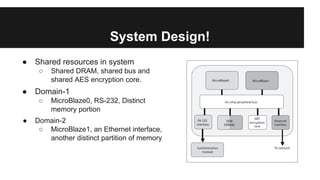
System Design!
● Shared resources in system
○ Shared DRAM, shared bus and
shared AES encryption core.
● Domain-1
○ MicroBlaze0, RS-232, Distinct
memory portion
● Domain-2
○ MicroBlaze1, an Ethernet interface,
another distinct partition of memory
Applications need separation of data
● Aviation field.
○ Uses Commercial off-the-shelf (COTS) FPGA components.
○ Sensitive and non-sensitive data is processed in same device.
○ This isolation of the sensitive and non-sensitive data is achieved in
modern FPGAs
● Intelligent video surveillance
○ FPGA provides deep computation pipelining and isolation.
○ Rely on 3 cores
■ Video interface for decoding
■ Encryption mechanism for processing the video
■ Network interface for sending data.
FPGA System Flow
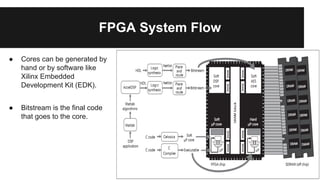
● Cores can be generated by
hand or by software like
Xilinx Embedded
Development Kit (EDK).
● Bitstream is the final code
that goes to the core.
Reconfigurable Security Problems
● Design-tool subversion
● Composition
● Trusted Foundries
● Bitstream protection
Design-tool subversion
● Malicious design could destroy FPGA because of short circuit.
● Trusted tools should be used to develop trusted cores.
● Xilinx provide signed cores.
Composition problem
● As final design, we can trust the design as much as the least-trusted design path.
● Systems can be composed on
○ Device level
■ one or more IP cores resides on single chip
○ Board level
■ one or more chips on a single board
○ Network level
■ Multiple boards are connected through network
● Now, it is possible to copy the hardware from existing products.
● Protected IP could be a solution.
● a separate chip for each core can be used which can provide security advantage
Security issues with COTS
● COTS : Commercial off-the-shelf
● Manufacturer should not insert unintended functionalities into FPGA.
● All cores should be flawless so that attacker can’t exploit.
● Security flaws should not exist in running software or the compiler.
● Embedded device depends on other parts of larger nw should not be malicious.
Trusted-Foundry Problem and Bitstream
Protection
● Trusted-Foundry Problem
○ ASIC is having problem of IP theft.
○ FPGA provide important security benefit over ASIC in this issue.
● Bitstream Protection
○ Securely Bitstream uploading is essential to avoid the IP-theft
○ These theft impacts the “Bottom Line”
○ Some FPGA’s can remotely updated in the field.
■ Requires secure channel and authentication.
Reconfigurable security solutions
● Life-cycle management
○ Configuration management stores software with version numbers.
○ Any new version is thoroughly tested before assignment of new version.
○ Control on development environment and tools can support accountability.
○ Alternative is to build a custom set of trusted tools for security critical HW.
○ A critical function of life-cycle protection ensure that o/p is not malicious.
● Secure Architecture
○ FPGA provides self-protected security mechanism at a low cost.
○ Examples
■ Memory Protection
■ Spatial Isolation
■ Tags
■ Secure Communication
Secure Architecture
● Memory Protection
○ Reference monitor is well known method for legal sharing of memory.
○ Reference monitor possesses
■ Self-protecting
■ Enforcement mechanisms cannot be bypassed.
■ Correct and complete.
● Spatial Isolation
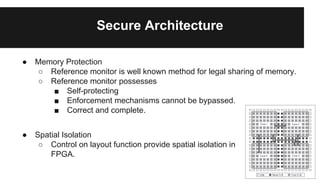
○ Control on layout function provide spatial isolation in
FPGA.
Secure Architecture cont..
● Tags
○ Ability to track information and its transformation as it flows through
the system.
○ Tag is metadata that can be attached to each piece of system data.
○ Tag can be used in FPGA at different granularity.
● Secure Communication
○ Cores need to share data so can’t be isolated.
○ Currently FPGA system use
■ Shared Memory
■ Direct connection
■ Shared Bus
Future Work
● Multicore Systems
○ Chip multiprocessors running multiple threads
○ SoCs with multiple single-purpose cores on single ASIC.
○ New techniques are needed to mediate secure, efficient communication of
multi core system.
● Integration of security primitives.
○ If computing units are shared among security domains then temporal scheme
might be required.
○ Spatial schemes, temporal scheme or tags should be designed which can meet
security requirement and minimize overhead.
Future Work
● Reconfigurable Updates
○ Latest FPGA are capable of changing configuration on runtime.
○ These dynamic systems need more communication between core.
○ Cores state can be changed from executing to updated.
○ These are complicated systems and require new primitives for security.
● Channels and information leakage
○ Core are isolated still need communication through covert channel which can
be insecure.
○ Another attack can be side channel attack. E.g Power-analysis attack.
Conclusion
● A Successful approach must combine life-cycle management and a
coherent security architecture.
● Designing any trustworthy complex system is challenging.
● Hardware security is getting more and more important.
Questions??
Thanks!

Security issues in FPGA based systems.

  • 1.
    Managing Securities inFPGA- Based Embedded Systems Presenters: Rajeev Verma Pratheep Joe Siluvai Iruthayaraj
  • 2.
    Why FPGA? ● Betterperformance. ○ Large number of bit level operations can be performed. ○ shifting, permutations are achieved ny just wiring. ○ extreme level of parallelism ○ low overheads ● Rapid time to market ● Flexible ● Truth tables or Lookup tables are used for hw acceleration. ● Applications ○ Face recognition systems, wireless networks, cryptographic applications, supercomputers and many security applications.
  • 3.
    Reconfigurable systems ● Cryptographicalgorithms are generally implemented on FPGA ● Encryption devices require strong isolation to segregate plaintext(red) from ciphertext(black). ● Unencrypted data should be unavailable for black network.
  • 4.
    System Design! ● Sharedresources in system ○ Shared DRAM, shared bus and shared AES encryption core. ● Domain-1 ○ MicroBlaze0, RS-232, Distinct memory portion ● Domain-2 ○ MicroBlaze1, an Ethernet interface, another distinct partition of memory
  • 5.
    Applications need separationof data ● Aviation field. ○ Uses Commercial off-the-shelf (COTS) FPGA components. ○ Sensitive and non-sensitive data is processed in same device. ○ This isolation of the sensitive and non-sensitive data is achieved in modern FPGAs ● Intelligent video surveillance ○ FPGA provides deep computation pipelining and isolation. ○ Rely on 3 cores ■ Video interface for decoding ■ Encryption mechanism for processing the video ■ Network interface for sending data.
  • 6.
    FPGA System Flow ●Cores can be generated by hand or by software like Xilinx Embedded Development Kit (EDK). ● Bitstream is the final code that goes to the core.
  • 7.
    Reconfigurable Security Problems ●Design-tool subversion ● Composition ● Trusted Foundries ● Bitstream protection
  • 8.
    Design-tool subversion ● Maliciousdesign could destroy FPGA because of short circuit. ● Trusted tools should be used to develop trusted cores. ● Xilinx provide signed cores.
  • 9.
    Composition problem ● Asfinal design, we can trust the design as much as the least-trusted design path. ● Systems can be composed on ○ Device level ■ one or more IP cores resides on single chip ○ Board level ■ one or more chips on a single board ○ Network level ■ Multiple boards are connected through network ● Now, it is possible to copy the hardware from existing products. ● Protected IP could be a solution. ● a separate chip for each core can be used which can provide security advantage
  • 10.
    Security issues withCOTS ● COTS : Commercial off-the-shelf ● Manufacturer should not insert unintended functionalities into FPGA. ● All cores should be flawless so that attacker can’t exploit. ● Security flaws should not exist in running software or the compiler. ● Embedded device depends on other parts of larger nw should not be malicious.
  • 11.
    Trusted-Foundry Problem andBitstream Protection ● Trusted-Foundry Problem ○ ASIC is having problem of IP theft. ○ FPGA provide important security benefit over ASIC in this issue. ● Bitstream Protection ○ Securely Bitstream uploading is essential to avoid the IP-theft ○ These theft impacts the “Bottom Line” ○ Some FPGA’s can remotely updated in the field. ■ Requires secure channel and authentication.
  • 12.
    Reconfigurable security solutions ●Life-cycle management ○ Configuration management stores software with version numbers. ○ Any new version is thoroughly tested before assignment of new version. ○ Control on development environment and tools can support accountability. ○ Alternative is to build a custom set of trusted tools for security critical HW. ○ A critical function of life-cycle protection ensure that o/p is not malicious. ● Secure Architecture ○ FPGA provides self-protected security mechanism at a low cost. ○ Examples ■ Memory Protection ■ Spatial Isolation ■ Tags ■ Secure Communication
  • 13.
    Secure Architecture ● MemoryProtection ○ Reference monitor is well known method for legal sharing of memory. ○ Reference monitor possesses ■ Self-protecting ■ Enforcement mechanisms cannot be bypassed. ■ Correct and complete. ● Spatial Isolation ○ Control on layout function provide spatial isolation in FPGA.
  • 14.
    Secure Architecture cont.. ●Tags ○ Ability to track information and its transformation as it flows through the system. ○ Tag is metadata that can be attached to each piece of system data. ○ Tag can be used in FPGA at different granularity. ● Secure Communication ○ Cores need to share data so can’t be isolated. ○ Currently FPGA system use ■ Shared Memory ■ Direct connection ■ Shared Bus
  • 15.
    Future Work ● MulticoreSystems ○ Chip multiprocessors running multiple threads ○ SoCs with multiple single-purpose cores on single ASIC. ○ New techniques are needed to mediate secure, efficient communication of multi core system. ● Integration of security primitives. ○ If computing units are shared among security domains then temporal scheme might be required. ○ Spatial schemes, temporal scheme or tags should be designed which can meet security requirement and minimize overhead.
  • 16.
    Future Work ● ReconfigurableUpdates ○ Latest FPGA are capable of changing configuration on runtime. ○ These dynamic systems need more communication between core. ○ Cores state can be changed from executing to updated. ○ These are complicated systems and require new primitives for security. ● Channels and information leakage ○ Core are isolated still need communication through covert channel which can be insecure. ○ Another attack can be side channel attack. E.g Power-analysis attack.
  • 17.
    Conclusion ● A Successfulapproach must combine life-cycle management and a coherent security architecture. ● Designing any trustworthy complex system is challenging. ● Hardware security is getting more and more important.
  • 18.