SMART GRID COMMUNICATIONS
AND MEASUREMENT TECHNOLOGY
Prepared By:
Srikanth Reddy K
Renewable Energy-NIT Jaipur (INDIA)
Srikanthkonda.eee@gmail.com
1
Introduction:
 Smart Grid Communication Needs :
 High - speed
 Full integration
 two - way communication technologies
 to allow the smart grid to be a dynamic, interactive mega - infrastructure for real - time information and power
exchange.
 Possible wired and wireless communication technologies can include:
 Multiprotocol Label Switching (MPLS): High - performance telecommunications networks for data transmission
between network nodes
 Worldwide Interoperability for Microwave Access (WiMax): Wireless telecommunication technology for point to
multipoint data transmission utilizing Internet technology
 Broadband over Power Lines (BPL): Power line communication with Internet access
 Wi - Fi: Commonly used wireless local area network
 Additional technologies: Fiber, mesh, and multipoint spread spectrum
2
Characteristics of smart grid communications
technology
 High bandwidth
 IP - enabled digital communication (IPv6 support is preferable)
 Encryption
 Cyber security
 Support and quality of service and Voice over Internet Protocol (VoIP)
3
Network topologies for smart grid connections:
1. Local Area Network (LAN) [1,2] : Consists of two or more components and high capacity disk
storage (file servers), which allow each computer in a network to access a common set of rules.
 Range : LAN combines high speed with a geographical spread of 1 – 10 km.
LAN Special attributes and advantages:
 Resource sharing: Allows intelligent devices such as storage devices, programs, and data fi les to
share resources.
 Area covered: LAN is normally restricted to a small geographical area, for example, office building,
utility, campus.
 Cost and availability: Application software and interface devices are affordable and off - the – shelf.
 High channel speed: Ability to transfer data at rates between 1 and 10 million bits per second.
 Flexibility: Grow/expand with low probability of error; easy to maintain and operate.
4
LAN -Categories of data transmission
 Unicast transmission: A single data packet is sent from a source node to a destination (address) on the network
 Multicast transmission: A single data packet is copied and sent to a specific subset of nodes on the network;
the source node addresses the packet by using the multicast addresses
 Broadcast transmission:A single data packet is copied and sent to all nodes on the network; the source node
addresses the packet by using the broadcast address.
5
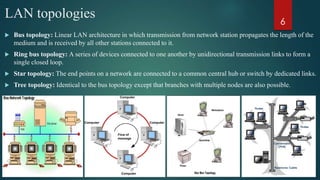
LAN topologies
 Bus topology: Linear LAN architecture in which transmission from network station propagates the length of the
medium and is received by all other stations connected to it.
 Ring bus topology: A series of devices connected to one another by unidirectional transmission links to form a
single closed loop.
 Star topology: The end points on a network are connected to a common central hub or switch by dedicated links.
 Tree topology: Identical to the bus topology except that branches with multiple nodes are also possible.
6
Neighborhood Area Network (NAN):
 NAN is a wireless community currently used for wireless local distribution applications. Ideally, it will cover an area
larger than a LAN [3,4].
 Characteristics:
 Bulk generation: Includes market services interface, plant control system, and generators; this domain interacts
with the market operations and transmission domains through wide area networks, substation LANs, and the
Internet.
 Transmission : Includes substation devices and controllers, data collectors, and electric storage; this domain
interacts with bulk generation and operations through WANs and substation LANs; integrated with the distribution
domain.
 Distribution: This domain interacts with operations and customers through Field Area Network.
 Customer: Includes customer equipment, metering, Energy Management Systems (EMS), electric storage,
appliances, PHEVs, and so on.
 Service Providers: Includes utility and third party providers which handle billing customer services, and so on;
this domain interacts with operations and customers primarily through the Internet
 Operations : Includes EMS, Web Access Management System (WAMS), and SCADA; this domain can be sub -
divided into ISO/RTO, transmission, and distribution
 Market: Includes /ISOs/RTOs, aggregators, and other market participants
7
Sensing, Metering, and Measurements for Smart Grid:
 Need: These components will provide the data necessary for monitoring the grid and the power market.
 Sensor’s Attributes to Smart Grid:
 Outage detection and response
 Evaluates the health of equipment and the integrity of the grid
 Eliminates meter estimations
 Provides energy theft protection
 Enables consumer choice and DSM
 Wide Area Monitoring Systems (WAMS):
 WAMS utilize sensors distributed throughout the network in conjunction with GPS satellites for precise time
stamping of measurements in the transmission system.
 By providing real - time information on stability and operating safety margins, WAMS give early warnings of
system disturbances for the prevention and mitigation of system- wide blackouts.
8
Phasor Measurement Units (PMU):
 PURPOSE: Phasor Measurement Units or Synchrophasors give operators a time - stamped snapshotof the
power system.
 The PMUs consist of bus voltage phasors and branch current phasors, in addition to information such as
locations and other network parameters.
 PMU Attributes [5] :
 PMUs ensure voltage and current with high accuracy at a
rate of 2.88 kHz.
 They can calculate real power, reactive power, frequency,
and phase angle 12 times per 60 hertz cycle.
 Over the years, researchers and engineers have found PMUs
are suitable for monitoring and control of voltage stability
PMUs.
Figure Source: [7]
9
Smart Meters:
 Smart meters have two functions:
1. providing data on energy usage to customers (end -users) to help control cost and consumption; sending
data to the utility for load factor control, peak - load requirements.
2. The development of pricing strategies based on consumption information and so on Automated data
reading is an additional component of both smart meters.
 Smart Meter Attributes :
 Let’s the customer to know:
 How much energy they use
 How much they pay
 When they use energy
 Helps Utility in:
 Better load pricing
 Faster outage detection and restoration
 Accurate billing
 Enhanced grid monitoring
10
Smart Appliances:
 Smart appliances cycle up and down in response to signals sent by the utility
 Enable customers to participate in voluntary demand response programs which award credits for limiting power
use in:
 Peak demand periods or
 When the grid is under stress.
 An override function allows customers to control their appliances using the Internet.
 Grid - friendly appliances use a simple computer chip that can sense disturbances in the grid’s power frequency
and can turn an appliance off for a few minutes to allow the grid to stabilize during a crisis.
 Some of the flexible smart appliances include:
 Air conditioners
 Space heaters
 Water heaters
 Refrigerators
 Washers
 Dryers
11
Advanced Metering Infrastructure (AMI):
 What is it ?
 AMI is the convergence of the grid, the communication infrastructure, and the supporting information
infrastructure.
 Functions of AMI:
 Market applications: serve to reduce/eliminate labor, transportation, and infrastructure costs associated
with meter reading and maintenance, increase accuracy of billing, and allow for time - based rates while
reducing bad debts; facilitates informed customer participation for energy management.
 Customer applications: serves to increase customer awareness about load reduction, reduces bad debt, and
improves cash flow, and enhances customer convenience and satisfaction; provides demand response and
load management to improve system reliability and performance
 Distribution operations: curtails customer load for grid management, optimizes network based on data
collected, allows for the location of outages and restoration of service, improves customer satisfaction,
reduces energy losses, improves performance in event of outage with reduced outage duration and
optimization of the distribution system and distributed generation management, provides emergency demand
response
12
GIS AND GOOGLE MAPPING TOOLS:
 Purpose and uses:
 GIS is useful for managing traditional electric transmission and distribution and telecom networks.
 It can also help to manage information about utility assets for data collection and maintenance.
 Needs:
 Reducing outage time
 Preventing power theft which causes significant unaccounted losses
 Effective system for collection and billing system
 Expanding services for customers
 Effective asset management
 Improving reliability such as SAIDI (System Average Interruption Duration
Index) and SAIFI (System Average Interruption Frequency Index) for distribution networks
 Improving analysis of customer complaint logs
 Enhancing load fl ow power quality analysis and fault study for current and
anticipated problems
 Scheduling of actions such as load shedding and vegetation control
13
MULTIAGENT SYSTEMS (MAS) TECHNOLOGY:
Introduction
 What is it? And how it works?
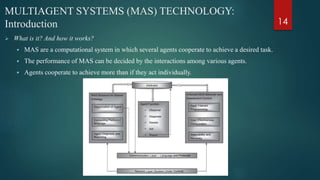
 MAS are a computational system in which several agents cooperate to achieve a desired task.
 The performance of MAS can be decided by the interactions among various agents.
 Agents cooperate to achieve more than if they act individually.
14
Multiagent Systems for Smart Grid Implementation
 The multiagent system is autonomous in that they operate without human interventions.
 The multiagent system is sociable in that they interact with other agents via some kind of agent communication
language.
 MAS in smart grid has four agents namely:
 Control agent: Responsibilities include
 Monitoring system voltage and frequency
 Sending signals to the main circuit breaker in case of upstream outage
 Receiving electricity price ($/kWh) signal from the main grid and publishing them to the Intelligent Distributed
Autonomous Power System (IDAPS) entities
 Distributed energy resource (DER) agent: Responsibilities include
 Controlling power levels of DER and storing their data
 Information about DER include
 Availability and on/off status
 Cost of participation
 Maintenance schedule etc.
15
MAS for Smart Grid (Contd.)
 User agent: Responsibilities include
 Acts as a customer gateway between IDAPS and users
 providing users with real - time information on entities residing in the IDAPS system
 Monitoring electricity consumption by each critical and noncritical load
 Allowing users to control the status of loads based on user ’ s predefined priority
 Database agent: serves as a data access point for all agents and responsibilities include
 Storing system information
 Recording messages
 Data shared among agents
16
Multiagent Technique
 An agent is an information processor that performs autonomous actions based on information.
 Agent attributes:
 Autonomy: Goal - directedness, proactive and self - starting behavior
 Collaborative behavior: The ability to work with other agents to achieve a common goal
 Knowledge - level communication ability: The ability to communicate with other agents with language resembling
human speech acts rather than typical symbol - level program - to - program protocols
 Reactivity: The ability to selectively sense and act
 Temporal continuity: Persistence of identity and state over long periods
 MAS can be characterized by:
 Each agent has incomplete capabilities to solve a problem
 No global system control
 Decentralized data
 Asynchronous computation
17
References:
[1]. A. Englebrecht .Computational Intelligence: An Introduction , John Wiley & Sons , 2007 .
[2] M. Dorigo and T. Stuzle .Ant Colony Optimization. Massachusetts Institute of Technology, Cambridge , 2004.
[3]. J.L. Marinho and B. Stott . “ Linear Programming for Power System Network Security Applications. ”IEEE
Transactions on Power Apparatus and Systems 1979 , PAS - 98, 837 – 848 .
[4] R.C. Eberhart and J. Kennedy . “ A New Optimizer Using Particle Swarm Theory . ” InProceedings on the Sixth
International Symposium on Micromachine and Human Science 1995 , 39 – 31 .
[5]. A.G. Phadhke . “ Synchronized Phasor Measurements in Power Systems . ”IEEE Comput. Appl. Power 1993 , 6
, 10 – 15 .
[6]. W.H. Zhange and T. Gao . “ A Min - Max Method with Adaptive Weightings for Uniformly Spaced Pareto
Optimum Points . ”Computers and Structures 2006 , 84 , 1760 – 1769 .
[7].W.H. Zhange and T. Gao . “ A Min - Max Method with Adaptive Weightings for Uniformly Spaced Pareto
Optimum Points . ”Computers and Structures 2006 , 84 , 1760 – 1769 .
18
Thank You
19

Smart grid communications

  • 1.
    SMART GRID COMMUNICATIONS ANDMEASUREMENT TECHNOLOGY Prepared By: Srikanth Reddy K Renewable Energy-NIT Jaipur (INDIA) Srikanthkonda.eee@gmail.com 1
  • 2.
    Introduction:  Smart GridCommunication Needs :  High - speed  Full integration  two - way communication technologies  to allow the smart grid to be a dynamic, interactive mega - infrastructure for real - time information and power exchange.  Possible wired and wireless communication technologies can include:  Multiprotocol Label Switching (MPLS): High - performance telecommunications networks for data transmission between network nodes  Worldwide Interoperability for Microwave Access (WiMax): Wireless telecommunication technology for point to multipoint data transmission utilizing Internet technology  Broadband over Power Lines (BPL): Power line communication with Internet access  Wi - Fi: Commonly used wireless local area network  Additional technologies: Fiber, mesh, and multipoint spread spectrum 2
  • 3.
    Characteristics of smartgrid communications technology  High bandwidth  IP - enabled digital communication (IPv6 support is preferable)  Encryption  Cyber security  Support and quality of service and Voice over Internet Protocol (VoIP) 3
  • 4.
    Network topologies forsmart grid connections: 1. Local Area Network (LAN) [1,2] : Consists of two or more components and high capacity disk storage (file servers), which allow each computer in a network to access a common set of rules.  Range : LAN combines high speed with a geographical spread of 1 – 10 km. LAN Special attributes and advantages:  Resource sharing: Allows intelligent devices such as storage devices, programs, and data fi les to share resources.  Area covered: LAN is normally restricted to a small geographical area, for example, office building, utility, campus.  Cost and availability: Application software and interface devices are affordable and off - the – shelf.  High channel speed: Ability to transfer data at rates between 1 and 10 million bits per second.  Flexibility: Grow/expand with low probability of error; easy to maintain and operate. 4
  • 5.
    LAN -Categories ofdata transmission  Unicast transmission: A single data packet is sent from a source node to a destination (address) on the network  Multicast transmission: A single data packet is copied and sent to a specific subset of nodes on the network; the source node addresses the packet by using the multicast addresses  Broadcast transmission:A single data packet is copied and sent to all nodes on the network; the source node addresses the packet by using the broadcast address. 5
  • 6.
    LAN topologies  Bustopology: Linear LAN architecture in which transmission from network station propagates the length of the medium and is received by all other stations connected to it.  Ring bus topology: A series of devices connected to one another by unidirectional transmission links to form a single closed loop.  Star topology: The end points on a network are connected to a common central hub or switch by dedicated links.  Tree topology: Identical to the bus topology except that branches with multiple nodes are also possible. 6
  • 7.
    Neighborhood Area Network(NAN):  NAN is a wireless community currently used for wireless local distribution applications. Ideally, it will cover an area larger than a LAN [3,4].  Characteristics:  Bulk generation: Includes market services interface, plant control system, and generators; this domain interacts with the market operations and transmission domains through wide area networks, substation LANs, and the Internet.  Transmission : Includes substation devices and controllers, data collectors, and electric storage; this domain interacts with bulk generation and operations through WANs and substation LANs; integrated with the distribution domain.  Distribution: This domain interacts with operations and customers through Field Area Network.  Customer: Includes customer equipment, metering, Energy Management Systems (EMS), electric storage, appliances, PHEVs, and so on.  Service Providers: Includes utility and third party providers which handle billing customer services, and so on; this domain interacts with operations and customers primarily through the Internet  Operations : Includes EMS, Web Access Management System (WAMS), and SCADA; this domain can be sub - divided into ISO/RTO, transmission, and distribution  Market: Includes /ISOs/RTOs, aggregators, and other market participants 7
  • 8.
    Sensing, Metering, andMeasurements for Smart Grid:  Need: These components will provide the data necessary for monitoring the grid and the power market.  Sensor’s Attributes to Smart Grid:  Outage detection and response  Evaluates the health of equipment and the integrity of the grid  Eliminates meter estimations  Provides energy theft protection  Enables consumer choice and DSM  Wide Area Monitoring Systems (WAMS):  WAMS utilize sensors distributed throughout the network in conjunction with GPS satellites for precise time stamping of measurements in the transmission system.  By providing real - time information on stability and operating safety margins, WAMS give early warnings of system disturbances for the prevention and mitigation of system- wide blackouts. 8
  • 9.
    Phasor Measurement Units(PMU):  PURPOSE: Phasor Measurement Units or Synchrophasors give operators a time - stamped snapshotof the power system.  The PMUs consist of bus voltage phasors and branch current phasors, in addition to information such as locations and other network parameters.  PMU Attributes [5] :  PMUs ensure voltage and current with high accuracy at a rate of 2.88 kHz.  They can calculate real power, reactive power, frequency, and phase angle 12 times per 60 hertz cycle.  Over the years, researchers and engineers have found PMUs are suitable for monitoring and control of voltage stability PMUs. Figure Source: [7] 9
  • 10.
    Smart Meters:  Smartmeters have two functions: 1. providing data on energy usage to customers (end -users) to help control cost and consumption; sending data to the utility for load factor control, peak - load requirements. 2. The development of pricing strategies based on consumption information and so on Automated data reading is an additional component of both smart meters.  Smart Meter Attributes :  Let’s the customer to know:  How much energy they use  How much they pay  When they use energy  Helps Utility in:  Better load pricing  Faster outage detection and restoration  Accurate billing  Enhanced grid monitoring 10
  • 11.
    Smart Appliances:  Smartappliances cycle up and down in response to signals sent by the utility  Enable customers to participate in voluntary demand response programs which award credits for limiting power use in:  Peak demand periods or  When the grid is under stress.  An override function allows customers to control their appliances using the Internet.  Grid - friendly appliances use a simple computer chip that can sense disturbances in the grid’s power frequency and can turn an appliance off for a few minutes to allow the grid to stabilize during a crisis.  Some of the flexible smart appliances include:  Air conditioners  Space heaters  Water heaters  Refrigerators  Washers  Dryers 11
  • 12.
    Advanced Metering Infrastructure(AMI):  What is it ?  AMI is the convergence of the grid, the communication infrastructure, and the supporting information infrastructure.  Functions of AMI:  Market applications: serve to reduce/eliminate labor, transportation, and infrastructure costs associated with meter reading and maintenance, increase accuracy of billing, and allow for time - based rates while reducing bad debts; facilitates informed customer participation for energy management.  Customer applications: serves to increase customer awareness about load reduction, reduces bad debt, and improves cash flow, and enhances customer convenience and satisfaction; provides demand response and load management to improve system reliability and performance  Distribution operations: curtails customer load for grid management, optimizes network based on data collected, allows for the location of outages and restoration of service, improves customer satisfaction, reduces energy losses, improves performance in event of outage with reduced outage duration and optimization of the distribution system and distributed generation management, provides emergency demand response 12
  • 13.
    GIS AND GOOGLEMAPPING TOOLS:  Purpose and uses:  GIS is useful for managing traditional electric transmission and distribution and telecom networks.  It can also help to manage information about utility assets for data collection and maintenance.  Needs:  Reducing outage time  Preventing power theft which causes significant unaccounted losses  Effective system for collection and billing system  Expanding services for customers  Effective asset management  Improving reliability such as SAIDI (System Average Interruption Duration Index) and SAIFI (System Average Interruption Frequency Index) for distribution networks  Improving analysis of customer complaint logs  Enhancing load fl ow power quality analysis and fault study for current and anticipated problems  Scheduling of actions such as load shedding and vegetation control 13
  • 14.
    MULTIAGENT SYSTEMS (MAS)TECHNOLOGY: Introduction  What is it? And how it works?  MAS are a computational system in which several agents cooperate to achieve a desired task.  The performance of MAS can be decided by the interactions among various agents.  Agents cooperate to achieve more than if they act individually. 14
  • 15.
    Multiagent Systems forSmart Grid Implementation  The multiagent system is autonomous in that they operate without human interventions.  The multiagent system is sociable in that they interact with other agents via some kind of agent communication language.  MAS in smart grid has four agents namely:  Control agent: Responsibilities include  Monitoring system voltage and frequency  Sending signals to the main circuit breaker in case of upstream outage  Receiving electricity price ($/kWh) signal from the main grid and publishing them to the Intelligent Distributed Autonomous Power System (IDAPS) entities  Distributed energy resource (DER) agent: Responsibilities include  Controlling power levels of DER and storing their data  Information about DER include  Availability and on/off status  Cost of participation  Maintenance schedule etc. 15
  • 16.
    MAS for SmartGrid (Contd.)  User agent: Responsibilities include  Acts as a customer gateway between IDAPS and users  providing users with real - time information on entities residing in the IDAPS system  Monitoring electricity consumption by each critical and noncritical load  Allowing users to control the status of loads based on user ’ s predefined priority  Database agent: serves as a data access point for all agents and responsibilities include  Storing system information  Recording messages  Data shared among agents 16
  • 17.
    Multiagent Technique  Anagent is an information processor that performs autonomous actions based on information.  Agent attributes:  Autonomy: Goal - directedness, proactive and self - starting behavior  Collaborative behavior: The ability to work with other agents to achieve a common goal  Knowledge - level communication ability: The ability to communicate with other agents with language resembling human speech acts rather than typical symbol - level program - to - program protocols  Reactivity: The ability to selectively sense and act  Temporal continuity: Persistence of identity and state over long periods  MAS can be characterized by:  Each agent has incomplete capabilities to solve a problem  No global system control  Decentralized data  Asynchronous computation 17
  • 18.
    References: [1]. A. Englebrecht.Computational Intelligence: An Introduction , John Wiley & Sons , 2007 . [2] M. Dorigo and T. Stuzle .Ant Colony Optimization. Massachusetts Institute of Technology, Cambridge , 2004. [3]. J.L. Marinho and B. Stott . “ Linear Programming for Power System Network Security Applications. ”IEEE Transactions on Power Apparatus and Systems 1979 , PAS - 98, 837 – 848 . [4] R.C. Eberhart and J. Kennedy . “ A New Optimizer Using Particle Swarm Theory . ” InProceedings on the Sixth International Symposium on Micromachine and Human Science 1995 , 39 – 31 . [5]. A.G. Phadhke . “ Synchronized Phasor Measurements in Power Systems . ”IEEE Comput. Appl. Power 1993 , 6 , 10 – 15 . [6]. W.H. Zhange and T. Gao . “ A Min - Max Method with Adaptive Weightings for Uniformly Spaced Pareto Optimum Points . ”Computers and Structures 2006 , 84 , 1760 – 1769 . [7].W.H. Zhange and T. Gao . “ A Min - Max Method with Adaptive Weightings for Uniformly Spaced Pareto Optimum Points . ”Computers and Structures 2006 , 84 , 1760 – 1769 . 18
  • 19.