Building Cloud Native Software
Navigating the waters of a cloudy infrastructure
Paul Fremantle
CTO and Co-Founder, WSO2
VP, Apache Synapse
ASF Member
@pzfreo
http://pzf.fremantle.org
http://www.flickr.com/photos/ladymaggic/
http://www.flickr.com/photos/jurvetson/
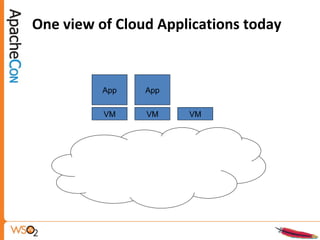
One view of Cloud Applications today
VM
App
VM VM
App
What’s wrong with this picture?
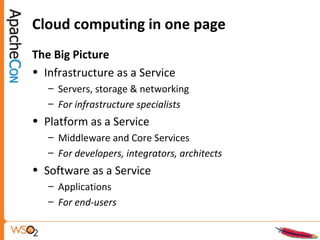
Cloud computing in one page
The Big Picture
• Infrastructure as a Service
– Servers, storage & networking
– For infrastructure specialists
• Platform as a Service
– Middleware and Core Services
– For developers, integrators, architects
• Software as a Service
– Applications
– For end-users
© WSO2 2010
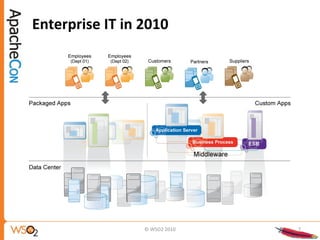
Enterprise IT in 2010
7
© WSO2 2010
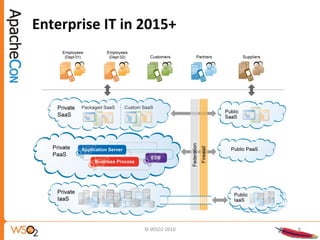
Enterprise IT in 2015+
8
So how do you get into the water?
http://www.flickr.com/photos/csessums/
Elasticity
http://www.flickr.com/photos/clanlife/
Why do people choose Cloud?
• Usually provisioning time is much more
important than elasticity
• Some companies take 3-6 months to
provision an application
Self-Service
• Provision your company / dept
• Provision your application
• Provision integration
• Provision users
• Provision a portal
• Provision storage
• Provision queues
• Etc
How do you effectively provision systems?
• They should be multi-tenant
• Why?
– Per instance cost is very small
• Unless the instance is used
– Better shared resources
– Infinitely simpler management
So far
• (Elastic)
• Self-Service
• Multi-tenant
Elasticity
• Yes you can (sometimes) rely on the IaaS
– E.g. Amazon
• But ultimately we will want to provide more
intelligent elasticity
– E.g. Coach/Business/Private Jet
– Or based on market pricing
– Or……
• Elasticity requires the underlying code to be
“distributed”
So…..
• You have an elastic, self-service, multi-
tenant runtime
• What next?
Money (aka Metering and Billing)
http://www.flickr.com/photos/amagill/
Metering
• For many businesses, internal billing hasn’t
been successful
– That will have to change!
• Metering is very important
– And overall system, service and tenant
monitoring
Monolithic is back!!!!
• And, no, that isn’t good!
Wiring!
• You’ve heard plenty about wiring from
Tuscany
• Wiring is really important in any large
application
• Dynamic wiring for the Cloud
Dynamic Discovery
http://www.flickr.com/photos/unc-cfc-usfk/
Discovering other services?
• Registry – for long term metadata
• WS-Discovery – for “who is where now?”
– “aka Discovery Proxy”
• Probe (types, scope)
• ProbeMatch <- UUID
• Resolve(UUID)
• ResolveMatch <- Transport Address
Incremental deployment and test
• Co-deploy version 5.5.4 next to 5.5.3
– Implies versioned
• Test in place
• Partially switch 5% of live traffic over
• Monitor CPU and Memory usage
– And billing!
• Switch the rest over
• Revert
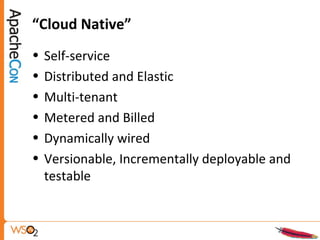
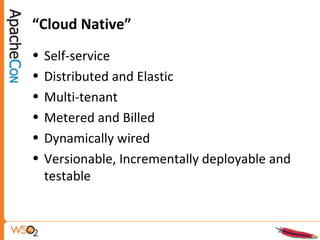
“Cloud Native”
• Self-service
• Distributed and Elastic
• Multi-tenant
• Metered and Billed
• Dynamically wired
• Versionable, Incrementally deployable and
testable
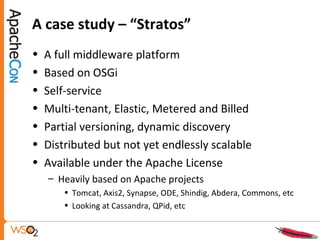
A case study – “Stratos”
• A full middleware platform
• Based on OSGi
• Self-service
• Multi-tenant, Elastic, Metered and Billed
• Partial versioning, dynamic discovery
• Distributed but not yet endlessly scalable
• Available under the Apache License
– Heavily based on Apache projects
• Tomcat, Axis2, Synapse, ODE, Shindig, Abdera, Commons, etc
• Looking at Cassandra, QPid, etc
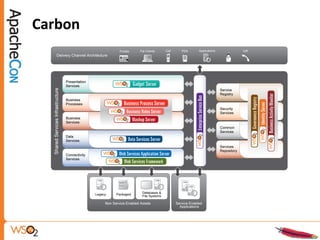
Carbon
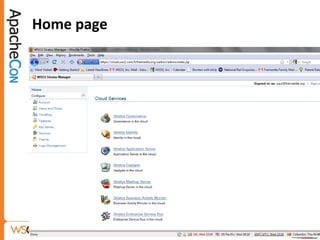
Home page
First steps
• Identity (and hence Multi-Tenancy)
– Every domain/tenant has its own single-sign on
and identity manager
– Based on LDAP – which is inherently multi-
tenant
– Supporting SAML2, OpenId, OAuth, XACML,
Infocard, WS-Trust
Next step – Registry/Repository
• Added a tenant id column to every database
in our registry/repository schema
• Used to store:
– Permissions
– Metadata / Configuration
– Code
– The works
Next step
• Security management
– Using Java and OSGi security managers to isolate
tenants
– Come hear my talk on making Tomcat Multi-
tenant tomorrow!
Billing and Metering
• A generic multi-tenanted metering and
billing module
• Written as OSGi
• Uses Drools to implement service levels
– E.g. 10 users, 100Mb transfer/month, 15
deployed services for free level of subscription
• Can be used to meter real business events
– How many sales transactions / month
Elasticity
• Elastic Load Balancer
– Apache Synapse
• Always done load balancing
• Now has full transparent HTTP support
• Has “Autoscale” mediators
– Based on Azeez’s Master’s thesis
• Priority Execution support and throttling (Business
Class)
– Underlying Cloud API
• We have based on Amazon/Eucalyptus/Ubuntu API
• Adding support for vmWare underneath
Distributed
• Our distribution model is based on Apache
Tribes
• Adjusted Tribes to support WKA model
• In a large cloud (e.g. Amazon) you cannot
rely on subnet communications between
nodes
• Nominate two Well Known Addresses
– Tribes contacts the WKA and uses that the
bootstrap the fabric
Versioning and incremental behaviour
• OSGi
• We have a simple deployment model (CAR)
– Each CAR consists of stuff
• Webapps, ESB flows, BPEL, Registry entries, etc
• Simple XML syntax is used to wrap everything as OSGi
• Each Bundle has a version
Dynamic Wiring
• A complete Governance Registry per tenant
• Supports WS-Discovery seamlessly
– i.e. supports both long-lived metadata and
presence
• Not finished yet
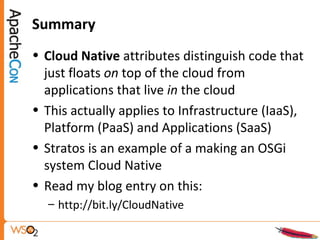
Quick demo
Still to do
• Lots
– Multi-tenant services
• Log, Cache, Data, …
– Better support for incremental deployment and
test
– Better support for coach/business/private jet
– Extreme scale
“Cloud Native”
• Self-service
• Distributed and Elastic
• Multi-tenant
• Metered and Billed
• Dynamically wired
• Versionable, Incrementally deployable and
testable
Summary
• Cloud Native attributes distinguish code that
just floats on top of the cloud from
applications that live in the cloud
• This actually applies to Infrastructure (IaaS),
Platform (PaaS) and Applications (SaaS)
• Stratos is an example of a making an OSGi
system Cloud Native
• Read my blog entry on this:
– http://bit.ly/CloudNative

Building Cloud Native Software

  • 1.
    Building Cloud NativeSoftware Navigating the waters of a cloudy infrastructure Paul Fremantle CTO and Co-Founder, WSO2 VP, Apache Synapse ASF Member @pzfreo http://pzf.fremantle.org
  • 2.
  • 3.
  • 4.
    One view ofCloud Applications today VM App VM VM App
  • 5.
    What’s wrong withthis picture?
  • 6.
    Cloud computing inone page The Big Picture • Infrastructure as a Service – Servers, storage & networking – For infrastructure specialists • Platform as a Service – Middleware and Core Services – For developers, integrators, architects • Software as a Service – Applications – For end-users
  • 7.
  • 8.
  • 9.
    So how doyou get into the water? http://www.flickr.com/photos/csessums/
  • 10.
  • 11.
    Why do peoplechoose Cloud? • Usually provisioning time is much more important than elasticity • Some companies take 3-6 months to provision an application
  • 12.
    Self-Service • Provision yourcompany / dept • Provision your application • Provision integration • Provision users • Provision a portal • Provision storage • Provision queues • Etc
  • 13.
    How do youeffectively provision systems? • They should be multi-tenant • Why? – Per instance cost is very small • Unless the instance is used – Better shared resources – Infinitely simpler management
  • 14.
    So far • (Elastic) •Self-Service • Multi-tenant
  • 15.
    Elasticity • Yes youcan (sometimes) rely on the IaaS – E.g. Amazon • But ultimately we will want to provide more intelligent elasticity – E.g. Coach/Business/Private Jet – Or based on market pricing – Or…… • Elasticity requires the underlying code to be “distributed”
  • 16.
    So….. • You havean elastic, self-service, multi- tenant runtime • What next?
  • 17.
    Money (aka Meteringand Billing) http://www.flickr.com/photos/amagill/
  • 18.
    Metering • For manybusinesses, internal billing hasn’t been successful – That will have to change! • Metering is very important – And overall system, service and tenant monitoring
  • 19.
    Monolithic is back!!!! •And, no, that isn’t good!
  • 20.
    Wiring! • You’ve heardplenty about wiring from Tuscany • Wiring is really important in any large application • Dynamic wiring for the Cloud
  • 21.
  • 22.
    Discovering other services? •Registry – for long term metadata • WS-Discovery – for “who is where now?” – “aka Discovery Proxy” • Probe (types, scope) • ProbeMatch <- UUID • Resolve(UUID) • ResolveMatch <- Transport Address
  • 23.
    Incremental deployment andtest • Co-deploy version 5.5.4 next to 5.5.3 – Implies versioned • Test in place • Partially switch 5% of live traffic over • Monitor CPU and Memory usage – And billing! • Switch the rest over • Revert
  • 24.
    “Cloud Native” • Self-service •Distributed and Elastic • Multi-tenant • Metered and Billed • Dynamically wired • Versionable, Incrementally deployable and testable
  • 25.
    A case study– “Stratos” • A full middleware platform • Based on OSGi • Self-service • Multi-tenant, Elastic, Metered and Billed • Partial versioning, dynamic discovery • Distributed but not yet endlessly scalable • Available under the Apache License – Heavily based on Apache projects • Tomcat, Axis2, Synapse, ODE, Shindig, Abdera, Commons, etc • Looking at Cassandra, QPid, etc
  • 26.
  • 27.
  • 28.
    First steps • Identity(and hence Multi-Tenancy) – Every domain/tenant has its own single-sign on and identity manager – Based on LDAP – which is inherently multi- tenant – Supporting SAML2, OpenId, OAuth, XACML, Infocard, WS-Trust
  • 29.
    Next step –Registry/Repository • Added a tenant id column to every database in our registry/repository schema • Used to store: – Permissions – Metadata / Configuration – Code – The works
  • 30.
    Next step • Securitymanagement – Using Java and OSGi security managers to isolate tenants – Come hear my talk on making Tomcat Multi- tenant tomorrow!
  • 31.
    Billing and Metering •A generic multi-tenanted metering and billing module • Written as OSGi • Uses Drools to implement service levels – E.g. 10 users, 100Mb transfer/month, 15 deployed services for free level of subscription • Can be used to meter real business events – How many sales transactions / month
  • 32.
    Elasticity • Elastic LoadBalancer – Apache Synapse • Always done load balancing • Now has full transparent HTTP support • Has “Autoscale” mediators – Based on Azeez’s Master’s thesis • Priority Execution support and throttling (Business Class) – Underlying Cloud API • We have based on Amazon/Eucalyptus/Ubuntu API • Adding support for vmWare underneath
  • 33.
    Distributed • Our distributionmodel is based on Apache Tribes • Adjusted Tribes to support WKA model • In a large cloud (e.g. Amazon) you cannot rely on subnet communications between nodes • Nominate two Well Known Addresses – Tribes contacts the WKA and uses that the bootstrap the fabric
  • 34.
    Versioning and incrementalbehaviour • OSGi • We have a simple deployment model (CAR) – Each CAR consists of stuff • Webapps, ESB flows, BPEL, Registry entries, etc • Simple XML syntax is used to wrap everything as OSGi • Each Bundle has a version
  • 35.
    Dynamic Wiring • Acomplete Governance Registry per tenant • Supports WS-Discovery seamlessly – i.e. supports both long-lived metadata and presence • Not finished yet
  • 36.
  • 37.
    Still to do •Lots – Multi-tenant services • Log, Cache, Data, … – Better support for incremental deployment and test – Better support for coach/business/private jet – Extreme scale
  • 38.
    “Cloud Native” • Self-service •Distributed and Elastic • Multi-tenant • Metered and Billed • Dynamically wired • Versionable, Incrementally deployable and testable
  • 39.
    Summary • Cloud Nativeattributes distinguish code that just floats on top of the cloud from applications that live in the cloud • This actually applies to Infrastructure (IaaS), Platform (PaaS) and Applications (SaaS) • Stratos is an example of a making an OSGi system Cloud Native • Read my blog entry on this: – http://bit.ly/CloudNative

Editor's Notes

  • #8 Data center provisioned for peak capacity Utilization is 5-10% or up to 50% with virt Tight coupling between applications and hardware allocation Bought app silos (e.g. SAP) Provisioned for peak capacity Build apps using enterprise middleware Provisioned for peak capacity Hardware &amp; app provisioning takes months
  • #9 Has a private IaaS Overflows to one or more public IaaS Uses a bunch of public SaaS Has a bunch of private SaaS, both build &amp; buy Internally built SaaS is HUGE Because that is the competitive differentiator for every business Private SaaS running on PaaS using private hybrid IaaS PaaS also could be private or public Has unified identity, security, audit, etc. across all of these Has federated identity management across public / private infra (SaaS/IaaS)