Electrical & Electronics Dept.
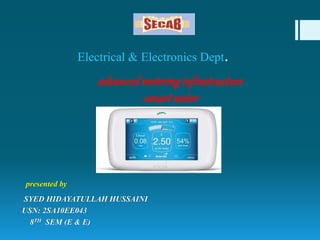
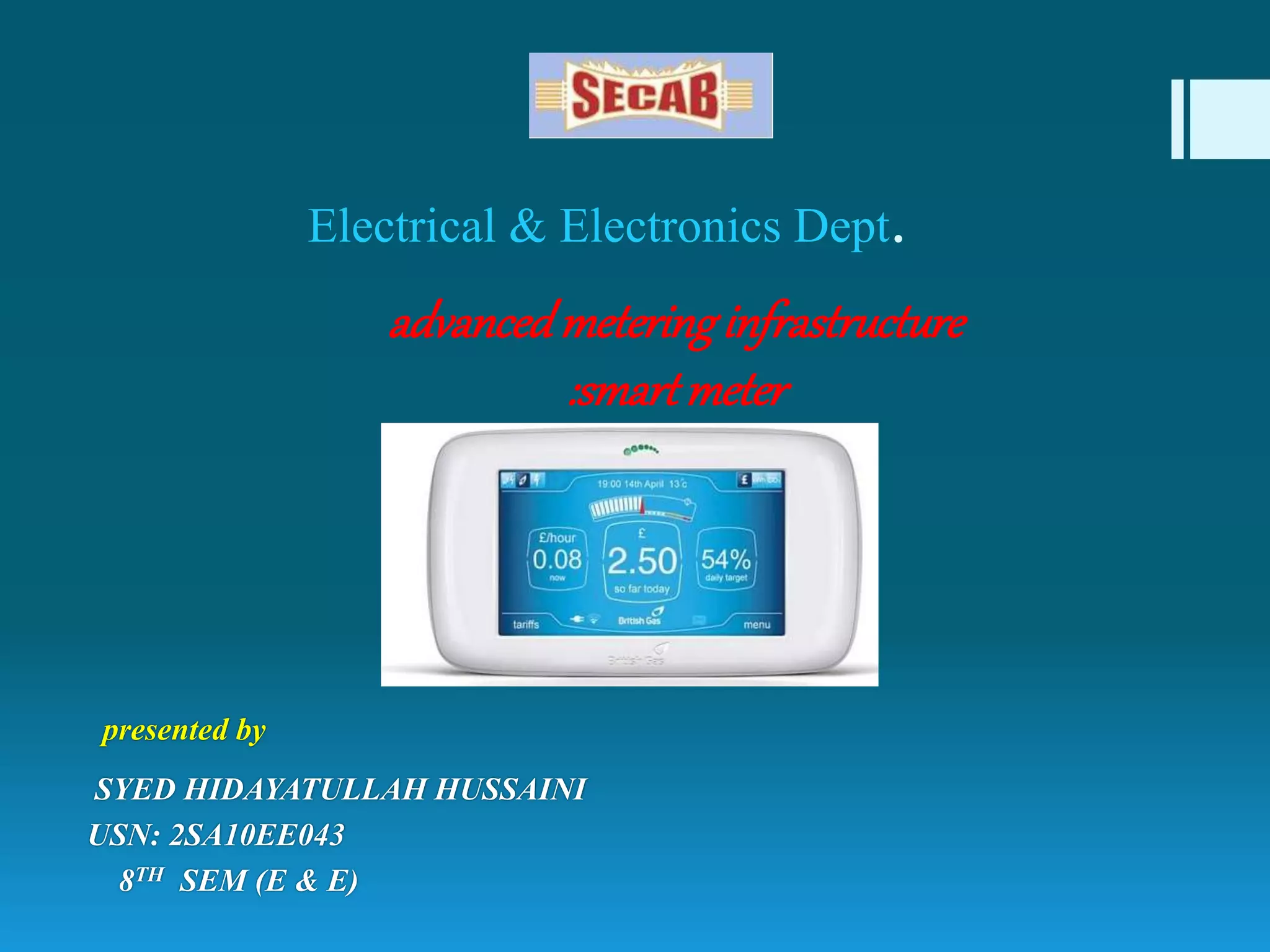
advancedmeteringinfrastructure
:smart meter
presented by
SYED HIDAYATULLAH HUSSAINI
USN: 2SA10EE043
8TH SEM (E & E)
CONTENTS :
 INTRODUCTION
 AMI
 SMART METER
 Communication INFRASTRUCTURE
 TYPES OF SMART METERS
 WORKING PRINCIPLE OF SMART METER
 FUNCTIONS & BENEFICTS
 VULNERABILITIES
 CONCLUSION & FUTURE SCOPE
INTRODUCTION
ADVANCED METERING INFRASTRUCTURE
 AMI is not a single technology, but rather an integration of
many technologies that provides an intelligent connection
between consumers and system operators
 AMI provides an essential link between the grid, consumers
and their loads, and generation and storage resources.
 Smart meter
 Home area networks
 Meter data management system
Smart meter
Conventional electromechanical meters served as the utility cash
register for most of its history.
 Smart meters are solid state programmable devices that
perform many more functions, including most or all of the
following:
 Time-based pricing
 Net metering
 Loss of power (and restoration) notification
 Remote turn ON / turn OFF operations
 Load limiting for “bad pay” or demand response purposes
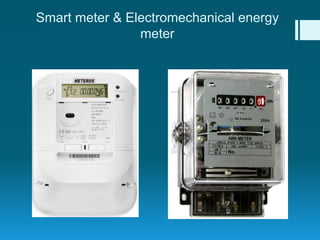
Smart meter & Electromechanical energy
meter
SMART METER :Communication Media
 The AMI communication infrastructure supports continuous
interaction between the utility, the consumer and the
controllable electrical load.
Various media can be used for communication
Power Line Carrier (PLC)
Broadband over power lines (BPL)
Copper or optical fiber
Wireless, either centralized or a distributed mesh
Internet
Types of smart meter
 There are two basic categories of Smart Meter
 Radio frequency
Mesh Technology : Group of Smart Meters talks to a collector
Point to point Technology: Each Smart Meter directly talks to a collector(Tower)
 Power line carrier
 Data and information is transmitted via utility power lines.
Latest Smart Meters uses a Hybrid design or combination design for improved
performance.
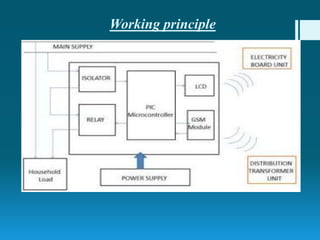
Working principle
Functions of smart meter
 Time-based pricing
Net metering
Loss of power (and restoration) notification
Remote turn ON / turn OFF operations
Load limiting for “bad pay” or demand response
purposes
Benefits of smart meter
 Consumer benefits : It also means higher reliability, better
power quality, more prompt and more accurate billing.
 Utility benefits : AMI helps the utility avoid estimated
readings, provide accurate and timely bills, operate more
efficiently and reliably and offer significantly better consumer
service
 Social benefits :One way is through improved efficiency in
energy delivery and use, producing a favourable
environmental impact.
VULNERABILITIES
 Fabricating generated energy meter readings
 Manipulating energy costs
 Sending false control signals
 Disabling grid control center computer systems
and monitors
 Disabling protective relays.
VULNERABILITIES
AMI introduces serious privacy concerns, as
immense amounts of energy use information will be
stored at the meter. Breaches into this data could
expose customer habits and behaviours.
In order to defend against the vulnerabilities
described above, several security features need to
be incorporated into the development of AMI, to
protect consumers.
FUTURE SCOPE
 Smart meters have been introduced as a means
to modernise the grids and to bring about
operational changes such as reduce nontechnical
losses, introduce remote reading and switching or
simplify the billing procedures.
CONCLUSION
 The existing grid is not intelligent and is operated near its thermal
limits due to increasing population and power demand.
 Advanced Metering Infrastructure is a relatively new concept which
needs improvement in the areas of communication, data analysis and
control schemes.
 A smart meter is a green meter because it enables the demand
response that can lead to emissions and carbon reductions.
It facilitates greater energy efficiency since information feedback is
shown to the consumers to reduce usage.
 AMI allows the users to better control their consumption pattern. It
also offers higher power quality and stability.
QUERIES…..?
THANK YOU……

Advance Metering Infrastructure: Smart Meter

  • 1.
    Electrical & ElectronicsDept. advancedmeteringinfrastructure :smart meter presented by SYED HIDAYATULLAH HUSSAINI USN: 2SA10EE043 8TH SEM (E & E)
  • 2.
    CONTENTS :  INTRODUCTION AMI  SMART METER  Communication INFRASTRUCTURE  TYPES OF SMART METERS  WORKING PRINCIPLE OF SMART METER  FUNCTIONS & BENEFICTS  VULNERABILITIES  CONCLUSION & FUTURE SCOPE
  • 3.
    INTRODUCTION ADVANCED METERING INFRASTRUCTURE AMI is not a single technology, but rather an integration of many technologies that provides an intelligent connection between consumers and system operators  AMI provides an essential link between the grid, consumers and their loads, and generation and storage resources.  Smart meter  Home area networks  Meter data management system
  • 4.
    Smart meter Conventional electromechanicalmeters served as the utility cash register for most of its history.  Smart meters are solid state programmable devices that perform many more functions, including most or all of the following:  Time-based pricing  Net metering  Loss of power (and restoration) notification  Remote turn ON / turn OFF operations  Load limiting for “bad pay” or demand response purposes
  • 5.
    Smart meter &Electromechanical energy meter
  • 6.
    SMART METER :CommunicationMedia  The AMI communication infrastructure supports continuous interaction between the utility, the consumer and the controllable electrical load. Various media can be used for communication Power Line Carrier (PLC) Broadband over power lines (BPL) Copper or optical fiber Wireless, either centralized or a distributed mesh Internet
  • 7.
    Types of smartmeter  There are two basic categories of Smart Meter  Radio frequency Mesh Technology : Group of Smart Meters talks to a collector Point to point Technology: Each Smart Meter directly talks to a collector(Tower)  Power line carrier  Data and information is transmitted via utility power lines. Latest Smart Meters uses a Hybrid design or combination design for improved performance.
  • 8.
  • 9.
    Functions of smartmeter  Time-based pricing Net metering Loss of power (and restoration) notification Remote turn ON / turn OFF operations Load limiting for “bad pay” or demand response purposes
  • 10.
    Benefits of smartmeter  Consumer benefits : It also means higher reliability, better power quality, more prompt and more accurate billing.  Utility benefits : AMI helps the utility avoid estimated readings, provide accurate and timely bills, operate more efficiently and reliably and offer significantly better consumer service  Social benefits :One way is through improved efficiency in energy delivery and use, producing a favourable environmental impact.
  • 11.
    VULNERABILITIES  Fabricating generatedenergy meter readings  Manipulating energy costs  Sending false control signals  Disabling grid control center computer systems and monitors  Disabling protective relays.
  • 12.
    VULNERABILITIES AMI introduces seriousprivacy concerns, as immense amounts of energy use information will be stored at the meter. Breaches into this data could expose customer habits and behaviours. In order to defend against the vulnerabilities described above, several security features need to be incorporated into the development of AMI, to protect consumers.
  • 13.
    FUTURE SCOPE  Smartmeters have been introduced as a means to modernise the grids and to bring about operational changes such as reduce nontechnical losses, introduce remote reading and switching or simplify the billing procedures.
  • 14.
    CONCLUSION  The existinggrid is not intelligent and is operated near its thermal limits due to increasing population and power demand.  Advanced Metering Infrastructure is a relatively new concept which needs improvement in the areas of communication, data analysis and control schemes.  A smart meter is a green meter because it enables the demand response that can lead to emissions and carbon reductions. It facilitates greater energy efficiency since information feedback is shown to the consumers to reduce usage.  AMI allows the users to better control their consumption pattern. It also offers higher power quality and stability.
  • 15.
  • 16.