The Hip Joint and Pelvic
Gateways
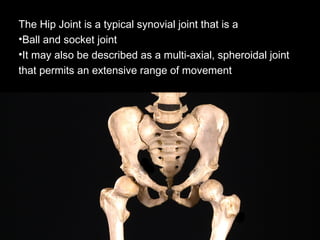
The Hip Joint is a typical synovial joint that is a
•Ball and socket joint
•It may also be described as a multi-axial, spheroidal joint
that permits an extensive range of movement
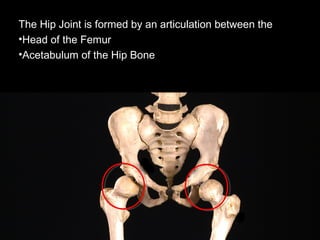
The Hip Joint is formed by an articulation between the
•Head of the Femur
•Acetabulum of the Hip Bone
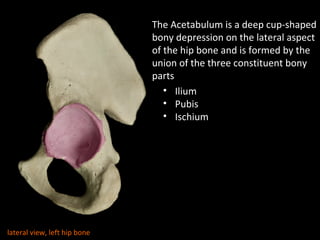
The Acetabulum is a deep cup-shaped
bony depression on the lateral aspect
of the hip bone and is formed by the
union of the three constituent bony
parts
• Ilium
• Pubis
• Ischium
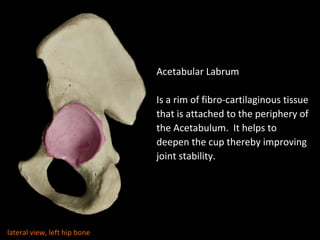
lateral view, left hip bone
Acetabular Labrum
Is a rim of fibro-cartilaginous tissue
that is attached to the periphery of
the Acetabulum. It helps to
deepen the cup thereby improving
joint stability.
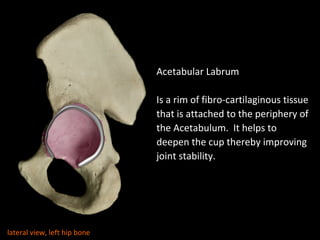
lateral view, left hip bone
Acetabular Labrum
Is a rim of fibro-cartilaginous tissue
that is attached to the periphery of
the Acetabulum. It helps to
deepen the cup thereby improving
joint stability.
lateral view, left hip bone
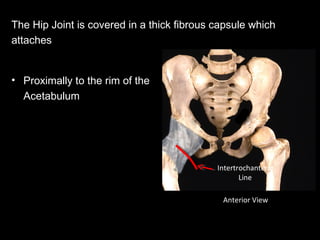
The Hip Joint is covered in a thick fibrous capsule which
attaches
Anterior View
Intertrochanteric
Line
• Proximally to the rim of the
Acetabulum
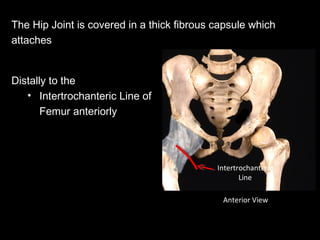
The Hip Joint is covered in a thick fibrous capsule which
attaches
Anterior View
Intertrochanteric
Line
Distally to the
• Intertrochanteric Line of
Femur anteriorly
The Hip Joint is covered in a thick fibrous capsule which
attaches
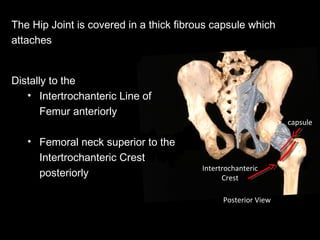
Posterior View
Intertrochanteric
Crest
Distally to the
• Intertrochanteric Line of
Femur anteriorly
• Femoral neck superior to the
Intertrochanteric Crest
posteriorly
capsule
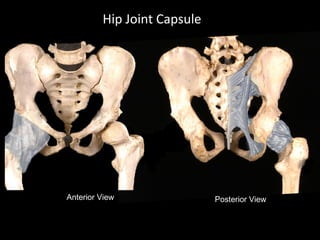
Anterior View Posterior View
Hip Joint Capsule
The capsule of the hip joint is reinforced by 3 strong
ligaments that are thickenings or condensations of the
capsule on the anterior, inferomedial and posterior
aspects
Ligaments of the Hip Joint
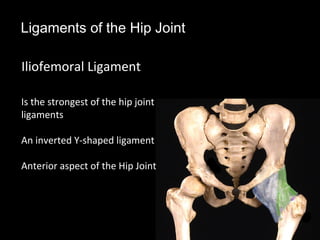
Iliofemoral Ligament
Is the strongest of the hip joint
ligaments
An inverted Y-shaped ligament
Anterior aspect of the Hip Joint
Ligaments of the Hip Joint
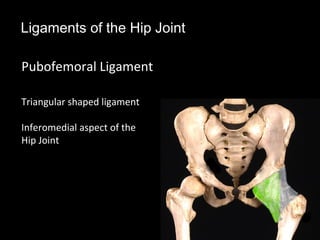
Pubofemoral Ligament
Triangular shaped ligament
Inferomedial aspect of the
Hip Joint
Ligaments of the Hip Joint
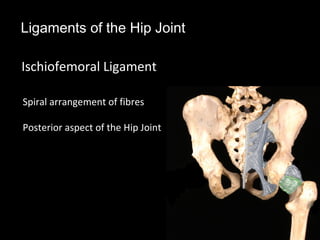
Ischiofemoral Ligament
Spiral arrangement of fibres
Posterior aspect of the Hip Joint
Ligaments of the Hip Joint
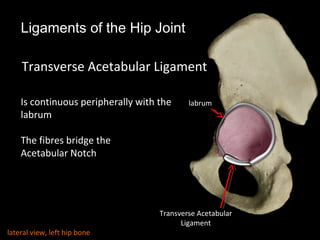
Transverse Acetabular Ligament
Is continuous peripherally with the
labrum
The fibres bridge the
Acetabular Notch
labrum
Transverse Acetabular
Ligament
lateral view, left hip bone
Ligaments of the Hip Joint
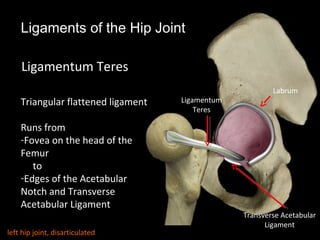
Ligamentum Teres
Triangular flattened ligament
Runs from
-Fovea on the head of the
Femur
to
-Edges of the Acetabular
Notch and Transverse
Acetabular Ligament
Labrum
Transverse Acetabular
Ligament
Ligamentum
Teres
left hip joint, disarticulated
Labrum
Transverse Acetabular
Ligament
Ligamentum
Teres
Ligaments of the Hip Joint
1. Iliofemoral Ligament
2. Pubofemoral Ligament
3. Ischiofemoral Ligament
4. Transverse Acetabular
Ligament
3. Ligamentum Teres
left hip joint, disarticulated
Pelvic Gateways
There are two major pelvic gateways that
transmit vessels from the pelvis to the lower limb
•Myopectineal Orifice
•Greater Sciatic Foramen
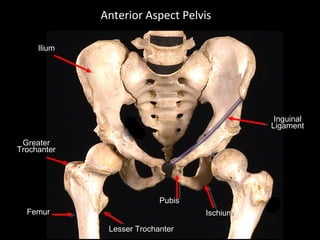
FemurFemur
IliumIlium
GreaterGreater
TrochanterTrochanter
Lesser TrochanterLesser Trochanter
IschiumIschium
PubisPubis
InguinalInguinal
LigamentLigament
Anterior Aspect Pelvis
The Myopectineal Orifice
Inferior Aspect Pelvis
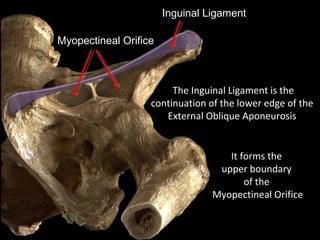
Myopectineal Orifice
The Inguinal Ligament is the
continuation of the lower edge of the
External Oblique Aponeurosis
Inguinal Ligament
It forms the
upper boundary
of the
Myopectineal Orifice
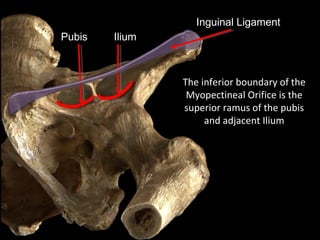
Pubis
The inferior boundary of the
Myopectineal Orifice is the
superior ramus of the pubis
and adjacent Ilium
Inguinal Ligament
Ilium
Pubis
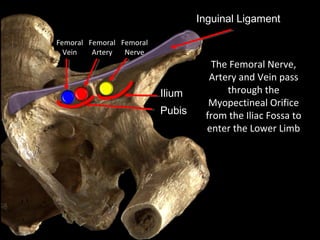
The Femoral Nerve,
Artery and Vein pass
through the
Myopectineal Orifice
from the Iliac Fossa to
enter the Lower Limb
Inguinal Ligament
Ilium
Femoral
Nerve
Femoral
Vein
Femoral
Artery
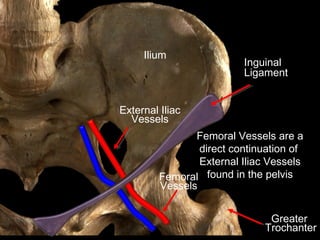
Inguinal
Ligament
Greater
Trochanter
Ilium
Femoral Vessels are a
direct continuation of
External Iliac Vessels
found in the pelvis
External Iliac
Vessels
Femoral
Vessels
One of the major
gateways between the
abdomino-pelvic cavity
and the lower limb
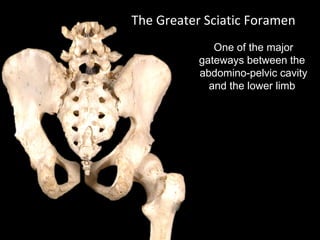
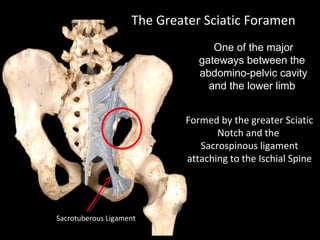
The Greater Sciatic Foramen
One of the major
gateways between the
abdomino-pelvic cavity
and the lower limb
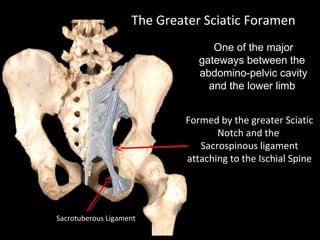
The Greater Sciatic Foramen
Sacrotuberous Ligament
Formed by the greater Sciatic
Notch and the
Sacrospinous ligament
attaching to the Ischial Spine
One of the major
gateways between the
abdomino-pelvic cavity
and the lower limb
The Greater Sciatic Foramen
Formed by the greater Sciatic
Notch and the
Sacrospinous ligament
attaching to the Ischial Spine
Sacrotuberous Ligament
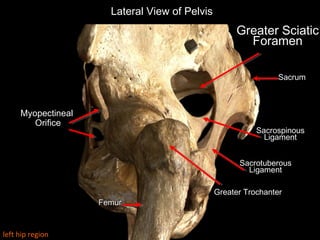
Greater SciaticGreater Sciatic
ForamenForamen
Lateral View of Pelvis
SacrumSacrum
FemurFemur
Greater TrochanterGreater Trochanter
Myopectineal
Orifice
SacrospinousSacrospinous
LigamentLigament
SacrotuberousSacrotuberous
LigamentLigament
left hip region
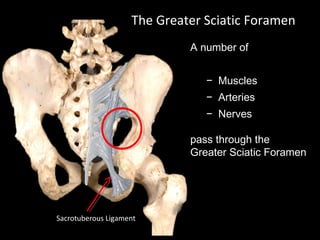
A number of
− Muscles
− Arteries
− Nerves
pass through the
Greater Sciatic Foramen
The Greater Sciatic Foramen
Sacrotuberous Ligament
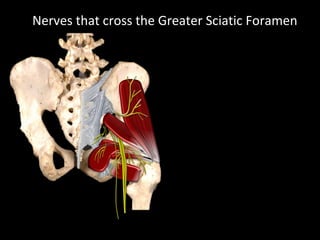
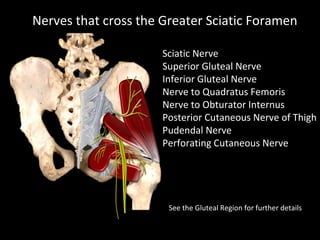
Nerves that cross the Greater Sciatic Foramen
Sciatic Nerve
Superior Gluteal Nerve
Inferior Gluteal Nerve
Nerve to Quadratus Femoris
Nerve to Obturator Internus
Posterior Cutaneous Nerve of Thigh
Pudendal Nerve
Perforating Cutaneous Nerve
Nerves that cross the Greater Sciatic Foramen
See the Gluteal Region for further details
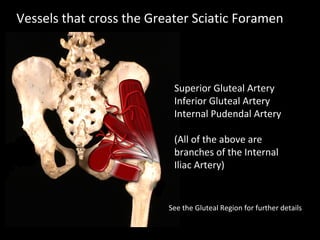
Vessels that cross the Greater Sciatic Foramen
Superior Gluteal Artery
Inferior Gluteal Artery
Internal Pudendal Artery
(All of the above are
branches of the Internal
Iliac Artery)
See the Gluteal Region for further details

Slideshow: Hip Joint and Pelvic Gateways

  • 1.
    The Hip Jointand Pelvic Gateways
  • 2.
    The Hip Jointis a typical synovial joint that is a •Ball and socket joint •It may also be described as a multi-axial, spheroidal joint that permits an extensive range of movement
  • 3.
    The Hip Jointis formed by an articulation between the •Head of the Femur •Acetabulum of the Hip Bone
  • 4.
    The Acetabulum isa deep cup-shaped bony depression on the lateral aspect of the hip bone and is formed by the union of the three constituent bony parts • Ilium • Pubis • Ischium lateral view, left hip bone
  • 5.
    Acetabular Labrum Is arim of fibro-cartilaginous tissue that is attached to the periphery of the Acetabulum. It helps to deepen the cup thereby improving joint stability. lateral view, left hip bone
  • 6.
    Acetabular Labrum Is arim of fibro-cartilaginous tissue that is attached to the periphery of the Acetabulum. It helps to deepen the cup thereby improving joint stability. lateral view, left hip bone
  • 7.
    The Hip Jointis covered in a thick fibrous capsule which attaches Anterior View Intertrochanteric Line • Proximally to the rim of the Acetabulum
  • 8.
    The Hip Jointis covered in a thick fibrous capsule which attaches Anterior View Intertrochanteric Line Distally to the • Intertrochanteric Line of Femur anteriorly
  • 9.
    The Hip Jointis covered in a thick fibrous capsule which attaches Posterior View Intertrochanteric Crest Distally to the • Intertrochanteric Line of Femur anteriorly • Femoral neck superior to the Intertrochanteric Crest posteriorly capsule
  • 10.
    Anterior View PosteriorView Hip Joint Capsule
  • 11.
    The capsule ofthe hip joint is reinforced by 3 strong ligaments that are thickenings or condensations of the capsule on the anterior, inferomedial and posterior aspects Ligaments of the Hip Joint
  • 12.
    Ligaments of theHip Joint Iliofemoral Ligament Is the strongest of the hip joint ligaments An inverted Y-shaped ligament Anterior aspect of the Hip Joint
  • 13.
    Ligaments of theHip Joint Pubofemoral Ligament Triangular shaped ligament Inferomedial aspect of the Hip Joint
  • 14.
    Ligaments of theHip Joint Ischiofemoral Ligament Spiral arrangement of fibres Posterior aspect of the Hip Joint
  • 15.
    Ligaments of theHip Joint Transverse Acetabular Ligament Is continuous peripherally with the labrum The fibres bridge the Acetabular Notch labrum Transverse Acetabular Ligament lateral view, left hip bone
  • 16.
    Ligaments of theHip Joint Ligamentum Teres Triangular flattened ligament Runs from -Fovea on the head of the Femur to -Edges of the Acetabular Notch and Transverse Acetabular Ligament Labrum Transverse Acetabular Ligament Ligamentum Teres left hip joint, disarticulated
  • 17.
    Labrum Transverse Acetabular Ligament Ligamentum Teres Ligaments ofthe Hip Joint 1. Iliofemoral Ligament 2. Pubofemoral Ligament 3. Ischiofemoral Ligament 4. Transverse Acetabular Ligament 3. Ligamentum Teres left hip joint, disarticulated
  • 18.
    Pelvic Gateways There aretwo major pelvic gateways that transmit vessels from the pelvis to the lower limb •Myopectineal Orifice •Greater Sciatic Foramen
  • 19.
  • 20.
  • 21.
    Myopectineal Orifice The InguinalLigament is the continuation of the lower edge of the External Oblique Aponeurosis Inguinal Ligament It forms the upper boundary of the Myopectineal Orifice
  • 22.
    Pubis The inferior boundaryof the Myopectineal Orifice is the superior ramus of the pubis and adjacent Ilium Inguinal Ligament Ilium
  • 23.
    Pubis The Femoral Nerve, Arteryand Vein pass through the Myopectineal Orifice from the Iliac Fossa to enter the Lower Limb Inguinal Ligament Ilium Femoral Nerve Femoral Vein Femoral Artery
  • 24.
    Inguinal Ligament Greater Trochanter Ilium Femoral Vessels area direct continuation of External Iliac Vessels found in the pelvis External Iliac Vessels Femoral Vessels
  • 25.
    One of themajor gateways between the abdomino-pelvic cavity and the lower limb The Greater Sciatic Foramen
  • 26.
    One of themajor gateways between the abdomino-pelvic cavity and the lower limb The Greater Sciatic Foramen Sacrotuberous Ligament Formed by the greater Sciatic Notch and the Sacrospinous ligament attaching to the Ischial Spine
  • 27.
    One of themajor gateways between the abdomino-pelvic cavity and the lower limb The Greater Sciatic Foramen Formed by the greater Sciatic Notch and the Sacrospinous ligament attaching to the Ischial Spine Sacrotuberous Ligament
  • 28.
    Greater SciaticGreater Sciatic ForamenForamen LateralView of Pelvis SacrumSacrum FemurFemur Greater TrochanterGreater Trochanter Myopectineal Orifice SacrospinousSacrospinous LigamentLigament SacrotuberousSacrotuberous LigamentLigament left hip region
  • 29.
    A number of −Muscles − Arteries − Nerves pass through the Greater Sciatic Foramen The Greater Sciatic Foramen Sacrotuberous Ligament
  • 30.
    Nerves that crossthe Greater Sciatic Foramen
  • 31.
    Sciatic Nerve Superior GlutealNerve Inferior Gluteal Nerve Nerve to Quadratus Femoris Nerve to Obturator Internus Posterior Cutaneous Nerve of Thigh Pudendal Nerve Perforating Cutaneous Nerve Nerves that cross the Greater Sciatic Foramen See the Gluteal Region for further details
  • 32.
    Vessels that crossthe Greater Sciatic Foramen Superior Gluteal Artery Inferior Gluteal Artery Internal Pudendal Artery (All of the above are branches of the Internal Iliac Artery) See the Gluteal Region for further details