Cognitive Strategies
According to O'Malley and Chamot (1990: 44),
cognitive strategies 'operate directly on
incoming information, manipulating it in ways
that enhance learning'. Learners may use any
or all of the following cognitive strategies (see
Cook, 1993: 114-115):
• repetition, when imitating others' speech;
• resourcing, i.e., having recourse to dictionaries
and other materials;
• translation, that is, using their mother tongue
as a basis for understanding and/or producing
the target language;
• note-taking;
• deduction, i.e., conscious application of L2 rules;
• contextualisation, when embedding a word or
phrase in a meaningful sequence;
• transfer, that is, using knowledge acquired in the
L1 to remember and understand facts and
sequences in the L2;
• inferencing, when matching an unfamiliar word
against available information (a new word etc);
• question for clarification, when asking the
teacher to explain, etc.
• There are many more cognitive
strategies in the relevant literature.
O'Malley and Chamot (1990)
recognise 16.
Metacognitive Strategies
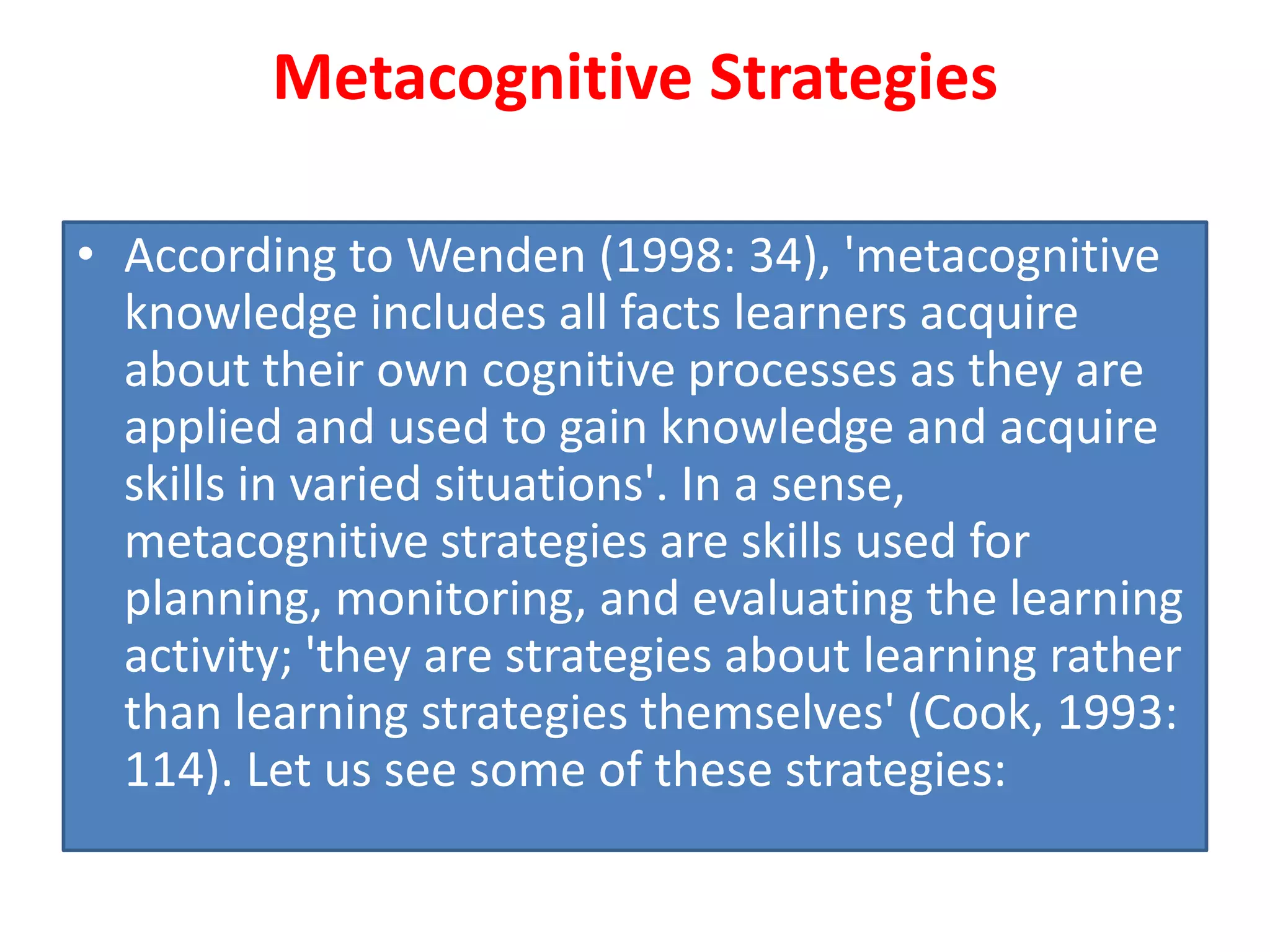
• According to Wenden (1998: 34), 'metacognitive
knowledge includes all facts learners acquire
about their own cognitive processes as they are
applied and used to gain knowledge and acquire
skills in varied situations'. In a sense,
metacognitive strategies are skills used for
planning, monitoring, and evaluating the learning
activity; 'they are strategies about learning rather
than learning strategies themselves' (Cook, 1993:
114). Let us see some of these strategies:
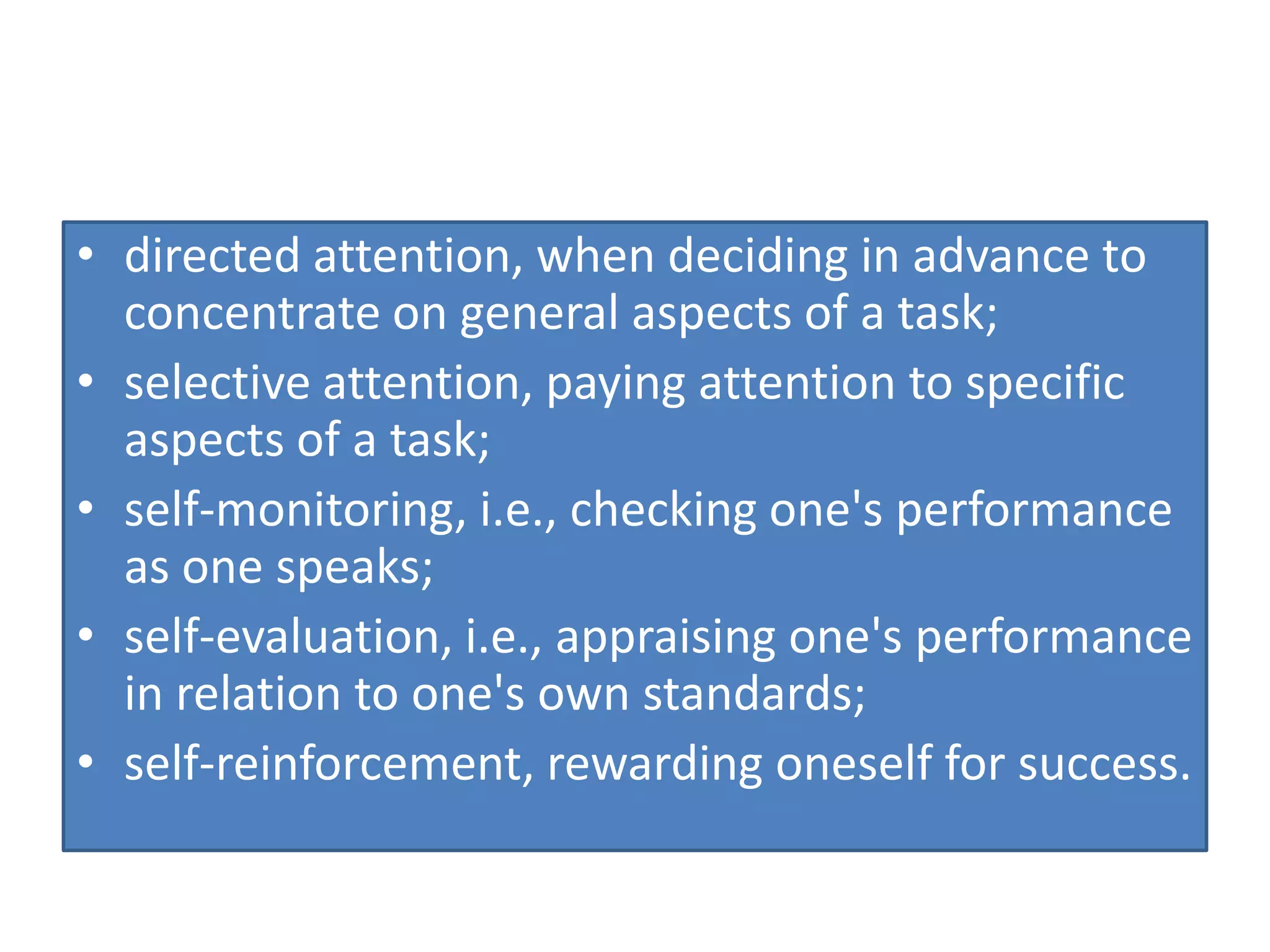
• directed attention, when deciding in advance to
concentrate on general aspects of a task;
• selective attention, paying attention to specific
aspects of a task;
• self-monitoring, i.e., checking one's performance
as one speaks;
• self-evaluation, i.e., appraising one's performance
in relation to one's own standards;
• self-reinforcement, rewarding oneself for success.
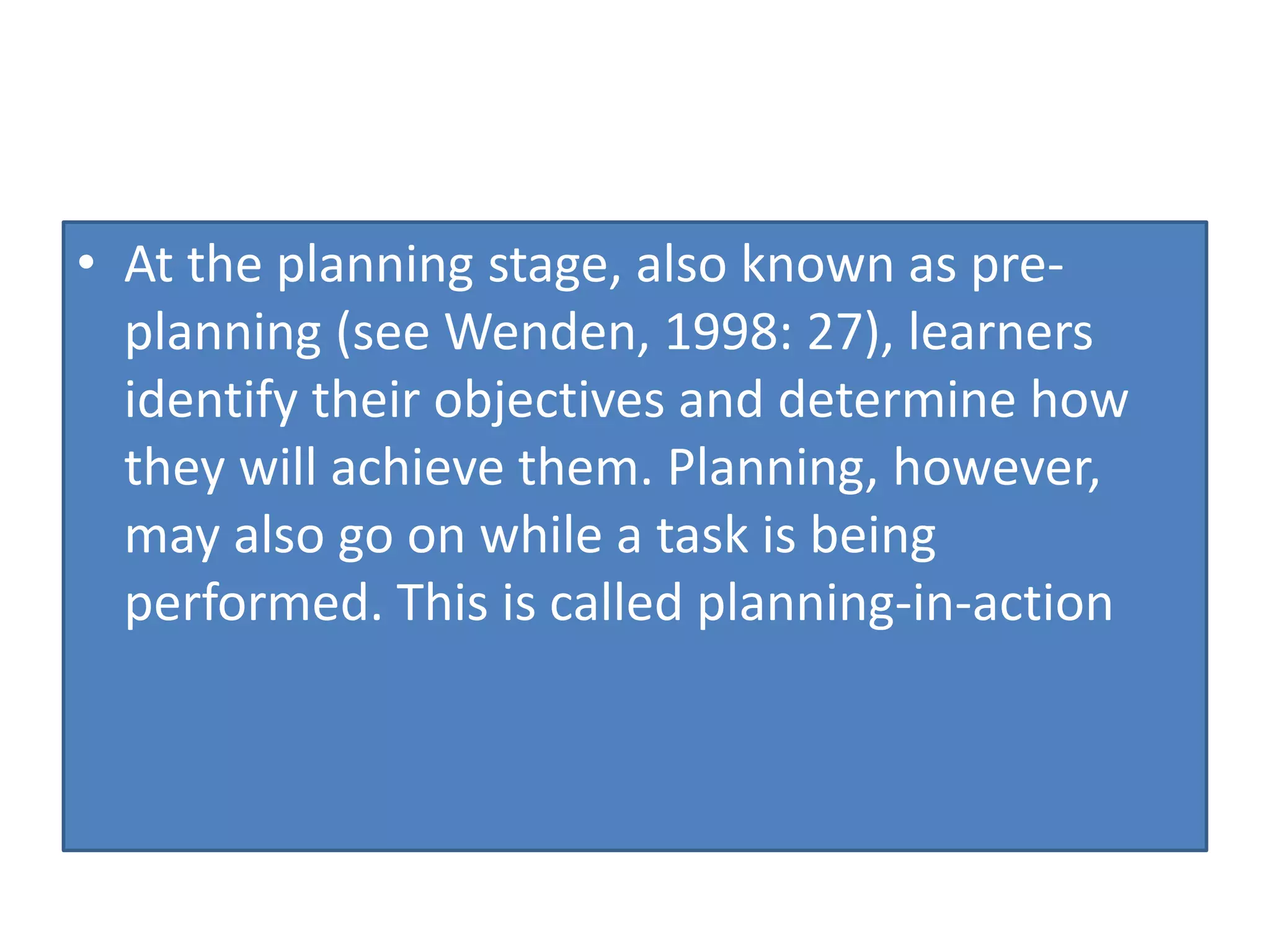
• At the planning stage, also known as pre-
planning (see Wenden, 1998: 27), learners
identify their objectives and determine how
they will achieve them. Planning, however,
may also go on while a task is being
performed. This is called planning-in-action
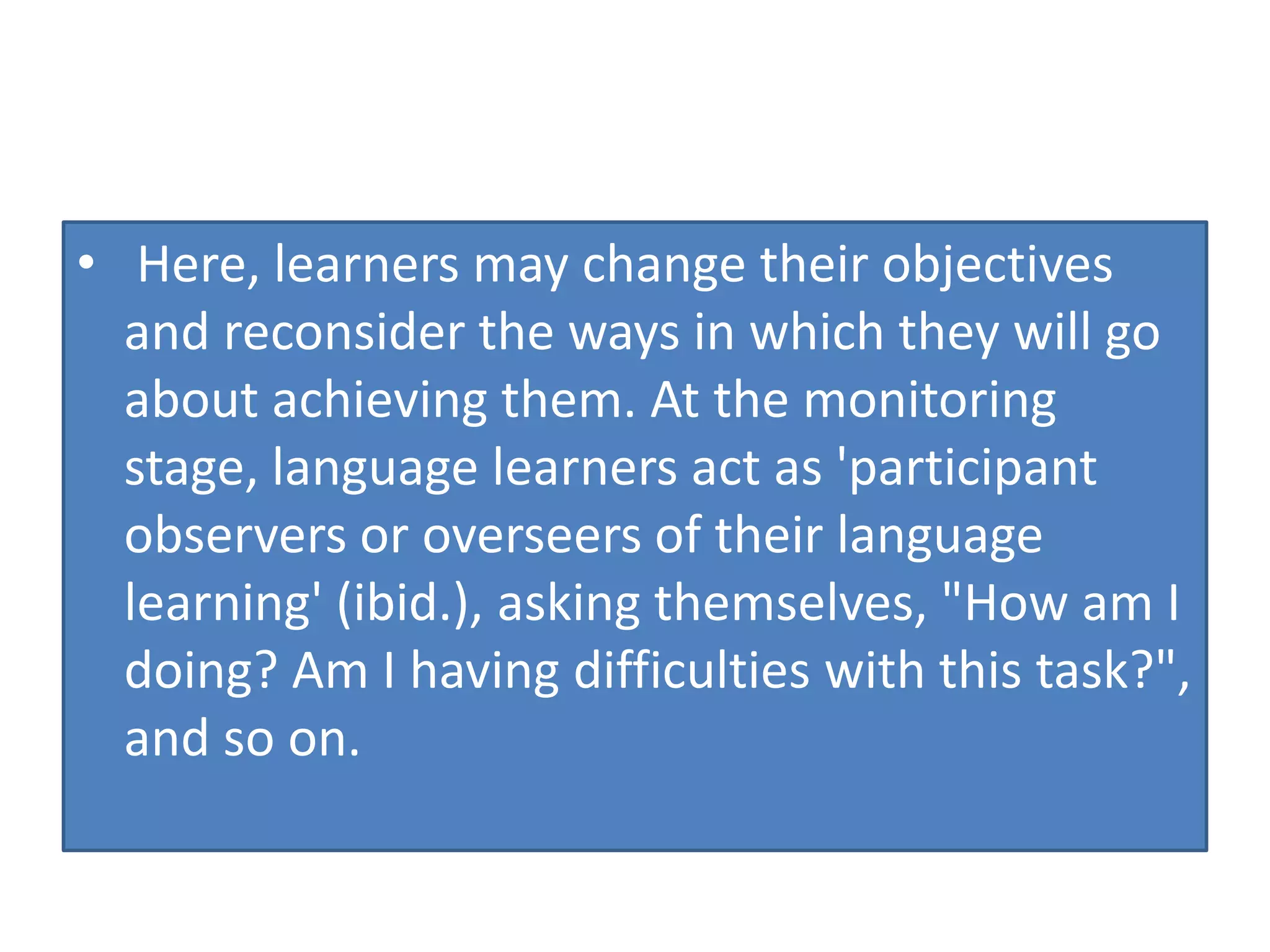
• Here, learners may change their objectives
and reconsider the ways in which they will go
about achieving them. At the monitoring
stage, language learners act as 'participant
observers or overseers of their language
learning' (ibid.), asking themselves, "How am I
doing? Am I having difficulties with this task?",
and so on.
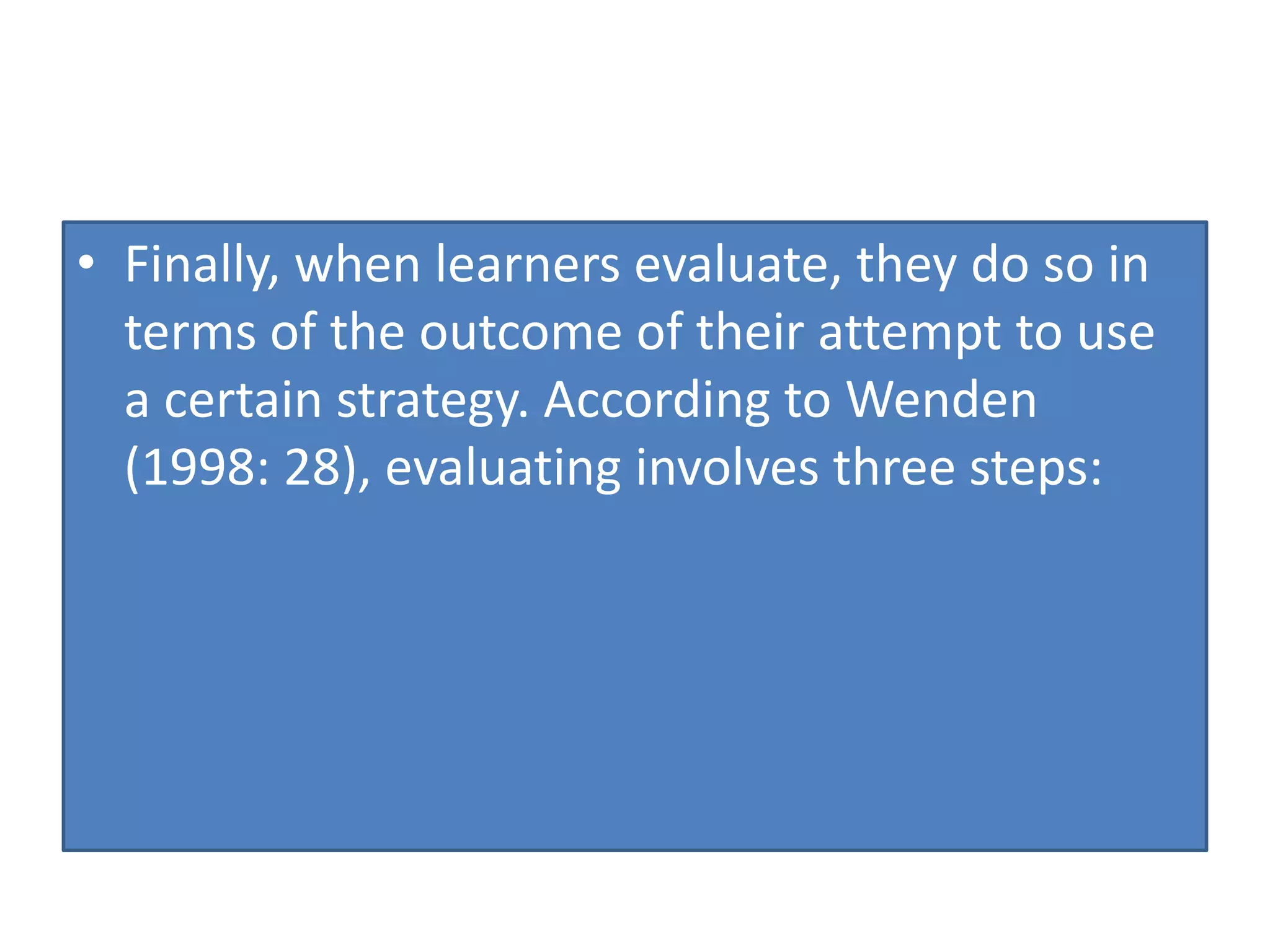
• Finally, when learners evaluate, they do so in
terms of the outcome of their attempt to use
a certain strategy. According to Wenden
(1998: 28), evaluating involves three steps:
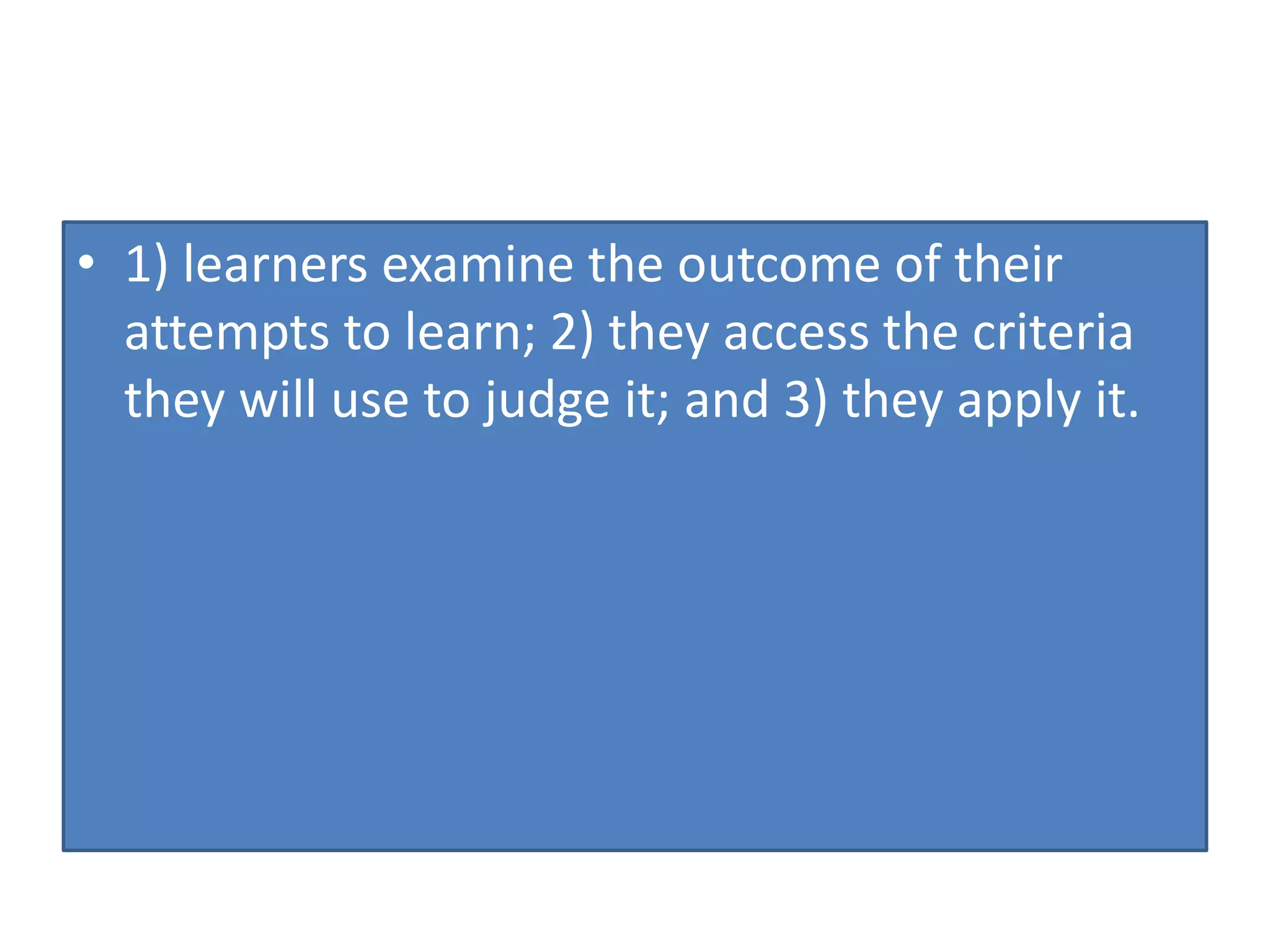
• 1) learners examine the outcome of their
attempts to learn; 2) they access the criteria
they will use to judge it; and 3) they apply it.

Cognitive Strategies-Metacognitive Strategies

  • 1.
    Cognitive Strategies According toO'Malley and Chamot (1990: 44), cognitive strategies 'operate directly on incoming information, manipulating it in ways that enhance learning'. Learners may use any or all of the following cognitive strategies (see Cook, 1993: 114-115):
  • 2.
    • repetition, whenimitating others' speech; • resourcing, i.e., having recourse to dictionaries and other materials; • translation, that is, using their mother tongue as a basis for understanding and/or producing the target language; • note-taking;
  • 3.
    • deduction, i.e.,conscious application of L2 rules; • contextualisation, when embedding a word or phrase in a meaningful sequence; • transfer, that is, using knowledge acquired in the L1 to remember and understand facts and sequences in the L2; • inferencing, when matching an unfamiliar word against available information (a new word etc); • question for clarification, when asking the teacher to explain, etc.
  • 4.
    • There aremany more cognitive strategies in the relevant literature. O'Malley and Chamot (1990) recognise 16.
  • 5.
    Metacognitive Strategies • Accordingto Wenden (1998: 34), 'metacognitive knowledge includes all facts learners acquire about their own cognitive processes as they are applied and used to gain knowledge and acquire skills in varied situations'. In a sense, metacognitive strategies are skills used for planning, monitoring, and evaluating the learning activity; 'they are strategies about learning rather than learning strategies themselves' (Cook, 1993: 114). Let us see some of these strategies:
  • 6.
    • directed attention,when deciding in advance to concentrate on general aspects of a task; • selective attention, paying attention to specific aspects of a task; • self-monitoring, i.e., checking one's performance as one speaks; • self-evaluation, i.e., appraising one's performance in relation to one's own standards; • self-reinforcement, rewarding oneself for success.
  • 7.
    • At theplanning stage, also known as pre- planning (see Wenden, 1998: 27), learners identify their objectives and determine how they will achieve them. Planning, however, may also go on while a task is being performed. This is called planning-in-action
  • 8.
    • Here, learnersmay change their objectives and reconsider the ways in which they will go about achieving them. At the monitoring stage, language learners act as 'participant observers or overseers of their language learning' (ibid.), asking themselves, "How am I doing? Am I having difficulties with this task?", and so on.
  • 9.
    • Finally, whenlearners evaluate, they do so in terms of the outcome of their attempt to use a certain strategy. According to Wenden (1998: 28), evaluating involves three steps:
  • 10.
    • 1) learnersexamine the outcome of their attempts to learn; 2) they access the criteria they will use to judge it; and 3) they apply it.