
Language Teaching Methodologies
      Didáctica de las Lenguas Extranjeras I (2012)
                                 Module 3 Issue 2


                         Prof. Lic. María Alejandra Soto
Why approaches and methods?

“When teachers are exposed to methods and
asked to reflect on their principles and actively
engage with their techniques, they can become
 clearer about why they do what they do. They
    become aware of their own fundamental
       assumptions, values and beliefs”
         (Larsen Freeman, 2000: ix)
And because methods can shed light on:
  1. the teacher’s goals
  2. the teacher’s role
  3. the learner’s role
  4. the main characteristics of the teaching and
     learning processes
  5. the nature of teacher-student interaction
  6. the consideration of learner feelings
  7. the role of language & the role of culture
  8. the role of the L1
  9. assessment
  10.the treatment of learner error
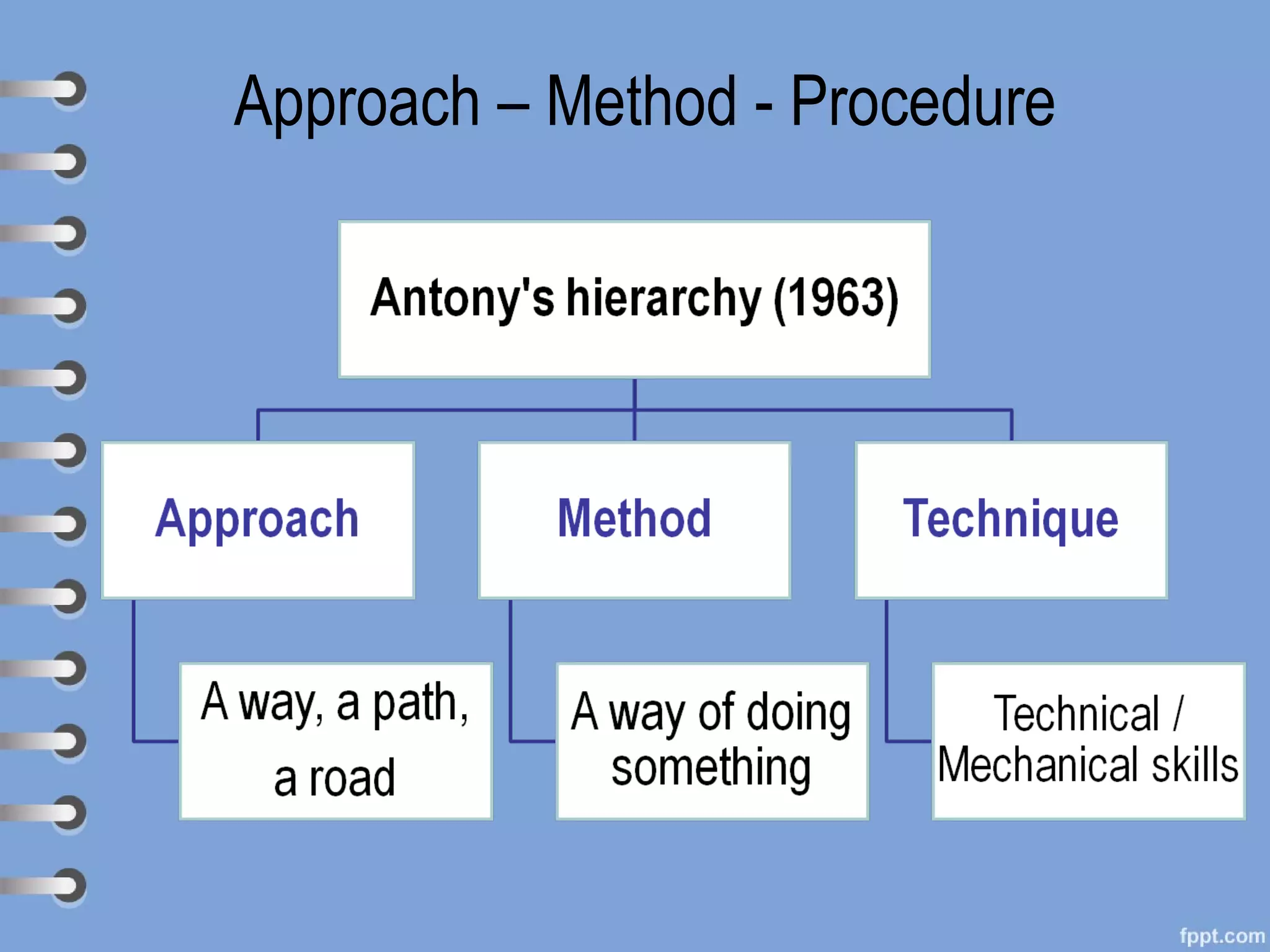
Approach – Method - Procedure
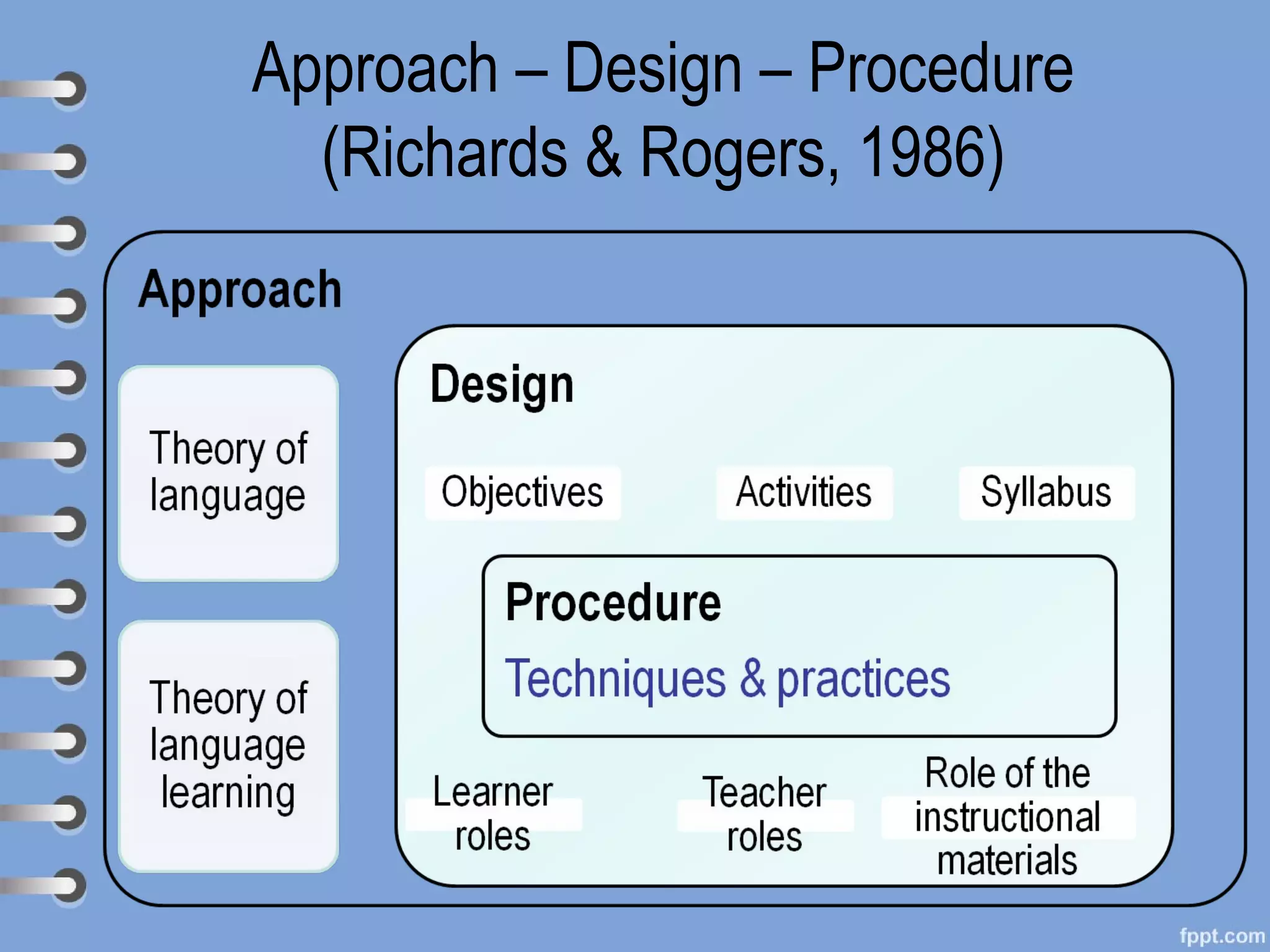
Approach – Design – Procedure
  (Richards & Rogers, 1986)
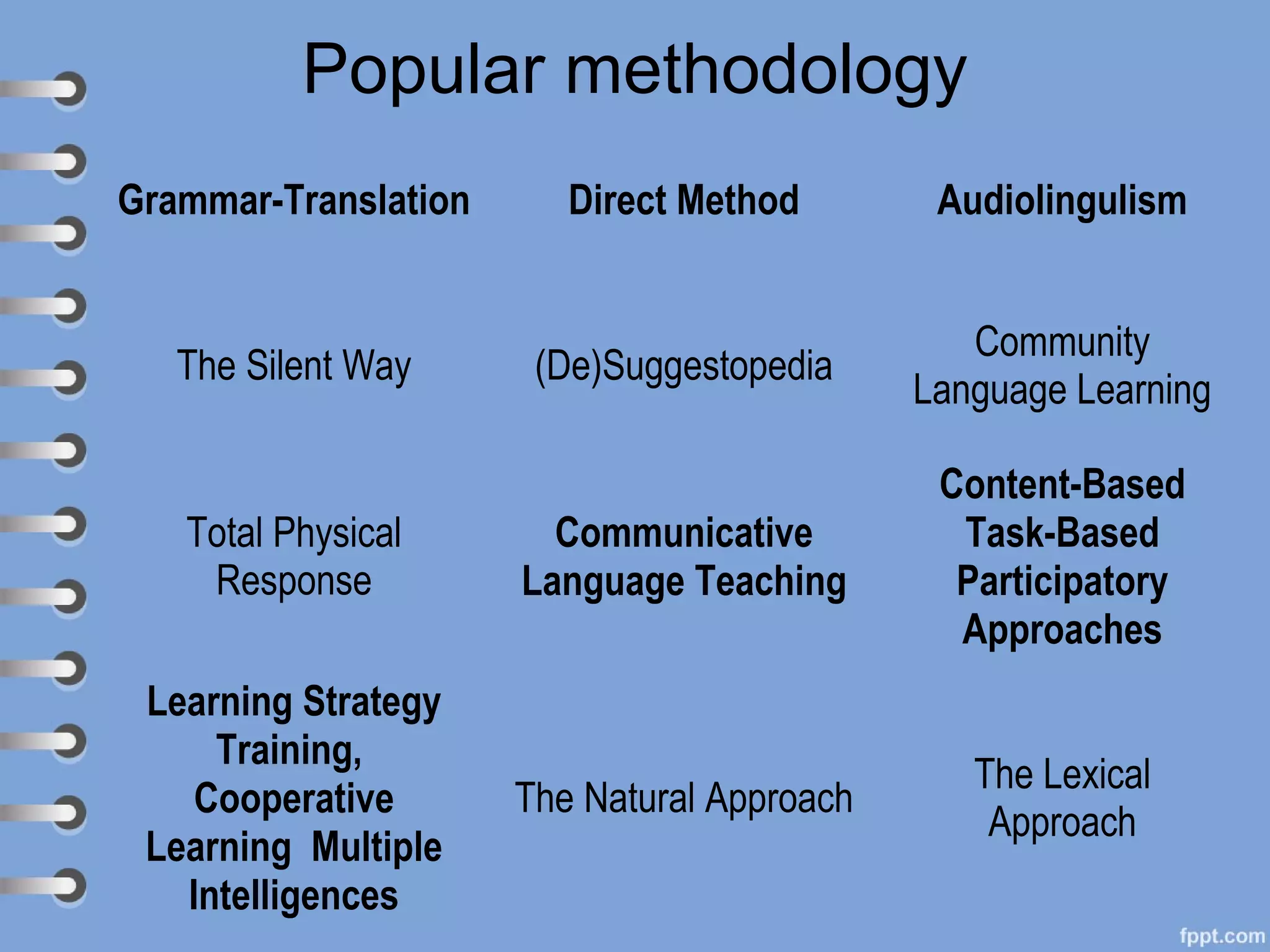
Popular methodology
Grammar-Translation      Direct Method        Audiolingulism


                                                Community
   The Silent Way      (De)Suggestopedia
                                             Language Learning

                                              Content-Based
   Total Physical       Communicative          Task-Based
    Response          Language Teaching        Participatory
                                               Approaches
 Learning Strategy
     Training,
                                                The Lexical
    Cooperative       The Natural Approach
                                                 Approach
 Learning Multiple
   Intelligences
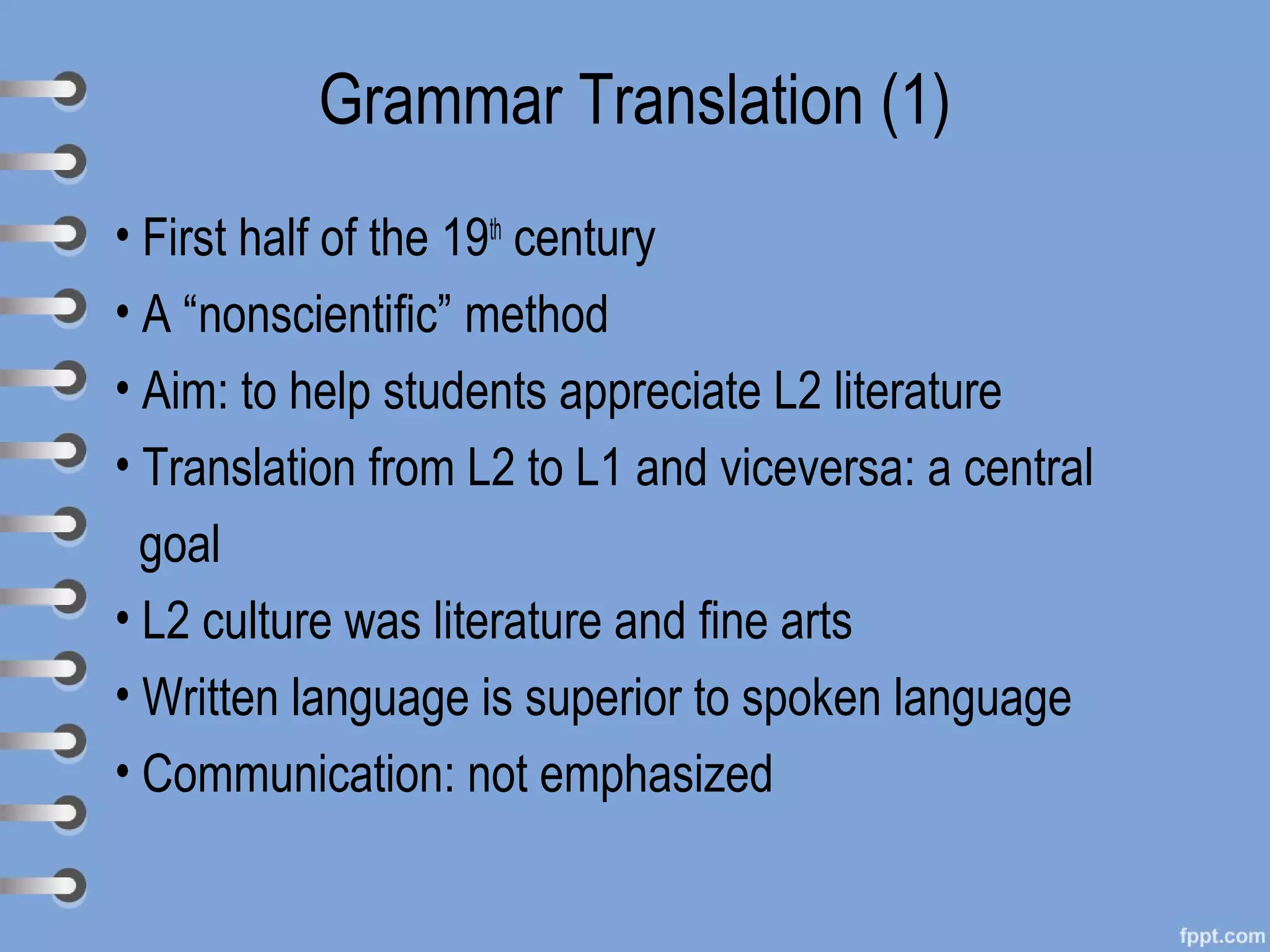
Grammar Translation (1)
• First half of the 19th century
• A “nonscientific” method
• Aim: to help students appreciate L2 literature
• Translation from L2 to L1 and viceversa: a central
  goal
• L2 culture was literature and fine arts
• Written language is superior to spoken language
• Communication: not emphasized
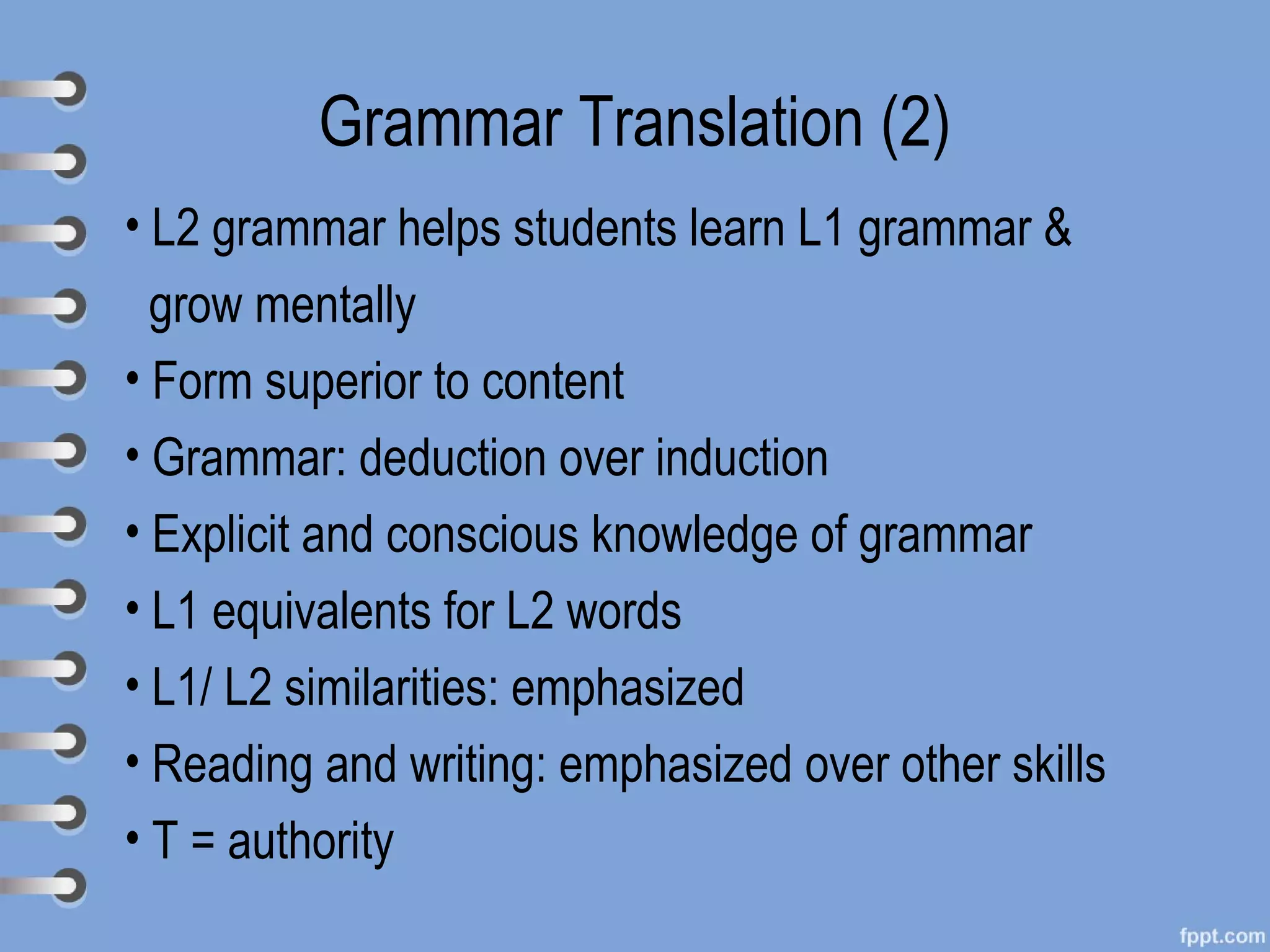
Grammar Translation (2)
• L2 grammar helps students learn L1 grammar &
  grow mentally
• Form superior to content
• Grammar: deduction over induction
• Explicit and conscious knowledge of grammar
• L1 equivalents for L2 words
• L1/ L2 similarities: emphasized
• Reading and writing: emphasized over other skills
• T = authority
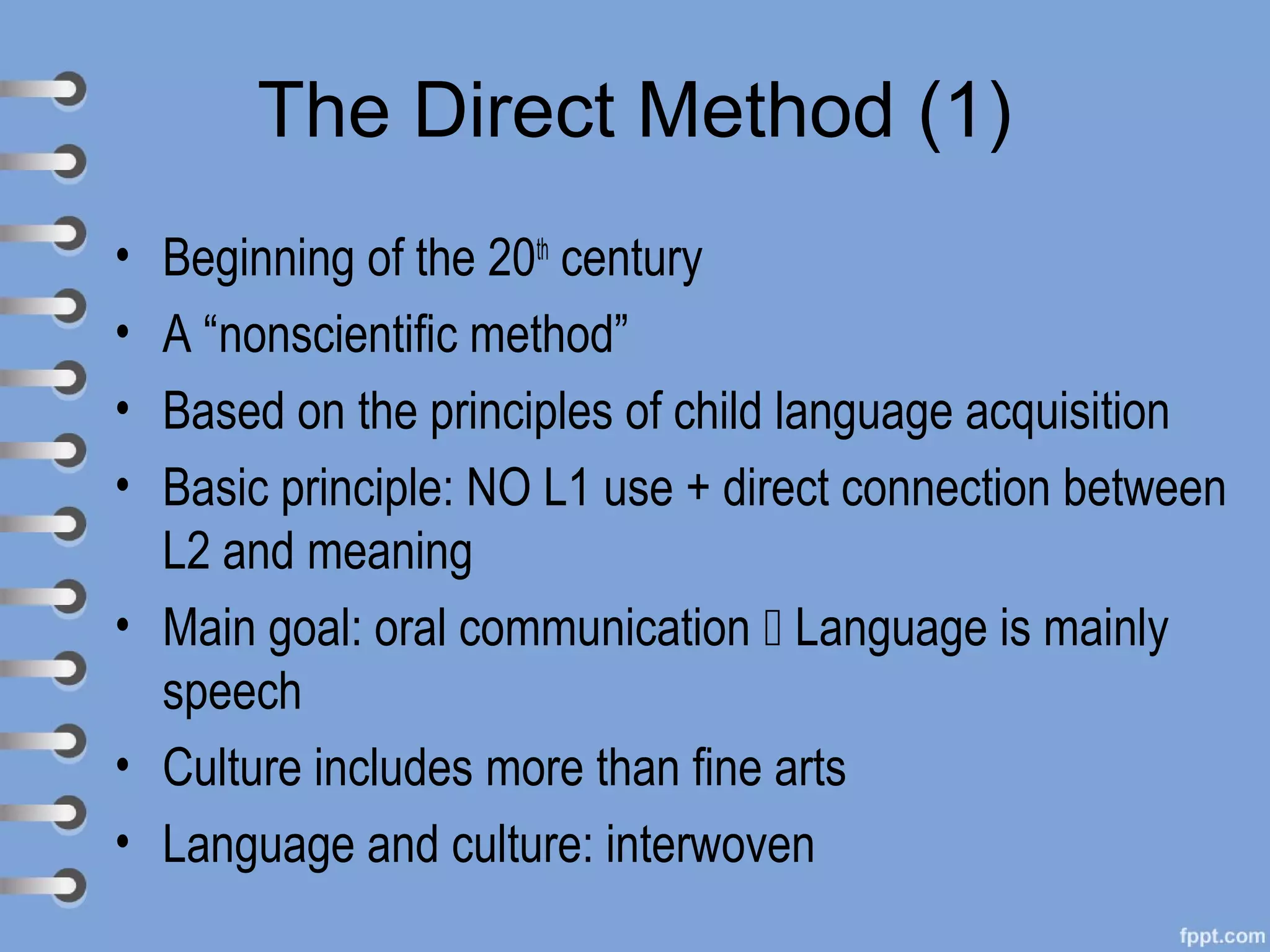
The Direct Method (1)
• Beginning of the 20th century
• A “nonscientific method”
• Based on the principles of child language acquisition
• Basic principle: NO L1 use + direct connection between
  L2 and meaning
• Main goal: oral communication  Language is mainly
  speech
• Culture includes more than fine arts
• Language and culture: interwoven
The Direct Method (2)
• Concrete objects are used to make the direct link
  between form (language) and meaning
• Topic based lessons (not structurally designed)
• Reading & Writing taught from the beginning
• Fluency over accuracy
• Pronunciation: primary focus
• Grammar: induction over deduction
• Demonstration rather than explanation or translation
• Errors: to be avoided; self-correction mainly
The Audio-Lingual Method (1)
• Developed in the USA during WW1
• First “scientific” method: rooted in both psychology
  (Behaviourism, Skinner) and linguistics (Structuralism,
  Bloomfiled)
• Prior goal: communication
• Form in context (e.g. use of dialogue)
• Different L1 and L2 systems  treated differently to
  avoid interference.
• Teacher = model  importance of native-like accent
The Audio-Lingual Method (2)

• Language learning = habit formation  Filling in slots in
  sentences
• Automatic repetition is the result of overlearning;
  drilling and mechanical repetition
• L2 learning = L1 acquisition
• Rules: induced (implicit) from examples.
• Contrastive analysis of L1 and L2 shows the areas of
  difficulty  Natural order of acquisition
• Errors = barriers for habit formation (inhibition)
• Positive reinforcement
The “Designer” Methods
• 1970s
• Birth of the field of Second Language Learning and
  Teaching
• “Innovative” flair

 A reaction against Behaviourism and Structuralism

 1.      Communicative Language Learning
 2.      Suggestopedia
 3.      The Silent Way
 4.      TPR
The Communicative Approach and
Communicative Language Teaching (CLT)

 • A British approach to L2 learning and teaching
 • Communication includes functions.
 • Functions are what we do with the language: arguing,
   persuading, promising, rejection or accepting an
   invitation, etc.
 • These functions happen inside a social context.
 • Based on Wilkin’s Notional-Functional Approach
   (1970s)
CLT: main tenets
• Linguistic theory underpinning CLT: Communicative
  Competence (Hymes, 1972): The ability to figure out
  someone’s communicative intentions
• The use of authentic language in real contexts
• Language = A vehicle for communication
• Knowledge of forms, meanings and functions can be
  positive if they help the learner in the process of
  meaning exchange
1. Real communication
2. Task-based activities
3. Meaningfulness (= authenticity)
CLT: meaning negotiation
• Opportunities for self-expression
• Negotiation of meaning
• Linguistic knowledge = not very critical for
   communicative ability
• Choosing what to say and how to say it
   (Communicative Competence development)
1. Situations that promote communication
2. Cooperation and team work
3. Role play and information gap
• L1 = no role  Communication happens in L2 context
CLT: the teacher’s role

1. Facilitator of the learning process
2. Manager of classroom activities
   - T innitiates activities
   - Ss interact
3. Advisor
4. Co-communicator
CLT: assessment & error treatment

  •Errors = a natural outcome of the development of
  communicative skills
  •Accuracy and fluency
  •Evaluation = informal and in the process of the
communicative act
  •Communicative tests
  •Skill integration
Content-based, task-based, and
     Participatory Approaches (1)
  Three approaches that make communication central

• Importance given to the process of learning over
  linguistic content
• Using English to learn
• English AS communication
• Content and language integration (e.g. ESP - English
  for special purposes; content oriented/based)
• No pre-determined syllabus; syllabus based on the
  learners’ communicative needs
Content-based, task-based, and
      Participatory Approaches (2)
• The subject matter (content) = platform for language
  learning
• Previous knowledge = the basis; schema activation
• Language = the medium of instruction (cf. not the
  purpose of instruction)  used to complete tasks
• Learners work with meaningful, cognitively demanding,
  and authentic texts and tasks (learning by doing).
• Problem-solving = key concept
• Tasks: clear and purposeful; challenging; developed by
  teacher-learner interaction
Content-based, task-based, and
      Participatory Approaches (3)
• Authentic activity through authentic language use
  encouraged.
• Focus on meaning.
           .
• Feedback is given upon task completion
• Self evaluation encouraged = Ss’ own evaluation of
  outcomes and learning process
Learning Strategy Training, Cooperative
Learning, and Multiple Intelligences (1)

• Three methodological innovations
• Learner oriented methodologies = focus on the learner
• Learners
1. are willing and accurate guessers
2. have great desire to communicate
3. pay attention to both meaning and form
4. practice and monitor their own and others’ speech
5. should become independent and self regulated
Learning Strategy Training, Cooperative
Learning, and Multiple Intelligences (1)
• Prior knowledge and experiences: used to build up new
  knowledge
• Learning strategies: lead to academic success
• Learning should be taught, as well as language
• Autonomy and “positive interdependence”
  encouragement
• Strategies: transferable to new learning situations
• Cooperation and social skills development (e.g.
  apologizing, repetition, asking for help)
• Attention given to Ss’ multiple intelligences
Approaches and methods in language
        teaching: conclusion
• The methods and approaches here discussed are all
  still practised today. However, they carry different
  weights and distributions.
• Every method represents either a reaction against or
            .

  an improvement on its predecessor.
• There are no “good” and “bad” methods.
• At present, the use of technology , strategies, styles,
  innovations, interaction, cooperation, and affective
  factors are given primary attention by language
  teaching methodologies.
The best method, no method?
• Deciding upon which method to implement should
  consider a myriad of impinging factors.

 Research suggest that the best approach is principled
                     eclecticism.

• This is not a method in itself but the use of different
  methods and/or different techniques depending on
  factors such as the learners’ age and gender and
  needs; the goals and objectives set, the available
  materials, and the teacher’s views about what learning
  and teaching encompasses
Bibliography
• Anthony, E. M. (1963): Approach, method and
  technique, English Language Teaching, 17, 63-67.
• Brown, H.D. (2000): Principles of language learning
  and teaching, Chapter 5, pp.112-141. Harlow:
  Longman.
• Larsen-Freeman, D. (2000): Techniques and principles
  in language teaching. Oxford: Oxford University Press.
• Richards, J. C. & Rodgers, T. S. (2001): Approaches
  and methods in language teaching (2nd ed.).
  Cambridge: Cambridge University Press.

Language teaching: Approaches and methods

  • 1.
    Language Teaching Methodologies Didáctica de las Lenguas Extranjeras I (2012) Module 3 Issue 2 Prof. Lic. María Alejandra Soto
  • 2.
    Why approaches andmethods? “When teachers are exposed to methods and asked to reflect on their principles and actively engage with their techniques, they can become clearer about why they do what they do. They become aware of their own fundamental assumptions, values and beliefs” (Larsen Freeman, 2000: ix)
  • 3.
    And because methodscan shed light on: 1. the teacher’s goals 2. the teacher’s role 3. the learner’s role 4. the main characteristics of the teaching and learning processes 5. the nature of teacher-student interaction 6. the consideration of learner feelings 7. the role of language & the role of culture 8. the role of the L1 9. assessment 10.the treatment of learner error
  • 4.
  • 5.
    Approach – Design– Procedure (Richards & Rogers, 1986)
  • 6.
    Popular methodology Grammar-Translation Direct Method Audiolingulism Community The Silent Way (De)Suggestopedia Language Learning Content-Based Total Physical Communicative Task-Based Response Language Teaching Participatory Approaches Learning Strategy Training, The Lexical Cooperative The Natural Approach Approach Learning Multiple Intelligences
  • 7.
    Grammar Translation (1) •First half of the 19th century • A “nonscientific” method • Aim: to help students appreciate L2 literature • Translation from L2 to L1 and viceversa: a central goal • L2 culture was literature and fine arts • Written language is superior to spoken language • Communication: not emphasized
  • 8.
    Grammar Translation (2) •L2 grammar helps students learn L1 grammar & grow mentally • Form superior to content • Grammar: deduction over induction • Explicit and conscious knowledge of grammar • L1 equivalents for L2 words • L1/ L2 similarities: emphasized • Reading and writing: emphasized over other skills • T = authority
  • 9.
    The Direct Method(1) • Beginning of the 20th century • A “nonscientific method” • Based on the principles of child language acquisition • Basic principle: NO L1 use + direct connection between L2 and meaning • Main goal: oral communication  Language is mainly speech • Culture includes more than fine arts • Language and culture: interwoven
  • 10.
    The Direct Method(2) • Concrete objects are used to make the direct link between form (language) and meaning • Topic based lessons (not structurally designed) • Reading & Writing taught from the beginning • Fluency over accuracy • Pronunciation: primary focus • Grammar: induction over deduction • Demonstration rather than explanation or translation • Errors: to be avoided; self-correction mainly
  • 11.
    The Audio-Lingual Method(1) • Developed in the USA during WW1 • First “scientific” method: rooted in both psychology (Behaviourism, Skinner) and linguistics (Structuralism, Bloomfiled) • Prior goal: communication • Form in context (e.g. use of dialogue) • Different L1 and L2 systems  treated differently to avoid interference. • Teacher = model  importance of native-like accent
  • 12.
    The Audio-Lingual Method(2) • Language learning = habit formation  Filling in slots in sentences • Automatic repetition is the result of overlearning; drilling and mechanical repetition • L2 learning = L1 acquisition • Rules: induced (implicit) from examples. • Contrastive analysis of L1 and L2 shows the areas of difficulty  Natural order of acquisition • Errors = barriers for habit formation (inhibition) • Positive reinforcement
  • 13.
    The “Designer” Methods •1970s • Birth of the field of Second Language Learning and Teaching • “Innovative” flair A reaction against Behaviourism and Structuralism 1. Communicative Language Learning 2. Suggestopedia 3. The Silent Way 4. TPR
  • 14.
    The Communicative Approachand Communicative Language Teaching (CLT) • A British approach to L2 learning and teaching • Communication includes functions. • Functions are what we do with the language: arguing, persuading, promising, rejection or accepting an invitation, etc. • These functions happen inside a social context. • Based on Wilkin’s Notional-Functional Approach (1970s)
  • 15.
    CLT: main tenets •Linguistic theory underpinning CLT: Communicative Competence (Hymes, 1972): The ability to figure out someone’s communicative intentions • The use of authentic language in real contexts • Language = A vehicle for communication • Knowledge of forms, meanings and functions can be positive if they help the learner in the process of meaning exchange 1. Real communication 2. Task-based activities 3. Meaningfulness (= authenticity)
  • 16.
    CLT: meaning negotiation •Opportunities for self-expression • Negotiation of meaning • Linguistic knowledge = not very critical for communicative ability • Choosing what to say and how to say it (Communicative Competence development) 1. Situations that promote communication 2. Cooperation and team work 3. Role play and information gap • L1 = no role  Communication happens in L2 context
  • 17.
    CLT: the teacher’srole 1. Facilitator of the learning process 2. Manager of classroom activities - T innitiates activities - Ss interact 3. Advisor 4. Co-communicator
  • 18.
    CLT: assessment &error treatment •Errors = a natural outcome of the development of communicative skills •Accuracy and fluency •Evaluation = informal and in the process of the communicative act •Communicative tests •Skill integration
  • 19.
    Content-based, task-based, and Participatory Approaches (1) Three approaches that make communication central • Importance given to the process of learning over linguistic content • Using English to learn • English AS communication • Content and language integration (e.g. ESP - English for special purposes; content oriented/based) • No pre-determined syllabus; syllabus based on the learners’ communicative needs
  • 20.
    Content-based, task-based, and Participatory Approaches (2) • The subject matter (content) = platform for language learning • Previous knowledge = the basis; schema activation • Language = the medium of instruction (cf. not the purpose of instruction)  used to complete tasks • Learners work with meaningful, cognitively demanding, and authentic texts and tasks (learning by doing). • Problem-solving = key concept • Tasks: clear and purposeful; challenging; developed by teacher-learner interaction
  • 21.
    Content-based, task-based, and Participatory Approaches (3) • Authentic activity through authentic language use encouraged. • Focus on meaning. . • Feedback is given upon task completion • Self evaluation encouraged = Ss’ own evaluation of outcomes and learning process
  • 22.
    Learning Strategy Training,Cooperative Learning, and Multiple Intelligences (1) • Three methodological innovations • Learner oriented methodologies = focus on the learner • Learners 1. are willing and accurate guessers 2. have great desire to communicate 3. pay attention to both meaning and form 4. practice and monitor their own and others’ speech 5. should become independent and self regulated
  • 23.
    Learning Strategy Training,Cooperative Learning, and Multiple Intelligences (1) • Prior knowledge and experiences: used to build up new knowledge • Learning strategies: lead to academic success • Learning should be taught, as well as language • Autonomy and “positive interdependence” encouragement • Strategies: transferable to new learning situations • Cooperation and social skills development (e.g. apologizing, repetition, asking for help) • Attention given to Ss’ multiple intelligences
  • 24.
    Approaches and methodsin language teaching: conclusion • The methods and approaches here discussed are all still practised today. However, they carry different weights and distributions. • Every method represents either a reaction against or . an improvement on its predecessor. • There are no “good” and “bad” methods. • At present, the use of technology , strategies, styles, innovations, interaction, cooperation, and affective factors are given primary attention by language teaching methodologies.
  • 25.
    The best method,no method? • Deciding upon which method to implement should consider a myriad of impinging factors. Research suggest that the best approach is principled eclecticism. • This is not a method in itself but the use of different methods and/or different techniques depending on factors such as the learners’ age and gender and needs; the goals and objectives set, the available materials, and the teacher’s views about what learning and teaching encompasses
  • 26.
    Bibliography • Anthony, E.M. (1963): Approach, method and technique, English Language Teaching, 17, 63-67. • Brown, H.D. (2000): Principles of language learning and teaching, Chapter 5, pp.112-141. Harlow: Longman. • Larsen-Freeman, D. (2000): Techniques and principles in language teaching. Oxford: Oxford University Press. • Richards, J. C. & Rodgers, T. S. (2001): Approaches and methods in language teaching (2nd ed.). Cambridge: Cambridge University Press.