LANGUAGE LEARNING STRATEGIES
Teaching English as a Foreign Language (TEFL)
lesson 3
Language Education Study Program Even semester 2022/ 2023 Lutfi Istikharoh
what is language learning strategy?
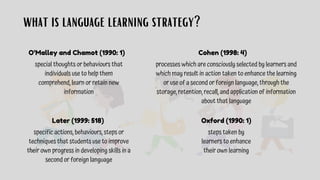
O’Malley and Chamot (1990: 1)
special thoughts or behaviours that
individuals use to help them
comprehend, learn or retain new
information
Oxford (1990: 1)
steps taken by
learners to enhance
their own learning
Later (1999: 518)
specific actions, behaviours, steps or
techniques that students use to improve
their own progress in developing skills in a
second or foreign language
Cohen (1998: 4)
processes which are consciously selected by learners and
which may result in action taken to enhance the learning
or use of a second or foreign language, through the
storage, retention, recall, and application of information
about that language
what is language learning strategy?
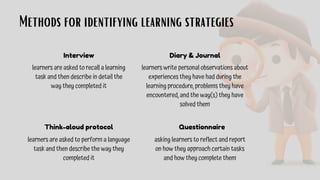
Methods for identifying
learning strategies
Interview
learners are asked to recall a learning
task and then describe in detail the
way they completed it
Questionnaire
asking learners to reflect and report
on how they approach certain tasks
and how they complete them
Think-aloud protocol
learners are asked to perform a language
task and then describe the way they
completed it
Diary & Journal
learners write personal observations about
experiences they have had during the
learning procedure, problems they have
encountered, and the way(s) they have
solved them
Methods for identifying learning strategies
What strategies do ‘good language learners’ use?
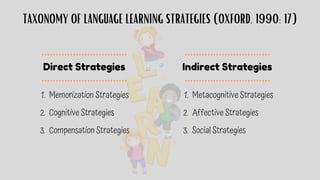
TAXONOMY OF LANGUAGE LEARNING STRATEGIES (OXFORD, 1990: 17)
Direct Strategies
Memorization Strategies
Cognitive Strategies
Compensation Strategies
1.
2.
3.
Indirect Strategies
Metacognitive Strategies
Affective Strategies
Social Strategies
1.
2.
3.
DIRECT STRATEGIES
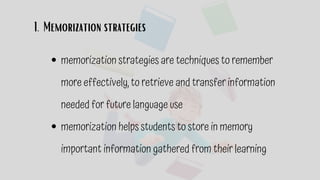
Memorization strategies
1.
memorization strategies are techniques to remember
more effectively, to retrieve and transfer information
needed for future language use
memorization helps students to store in memory
important information gathered from their learning
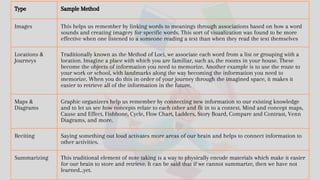
Type Sample Method
Images This helps us remember by linking words to meanings through associations based on how a word
sounds and creating imagery for specific words. This sort of visualization was found to be more
effective when one listened to a someone reading a text than when they read the text themselves
Locations &
Journeys
Traditionally known as the Method of Loci, we associate each word from a list or grouping with a
location. Imagine a place with which you are familiar, such as, the rooms in your house. These
become the objects of information you need to memorize. Another example is to use the route to
your work or school, with landmarks along the way becoming the information you need to
memorize. When you do this in order of your journey through the imagined space, it makes it
easier to retrieve all of the information in the future.
Maps &
Diagrams
Graphic organizers help us remember by connecting new information to our existing knowledge
and to let us see how concepts relate to each other and fit in to a context. Mind and concept maps,
Cause and Effect, Fishbone, Cycle, Flow Chart, Ladders, Story Board, Compare and Contrast, Venn
Diagrams, and more.
Reciting Saying something out loud activates more areas of our brain and helps to connect information to
other activities.
Summarizing This traditional element of note taking is a way to physically encode materials which make it easier
for our brain to store and retrieve. It can be said that if we cannot summarize, then we have not
learned…yet.
2. Cognitive strategies
cognitive startegies used to help the students to
manipulate the target language or task correctly by
using all their processes
they include reasoning, analysing, and drawing
conclusion
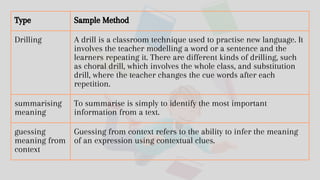
Type Sample Method
Drilling A drill is a classroom technique used to practise new language. It
involves the teacher modelling a word or a sentence and the
learners repeating it. There are different kinds of drilling, such
as choral drill, which involves the whole class, and substitution
drill, where the teacher changes the cue words after each
repetition.
summarising
meaning
To summarise is simply to identify the most important
information from a text.
guessing
meaning from
context
Guessing from context refers to the ability to infer the meaning
of an expression using contextual clues.
3. Compansation strategies
compansation strategies are employed by the students to compensate the
missing knowledge in the target langugae, English, due to lack of vocabulary
the strategies help to allow the students to use the language to speak and write
in the target language even when their vocabulary is limited
compensation strategies help the students to find synonyms from the context
of the reading and relying on non-verbal communication, such as gestures, to
communicate meaning when the exact meaning of a statement is not
understood.
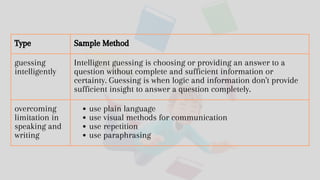
Type Sample Method
guessing
intelligently
Intelligent guessing is choosing or providing an answer to a
question without complete and sufficient information or
certainty. Guessing is when logic and information don't provide
sufficient insight to answer a question completely.
overcoming
limitation in
speaking and
writing
use plain language
use visual methods for communication
use repetition
use paraphrasing
INDIRECT STRATEGIES
1. Metacognitive strategies
metacognitive strategies are employed by the students to help them
coordinate the learning process by centering, arranging, planning and evaluating
their learning
metacognitive strategies are processes designed for students to 'think' about
their 'thinking'.
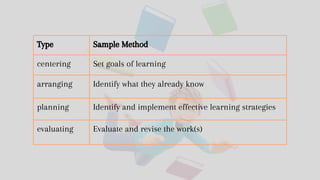
Type Sample Method
centering Set goals of learning
arranging Identify what they already know
planning Identify and implement effective learning strategies
evaluating Evaluate and revise the work(s)
2. Affective strategies
affective strategies help the students control their emotions, attitudes,
motivations, and values
these strategies allow students to manage their feeling
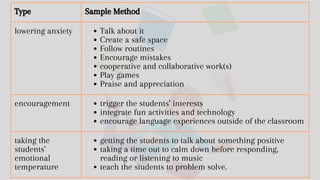
Type Sample Method
lowering anxiety Talk about it
Create a safe space
Follow routines
Encourage mistakes
cooperative and collaborative work(s)
Play games
Praise and appreciation
encouragement trigger the students' interests
integrate fun activities and technology
encourage language experiences outside of the classroom
taking the
students'
emotional
temperature
getting the students to talk about something positive
taking a time out to calm down before responding,
reading or listening to music
teach the students to problem solve.
3. Social strategies
social strategies are activities that the stduents engage in to seek
opportunities to be exposed to an environment where practice is possible
these strategies are important because language learning always involves other
people
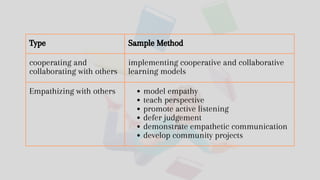
Type Sample Method
cooperating and
collaborating with others
implementing cooperative and collaborative
learning models
Empathizing with others model empathy
teach perspective
promote active listening
defer judgement
demonstrate empathetic communication
develop community projects
Comment on good
students by referring to
the six categories of
English-learning
strategies

Lesson 3_Language Learning Strategies_compressed.pdf

  • 1.
    LANGUAGE LEARNING STRATEGIES TeachingEnglish as a Foreign Language (TEFL) lesson 3 Language Education Study Program Even semester 2022/ 2023 Lutfi Istikharoh
  • 2.
    what is languagelearning strategy?
  • 3.
    O’Malley and Chamot(1990: 1) special thoughts or behaviours that individuals use to help them comprehend, learn or retain new information Oxford (1990: 1) steps taken by learners to enhance their own learning Later (1999: 518) specific actions, behaviours, steps or techniques that students use to improve their own progress in developing skills in a second or foreign language Cohen (1998: 4) processes which are consciously selected by learners and which may result in action taken to enhance the learning or use of a second or foreign language, through the storage, retention, recall, and application of information about that language what is language learning strategy?
  • 4.
  • 5.
    Interview learners are askedto recall a learning task and then describe in detail the way they completed it Questionnaire asking learners to reflect and report on how they approach certain tasks and how they complete them Think-aloud protocol learners are asked to perform a language task and then describe the way they completed it Diary & Journal learners write personal observations about experiences they have had during the learning procedure, problems they have encountered, and the way(s) they have solved them Methods for identifying learning strategies
  • 6.
    What strategies do‘good language learners’ use?
  • 7.
    TAXONOMY OF LANGUAGELEARNING STRATEGIES (OXFORD, 1990: 17) Direct Strategies Memorization Strategies Cognitive Strategies Compensation Strategies 1. 2. 3. Indirect Strategies Metacognitive Strategies Affective Strategies Social Strategies 1. 2. 3.
  • 8.
  • 9.
    Memorization strategies 1. memorization strategiesare techniques to remember more effectively, to retrieve and transfer information needed for future language use memorization helps students to store in memory important information gathered from their learning
  • 10.
    Type Sample Method ImagesThis helps us remember by linking words to meanings through associations based on how a word sounds and creating imagery for specific words. This sort of visualization was found to be more effective when one listened to a someone reading a text than when they read the text themselves Locations & Journeys Traditionally known as the Method of Loci, we associate each word from a list or grouping with a location. Imagine a place with which you are familiar, such as, the rooms in your house. These become the objects of information you need to memorize. Another example is to use the route to your work or school, with landmarks along the way becoming the information you need to memorize. When you do this in order of your journey through the imagined space, it makes it easier to retrieve all of the information in the future. Maps & Diagrams Graphic organizers help us remember by connecting new information to our existing knowledge and to let us see how concepts relate to each other and fit in to a context. Mind and concept maps, Cause and Effect, Fishbone, Cycle, Flow Chart, Ladders, Story Board, Compare and Contrast, Venn Diagrams, and more. Reciting Saying something out loud activates more areas of our brain and helps to connect information to other activities. Summarizing This traditional element of note taking is a way to physically encode materials which make it easier for our brain to store and retrieve. It can be said that if we cannot summarize, then we have not learned…yet.
  • 11.
    2. Cognitive strategies cognitivestartegies used to help the students to manipulate the target language or task correctly by using all their processes they include reasoning, analysing, and drawing conclusion
  • 12.
    Type Sample Method DrillingA drill is a classroom technique used to practise new language. It involves the teacher modelling a word or a sentence and the learners repeating it. There are different kinds of drilling, such as choral drill, which involves the whole class, and substitution drill, where the teacher changes the cue words after each repetition. summarising meaning To summarise is simply to identify the most important information from a text. guessing meaning from context Guessing from context refers to the ability to infer the meaning of an expression using contextual clues.
  • 13.
    3. Compansation strategies compansationstrategies are employed by the students to compensate the missing knowledge in the target langugae, English, due to lack of vocabulary the strategies help to allow the students to use the language to speak and write in the target language even when their vocabulary is limited compensation strategies help the students to find synonyms from the context of the reading and relying on non-verbal communication, such as gestures, to communicate meaning when the exact meaning of a statement is not understood.
  • 14.
    Type Sample Method guessing intelligently Intelligentguessing is choosing or providing an answer to a question without complete and sufficient information or certainty. Guessing is when logic and information don't provide sufficient insight to answer a question completely. overcoming limitation in speaking and writing use plain language use visual methods for communication use repetition use paraphrasing
  • 15.
  • 16.
    1. Metacognitive strategies metacognitivestrategies are employed by the students to help them coordinate the learning process by centering, arranging, planning and evaluating their learning metacognitive strategies are processes designed for students to 'think' about their 'thinking'.
  • 17.
    Type Sample Method centeringSet goals of learning arranging Identify what they already know planning Identify and implement effective learning strategies evaluating Evaluate and revise the work(s)
  • 18.
    2. Affective strategies affectivestrategies help the students control their emotions, attitudes, motivations, and values these strategies allow students to manage their feeling
  • 19.
    Type Sample Method loweringanxiety Talk about it Create a safe space Follow routines Encourage mistakes cooperative and collaborative work(s) Play games Praise and appreciation encouragement trigger the students' interests integrate fun activities and technology encourage language experiences outside of the classroom taking the students' emotional temperature getting the students to talk about something positive taking a time out to calm down before responding, reading or listening to music teach the students to problem solve.
  • 20.
    3. Social strategies socialstrategies are activities that the stduents engage in to seek opportunities to be exposed to an environment where practice is possible these strategies are important because language learning always involves other people
  • 21.
    Type Sample Method cooperatingand collaborating with others implementing cooperative and collaborative learning models Empathizing with others model empathy teach perspective promote active listening defer judgement demonstrate empathetic communication develop community projects
  • 22.
    Comment on good studentsby referring to the six categories of English-learning strategies