Prepared by Visakh V, Assistant
Professor,Dept. of CSE, LBSITW
DATA ABSTRACTION
&
3 SCHEMA
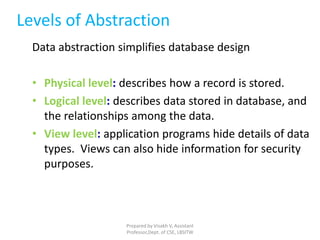
Levels of Abstraction
Data abstraction simplifies database design
• Physical level: describes how a record is stored.
• Logical level: describes data stored in database, and
the relationships among the data.
• View level: application programs hide details of data
types. Views can also hide information for security
purposes.
Prepared by Visakh V, Assistant
Professor,Dept. of CSE, LBSITW
Prepared by Visakh V, Assistant
Professor,Dept. of CSE, LBSITW
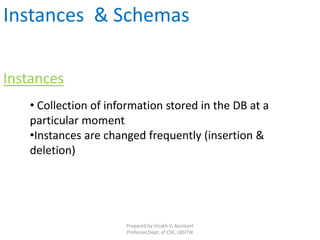
Instances & Schemas
Instances
• Collection of information stored in the DB at a
particular moment
•Instances are changed frequently (insertion &
deletion)
Prepared by Visakh V, Assistant
Professor,Dept. of CSE, LBSITW
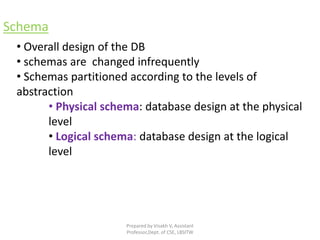
• Overall design of the DB
• schemas are changed infrequently
• Schemas partitioned according to the levels of
abstraction
• Physical schema: database design at the physical
level
• Logical schema: database design at the logical
level
Schema
Prepared by Visakh V, Assistant
Professor,Dept. of CSE, LBSITW
Data Independence
 Achieved through the use of 3 levels of abstraction
The ability to modify a schema definition in one
level without affecting a schema definition in higher
level is called data independence
 mainly two kinds of database independence
a) Logical data independence
b) Physical data independence
Prepared by Visakh V, Assistant
Professor,Dept. of CSE, LBSITW
Logical data independence
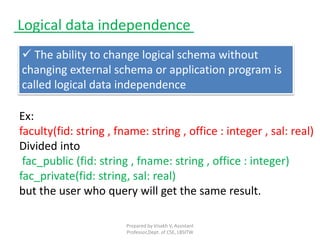
 The ability to change logical schema without
changing external schema or application program is
called logical data independence
Ex:
faculty(fid: string , fname: string , office : integer , sal: real)
Divided into
fac_public (fid: string , fname: string , office : integer)
fac_private(fid: string, sal: real)
but the user who query will get the same result.
Prepared by Visakh V, Assistant
Professor,Dept. of CSE, LBSITW
Physical data independence
 The ability to change physical schema without
changing logical schema is called Physical data
independence
Changes in physical schema may include
 Using new storage device
 Using different data structure
 Switching from one access method to another
 using different storage structures
 modifying indexes etc.
Prepared by Visakh V, Assistant
Professor,Dept. of CSE, LBSITW
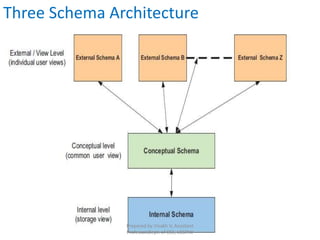
Three Schema Architecture
Prepared by Visakh V, Assistant
Professor,Dept. of CSE, LBSITW
Three Schema Architecture (Cont…)
• 3 Level Architecture / ANSI –SPARC Model
• Most modern DBMS are based on this system
• Objectives
 Allows independent customized user views
 Hides physical storage details from users
 Administrator can able to change DB storage
structure without affecting User’s view
 Internal structure of DB is unaffected by the changes
to the physical aspects of storage
 Admin can able to change the conceptual structure
of DB without affecting users
Prepared by Visakh V, Assistant
Professor,Dept. of CSE, LBSITW
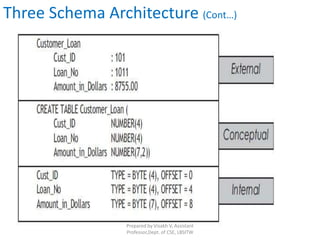
Three Schema Architecture (Cont…)
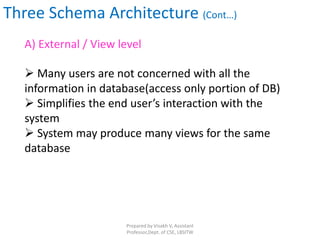
A) External / View level
 Many users are not concerned with all the
information in database(access only portion of DB)
 Simplifies the end user’s interaction with the
system
 System may produce many views for the same
database
Prepared by Visakh V, Assistant
Professor,Dept. of CSE, LBSITW
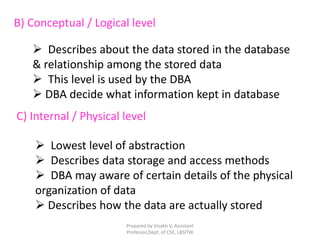
B) Conceptual / Logical level
 Describes about the data stored in the database
& relationship among the stored data
 This level is used by the DBA
 DBA decide what information kept in database
C) Internal / Physical level
 Lowest level of abstraction
 Describes data storage and access methods
 DBA may aware of certain details of the physical
organization of data
 Describes how the data are actually stored
Prepared by Visakh V, Assistant
Professor,Dept. of CSE, LBSITW
Detailed Three Schema Architecture
(Cont…)
Prepared by Visakh V, Assistant
Professor,Dept. of CSE, LBSITW
Three Schema Architecture (Cont…)
Prepared by Visakh V, Assistant
Professor,Dept. of CSE, LBSITW

Slide 3 data abstraction & 3 schema

  • 1.
    Prepared by VisakhV, Assistant Professor,Dept. of CSE, LBSITW DATA ABSTRACTION & 3 SCHEMA
  • 2.
    Levels of Abstraction Dataabstraction simplifies database design • Physical level: describes how a record is stored. • Logical level: describes data stored in database, and the relationships among the data. • View level: application programs hide details of data types. Views can also hide information for security purposes. Prepared by Visakh V, Assistant Professor,Dept. of CSE, LBSITW
  • 3.
    Prepared by VisakhV, Assistant Professor,Dept. of CSE, LBSITW
  • 4.
    Instances & Schemas Instances •Collection of information stored in the DB at a particular moment •Instances are changed frequently (insertion & deletion) Prepared by Visakh V, Assistant Professor,Dept. of CSE, LBSITW
  • 5.
    • Overall designof the DB • schemas are changed infrequently • Schemas partitioned according to the levels of abstraction • Physical schema: database design at the physical level • Logical schema: database design at the logical level Schema Prepared by Visakh V, Assistant Professor,Dept. of CSE, LBSITW
  • 6.
    Data Independence  Achievedthrough the use of 3 levels of abstraction The ability to modify a schema definition in one level without affecting a schema definition in higher level is called data independence  mainly two kinds of database independence a) Logical data independence b) Physical data independence Prepared by Visakh V, Assistant Professor,Dept. of CSE, LBSITW
  • 7.
    Logical data independence The ability to change logical schema without changing external schema or application program is called logical data independence Ex: faculty(fid: string , fname: string , office : integer , sal: real) Divided into fac_public (fid: string , fname: string , office : integer) fac_private(fid: string, sal: real) but the user who query will get the same result. Prepared by Visakh V, Assistant Professor,Dept. of CSE, LBSITW
  • 8.
    Physical data independence The ability to change physical schema without changing logical schema is called Physical data independence Changes in physical schema may include  Using new storage device  Using different data structure  Switching from one access method to another  using different storage structures  modifying indexes etc. Prepared by Visakh V, Assistant Professor,Dept. of CSE, LBSITW
  • 9.
    Three Schema Architecture Preparedby Visakh V, Assistant Professor,Dept. of CSE, LBSITW
  • 10.
    Three Schema Architecture(Cont…) • 3 Level Architecture / ANSI –SPARC Model • Most modern DBMS are based on this system • Objectives  Allows independent customized user views  Hides physical storage details from users  Administrator can able to change DB storage structure without affecting User’s view  Internal structure of DB is unaffected by the changes to the physical aspects of storage  Admin can able to change the conceptual structure of DB without affecting users Prepared by Visakh V, Assistant Professor,Dept. of CSE, LBSITW
  • 11.
    Three Schema Architecture(Cont…) A) External / View level  Many users are not concerned with all the information in database(access only portion of DB)  Simplifies the end user’s interaction with the system  System may produce many views for the same database Prepared by Visakh V, Assistant Professor,Dept. of CSE, LBSITW
  • 12.
    B) Conceptual /Logical level  Describes about the data stored in the database & relationship among the stored data  This level is used by the DBA  DBA decide what information kept in database C) Internal / Physical level  Lowest level of abstraction  Describes data storage and access methods  DBA may aware of certain details of the physical organization of data  Describes how the data are actually stored Prepared by Visakh V, Assistant Professor,Dept. of CSE, LBSITW
  • 13.
    Detailed Three SchemaArchitecture (Cont…) Prepared by Visakh V, Assistant Professor,Dept. of CSE, LBSITW
  • 14.
    Three Schema Architecture(Cont…) Prepared by Visakh V, Assistant Professor,Dept. of CSE, LBSITW