Lecture 4 Normalization of Database Tables
In this Lecture, you will learn: What normalization is and what role it plays in database design About the normal forms 1NF, 2NF, 3NF, BCNF, and 4NF  How normal forms can be transformed from lower normal forms to higher normal forms That normalization and E-R modeling are used concurrently to produce a good database design That some situations require denormalization to generate information efficiently
Database Tables and Normalization Table is basic building block in database design Normalization is process for assigning attributes to entities Reduces data redundancies Helps eliminate data anomalies Produces controlled redundancies to link tables Normalization stages 1NF - First normal form 2NF - Second normal form 3NF - Third normal form 4NF - Fourth normal form
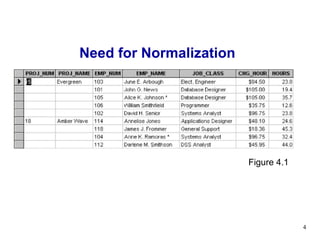
Need for Normalization Figure 4.1
Figure 4.1 Observations PRO_NUM intended to be primary key Table entries invite data inconsistencies Table displays data anomalies Update Modifying JOB_CLASS Insertion New employee must be assigned project Deletion If employee deleted, other vital data lost
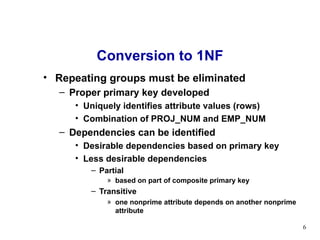
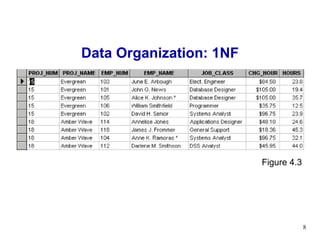
Conversion to 1NF Repeating groups must be eliminated Proper primary key developed   Uniquely identifies attribute values (rows) Combination of PROJ_NUM and EMP_NUM Dependencies can be identified Desirable dependencies based on primary key Less desirable dependencies Partial   based on part of composite primary key Transitive   one nonprime attribute depends on another nonprime attribute
Dependency Diagram (1NF) Figure 4.4
Data Organization: 1NF Figure 4.3
1NF Summarized All key attributes defined No repeating groups in table All attributes dependent on  primary key
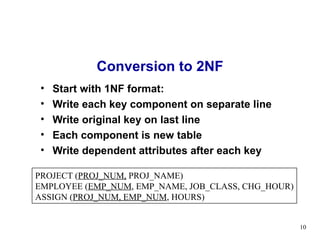
Conversion to 2NF Start with 1NF format: Write each key component on separate line Write original key on last line Each component is new table Write dependent attributes after each key PROJECT ( PROJ_NUM,  PROJ_NAME) EMPLOYEE ( EMP_NUM , EMP_NAME, JOB_CLASS, CHG_HOUR) ASSIGN ( PROJ_NUM, EMP_NUM , HOURS)
2NF Conversion Results Figure 4.5
2NF Summarized In 1NF Includes no partial dependencies No attribute dependent on a portion of primary key Still possible to exhibit transitive dependency Attributes may be functionally dependent on nonkey attributes
Conversion to 3NF Create separate table(s) to eliminate transitive functional dependencies  PROJECT ( PROJ_NUM,  PROJ_NAME) ASSIGN ( PROJ_NUM, EMP_NUM , HOURS) EMPLOYEE ( EMP_NUM , EMP_NAME, JOB_CLASS) JOB ( JOB_CLASS , CHG_HOUR)
3NF Summarized In 2NF Contains no transitive dependencies
Additional DB Enhancements Figure 4.6
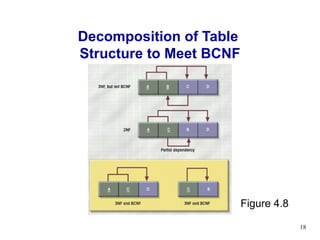
Boyce-Codd Normal Form (BCNF) Every determinant in the table is a candidate key Determinant is attribute whose value determines other values in row 3NF table with one candidate key is already in BCNF
3NF Table Not in BCNF Figure 4.7
Decomposition of Table  Structure to Meet BCNF Figure 4.8
Decomposition into BCNF Figure 4.9
Normalization and Database Design Normalization should be part of the design process E-R Diagram provides macro view Normalization provides micro view of entities Focuses on characteristics of specific entities May yield additional entities Difficult to separate normalization from E-R diagramming Business rules must be determined
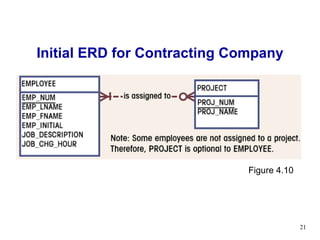
Initial ERD for Contracting Company Figure 4.10
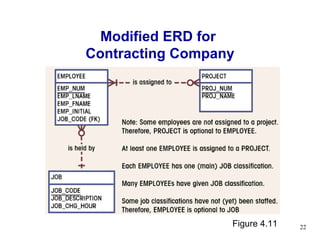
Modified ERD for  Contracting Company Figure 4.11
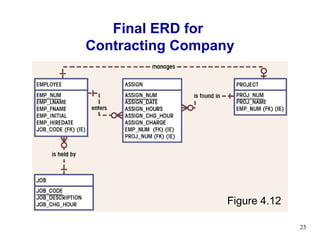
Final ERD for  Contracting Company Figure 4.12
Higher-Level Normal Forms Fourth Normal Form (4NF) Table is in 3NF Has no multiple sets of multivalued dependencies
Conversion to 4NF Figure 4.14 Multivalued Dependencies Figure 4.15 Set of Tables in 4NF
Denormalization Normalization is one of many database design goals  Normalized table requirements   Additional processing Loss of system speed Normalization purity is difficult to sustain due to conflict in: Design efficiency Information requirements Processing
Unnormalized Table Defects Data updates less efficient Indexing more cumbersome No simple strategies for creating views

Lecture 04 normalization

  • 1.
    Lecture 4 Normalizationof Database Tables
  • 2.
    In this Lecture,you will learn: What normalization is and what role it plays in database design About the normal forms 1NF, 2NF, 3NF, BCNF, and 4NF How normal forms can be transformed from lower normal forms to higher normal forms That normalization and E-R modeling are used concurrently to produce a good database design That some situations require denormalization to generate information efficiently
  • 3.
    Database Tables andNormalization Table is basic building block in database design Normalization is process for assigning attributes to entities Reduces data redundancies Helps eliminate data anomalies Produces controlled redundancies to link tables Normalization stages 1NF - First normal form 2NF - Second normal form 3NF - Third normal form 4NF - Fourth normal form
  • 4.
  • 5.
    Figure 4.1 ObservationsPRO_NUM intended to be primary key Table entries invite data inconsistencies Table displays data anomalies Update Modifying JOB_CLASS Insertion New employee must be assigned project Deletion If employee deleted, other vital data lost
  • 6.
    Conversion to 1NFRepeating groups must be eliminated Proper primary key developed Uniquely identifies attribute values (rows) Combination of PROJ_NUM and EMP_NUM Dependencies can be identified Desirable dependencies based on primary key Less desirable dependencies Partial based on part of composite primary key Transitive one nonprime attribute depends on another nonprime attribute
  • 7.
  • 8.
  • 9.
    1NF Summarized Allkey attributes defined No repeating groups in table All attributes dependent on primary key
  • 10.
    Conversion to 2NFStart with 1NF format: Write each key component on separate line Write original key on last line Each component is new table Write dependent attributes after each key PROJECT ( PROJ_NUM, PROJ_NAME) EMPLOYEE ( EMP_NUM , EMP_NAME, JOB_CLASS, CHG_HOUR) ASSIGN ( PROJ_NUM, EMP_NUM , HOURS)
  • 11.
  • 12.
    2NF Summarized In1NF Includes no partial dependencies No attribute dependent on a portion of primary key Still possible to exhibit transitive dependency Attributes may be functionally dependent on nonkey attributes
  • 13.
    Conversion to 3NFCreate separate table(s) to eliminate transitive functional dependencies PROJECT ( PROJ_NUM, PROJ_NAME) ASSIGN ( PROJ_NUM, EMP_NUM , HOURS) EMPLOYEE ( EMP_NUM , EMP_NAME, JOB_CLASS) JOB ( JOB_CLASS , CHG_HOUR)
  • 14.
    3NF Summarized In2NF Contains no transitive dependencies
  • 15.
  • 16.
    Boyce-Codd Normal Form(BCNF) Every determinant in the table is a candidate key Determinant is attribute whose value determines other values in row 3NF table with one candidate key is already in BCNF
  • 17.
    3NF Table Notin BCNF Figure 4.7
  • 18.
    Decomposition of Table Structure to Meet BCNF Figure 4.8
  • 19.
  • 20.
    Normalization and DatabaseDesign Normalization should be part of the design process E-R Diagram provides macro view Normalization provides micro view of entities Focuses on characteristics of specific entities May yield additional entities Difficult to separate normalization from E-R diagramming Business rules must be determined
  • 21.
    Initial ERD forContracting Company Figure 4.10
  • 22.
    Modified ERD for Contracting Company Figure 4.11
  • 23.
    Final ERD for Contracting Company Figure 4.12
  • 24.
    Higher-Level Normal FormsFourth Normal Form (4NF) Table is in 3NF Has no multiple sets of multivalued dependencies
  • 25.
    Conversion to 4NFFigure 4.14 Multivalued Dependencies Figure 4.15 Set of Tables in 4NF
  • 26.
    Denormalization Normalization isone of many database design goals Normalized table requirements Additional processing Loss of system speed Normalization purity is difficult to sustain due to conflict in: Design efficiency Information requirements Processing
  • 27.
    Unnormalized Table DefectsData updates less efficient Indexing more cumbersome No simple strategies for creating views