Functional
Dependencies
prepared by Visakh V,Assistant
Professor,LBSITW
There are two levels at which we discuss the goodness of
relation schema
•Logical (or Conceptual)Level
•Implementation (or storage ) Level
prepared by Visakh V,Assistant
Professor,LBSITW
prepared by Visakh V,Assistant
Professor,LBSITW
4 Informal measures of quality for
relation schemas are
I. Semantics of the attribute
• interpretation of attribute values
from tuples
• The attribute belonging to one relation
have certain real-world meaning and a
proper interpretation associated with
them
prepared by Visakh V,Assistant
Professor,LBSITW
ii. Reducing redundant information in tuples
• minimize the storage space used by the base
relation
• Problem of update anomalies
• Insertion of anomalies
• Deletion of anomalies
• Modification of anomalies
iii. Reducing the NULL values in the tuples
• Waste space at storage levels
• Also lead to problems with understanding
the meaning of attributes (ex:count,join )
iv. Disallowing the possibility of generating
spurious tuples
• Seems to be genuine but it is falseprepared by Visakh V,Assistant
Professor,LBSITW
prepared by Visakh V,Assistant
Professor,LBSITW
prepared by Visakh V,Assistant
Professor,LBSITW
prepared by Visakh V,Assistant
Professor,LBSITW
• Most important concept in relational schema design
theory.
• A functional dependency is a constraint between
two set of attributes from the database.
• it is denoted by X  Y(functional dependency
from x to y or y is functionally dependent on X.)
• i.e. Y component of a tuple in r depend on , or are
determined by , the values of the Y component.
•A functional dependency is a property of the of the
semantics or meaning .prepared by Visakh V,Assistant
Professor,LBSITW
prepared by Visakh V,Assistant
Professor,LBSITW
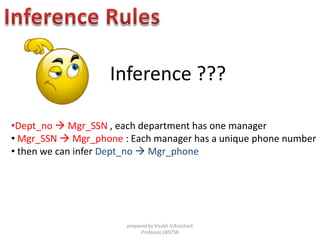
Inference ???
•Dept_no  Mgr_SSN , each department has one manager
• Mgr_SSN  Mgr_phone : Each manager has a unique phone number
• then we can infer Dept_no  Mgr_phone
prepared by Visakh V,Assistant
Professor,LBSITW
Closure : includes all dependencies that can
be inferred from the given set F, it is denoted
by F
closure ???
+
Let us see some examples on board
prepared by Visakh V,Assistant
Professor,LBSITW
The notation F XY means the functional
dependency XY is inferred from functional
dependencies F.
To determine a systematic way to infer dependencies,
we use inference rules that can be used to infer new
dependencies
prepared by Visakh V,Assistant
Professor,LBSITW
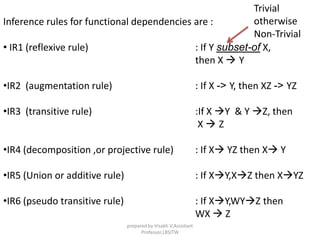
Inference rules for functional dependencies are :
• IR1 (reflexive rule) : If Y subset-of X,
then X  Y
•IR2 (augmentation rule) : If X -> Y, then XZ -> YZ
•IR3 (transitive rule) :If X Y & Y Z, then
X  Z
•IR4 (decomposition ,or projective rule) : If X YZ then X Y
•IR5 (Union or additive rule) : If XY,XZ then XYZ
•IR6 (pseudo transitive rule) : If XY,WYZ then
WX  Z
Trivial
otherwise
Non-Trivial
prepared by Visakh V,Assistant
Professor,LBSITW
Inference rules IR1 through IR3
are sound and complete
Dependency that we
can infer from F by
using IR1 to IR3 holds
every relation state r
of R that satisfies the
dependencies in F.
Using IR1to IR3
repeatedly to infer
dependencies until no
more dependencies
can be inferred from F
The closure of F , can be determined from F by using
inference rules IR1 to IR3 are known as Armstrong ‘s
inference rules.
prepared by Visakh V,Assistant
Professor,LBSITW
prepared by Visakh V,Assistant
Professor,LBSITW
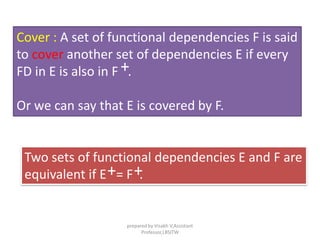
Cover : A set of functional dependencies F is said
to cover another set of dependencies E if every
FD in E is also in F .
Or we can say that E is covered by F.
+
Two sets of functional dependencies E and F are
equivalent if E = F .+ +
prepared by Visakh V,Assistant
Professor,LBSITW
prepared by Visakh V,Assistant
Professor,LBSITW
Minimal cover : minimal cover of a functional dependencies E
is a set functional dependencies F that satisfies the property
that every dependency in E is in the closure of F of F.+
•Every set of FDs has an equivalent minimal set
•There can be several equivalent minimal sets
•There is no simple algorithm for computing a minimal
set of FDs that is equivalent to a set F of FDs
•To synthesize a set of relations, we assume that we
start with a set of dependencies that is a minimal set
prepared by Visakh V,Assistant
Professor,LBSITW
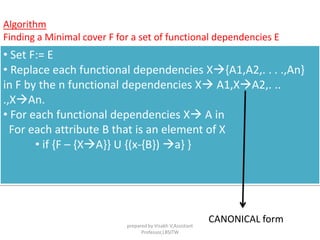
• Set F:= E
• Replace each functional dependencies X{A1,A2,. . . .,An}
in F by the n functional dependencies X A1,XA2,. ..
.,XAn.
• For each functional dependencies X A in
For each attribute B that is an element of X
• if {F – {XA}} U {(x-{B}) a} }
Algorithm
Finding a Minimal cover F for a set of functional dependencies E
CANONICAL formprepared by Visakh V,Assistant
Professor,LBSITW
Find minimum cover for E
{B A, DA,ABD}
Find minimum cover for E
{AD,BCA,BCD,CB,EA,ED}
Find minimum cover for E
{ AB -> C, C -> A, BC -> D, ACD -> B, D -> E, D ->
G, BE -> C, CG -> B, CG -> D, CE -> A, CE -> G}
prepared by Visakh V,Assistant
Professor,LBSITW
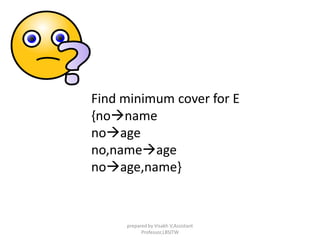
Find minimum cover for E
{noname
noage
no,nameage
noage,name}
prepared by Visakh V,Assistant
Professor,LBSITW
NORMAL
FORMS
prepared by Visakh V,Assistant
Professor,LBSITW
prepared by Visakh V,Assistant
Professor,LBSITW
•First proposed by Codd (1972)
•Initially proposed first ,second and
3NF
• later Boyce and Codd proposed
BCNF
• later 4th and 5th NF are proposed
based on the concept of multi-
valued dependency and join
dependencies
prepared by Visakh V,Assistant
Professor,LBSITW
Advantages
•Minimizing redundancy
•Minimizing insertion , deletion, and
modification of anomalies
Normal form a relation refers to the highest
normal form condition that it meets, and hence
indicate the degree to which it has been
normalized prepared by Visakh V,Assistant
Professor,LBSITW
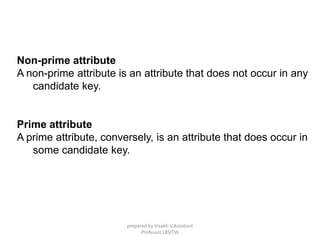
Non-prime attribute
A non-prime attribute is an attribute that does not occur in any
candidate key.
Prime attribute
A prime attribute, conversely, is an attribute that does occur in
some candidate key.
prepared by Visakh V,Assistant
Professor,LBSITW
prepared by Visakh V,Assistant
Professor,LBSITW
•Disallow multi valued attributes and composite attributes
• it states that domain of an attributes must include only
atomic (simple, indivisible)values.
•Ex: address
prepared by Visakh V,Assistant
Professor,LBSITW
prepared by Visakh V,Assistant
Professor,LBSITW
Partial key
prepared by Visakh V,Assistant
Professor,LBSITW
Must be in 1NF
prepared by Visakh V,Assistant
Professor,LBSITW
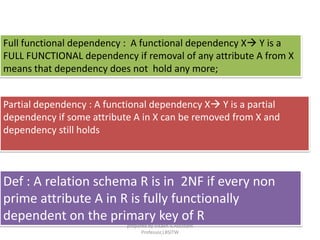
Full functional dependency : A functional dependency X Y is a
FULL FUNCTIONAL dependency if removal of any attribute A from X
means that dependency does not hold any more;
Partial dependency : A functional dependency X Y is a partial
dependency if some attribute A in X can be removed from X and
dependency still holds
Def : A relation schema R is in 2NF if every non
prime attribute A in R is fully functionally
dependent on the primary key of R
prepared by Visakh V,Assistant
Professor,LBSITW
prepared by Visakh V,Assistant
Professor,LBSITW
prepared by Visakh V,Assistant
Professor,LBSITW
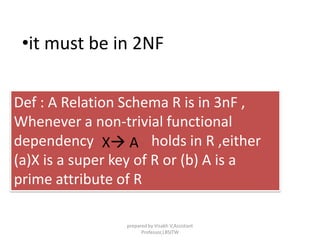
•it must be in 2NF
Def : A Relation Schema R is in 3nF ,
Whenever a non-trivial functional
dependency holds in R ,either
(a)X is a super key of R or (b) A is a
prime attribute of R
X A
prepared by Visakh V,Assistant
Professor,LBSITW
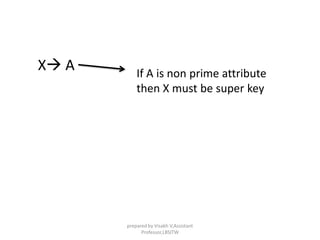
X A If A is non prime attribute
then X must be super key
prepared by Visakh V,Assistant
Professor,LBSITW
prepared by Visakh V,Assistant
Professor,LBSITW
Def : A Relation Schema R is in BCNF ,
Whenever a non-trvial functional
dependency holds in R , X is a
superkey
X A
prepared by Visakh V,Assistant
Professor,LBSITW
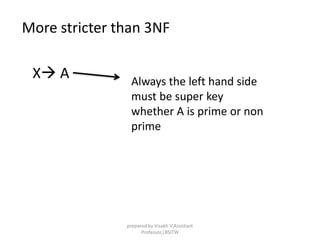
More stricter than 3NF
X A Always the left hand side
must be super key
whether A is prime or non
prime
prepared by Visakh V,Assistant
Professor,LBSITW
Here {student, course  instructor}
{instructor course}
It is 3NF but not BCNF
prepared by Visakh V,Assistant
Professor,LBSITW
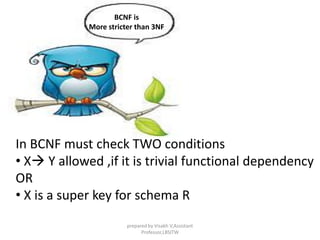
In BCNF must check TWO conditions
• X Y allowed ,if it is trivial functional dependency
OR
• X is a super key for schema R
BCNF is
More stricter than 3NF
prepared by Visakh V,Assistant
Professor,LBSITW
A 3NF table which does not have
multiple overlapping candidate keys
is guaranteed to be in BCNF
Ex: 3NF but not BCNF
Court Start Time End Time Rate Type
1 09:30 10:00 SAVER
1 11:00 12:00 SAVER
1 14:00 15:30 STANDARD
2 10:00 11:30 PREMIUM-B
2 11:30 13:30 PREMIUM-B
2 15:00 16:30 PREMIUM-A
2 9:30 10:00 PREMIUM-A
prepared by Visakh V,Assistant
Professor,LBSITW
Here the candidate keys are
S1: {COURT,START TIME}
S2:{COURT,END TIME}
S3:{RATE TYPE,START TIME}
S4:{RATE TYPE, END TIME}
Here no non prime attributes , all are prime attribute
belongs to some candidate key.
So the table is 2NF and 3NF.but not in BCNF.prepared by Visakh V,Assistant
Professor,LBSITW
Here no non prime attributes , all are prime attribute
belongs to some candidate key.
So the table is 2NF and 3NF,but not in BCNF because of
rate type  court.
prepared by Visakh V,Assistant
Professor,LBSITW
Today's Bookings
Rate Type Start Time End Time
SAVER 09:30 10:30
SAVER 11:00 12:00
STANDARD 14:00 15:30
PREMIUM-B 10:00 11:30
PREMIUM-B 11:30 13:30
PREMIUM-A 15:00 16:30
Rate Types
Rate Type Court Member Flag
SAVER 1 Yes
STANDARD 1 No
PREMIUM-A 2 Yes
PREMIUM-B 2 No
Now it is in BCNF
prepared by Visakh V,Assistant
Professor,LBSITW
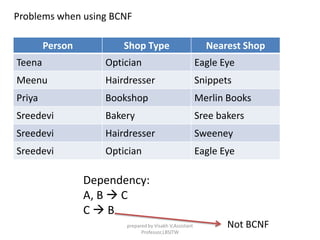
Problems when using BCNF
Person Shop Type Nearest Shop
Teena Optician Eagle Eye
Meenu Hairdresser Snippets
Priya Bookshop Merlin Books
Sreedevi Bakery Sree bakers
Sreedevi Hairdresser Sweeney
Sreedevi Optician Eagle Eye
Dependency:
A, B  C
C  B
Not BCNFprepared by Visakh V,Assistant
Professor,LBSITW
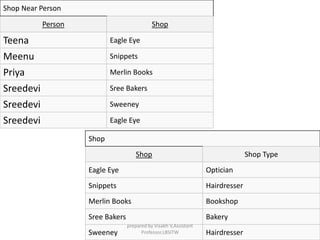
Shop Near Person
Person Shop
Teena Eagle Eye
Meenu Snippets
Priya Merlin Books
Sreedevi Sree Bakers
Sreedevi Sweeney
Sreedevi Eagle Eye
Shop
Shop Shop Type
Eagle Eye Optician
Snippets Hairdresser
Merlin Books Bookshop
Sree Bakers Bakery
Sweeney Hairdresser
prepared by Visakh V,Assistant
Professor,LBSITW
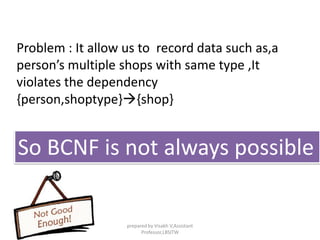
Problem : It allow us to record data such as,a
person’s multiple shops with same type ,It
violates the dependency
{person,shoptype}{shop}
So BCNF is not always possible
prepared by Visakh V,Assistant
Professor,LBSITW
(Lets do some problems)
prepared by Visakh V,Assistant
Professor,LBSITW
prepared by Visakh V,Assistant
Professor,LBSITW
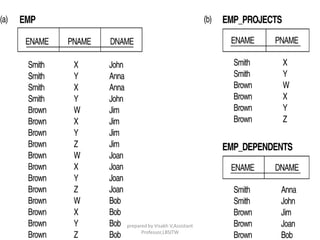
MULTIVALUED DEPENDENCY
: A consequence of first normal form, Which disallows an attribute
have a set of values
: A multivalued dependency is a special case of a join dependency,
Course Book Lecturer
AHA Silberschatz John D
AHA Nederpelt William M
AHA Silberschatz William M
AHA Nederpelt John D
AHA Silberschatz Christian G
AHA Nederpelt Christian G
OSO Silberschatz John D
OSO Silberschatz William M
{course} {book}
and equivalently
{course}  {lecturer}.
prepared by Visakh V,Assistant
Professor,LBSITW
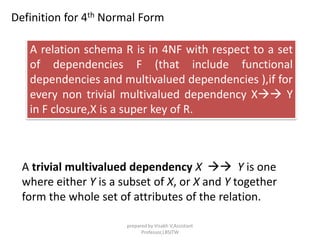
Definition for 4th Normal Form
A relation schema R is in 4NF with respect to a set
of dependencies F (that include functional
dependencies and multivalued dependencies ),if for
every non trivial multivalued dependency X Y
in F closure,X is a super key of R.
A trivial multivalued dependency X  Y is one
where either Y is a subset of X, or X and Y together
form the whole set of attributes of the relation.
prepared by Visakh V,Assistant
Professor,LBSITW
prepared by Visakh V,Assistant
Professor,LBSITW
prepared by Visakh V,Assistant
Professor,LBSITW
prepared by Visakh V,Assistant
Professor,LBSITW
prepared by Visakh V,Assistant
Professor,LBSITW
•In dependency theory, a join dependency is a
constraint on the set of legal relations over a
database scheme.
• A table T is subject to a join dependency if T can
always be recreated by joining multiple tables
each having a subset of the attributes of T.
• If one of the tables in the join has all the
attributes of the table T, the join dependency is
called trivial
prepared by Visakh V,Assistant
Professor,LBSITW
•If JOIN dependency is present carry out a
multiway decomposition in to 5th Normal
form
•Such dependency is very peculiar semantic
constraint, that is very difficult to detect I
practice. So 5NF very rarely done in practice.
prepared by Visakh V,Assistant
Professor,LBSITW
NON ADDITIVE (LOSELESS) JOIN DEPENDENCY
•Which ensures that no spurious tuples are generated
when a NATURAL JOIN operation is applied to the
relations in the decomposition
• lossless refers to loss information ,not to loss of
tuples.
prepared by Visakh V,Assistant
Professor,LBSITW
Example of lossy decomposition
A B C
1 1 1
1 1 2
1 2 1
A B C
1 1 1
1 1 2
1 2 1
1 2 2
A B
1 1
1 2
A C
1 1
1 2
Original table Decomposition
Reconstruction
prepared by Visakh V,Assistant
Professor,LBSITW

Functional dependency and normalization

  • 1.
    Functional Dependencies prepared by VisakhV,Assistant Professor,LBSITW
  • 2.
    There are twolevels at which we discuss the goodness of relation schema •Logical (or Conceptual)Level •Implementation (or storage ) Level prepared by Visakh V,Assistant Professor,LBSITW
  • 3.
    prepared by VisakhV,Assistant Professor,LBSITW
  • 4.
    4 Informal measuresof quality for relation schemas are I. Semantics of the attribute • interpretation of attribute values from tuples • The attribute belonging to one relation have certain real-world meaning and a proper interpretation associated with them prepared by Visakh V,Assistant Professor,LBSITW
  • 5.
    ii. Reducing redundantinformation in tuples • minimize the storage space used by the base relation • Problem of update anomalies • Insertion of anomalies • Deletion of anomalies • Modification of anomalies iii. Reducing the NULL values in the tuples • Waste space at storage levels • Also lead to problems with understanding the meaning of attributes (ex:count,join ) iv. Disallowing the possibility of generating spurious tuples • Seems to be genuine but it is falseprepared by Visakh V,Assistant Professor,LBSITW
  • 6.
    prepared by VisakhV,Assistant Professor,LBSITW
  • 7.
    prepared by VisakhV,Assistant Professor,LBSITW
  • 8.
    prepared by VisakhV,Assistant Professor,LBSITW
  • 9.
    • Most importantconcept in relational schema design theory. • A functional dependency is a constraint between two set of attributes from the database. • it is denoted by X  Y(functional dependency from x to y or y is functionally dependent on X.) • i.e. Y component of a tuple in r depend on , or are determined by , the values of the Y component. •A functional dependency is a property of the of the semantics or meaning .prepared by Visakh V,Assistant Professor,LBSITW
  • 10.
    prepared by VisakhV,Assistant Professor,LBSITW
  • 11.
    Inference ??? •Dept_no Mgr_SSN , each department has one manager • Mgr_SSN  Mgr_phone : Each manager has a unique phone number • then we can infer Dept_no  Mgr_phone prepared by Visakh V,Assistant Professor,LBSITW
  • 12.
    Closure : includesall dependencies that can be inferred from the given set F, it is denoted by F closure ??? + Let us see some examples on board prepared by Visakh V,Assistant Professor,LBSITW
  • 13.
    The notation FXY means the functional dependency XY is inferred from functional dependencies F. To determine a systematic way to infer dependencies, we use inference rules that can be used to infer new dependencies prepared by Visakh V,Assistant Professor,LBSITW
  • 14.
    Inference rules forfunctional dependencies are : • IR1 (reflexive rule) : If Y subset-of X, then X  Y •IR2 (augmentation rule) : If X -> Y, then XZ -> YZ •IR3 (transitive rule) :If X Y & Y Z, then X  Z •IR4 (decomposition ,or projective rule) : If X YZ then X Y •IR5 (Union or additive rule) : If XY,XZ then XYZ •IR6 (pseudo transitive rule) : If XY,WYZ then WX  Z Trivial otherwise Non-Trivial prepared by Visakh V,Assistant Professor,LBSITW
  • 15.
    Inference rules IR1through IR3 are sound and complete Dependency that we can infer from F by using IR1 to IR3 holds every relation state r of R that satisfies the dependencies in F. Using IR1to IR3 repeatedly to infer dependencies until no more dependencies can be inferred from F The closure of F , can be determined from F by using inference rules IR1 to IR3 are known as Armstrong ‘s inference rules. prepared by Visakh V,Assistant Professor,LBSITW
  • 16.
    prepared by VisakhV,Assistant Professor,LBSITW
  • 17.
    Cover : Aset of functional dependencies F is said to cover another set of dependencies E if every FD in E is also in F . Or we can say that E is covered by F. + Two sets of functional dependencies E and F are equivalent if E = F .+ + prepared by Visakh V,Assistant Professor,LBSITW
  • 18.
    prepared by VisakhV,Assistant Professor,LBSITW
  • 19.
    Minimal cover :minimal cover of a functional dependencies E is a set functional dependencies F that satisfies the property that every dependency in E is in the closure of F of F.+ •Every set of FDs has an equivalent minimal set •There can be several equivalent minimal sets •There is no simple algorithm for computing a minimal set of FDs that is equivalent to a set F of FDs •To synthesize a set of relations, we assume that we start with a set of dependencies that is a minimal set prepared by Visakh V,Assistant Professor,LBSITW
  • 20.
    • Set F:=E • Replace each functional dependencies X{A1,A2,. . . .,An} in F by the n functional dependencies X A1,XA2,. .. .,XAn. • For each functional dependencies X A in For each attribute B that is an element of X • if {F – {XA}} U {(x-{B}) a} } Algorithm Finding a Minimal cover F for a set of functional dependencies E CANONICAL formprepared by Visakh V,Assistant Professor,LBSITW
  • 21.
    Find minimum coverfor E {B A, DA,ABD} Find minimum cover for E {AD,BCA,BCD,CB,EA,ED} Find minimum cover for E { AB -> C, C -> A, BC -> D, ACD -> B, D -> E, D -> G, BE -> C, CG -> B, CG -> D, CE -> A, CE -> G} prepared by Visakh V,Assistant Professor,LBSITW
  • 22.
    Find minimum coverfor E {noname noage no,nameage noage,name} prepared by Visakh V,Assistant Professor,LBSITW
  • 23.
    NORMAL FORMS prepared by VisakhV,Assistant Professor,LBSITW
  • 24.
    prepared by VisakhV,Assistant Professor,LBSITW
  • 25.
    •First proposed byCodd (1972) •Initially proposed first ,second and 3NF • later Boyce and Codd proposed BCNF • later 4th and 5th NF are proposed based on the concept of multi- valued dependency and join dependencies prepared by Visakh V,Assistant Professor,LBSITW
  • 26.
    Advantages •Minimizing redundancy •Minimizing insertion, deletion, and modification of anomalies Normal form a relation refers to the highest normal form condition that it meets, and hence indicate the degree to which it has been normalized prepared by Visakh V,Assistant Professor,LBSITW
  • 27.
    Non-prime attribute A non-primeattribute is an attribute that does not occur in any candidate key. Prime attribute A prime attribute, conversely, is an attribute that does occur in some candidate key. prepared by Visakh V,Assistant Professor,LBSITW
  • 28.
    prepared by VisakhV,Assistant Professor,LBSITW
  • 29.
    •Disallow multi valuedattributes and composite attributes • it states that domain of an attributes must include only atomic (simple, indivisible)values. •Ex: address prepared by Visakh V,Assistant Professor,LBSITW
  • 30.
    prepared by VisakhV,Assistant Professor,LBSITW
  • 31.
    Partial key prepared byVisakh V,Assistant Professor,LBSITW
  • 32.
    Must be in1NF prepared by Visakh V,Assistant Professor,LBSITW
  • 33.
    Full functional dependency: A functional dependency X Y is a FULL FUNCTIONAL dependency if removal of any attribute A from X means that dependency does not hold any more; Partial dependency : A functional dependency X Y is a partial dependency if some attribute A in X can be removed from X and dependency still holds Def : A relation schema R is in 2NF if every non prime attribute A in R is fully functionally dependent on the primary key of R prepared by Visakh V,Assistant Professor,LBSITW
  • 34.
    prepared by VisakhV,Assistant Professor,LBSITW
  • 35.
    prepared by VisakhV,Assistant Professor,LBSITW
  • 36.
    •it must bein 2NF Def : A Relation Schema R is in 3nF , Whenever a non-trivial functional dependency holds in R ,either (a)X is a super key of R or (b) A is a prime attribute of R X A prepared by Visakh V,Assistant Professor,LBSITW
  • 37.
    X A IfA is non prime attribute then X must be super key prepared by Visakh V,Assistant Professor,LBSITW
  • 38.
    prepared by VisakhV,Assistant Professor,LBSITW
  • 39.
    Def : ARelation Schema R is in BCNF , Whenever a non-trvial functional dependency holds in R , X is a superkey X A prepared by Visakh V,Assistant Professor,LBSITW
  • 40.
    More stricter than3NF X A Always the left hand side must be super key whether A is prime or non prime prepared by Visakh V,Assistant Professor,LBSITW
  • 41.
    Here {student, course instructor} {instructor course} It is 3NF but not BCNF prepared by Visakh V,Assistant Professor,LBSITW
  • 42.
    In BCNF mustcheck TWO conditions • X Y allowed ,if it is trivial functional dependency OR • X is a super key for schema R BCNF is More stricter than 3NF prepared by Visakh V,Assistant Professor,LBSITW
  • 43.
    A 3NF tablewhich does not have multiple overlapping candidate keys is guaranteed to be in BCNF Ex: 3NF but not BCNF Court Start Time End Time Rate Type 1 09:30 10:00 SAVER 1 11:00 12:00 SAVER 1 14:00 15:30 STANDARD 2 10:00 11:30 PREMIUM-B 2 11:30 13:30 PREMIUM-B 2 15:00 16:30 PREMIUM-A 2 9:30 10:00 PREMIUM-A prepared by Visakh V,Assistant Professor,LBSITW
  • 44.
    Here the candidatekeys are S1: {COURT,START TIME} S2:{COURT,END TIME} S3:{RATE TYPE,START TIME} S4:{RATE TYPE, END TIME} Here no non prime attributes , all are prime attribute belongs to some candidate key. So the table is 2NF and 3NF.but not in BCNF.prepared by Visakh V,Assistant Professor,LBSITW
  • 45.
    Here no nonprime attributes , all are prime attribute belongs to some candidate key. So the table is 2NF and 3NF,but not in BCNF because of rate type  court. prepared by Visakh V,Assistant Professor,LBSITW
  • 46.
    Today's Bookings Rate TypeStart Time End Time SAVER 09:30 10:30 SAVER 11:00 12:00 STANDARD 14:00 15:30 PREMIUM-B 10:00 11:30 PREMIUM-B 11:30 13:30 PREMIUM-A 15:00 16:30 Rate Types Rate Type Court Member Flag SAVER 1 Yes STANDARD 1 No PREMIUM-A 2 Yes PREMIUM-B 2 No Now it is in BCNF prepared by Visakh V,Assistant Professor,LBSITW
  • 47.
    Problems when usingBCNF Person Shop Type Nearest Shop Teena Optician Eagle Eye Meenu Hairdresser Snippets Priya Bookshop Merlin Books Sreedevi Bakery Sree bakers Sreedevi Hairdresser Sweeney Sreedevi Optician Eagle Eye Dependency: A, B  C C  B Not BCNFprepared by Visakh V,Assistant Professor,LBSITW
  • 48.
    Shop Near Person PersonShop Teena Eagle Eye Meenu Snippets Priya Merlin Books Sreedevi Sree Bakers Sreedevi Sweeney Sreedevi Eagle Eye Shop Shop Shop Type Eagle Eye Optician Snippets Hairdresser Merlin Books Bookshop Sree Bakers Bakery Sweeney Hairdresser prepared by Visakh V,Assistant Professor,LBSITW
  • 49.
    Problem : Itallow us to record data such as,a person’s multiple shops with same type ,It violates the dependency {person,shoptype}{shop} So BCNF is not always possible prepared by Visakh V,Assistant Professor,LBSITW
  • 50.
    (Lets do someproblems) prepared by Visakh V,Assistant Professor,LBSITW
  • 51.
    prepared by VisakhV,Assistant Professor,LBSITW
  • 52.
    MULTIVALUED DEPENDENCY : Aconsequence of first normal form, Which disallows an attribute have a set of values : A multivalued dependency is a special case of a join dependency, Course Book Lecturer AHA Silberschatz John D AHA Nederpelt William M AHA Silberschatz William M AHA Nederpelt John D AHA Silberschatz Christian G AHA Nederpelt Christian G OSO Silberschatz John D OSO Silberschatz William M {course} {book} and equivalently {course}  {lecturer}. prepared by Visakh V,Assistant Professor,LBSITW
  • 53.
    Definition for 4thNormal Form A relation schema R is in 4NF with respect to a set of dependencies F (that include functional dependencies and multivalued dependencies ),if for every non trivial multivalued dependency X Y in F closure,X is a super key of R. A trivial multivalued dependency X  Y is one where either Y is a subset of X, or X and Y together form the whole set of attributes of the relation. prepared by Visakh V,Assistant Professor,LBSITW
  • 54.
    prepared by VisakhV,Assistant Professor,LBSITW
  • 55.
    prepared by VisakhV,Assistant Professor,LBSITW
  • 56.
    prepared by VisakhV,Assistant Professor,LBSITW
  • 57.
    prepared by VisakhV,Assistant Professor,LBSITW
  • 58.
    •In dependency theory,a join dependency is a constraint on the set of legal relations over a database scheme. • A table T is subject to a join dependency if T can always be recreated by joining multiple tables each having a subset of the attributes of T. • If one of the tables in the join has all the attributes of the table T, the join dependency is called trivial prepared by Visakh V,Assistant Professor,LBSITW
  • 59.
    •If JOIN dependencyis present carry out a multiway decomposition in to 5th Normal form •Such dependency is very peculiar semantic constraint, that is very difficult to detect I practice. So 5NF very rarely done in practice. prepared by Visakh V,Assistant Professor,LBSITW
  • 60.
    NON ADDITIVE (LOSELESS)JOIN DEPENDENCY •Which ensures that no spurious tuples are generated when a NATURAL JOIN operation is applied to the relations in the decomposition • lossless refers to loss information ,not to loss of tuples. prepared by Visakh V,Assistant Professor,LBSITW
  • 61.
    Example of lossydecomposition A B C 1 1 1 1 1 2 1 2 1 A B C 1 1 1 1 1 2 1 2 1 1 2 2 A B 1 1 1 2 A C 1 1 1 2 Original table Decomposition Reconstruction prepared by Visakh V,Assistant Professor,LBSITW