

Topics for Today Data Abstraction Data Independence  Data Modeling
Data Abstraction Why it is Important? How it is provided by a DBMS? 3 levels of abstraction Physical or Internal Level Logical Level View or External Level
Data Independence What is Data Independence? Why it is Important? How it is provided by a DBMS? Types of Independence Physical Data Independence Logical Data Independence
Data Modeling What is Data Modeling? An integrated collection of concepts for describing & manipulating data, relationships between data, & constraints on the data in an organization Used for defining Database Schemas Databases have several schemas, partitioned according to levels of abstraction Schema Levels Physical Schema Conceptual/Logical Schema Sub-schemas or external schemas
Popular Data Models Entity-Relationship Model Relational Model Hierarchical Model Network Model Inverted File Model Object-Oriented Model Object-Relational Model
Data Abstraction Major aim of a DBMS is to provide users with an abstract view of data Hides certain details of how the data are stored & maintained DBMS must retrieve data efficiently Need for efficiency has led designers to use complex data structures to represent the data in the database Most DB users are not computer trained, developers hide complexity through several levels of abstraction to simplify user’s interaction with the systems
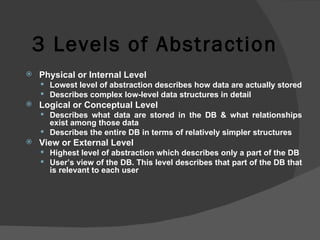
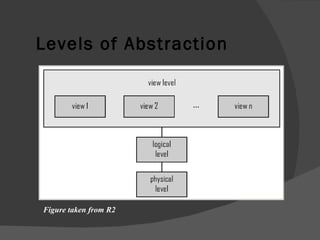
3 Levels of Abstraction Physical or Internal Level Lowest level of abstraction describes how data are actually stored Describes complex low-level data structures in detail Logical or Conceptual Level Describes what data are stored in the DB & what relationships exist among those data Describes the entire DB in terms of relatively simpler structures  View or External Level Highest level of abstraction which describes only a part of the DB User’s view of the DB. This level describes that part of the DB that is relevant to each user
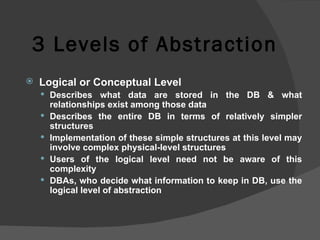
3 Levels of Abstraction Logical or Conceptual Level Describes what data are stored in the DB & what relationships exist among those data Describes the entire DB in terms of relatively simpler structures  Implementation of these simple structures at this level may involve complex physical-level structures Users of the logical level need not be aware of this complexity DBAs, who decide what information to keep in DB, use the logical level of abstraction
Levels of Abstraction Figure taken from R2
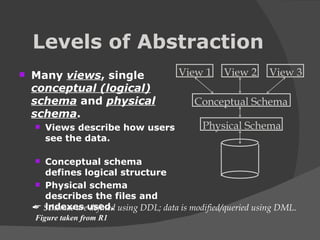
Levels of Abstraction Many  views , single  conceptual (logical) schema   and  physical schema . Views describe how users see the data.  Conceptual schema defines logical structure Physical schema describes the files and indexes used. Schemas are defined using DDL; data is modified/queried using DML . Physical Schema Conceptual Schema View 1 View 2 View 3 Figure taken from R1
Instances & Schemas Collection of information stored in the DB at a particular moment is called an INSTANCE The overall design of the DB is called a SCHEMA A DB has many schemas Physical Conceptual/Logical Sub-schemas DB design with requirements analysis Requirements of individual users are integrated into a single community view, called “conceptual schema” Represents “entities”, their “attributes”, & their “relationships”
Instances & Schemas Is independent of the DBMS, application programs, & physical considerations Conceptual schema is translated into a schema that is compatible with the chosen DBMS Relationships between entities as reflected in the conceptual schema may not be implementable with the chosen DBMS Version of the conceptual schema that can be presented to the DBMS is called the “Logical Schema” In a RDBMS, the logical schema describes all relations stored in the DB
Instances & Schemas Users are presented with the subsets, called “subschemas”,  of the logical schema Subschemas are also in terms of the data model of the DBMS Allow data access to be customized & authorized at the level of individual users or group of users Each subschema consists of a collection of one or more “views” & relations from the logical schema Logical schema is mapped to physical storage such as disk or tape
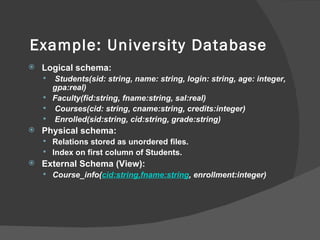
Example: University Database Logical schema:  Students(sid: string, name: string, login: string, age: integer, gpa:real) Faculty(fid:string, fname:string, sal:real) Courses(cid: string, cname:string, credits:integer)  Enrolled(sid:string, cid:string, grade:string) Physical schema: Relations stored as unordered files.  Index on first column of Students. External Schema (View):  Course_info( cid:string,fname:string , enrollment:integer)
ANSI/SPARC 3-Tier Architecture Proposal for standard terminology & general architecture for DBSs produced in 1971 by DBTG (Data Base Task Group) appointed by Conference on DBSs & Languages (CODASYL)  DBTG recognized the need for a 2-tier architecture with system view (schema) & user view (subschema) ANSI (American National Standards Institute)-SPARC (Standards Planning & Requirements Committee) produced similar terminology & architecture in 1975(ANSI/X3/SPARC)* in 1975 ANSI-SPARC recognized the need for a 3-tier architecture *ANSI/X3/SPARC study group on DBMSs. Interim Report, FDT. ACM SIGMOD Bulletin, 7(2), 1975.
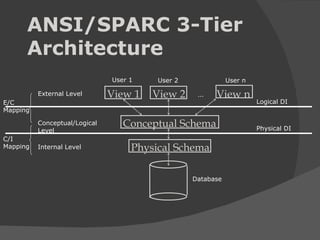
ANSI/SPARC 3-Tier Architecture Physical Schema Conceptual Schema View 1 View 2 View n External Level Conceptual/Logical Level Internal Level … Database User 1 User 2 User n Logical DI Physical DI E/C Mapping C/I Mapping
Data Independence Major objective of the 3-tier architecture is to proved data independence (DI) Upper levels are unaffected by changes at the lower level Two kinds of DI: Logical DI Physical DI
Data Independence Logical DI Immunity of the external schemas to changes in the conceptual schema Addition or removal of entities, attributes, or relationships, should be possible without having to change the external schemas or having to rewrite the application programs
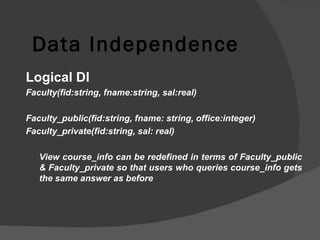
Data Independence Logical DI Faculty(fid:string, fname:string, sal:real) Faculty_public(fid:string, fname: string, office:integer) Faculty_private(fid:string, sal: real) View course_info can be redefined in terms of Faculty_public & Faculty_private so that users who queries course_info gets the same answer as before
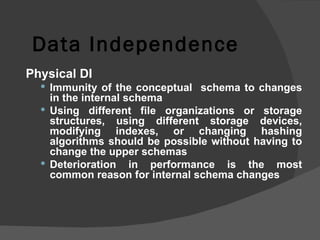
Data Independence Physical DI Immunity of the conceptual  schema to changes in the internal schema Using different file organizations or storage structures, using different storage devices, modifying indexes, or changing hashing algorithms should be possible without having to change the upper schemas Deterioration   in performance is the most common reason for internal schema changes
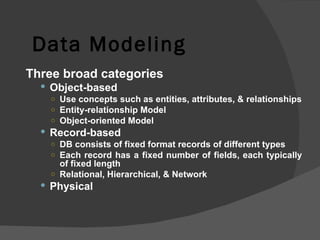
Data Modeling Three broad categories Object-based Use concepts such as entities, attributes, & relationships Entity-relationship Model Object-oriented Model Record-based DB consists of fixed format records of different types Each record has a fixed number of fields, each typically of fixed length Relational, Hierarchical, & Network Physical


Data abs ind & mod

  • 1.
  • 2.
    Topics for TodayData Abstraction Data Independence Data Modeling
  • 3.
    Data Abstraction Whyit is Important? How it is provided by a DBMS? 3 levels of abstraction Physical or Internal Level Logical Level View or External Level
  • 4.
    Data Independence Whatis Data Independence? Why it is Important? How it is provided by a DBMS? Types of Independence Physical Data Independence Logical Data Independence
  • 5.
    Data Modeling Whatis Data Modeling? An integrated collection of concepts for describing & manipulating data, relationships between data, & constraints on the data in an organization Used for defining Database Schemas Databases have several schemas, partitioned according to levels of abstraction Schema Levels Physical Schema Conceptual/Logical Schema Sub-schemas or external schemas
  • 6.
    Popular Data ModelsEntity-Relationship Model Relational Model Hierarchical Model Network Model Inverted File Model Object-Oriented Model Object-Relational Model
  • 7.
    Data Abstraction Majoraim of a DBMS is to provide users with an abstract view of data Hides certain details of how the data are stored & maintained DBMS must retrieve data efficiently Need for efficiency has led designers to use complex data structures to represent the data in the database Most DB users are not computer trained, developers hide complexity through several levels of abstraction to simplify user’s interaction with the systems
  • 8.
    3 Levels ofAbstraction Physical or Internal Level Lowest level of abstraction describes how data are actually stored Describes complex low-level data structures in detail Logical or Conceptual Level Describes what data are stored in the DB & what relationships exist among those data Describes the entire DB in terms of relatively simpler structures View or External Level Highest level of abstraction which describes only a part of the DB User’s view of the DB. This level describes that part of the DB that is relevant to each user
  • 9.
    3 Levels ofAbstraction Logical or Conceptual Level Describes what data are stored in the DB & what relationships exist among those data Describes the entire DB in terms of relatively simpler structures Implementation of these simple structures at this level may involve complex physical-level structures Users of the logical level need not be aware of this complexity DBAs, who decide what information to keep in DB, use the logical level of abstraction
  • 10.
    Levels of AbstractionFigure taken from R2
  • 11.
    Levels of AbstractionMany views , single conceptual (logical) schema and physical schema . Views describe how users see the data. Conceptual schema defines logical structure Physical schema describes the files and indexes used. Schemas are defined using DDL; data is modified/queried using DML . Physical Schema Conceptual Schema View 1 View 2 View 3 Figure taken from R1
  • 12.
    Instances & SchemasCollection of information stored in the DB at a particular moment is called an INSTANCE The overall design of the DB is called a SCHEMA A DB has many schemas Physical Conceptual/Logical Sub-schemas DB design with requirements analysis Requirements of individual users are integrated into a single community view, called “conceptual schema” Represents “entities”, their “attributes”, & their “relationships”
  • 13.
    Instances & SchemasIs independent of the DBMS, application programs, & physical considerations Conceptual schema is translated into a schema that is compatible with the chosen DBMS Relationships between entities as reflected in the conceptual schema may not be implementable with the chosen DBMS Version of the conceptual schema that can be presented to the DBMS is called the “Logical Schema” In a RDBMS, the logical schema describes all relations stored in the DB
  • 14.
    Instances & SchemasUsers are presented with the subsets, called “subschemas”, of the logical schema Subschemas are also in terms of the data model of the DBMS Allow data access to be customized & authorized at the level of individual users or group of users Each subschema consists of a collection of one or more “views” & relations from the logical schema Logical schema is mapped to physical storage such as disk or tape
  • 15.
    Example: University DatabaseLogical schema: Students(sid: string, name: string, login: string, age: integer, gpa:real) Faculty(fid:string, fname:string, sal:real) Courses(cid: string, cname:string, credits:integer) Enrolled(sid:string, cid:string, grade:string) Physical schema: Relations stored as unordered files. Index on first column of Students. External Schema (View): Course_info( cid:string,fname:string , enrollment:integer)
  • 16.
    ANSI/SPARC 3-Tier ArchitectureProposal for standard terminology & general architecture for DBSs produced in 1971 by DBTG (Data Base Task Group) appointed by Conference on DBSs & Languages (CODASYL) DBTG recognized the need for a 2-tier architecture with system view (schema) & user view (subschema) ANSI (American National Standards Institute)-SPARC (Standards Planning & Requirements Committee) produced similar terminology & architecture in 1975(ANSI/X3/SPARC)* in 1975 ANSI-SPARC recognized the need for a 3-tier architecture *ANSI/X3/SPARC study group on DBMSs. Interim Report, FDT. ACM SIGMOD Bulletin, 7(2), 1975.
  • 17.
    ANSI/SPARC 3-Tier ArchitecturePhysical Schema Conceptual Schema View 1 View 2 View n External Level Conceptual/Logical Level Internal Level … Database User 1 User 2 User n Logical DI Physical DI E/C Mapping C/I Mapping
  • 18.
    Data Independence Majorobjective of the 3-tier architecture is to proved data independence (DI) Upper levels are unaffected by changes at the lower level Two kinds of DI: Logical DI Physical DI
  • 19.
    Data Independence LogicalDI Immunity of the external schemas to changes in the conceptual schema Addition or removal of entities, attributes, or relationships, should be possible without having to change the external schemas or having to rewrite the application programs
  • 20.
    Data Independence LogicalDI Faculty(fid:string, fname:string, sal:real) Faculty_public(fid:string, fname: string, office:integer) Faculty_private(fid:string, sal: real) View course_info can be redefined in terms of Faculty_public & Faculty_private so that users who queries course_info gets the same answer as before
  • 21.
    Data Independence PhysicalDI Immunity of the conceptual schema to changes in the internal schema Using different file organizations or storage structures, using different storage devices, modifying indexes, or changing hashing algorithms should be possible without having to change the upper schemas Deterioration in performance is the most common reason for internal schema changes
  • 22.
    Data Modeling Threebroad categories Object-based Use concepts such as entities, attributes, & relationships Entity-relationship Model Object-oriented Model Record-based DB consists of fixed format records of different types Each record has a fixed number of fields, each typically of fixed length Relational, Hierarchical, & Network Physical
  • 23.
  • 24.

Editor's Notes