DBMS Users
Prepared by Visakh V, Assistant
Professor,Dept. of CSE, LBSITW
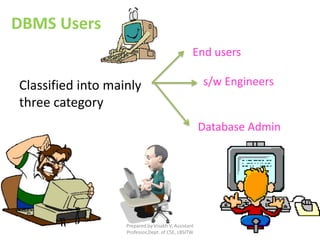
DBMS Users
Classified into mainly
three category
End users
s/w Engineers
Database Admin
Prepared by Visakh V, Assistant
Professor,Dept. of CSE, LBSITW
A) End User:
 Deal only with the highest level of abstraction.
 May not be concerned with the details of the DBMS.
 Involved in updates to the database or queries on the
database
Categories of end users
I. Casual End Users
II. Naïve or Parametric users
III. Sophisticated users
IV. Specialized users
Prepared by Visakh V, Assistant
Professor,Dept. of CSE, LBSITW
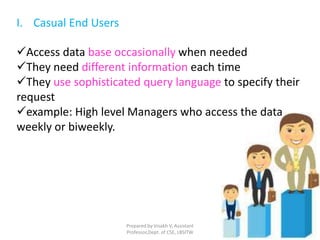
I. Casual End Users
Access data base occasionally when needed
They need different information each time
They use sophisticated query language to specify their
request
example: High level Managers who access the data
weekly or biweekly.
Prepared by Visakh V, Assistant
Professor,Dept. of CSE, LBSITW
II. Naive or parametric users
They make up large section of the database
 They communicate with the database on regular
period
 communicate with the system by invoking one of the
applications programs that have been written previously
Their job is to constantly querying and updating
database using standard queries
 This is called canned transaction
Ex: Bank teller, reservation clerks etc
Prepared by Visakh V, Assistant
Professor,Dept. of CSE, LBSITW
III.Sophisticated users
They include business analyst , scientist, engineers,
other thoroughly familiar with the system capability
 They interact with the system without writing
programs, instead they form their requests in a database
query language
 They submit each query to a query processor
Prepared by Visakh V, Assistant
Professor,Dept. of CSE, LBSITW
query processor : Its function is to break down DML
statements into instructions that the storage manager
can understands
Prepared by Visakh V, Assistant
Professor,Dept. of CSE, LBSITW
Storage manager : It is a program module that
provides the interface between the low level data
stored in the database and application programs and
queries submitted to the system
It translates various DML statements into low level file
system commands
Prepared by Visakh V, Assistant
Professor,Dept. of CSE, LBSITW
IV. Specialized users
 Also Sophisticated users who write specialized
database application that do not fit into the
traditional data processing framework
 Write specialized applications like CAD (Computer
Aided design),Multimedia database programs
Prepared by Visakh V, Assistant
Professor,Dept. of CSE, LBSITW
B) S/w Engineers
I. Application programmer
→Writing database programs in some programming
languages (Such as COBOL,C++ or some forth generation
languages)
→ Application programs access database by issuing the
appropriate request to the DBMS.
Prepared by Visakh V, Assistant
Professor,Dept. of CSE, LBSITW
II. Systems analysts
• Architects, as well as the project leaders, of an
information system.
•It is their job
 Develop solutions to users problems
 Determine the technical and operational feasibility of
their solutions
 Estimate the costs to develop and implement them.
Prepared by Visakh V, Assistant
Professor,Dept. of CSE, LBSITW
Application
programmer
System Analyst
Software
Engineers
Prepared by Visakh V, Assistant
Professor,Dept. of CSE, LBSITW
C) Database Administrator
• The DBA can be a single person or a team
comprising a group of persons
The functions of the DBA include the following:
 Definition of the Conceptual Schema
 Definition of the Internal Schema
 Liaising with users
 Granting of authorization for data access
 Defining Integrity constraints
Prepared by Visakh V, Assistant
Professor,Dept. of CSE, LBSITW
1. Definition of the Conceptual Schema
 To decide exactly what information is to be
held in the database.
 Identifies the entities and the information to
be recorded about those entities. This process is
usually referred to as logical database design.
 Once the DBA has decided the content of the
database at an abstract level, he creates the
corresponding conceptual schema
Prepared by Visakh V, Assistant
Professor,Dept. of CSE, LBSITW
2. Definition of the Internal Schema
 Decide how the data is to be represented in the
database. This process is usually referred to as
physical database design.
 Having done the physical design, the DBA must
then create the corresponding storage structure
definition.
 In addition, the DBA must also define the
associated conceptual/internal mapping
Prepared by Visakh V, Assistant
Professor,Dept. of CSE, LBSITW
3. Liaising with users
 The DBA liaises with users to ensure that the
data they need is available and to write the
necessary external schema.
 In addition, the DBA must also define the
associated external/conceptual mapping
Prepared by Visakh V, Assistant
Professor,Dept. of CSE, LBSITW
4. Granting of authorization for data access
 The granting of different types of
authorizations (read, write, etc.) allows
the DBA to regulate which parts of the
database various users can access
5. Defining Integrity constraints
 The data values stored in the database
must satisfy certain consistency constraints
Prepared by Visakh V, Assistant
Professor,Dept. of CSE, LBSITW
Prepared by Visakh V, Assistant
Professor,Dept. of CSE, LBSITW

Slide 4 dbms users

  • 1.
    DBMS Users Prepared byVisakh V, Assistant Professor,Dept. of CSE, LBSITW
  • 2.
    DBMS Users Classified intomainly three category End users s/w Engineers Database Admin Prepared by Visakh V, Assistant Professor,Dept. of CSE, LBSITW
  • 3.
    A) End User: Deal only with the highest level of abstraction.  May not be concerned with the details of the DBMS.  Involved in updates to the database or queries on the database Categories of end users I. Casual End Users II. Naïve or Parametric users III. Sophisticated users IV. Specialized users Prepared by Visakh V, Assistant Professor,Dept. of CSE, LBSITW
  • 4.
    I. Casual EndUsers Access data base occasionally when needed They need different information each time They use sophisticated query language to specify their request example: High level Managers who access the data weekly or biweekly. Prepared by Visakh V, Assistant Professor,Dept. of CSE, LBSITW
  • 5.
    II. Naive orparametric users They make up large section of the database  They communicate with the database on regular period  communicate with the system by invoking one of the applications programs that have been written previously Their job is to constantly querying and updating database using standard queries  This is called canned transaction Ex: Bank teller, reservation clerks etc Prepared by Visakh V, Assistant Professor,Dept. of CSE, LBSITW
  • 6.
    III.Sophisticated users They includebusiness analyst , scientist, engineers, other thoroughly familiar with the system capability  They interact with the system without writing programs, instead they form their requests in a database query language  They submit each query to a query processor Prepared by Visakh V, Assistant Professor,Dept. of CSE, LBSITW
  • 7.
    query processor :Its function is to break down DML statements into instructions that the storage manager can understands Prepared by Visakh V, Assistant Professor,Dept. of CSE, LBSITW
  • 8.
    Storage manager :It is a program module that provides the interface between the low level data stored in the database and application programs and queries submitted to the system It translates various DML statements into low level file system commands Prepared by Visakh V, Assistant Professor,Dept. of CSE, LBSITW
  • 9.
    IV. Specialized users Also Sophisticated users who write specialized database application that do not fit into the traditional data processing framework  Write specialized applications like CAD (Computer Aided design),Multimedia database programs Prepared by Visakh V, Assistant Professor,Dept. of CSE, LBSITW
  • 10.
    B) S/w Engineers I.Application programmer →Writing database programs in some programming languages (Such as COBOL,C++ or some forth generation languages) → Application programs access database by issuing the appropriate request to the DBMS. Prepared by Visakh V, Assistant Professor,Dept. of CSE, LBSITW
  • 11.
    II. Systems analysts •Architects, as well as the project leaders, of an information system. •It is their job  Develop solutions to users problems  Determine the technical and operational feasibility of their solutions  Estimate the costs to develop and implement them. Prepared by Visakh V, Assistant Professor,Dept. of CSE, LBSITW
  • 12.
    Application programmer System Analyst Software Engineers Prepared byVisakh V, Assistant Professor,Dept. of CSE, LBSITW
  • 13.
    C) Database Administrator •The DBA can be a single person or a team comprising a group of persons The functions of the DBA include the following:  Definition of the Conceptual Schema  Definition of the Internal Schema  Liaising with users  Granting of authorization for data access  Defining Integrity constraints Prepared by Visakh V, Assistant Professor,Dept. of CSE, LBSITW
  • 14.
    1. Definition ofthe Conceptual Schema  To decide exactly what information is to be held in the database.  Identifies the entities and the information to be recorded about those entities. This process is usually referred to as logical database design.  Once the DBA has decided the content of the database at an abstract level, he creates the corresponding conceptual schema Prepared by Visakh V, Assistant Professor,Dept. of CSE, LBSITW
  • 15.
    2. Definition ofthe Internal Schema  Decide how the data is to be represented in the database. This process is usually referred to as physical database design.  Having done the physical design, the DBA must then create the corresponding storage structure definition.  In addition, the DBA must also define the associated conceptual/internal mapping Prepared by Visakh V, Assistant Professor,Dept. of CSE, LBSITW
  • 16.
    3. Liaising withusers  The DBA liaises with users to ensure that the data they need is available and to write the necessary external schema.  In addition, the DBA must also define the associated external/conceptual mapping Prepared by Visakh V, Assistant Professor,Dept. of CSE, LBSITW
  • 17.
    4. Granting ofauthorization for data access  The granting of different types of authorizations (read, write, etc.) allows the DBA to regulate which parts of the database various users can access 5. Defining Integrity constraints  The data values stored in the database must satisfy certain consistency constraints Prepared by Visakh V, Assistant Professor,Dept. of CSE, LBSITW
  • 18.
    Prepared by VisakhV, Assistant Professor,Dept. of CSE, LBSITW