• DBMS stands for Database Management System.
•DBMS is a software system for creating, organizing
and managing the database.
• It provides an environment to the user to perform
operations on the database for creation, insertion,
deletion, updating and retrieval of data.
What is Data ?
 A collection of raw facts and figures.
 Raw material that can be processed by any
computing machine.
 A collection of facts from which conclusions may
be drawn.
 Data can be represented in the form of:
numbers and words which can be
stored in computer’s language.
i.e. Asif khan, Asad ,001,
What is Information?
 Systematic and meaningful form of data.
 Knowledge acquired through study or experience.
 Information helps human beings in their decision
making.
Database
 A safekeeping of logically related and similar data.
 An organized collection of related information so
that it can easily be accessed, managed and updated.
E.g.:
Dictionary
Airline Database
Student Database
Library
Railways Timetable
YouTube
What is DBMS ?
 A set of programs to access the interrelated
data.
 DBMS contains information about a
particular enterprise.
 Computerized record keeping system.
 Provides convenient environment to user to
perform operations:
-Creation, Insertion, Deletion,
Updating & Retrieval of information.
Database Users
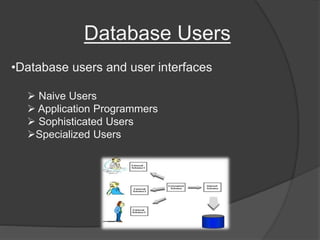
•Database users and user interfaces
 Naive Users
 Application Programmers
 Sophisticated Users
Specialized Users
Database Administrator (DBA)
 Schema definition
 Storage structure and access-method definition
 Schema and physical-organization modification
 Granting of authorization for data access
 Routine maintenance
 DBA manage all level of DBMS model
 Three level architecture is also called
ANSI/SPARC architecture or three schema
architecture
 This framework is used for describing the
structure of specific database systems (small
systems may not support all aspects of the
architecture)
 In this architecture the database schemas
can be defined at three levels explained in
next slide
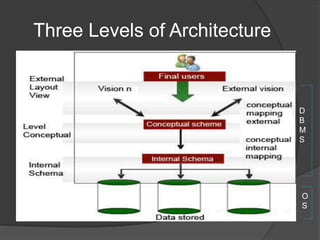
Three Levels of Architecture
D
B
M
S
O
S
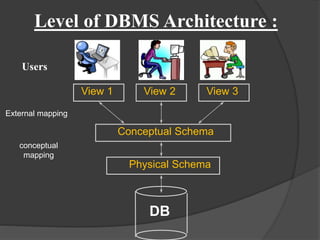
External View
11
 Highest or Top level of data abstraction ( No knowledge of
DBMS S/W and H/W or physical storage).
 This level is concerned with the user.
 Each external schema describes the part of the database
that a particular user is interested in and hides the rest of
the database from user.
 There can be n number of external views for database
where n is the number of users.
 For example, a accounts department may only be
interested in the student fee details. It would not be
expected to have any interest in the personal information
about students.
 All database users work on external level of Dbms .
Conceptual View
12
 This level is in between the user level and
physical storage view.
 There is only one conceptual view for single
database.
 It hides the details of physical storage
structures and concentrates on describing
entities, data types, relationships, user
operations, and constraints.
Internal View
13
 It is the lowest level of data abstraction. (it has the knowledge
about s/w and h/w)
 At this level, it keeps the information about the actual
representation of the entire database i.e. the actual storage of
the data on the disk in the form of records or blocks.
 It is close to the physical storage method.
 The internal view is the view that tells us what data is stored in
the database and how. At least the following aspects are
considered at this level: Storage allocation, Access paths etc.
 The internal view does not deal with the physical devices
directly. Instead it views a physical device as a collection of
physical pages and allocates space in terms of logical pages.
Page 14
Three Levels of Architecture (cont…)
 Internal/physical level: Shows how data are stored inside
the system. It is the closest level to the physical storage.
This level talks about database implementation and
describes such things as file organization and access
paths of indexes, data compression and encryption
techniques, and record placement
 Conceptual/logical level: Deals with the modeling of the
whole database. The conceptual schema of database is
defined in this level
 External level: This level models a user oriented
description of part of the database. The views for
individual users are defined by means of external
schemas in this level
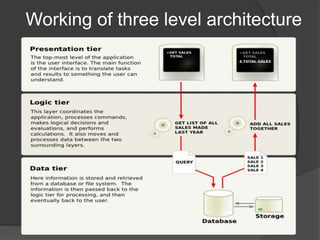
Working of three level architecture
Level of DBMS Architecture :
Physical Schema
Conceptual Schema
View 1 View 2 View 3
DB
Users
conceptual
mapping
External mapping
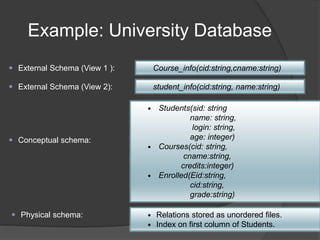
Example: University Database
 Students(sid: string
name: string,
login: string,
age: integer)
 Courses(cid: string,
cname:string,
credits:integer)
 Enrolled(Eid:string,
cid:string,
grade:string)
Course_info(cid:string,cname:string)
 Relations stored as unordered files.
 Index on first column of Students.
 Conceptual schema:
 Physical schema:
 External Schema (View 1 ):
student_info(cid:string, name:string) External Schema (View 2):
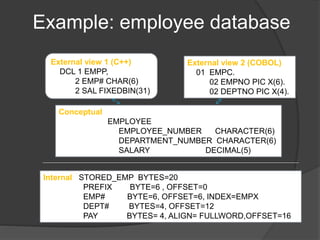
External view 2 (COBOL)
01 EMPC.
02 EMPNO PIC X(6).
02 DEPTNO PIC X(4).
Conceptual
EMPLOYEE
EMPLOYEE_NUMBER CHARACTER(6)
DEPARTMENT_NUMBER CHARACTER(6)
SALARY DECIMAL(5)
Internal STORED_EMP BYTES=20
PREFIX BYTE=6 , OFFSET=0
EMP# BYTE=6, OFFSET=6, INDEX=EMPX
DEPT# BYTES=4, OFFSET=12
PAY BYTES= 4, ALIGN= FULLWORD,OFFSET=16
External view 1 (C++)
DCL 1 EMPP,
2 EMP# CHAR(6)
2 SAL FIXEDBIN(31)
Example: employee database
Three Levels of Architecture
E_no F_name L_name Age Salary Empl_No L_name B_no
Empl_No F_name L_name DOB Salary Branch_No
External view 1 External view 2
Conceptual level
Internal level
struct EMPLOYEE {
int Empl_No;
int Branch_No;
char F_name [15];
char L_name [15];
struct date Date_of_Birth;
float Salary;
struct EMPLOYEE *next; //pointer to next employee record
}; index Empl_No; index Branch_No; //define indexes for
employees
Syntax Example:
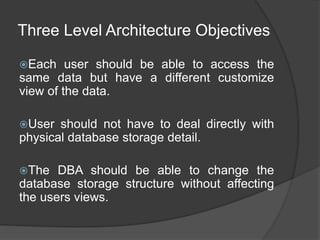
Three Level Architecture Objectives
Each user should be able to access the
same data but have a different customize
view of the data.
User should not have to deal directly with
physical database storage detail.
The DBA should be able to change the
database storage structure without affecting
the users views.
Three Level Architecture Objectives
The internal structure of the database
should be unaffected by changes to the
physical aspects of storage.
The DBA should be able to change the
conceptual structure of the database
without affecting all users.
Page 22
Mapping
 Mapping is the key for providing data
independence
 Data independence is the capacity to
change the schema at one level without
having to change the schema at the next
higher level
 Two types of data independence are
 Logical data independence
 Physical data independence
Page 23
Mapping - Data Independence
 Logical data independence (provided by external/
conceptual mapping)
 Ability to modify conceptual schema without changing
 External views
 Application programs
 Changes to conceptual schema may be necessary
 Whenever the logical structure of the database changes
- Due to changed objectives
 Examples
○ Adding a data item to schema
○ Adding price of a part to PART table
○ Adding PROJECT table to the SUPPLIER-PARTS database
Page 24
Mapping - Data Independence
 Physical data independence (provided by
conceptual/internal mapping)
 Ability to modify internal or physical schema without changing
 Conceptual or view level schema
 Application programs
 Changes to physical schema may be necessary to
 Improve performance of retrieval or update
 Achieving logical data independence is more difficult
than physical data independence
○ Because application programs heavily rely on the logical structure
of the data they access
Dbms architecture

Dbms architecture

  • 2.
    • DBMS standsfor Database Management System. •DBMS is a software system for creating, organizing and managing the database. • It provides an environment to the user to perform operations on the database for creation, insertion, deletion, updating and retrieval of data.
  • 3.
    What is Data?  A collection of raw facts and figures.  Raw material that can be processed by any computing machine.  A collection of facts from which conclusions may be drawn.  Data can be represented in the form of: numbers and words which can be stored in computer’s language. i.e. Asif khan, Asad ,001,
  • 4.
    What is Information? Systematic and meaningful form of data.  Knowledge acquired through study or experience.  Information helps human beings in their decision making.
  • 5.
    Database  A safekeepingof logically related and similar data.  An organized collection of related information so that it can easily be accessed, managed and updated. E.g.: Dictionary Airline Database Student Database Library Railways Timetable YouTube
  • 6.
    What is DBMS?  A set of programs to access the interrelated data.  DBMS contains information about a particular enterprise.  Computerized record keeping system.  Provides convenient environment to user to perform operations: -Creation, Insertion, Deletion, Updating & Retrieval of information.
  • 7.
    Database Users •Database usersand user interfaces  Naive Users  Application Programmers  Sophisticated Users Specialized Users
  • 8.
    Database Administrator (DBA) Schema definition  Storage structure and access-method definition  Schema and physical-organization modification  Granting of authorization for data access  Routine maintenance  DBA manage all level of DBMS model
  • 9.
     Three levelarchitecture is also called ANSI/SPARC architecture or three schema architecture  This framework is used for describing the structure of specific database systems (small systems may not support all aspects of the architecture)  In this architecture the database schemas can be defined at three levels explained in next slide
  • 10.
    Three Levels ofArchitecture D B M S O S
  • 11.
    External View 11  Highestor Top level of data abstraction ( No knowledge of DBMS S/W and H/W or physical storage).  This level is concerned with the user.  Each external schema describes the part of the database that a particular user is interested in and hides the rest of the database from user.  There can be n number of external views for database where n is the number of users.  For example, a accounts department may only be interested in the student fee details. It would not be expected to have any interest in the personal information about students.  All database users work on external level of Dbms .
  • 12.
    Conceptual View 12  Thislevel is in between the user level and physical storage view.  There is only one conceptual view for single database.  It hides the details of physical storage structures and concentrates on describing entities, data types, relationships, user operations, and constraints.
  • 13.
    Internal View 13  Itis the lowest level of data abstraction. (it has the knowledge about s/w and h/w)  At this level, it keeps the information about the actual representation of the entire database i.e. the actual storage of the data on the disk in the form of records or blocks.  It is close to the physical storage method.  The internal view is the view that tells us what data is stored in the database and how. At least the following aspects are considered at this level: Storage allocation, Access paths etc.  The internal view does not deal with the physical devices directly. Instead it views a physical device as a collection of physical pages and allocates space in terms of logical pages.
  • 14.
    Page 14 Three Levelsof Architecture (cont…)  Internal/physical level: Shows how data are stored inside the system. It is the closest level to the physical storage. This level talks about database implementation and describes such things as file organization and access paths of indexes, data compression and encryption techniques, and record placement  Conceptual/logical level: Deals with the modeling of the whole database. The conceptual schema of database is defined in this level  External level: This level models a user oriented description of part of the database. The views for individual users are defined by means of external schemas in this level
  • 15.
    Working of threelevel architecture
  • 16.
    Level of DBMSArchitecture : Physical Schema Conceptual Schema View 1 View 2 View 3 DB Users conceptual mapping External mapping
  • 17.
    Example: University Database Students(sid: string name: string, login: string, age: integer)  Courses(cid: string, cname:string, credits:integer)  Enrolled(Eid:string, cid:string, grade:string) Course_info(cid:string,cname:string)  Relations stored as unordered files.  Index on first column of Students.  Conceptual schema:  Physical schema:  External Schema (View 1 ): student_info(cid:string, name:string) External Schema (View 2):
  • 18.
    External view 2(COBOL) 01 EMPC. 02 EMPNO PIC X(6). 02 DEPTNO PIC X(4). Conceptual EMPLOYEE EMPLOYEE_NUMBER CHARACTER(6) DEPARTMENT_NUMBER CHARACTER(6) SALARY DECIMAL(5) Internal STORED_EMP BYTES=20 PREFIX BYTE=6 , OFFSET=0 EMP# BYTE=6, OFFSET=6, INDEX=EMPX DEPT# BYTES=4, OFFSET=12 PAY BYTES= 4, ALIGN= FULLWORD,OFFSET=16 External view 1 (C++) DCL 1 EMPP, 2 EMP# CHAR(6) 2 SAL FIXEDBIN(31) Example: employee database
  • 19.
    Three Levels ofArchitecture E_no F_name L_name Age Salary Empl_No L_name B_no Empl_No F_name L_name DOB Salary Branch_No External view 1 External view 2 Conceptual level Internal level struct EMPLOYEE { int Empl_No; int Branch_No; char F_name [15]; char L_name [15]; struct date Date_of_Birth; float Salary; struct EMPLOYEE *next; //pointer to next employee record }; index Empl_No; index Branch_No; //define indexes for employees Syntax Example:
  • 20.
    Three Level ArchitectureObjectives Each user should be able to access the same data but have a different customize view of the data. User should not have to deal directly with physical database storage detail. The DBA should be able to change the database storage structure without affecting the users views.
  • 21.
    Three Level ArchitectureObjectives The internal structure of the database should be unaffected by changes to the physical aspects of storage. The DBA should be able to change the conceptual structure of the database without affecting all users.
  • 22.
    Page 22 Mapping  Mappingis the key for providing data independence  Data independence is the capacity to change the schema at one level without having to change the schema at the next higher level  Two types of data independence are  Logical data independence  Physical data independence
  • 23.
    Page 23 Mapping -Data Independence  Logical data independence (provided by external/ conceptual mapping)  Ability to modify conceptual schema without changing  External views  Application programs  Changes to conceptual schema may be necessary  Whenever the logical structure of the database changes - Due to changed objectives  Examples ○ Adding a data item to schema ○ Adding price of a part to PART table ○ Adding PROJECT table to the SUPPLIER-PARTS database
  • 24.
    Page 24 Mapping -Data Independence  Physical data independence (provided by conceptual/internal mapping)  Ability to modify internal or physical schema without changing  Conceptual or view level schema  Application programs  Changes to physical schema may be necessary to  Improve performance of retrieval or update  Achieving logical data independence is more difficult than physical data independence ○ Because application programs heavily rely on the logical structure of the data they access

Editor's Notes