Prepared by Visakh V, Assistant
Professor,Dept. of CSE, LBSITW
Prepared by Visakh V, Assistant
Professor,Dept. of CSE, LBSITW
Prepared by Visakh V, Assistant
Professor,Dept. of CSE, LBSITW
Introduction To Database
• Data
• Information
• Knowledge
Prepared by Visakh V, Assistant
Professor,Dept. of CSE, LBSITW
Need for Information
• Addition Knowledge
•Decision making
• Can apply in different levels
• Increase in ProductivityPrepared by Visakh V, Assistant
Professor,Dept. of CSE, LBSITW
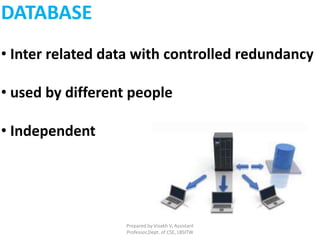
DATABASE
• Inter related data with controlled redundancy
• used by different people
• Independent
Prepared by Visakh V, Assistant
Professor,Dept. of CSE, LBSITW
Why Database ????
(advantages over traditional file systems)
1. Centralized control
2. Redundancy can be reduced
3. Inconsistency can be avoided
4. Data can be shared
5. Standard can be enforced
6. Security restriction can be applied
7. Integrity can be maintained
8. Conflicting requirements can be balanced
Prepared by Visakh V, Assistant
Professor,Dept. of CSE, LBSITW
1. Centralized control:
Prepared by Visakh V, Assistant
Professor,Dept. of CSE, LBSITW
2. Redundancy can be reduced:
Note: Sometimes redundancy is allowed
(Because of some technical & business reasons we need to
store multiple data ) Prepared by Visakh V, Assistant
Professor,Dept. of CSE, LBSITW
3. Inconsistency can be avoided
4. Data Can be shared
5. Standard can be enforced
6. Security restriction can be applied
7. Integrity can be maintained
Prepared by Visakh V, Assistant
Professor,Dept. of CSE, LBSITW
8. Conflicting requirement can be balanced
Prepared by Visakh V, Assistant
Professor,Dept. of CSE, LBSITW
CHARACTERISTICS OF DATA IN DATABASE
•Shared
•Persistence : It means the data exist permanently
,beyond the scope of the process
•Validity/Integrity/Correctness
•Security
•Consistency
•Non- redundancy
•Independence : ( we will discuss it later)
Prepared by Visakh V, Assistant
Professor,Dept. of CSE, LBSITW
TYPES OF DATABASE
Centralized
Distributed
Prepared by Visakh V, Assistant
Professor,Dept. of CSE, LBSITW
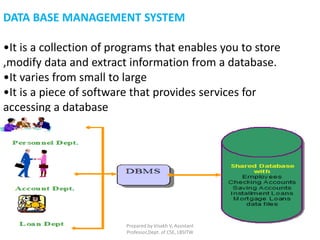
DATA BASE MANAGEMENT SYSTEM
•It is a collection of programs that enables you to store
,modify data and extract information from a database.
•It varies from small to large
•It is a piece of software that provides services for
accessing a database
Prepared by Visakh V, Assistant
Professor,Dept. of CSE, LBSITW
COMPONENTS OF DBMS
Prepared by Visakh V, Assistant
Professor,Dept. of CSE, LBSITW
•Transaction Management
•Concurrency Control
Prepared by Visakh V, Assistant
Professor,Dept. of CSE, LBSITW
•Recovery Management
• Return to a consistent state
•Security Management
• Protection against unauthorized access
• Different privileges
•Language Interface
• Data structure creation : DDL
• Manipulation of data : DML
•Storage Management
• Permanent storage
Prepared by Visakh V, Assistant
Professor,Dept. of CSE, LBSITW
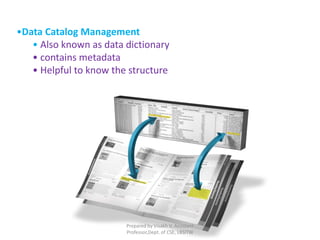
•Data Catalog Management
• Also known as data dictionary
• contains metadata
• Helpful to know the structure
Prepared by Visakh V, Assistant
Professor,Dept. of CSE, LBSITW

Slide 1 introduction to dbms

  • 1.
    Prepared by VisakhV, Assistant Professor,Dept. of CSE, LBSITW
  • 2.
    Prepared by VisakhV, Assistant Professor,Dept. of CSE, LBSITW
  • 3.
    Prepared by VisakhV, Assistant Professor,Dept. of CSE, LBSITW
  • 4.
    Introduction To Database •Data • Information • Knowledge Prepared by Visakh V, Assistant Professor,Dept. of CSE, LBSITW
  • 5.
    Need for Information •Addition Knowledge •Decision making • Can apply in different levels • Increase in ProductivityPrepared by Visakh V, Assistant Professor,Dept. of CSE, LBSITW
  • 6.
    DATABASE • Inter relateddata with controlled redundancy • used by different people • Independent Prepared by Visakh V, Assistant Professor,Dept. of CSE, LBSITW
  • 7.
    Why Database ???? (advantagesover traditional file systems) 1. Centralized control 2. Redundancy can be reduced 3. Inconsistency can be avoided 4. Data can be shared 5. Standard can be enforced 6. Security restriction can be applied 7. Integrity can be maintained 8. Conflicting requirements can be balanced Prepared by Visakh V, Assistant Professor,Dept. of CSE, LBSITW
  • 8.
    1. Centralized control: Preparedby Visakh V, Assistant Professor,Dept. of CSE, LBSITW
  • 9.
    2. Redundancy canbe reduced: Note: Sometimes redundancy is allowed (Because of some technical & business reasons we need to store multiple data ) Prepared by Visakh V, Assistant Professor,Dept. of CSE, LBSITW
  • 10.
    3. Inconsistency canbe avoided 4. Data Can be shared 5. Standard can be enforced 6. Security restriction can be applied 7. Integrity can be maintained Prepared by Visakh V, Assistant Professor,Dept. of CSE, LBSITW
  • 11.
    8. Conflicting requirementcan be balanced Prepared by Visakh V, Assistant Professor,Dept. of CSE, LBSITW
  • 12.
    CHARACTERISTICS OF DATAIN DATABASE •Shared •Persistence : It means the data exist permanently ,beyond the scope of the process •Validity/Integrity/Correctness •Security •Consistency •Non- redundancy •Independence : ( we will discuss it later) Prepared by Visakh V, Assistant Professor,Dept. of CSE, LBSITW
  • 13.
    TYPES OF DATABASE Centralized Distributed Preparedby Visakh V, Assistant Professor,Dept. of CSE, LBSITW
  • 14.
    DATA BASE MANAGEMENTSYSTEM •It is a collection of programs that enables you to store ,modify data and extract information from a database. •It varies from small to large •It is a piece of software that provides services for accessing a database Prepared by Visakh V, Assistant Professor,Dept. of CSE, LBSITW
  • 15.
    COMPONENTS OF DBMS Preparedby Visakh V, Assistant Professor,Dept. of CSE, LBSITW
  • 16.
    •Transaction Management •Concurrency Control Preparedby Visakh V, Assistant Professor,Dept. of CSE, LBSITW
  • 17.
    •Recovery Management • Returnto a consistent state •Security Management • Protection against unauthorized access • Different privileges •Language Interface • Data structure creation : DDL • Manipulation of data : DML •Storage Management • Permanent storage Prepared by Visakh V, Assistant Professor,Dept. of CSE, LBSITW
  • 18.
    •Data Catalog Management •Also known as data dictionary • contains metadata • Helpful to know the structure Prepared by Visakh V, Assistant Professor,Dept. of CSE, LBSITW