Ravinder Kamboj
Assistant Professor
LCET, Katani Kalan
Index
 Architecture of DBMS
 Three levels of Architecture
 External Level
 Conceptual Level
 Internal Level
 Data Independence
 Logical Data Independence
 Physical Data Independence
Architecture of DBMS
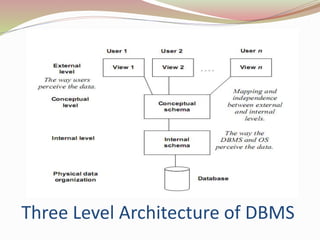
 There are following three levels or layers of DBMS
architecture:
 External Level
 Conceptual Level
 Internal Level
Three Level Architecture of DBMS
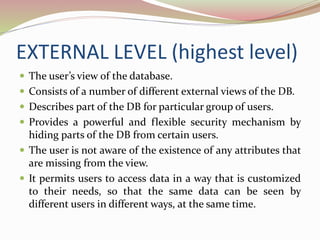
EXTERNAL LEVEL (highest level)
 The user’s view of the database.
 Consists of a number of different external views of the DB.
 Describes part of the DB for particular group of users.
 Provides a powerful and flexible security mechanism by
hiding parts of the DB from certain users.
 The user is not aware of the existence of any attributes that
are missing from the view.
 It permits users to access data in a way that is customized
to their needs, so that the same data can be seen by
different users in different ways, at the same time.
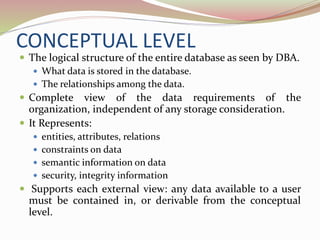
CONCEPTUAL LEVEL
 The logical structure of the entire database as seen by DBA.
 What data is stored in the database.
 The relationships among the data.
 Complete view of the data requirements of the
organization, independent of any storage consideration.
 It Represents:
 entities, attributes, relations
 constraints on data
 semantic information on data
 security, integrity information
 Supports each external view: any data available to a user
must be contained in, or derivable from the conceptual
level.
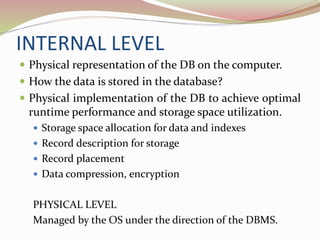
INTERNAL LEVEL
 Physical representation of the DB on the computer.
 How the data is stored in the database?
 Physical implementation of the DB to achieve optimal
runtime performance and storage space utilization.
 Storage space allocation for data and indexes
 Record description for storage
 Record placement
 Data compression, encryption
PHYSICAL LEVEL
Managed by the OS under the direction of the DBMS.
DATA INDEPENDENCE
 The ability to modify a scheme definition in one level
without affecting a scheme definition in a higher level
is called data independence.
 There are two kinds:
 Logical data independence
 Physical data independence
Logical data independence
 The ability to modify the conceptual scheme without
causing application programs to be rewritten.
 The change would be absorbed by the mapping
between the external and conceptual levels.
 Usually done when logical structure of database is
altered.
Physical data independence
 The ability to modify the internal scheme without
having to change the conceptual or external schemas.
 Modifications at this level are usually to improve
performance.
Architecture of dbms(lecture 3)

Architecture of dbms(lecture 3)

  • 1.
  • 2.
    Index  Architecture ofDBMS  Three levels of Architecture  External Level  Conceptual Level  Internal Level  Data Independence  Logical Data Independence  Physical Data Independence
  • 3.
    Architecture of DBMS There are following three levels or layers of DBMS architecture:  External Level  Conceptual Level  Internal Level
  • 4.
  • 5.
    EXTERNAL LEVEL (highestlevel)  The user’s view of the database.  Consists of a number of different external views of the DB.  Describes part of the DB for particular group of users.  Provides a powerful and flexible security mechanism by hiding parts of the DB from certain users.  The user is not aware of the existence of any attributes that are missing from the view.  It permits users to access data in a way that is customized to their needs, so that the same data can be seen by different users in different ways, at the same time.
  • 6.
    CONCEPTUAL LEVEL  Thelogical structure of the entire database as seen by DBA.  What data is stored in the database.  The relationships among the data.  Complete view of the data requirements of the organization, independent of any storage consideration.  It Represents:  entities, attributes, relations  constraints on data  semantic information on data  security, integrity information  Supports each external view: any data available to a user must be contained in, or derivable from the conceptual level.
  • 7.
    INTERNAL LEVEL  Physicalrepresentation of the DB on the computer.  How the data is stored in the database?  Physical implementation of the DB to achieve optimal runtime performance and storage space utilization.  Storage space allocation for data and indexes  Record description for storage  Record placement  Data compression, encryption PHYSICAL LEVEL Managed by the OS under the direction of the DBMS.
  • 8.
    DATA INDEPENDENCE  Theability to modify a scheme definition in one level without affecting a scheme definition in a higher level is called data independence.  There are two kinds:  Logical data independence  Physical data independence
  • 9.
    Logical data independence The ability to modify the conceptual scheme without causing application programs to be rewritten.  The change would be absorbed by the mapping between the external and conceptual levels.  Usually done when logical structure of database is altered.
  • 10.
    Physical data independence The ability to modify the internal scheme without having to change the conceptual or external schemas.  Modifications at this level are usually to improve performance.